
Loading article
Loading page...
If you’re serious about scaling on Amazon, you have to get comfortable with the data. Amazon rank tracking is how you do it. It’s the process of keeping a close eye on your product’s visibility and, more importantly, its sales momentum.
This isn’t about vanity metrics. It’s about making smarter, faster decisions that actually move the needle on your revenue. To do that, we need to focus on two core metrics that tell us almost everything we need to know: Best Sellers Rank (BSR) and keyword rank.
Before you can scale your brand, you need to speak Amazon’s language. The A9 algorithm uses two “dialects” to measure a product’s success: Best Sellers Rank and keyword ranking. A lot of sellers lump them together, but they tell very different stories about your product’s health. Think of them as two separate, critical dashboards for your business.
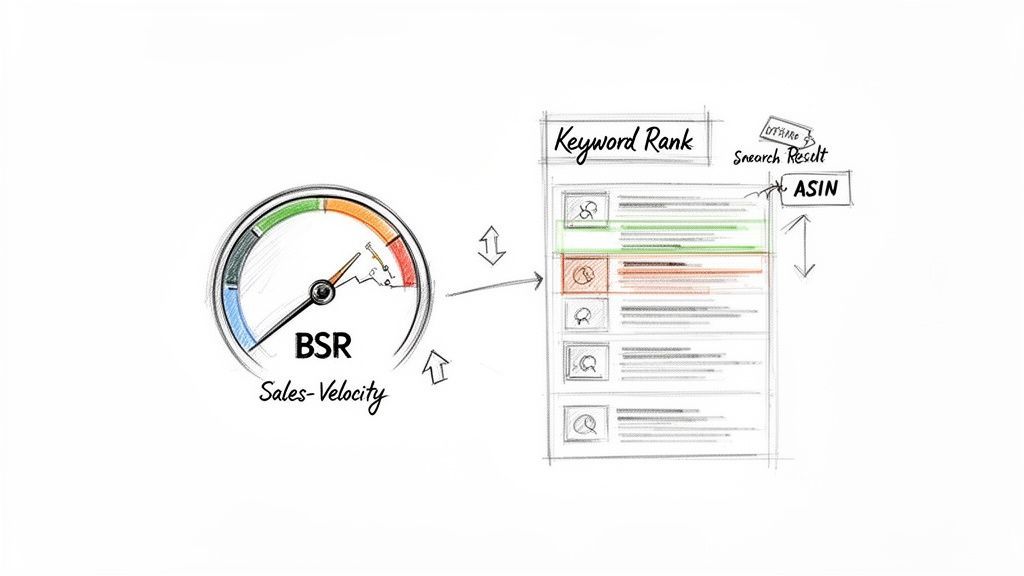
Your Best Sellers Rank, or BSR, is a score Amazon gives nearly every product, showing how well it’s selling compared to others in the same category. It’s a pure reflection of sales volume, and a lower number is always better. A product with a BSR of #5 is crushing a product with a BSR of #500.
But here’s the catch: BSR is extremely sensitive to recent sales. A product that moved 100 units yesterday will have a much better BSR than one that sold 1,000 units last month but has been quiet this week. This makes it an incredibly powerful, almost real-time pulse check on your sales velocity and current market demand.
A common myth is that BSR directly boosts your search rank. It doesn’t. While they’re often correlated—products that sell well tend to rank well—BSR is a result of sales, not a direct cause of higher search placement.
While BSR is all about sales comparisons, keyword rank is about pure search visibility. It measures your product’s exact position in the search results for a specific phrase a customer types in. If someone searches for “organic dog treats” and your product is the third result on page one, your keyword rank for that term is #3. Simple as that.
This metric is the lifeblood of your organic traffic. A great keyword rank puts your product right in front of shoppers who are ready to buy, which means you can rely less on burning through your ad budget.
Proper amazon rank tracking is all about obsessing over these positions, because even a small jump from page two to page one can lead to a massive spike in sales. When you monitor these ranks closely, you start to see things you’d otherwise miss:
For a quick reference, here’s a simple breakdown of these two essential metrics.
Metric
What It Measures
Primary Impact On
Update Frequency
Best Sellers Rank (BSR)
Sales velocity compared to other products in the same category.
Product popularity and sales momentum.
Hourly
Keyword Rank
Organic position in search results for a specific search term.
Organic traffic and discoverability.
Daily
Ultimately, both BSR and keyword rank provide critical feedback on your performance. BSR tells you if you’re winning the sales game, while keyword rank shows you if you’re winning the visibility game. You need both to build a sustainable brand on Amazon.
Knowing the metrics is one thing, but putting them to work is what separates the pros from the amateurs. A solid Amazon rank tracking workflow is the engine that turns raw data into strategic growth. This isn’t about spot-checking a few keywords here and there; it’s about creating a reliable system that feeds you actionable insights, week in and week out.
Your first move is picking the right tools for the job. You’ve really got two main paths here: all-in-one suites or dedicated, specialized trackers.
For most sellers, starting with an all-in-one suite just makes sense—it delivers the best bang for your buck. But as your brand grows, layering in a specialized tool can give you a sharper, more nuanced view of your organic footprint.
Look, your tracking is only as good as the keywords you feed it. I’ve seen so many sellers make the mistake of tracking hundreds of vague, low-relevance terms. All that does is create noise and drown out the signals that actually matter.
Instead, you need to build a curated list of high-intent keywords that cover the entire customer journey.
Start by sorting your keywords into three buckets:
A well-balanced portfolio for a single ASIN might include 5-10 broad keywords, 15-25 long-tail keywords, and a few key branded terms. This mix gives you a complete, 360-degree view of your search visibility.
Once you’ve got your tool and your keywords, it’s time for setup. This is where you’ll plug in your product ASINs and, just as importantly, the ASINs of your top three to five direct competitors. Tracking your rivals isn’t optional—their ranking shifts give you crucial context for your own performance. Are they running a promotion? Did their rank drop after a stockout? You need to know.
A critical piece of this setup is tracking historical BSR. Amazon doesn’t just hand you this data, so third-party tools are essential for seeing how sales have trended over time. With Amazon’s sales hitting a staggering $574.8 billion in 2023, understanding these historical patterns is vital.
Tools like Gorilla ROI can pull daily BSR for specific date ranges, showing you how different child variations are performing. Others, like AMZScout, let you chart rank changes over months to uncover profitability trends. This data is gold because a top BSR (ranks 1-50) can land you on the first-page “Best Sellers” list—a huge visibility boost that’s almost impossible to get otherwise. You can discover more insights about historical BSR and sales trends on Gorillaroi.com.
Pro Tip: When you’re setting up your tracker, double-check that you’ve selected the correct marketplace (e.g., US, UK, JP). Search volumes and ranking positions can be wildly different from one Amazon storefront to another. It’s a simple mistake, but one that leads to completely useless data.
By carefully choosing your tools, curating a smart keyword list, and setting up your system to watch both your products and your competition, you build a powerful workflow. This turns Amazon rank tracking from a chore into a strategic weapon, giving you the consistent insights you need to optimize listings, fine-tune your PPC, and drive real, sustainable growth.
Collecting data is just the first step. The real magic in amazon rank tracking happens when you start turning those numbers into an actionable game plan. This is where you graduate from being a data collector to a data strategist, learning to read the story your tracking tools are telling you every day.
It’s not about having a knee-jerk reaction to every tiny dip or spike. It’s about seeing the narrative behind the trends. A small drop in keyword rank might just be the market doing its thing, but a steady slide over a week? That’s a red flag telling you it’s time to dig deeper. Your job is to connect the dots between your rank data and what’s actually happening with your business.
Some of the most powerful insights come from looking at your Best Sellers Rank (BSR) and keyword rank together. Think of them as two sides of the same coin. Their relationship tells you a ton about your product’s health and what your competitors are up to.
For instance, what if your keyword ranks for top terms are holding strong, but your BSR is slowly creeping up (which is bad)? This is a classic sign of new competition or someone playing games with pricing. Another seller might be running a killer launch promotion or just undercutting you, stealing sales velocity even if they haven’t beaten you in the search results yet. This is your cue to start investigating competitor pricing and ad strategies, fast.
On the flip side, imagine your BSR is solid, but you suddenly see a keyword rank spike for a long-tail term you weren’t even targeting. That’s a gift from the Amazon algorithm. It often points to an emerging customer use case or a new niche you’ve tapped into by accident. This is an insight you should immediately use to tweak your listing optimization and PPC campaigns—lean into what the market is telling you.
Let’s walk through a few common situations to help you build the muscle memory for quick, accurate analysis.
This interplay is precisely why you can’t analyze metrics in a vacuum. A change in one area, like advertising, directly impacts another, like organic visibility. Effective Amazon rank tracking is about seeing the complete picture, not just isolated data points.
BSR is all about sales velocity, but not all sales carry the same weight in Amazon’s eyes. The algorithm cares a lot more about recent sales than historical ones. A product that sold 50 units yesterday will crush a product that sold 500 units last month but has had zero sales this week. This recency bias is key to understanding why BSR fluctuates so much.
This is why consistent, daily sales are far more valuable for a stable, low BSR than random sales spikes. A steady 10-20 units a day will almost always outperform a product that sells 100 units one day and zero the next. For many competitive categories, keeping your BSR under 5,500 might require 25-70 daily sales—a velocity that helps lock in first-page visibility and reduces your dependency on expensive ads. We often use this data to fine-tune both ad spend and listing content, turning rank insights directly into profit. For a deeper dive, check out this beginner’s guide to Amazon sales rank.
To help you put this all together, here are some common scenarios you’ll run into, what they likely mean, and what you should do about them.
This table breaks down frequent ranking situations, their probable causes, and the steps you can take to address them.
Scenario
Potential Cause
Recommended Action
BSR is worsening, keyword ranks are stable.
New competitor launch, competitor price drop, or increased ad spend from others stealing sales velocity.
Analyze the top 10 competitors for pricing changes, new promotions, or aggressive ad placements. Adjust your pricing or PPC strategy to compete.
Both BSR and keyword ranks are dropping.
Negative reviews, out-of-stock issue, listing suppression, or a major algorithm update.
Check Seller Central for listing health alerts. Read recent reviews and customer questions. Confirm inventory levels are healthy.
Keyword ranks are improving, BSR is stable or worsening.
Your SEO is working, but your conversion rate is low. Your price might be too high or your listing isn’t compelling enough.
A/B test your main image, price point, and the first three bullet points. Make sure your listing clearly answers customer questions and overcomes objections.
Sudden keyword rank drop for a single high-volume term.
A competitor is targeting that keyword aggressively with PPC, or you’ve been “de-indexed” for that term.
Check if you’re still indexed for the keyword using the “ASIN + keyword” search method. If indexed, increase your PPC bid on that term to defend your position.
BSR and keyword ranks are improving.
Your strategy (PPC, SEO, pricing) is working! Could also be due to a competitor running out of stock.
Double down on what’s working. If you recently optimized your listing or launched a new ad campaign, continue monitoring. Keep an eye on competitor stock levels.
Think of this table as your quick-reference diagnostic tool. When you see a change in your data, come back here to identify the likely cause and figure out your next move.
This decision tree helps you decide whether an all-in-one suite or a specialized tool is the better fit for your current goals.
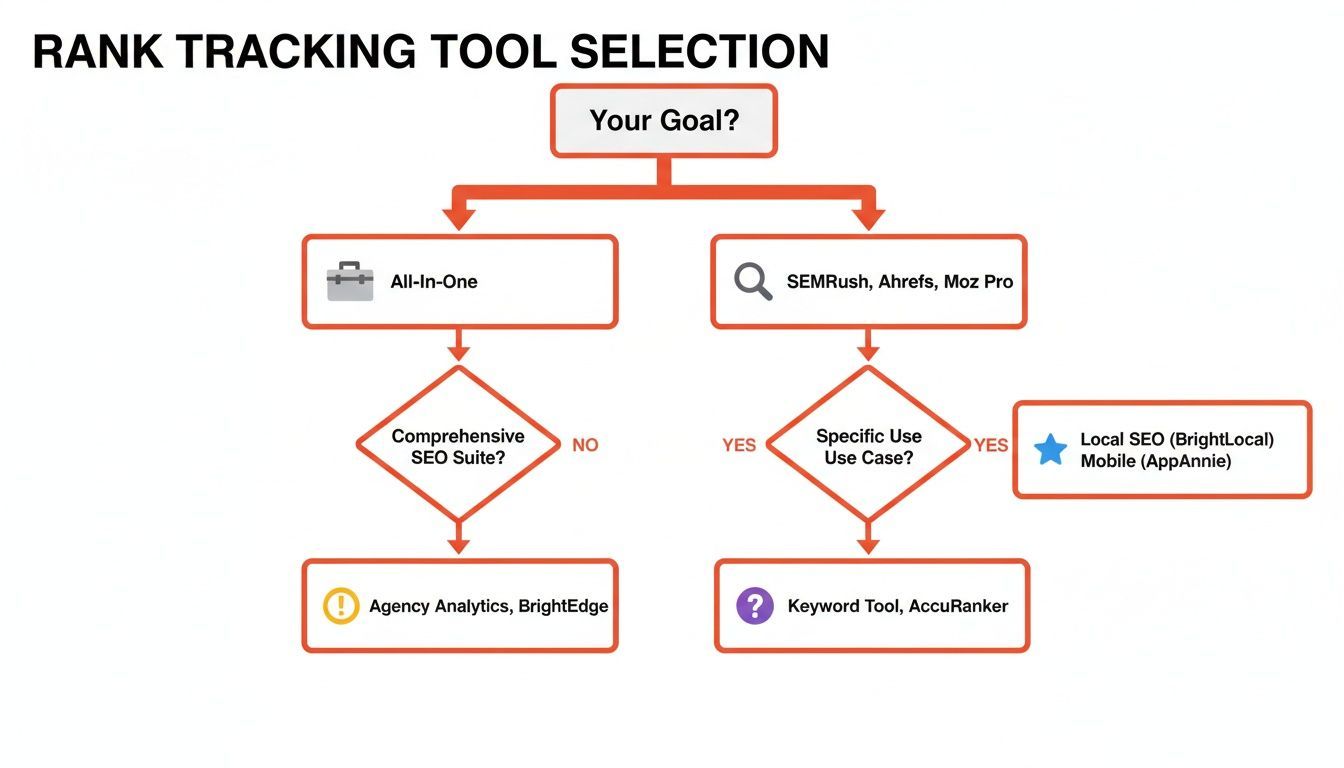
Essentially, the flowchart shows that if you’re looking for a single platform to handle multiple tasks, an integrated solution is probably your best bet. But if you need really deep, granular rank data, you’ll get more out of a dedicated tool.
Collecting data is only half the battle. The real value comes from turning those numbers and trends into tangible changes that actually boost sales and visibility. This is where your analytical insights meet real-world execution, creating a direct impact on your bottom line.
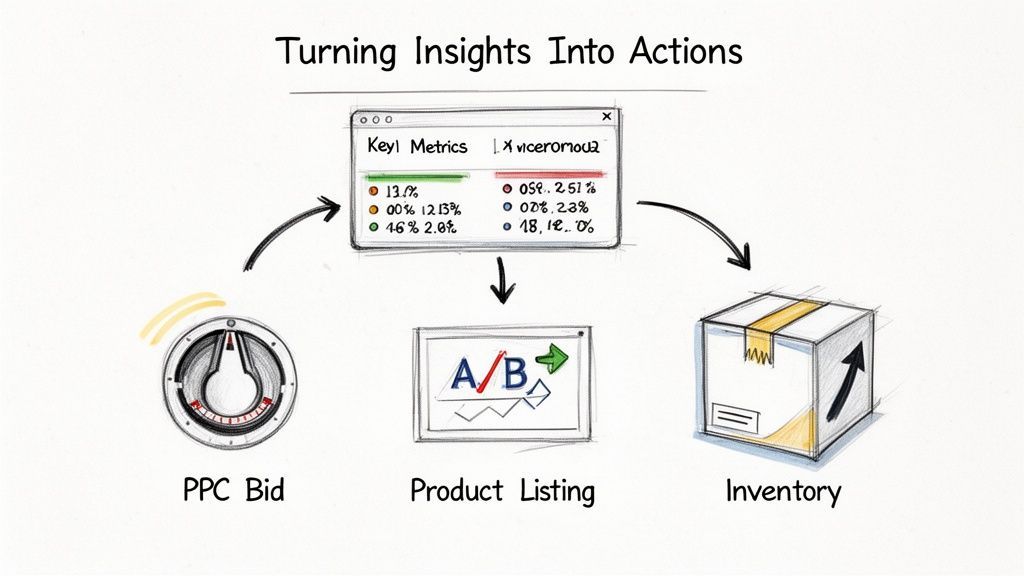
It’s all about creating a feedback loop. Your rank tracking tool tells you what’s happening, and you respond with precise, strategic adjustments. Think of your data as a roadmap showing you exactly where to focus your energy for the biggest returns.
Your keyword rank data is a goldmine for PPC optimization. Instead of guessing which bids to adjust, you can use your organic position as a guide for surgical precision. This approach helps you spend your ad budget far more efficiently, pushing keywords that are right on the edge of success over the finish line.
A classic, highly effective strategy is to focus on keywords that are in “striking distance” of page one.
This tactic works because a higher sales volume—even from ads—signals relevance to Amazon’s A9 algorithm, which can improve your organic rank. It’s a targeted investment to break through a visibility plateau.
On the flip side, for keywords where you already own a top-three organic spot, you can often afford to be less aggressive with your bids. Your strong organic presence is already capturing a huge share of clicks, freeing you up to reallocate that ad spend to other keywords with more room to grow.
Your rank tracking data is also the ultimate guide for what to test and change on your product detail page. Unexpected ranking shifts often reveal hidden opportunities or weaknesses in your listing content that you’d never find otherwise.
For example, let’s say your rank tracking tool uncovers that your product—an English-language kitchen gadget—is suddenly starting to rank on page three for the Spanish keyword “utensilios de cocina.” This isn’t a fluke; it’s a clear signal from the market. A segment of shoppers is looking for your type of product in Spanish, and Amazon is starting to connect your ASIN to that query.
This single insight gives you a clear directive:
This data-driven approach is far more effective than just guessing what might appeal to shoppers. If you’re looking for more ways to improve your on-page elements, you can find a lot of great information on SEO-focused platforms like https://rankmath.com/.
Beyond PPC and listings, your Best Sellers Rank (BSR) provides crucial clues for inventory management. A consistently improving BSR signals growing sales velocity, meaning you need to adjust your forecasting to avoid a stockout. Running out of stock is catastrophic for your rank; it kills your sales momentum and gives competitors a golden opportunity to steal your hard-earned position.
By connecting your BSR trends to your inventory planning software or processes, you create a proactive system. When you see a product’s BSR dropping (which means it’s getting better) for five consecutive days, it’s a trigger to check your stock levels and potentially place a new order ahead of schedule.
This prevents the costly mistake of going dark right in the middle of a sales spike you helped create.
Once you’ve got the basics of Amazon rank tracking down, it’s time to graduate from simply watching your ASINs to truly understanding your competitive turf. This is where you learn to sidestep the common traps that lead sellers to waste time chasing flawed data.
One of the most powerful metrics we use to gauge brand health is Share of Voice (SOV). Instead of just tracking your rank for a single term like “water bottle,” SOV tells you what slice of the digital shelf your brand owns for a whole cluster of related keywords. Think “insulated water bottle,” “stainless steel water bottle,” and “gym water bottle.” It’s a macro view of your brand’s dominance and the best way to measure whether your SEO efforts are actually moving the needle over time.
Another high-level metric to keep an eye on is your keyword rank distribution. This isn’t about one specific keyword; it’s the 30,000-foot view. How many of your tracked keywords are in the top 3? The top 10? The top 50? Tracking these buckets gives you a quick health check. If your “top 10” count starts to shrink, you know you have a problem that needs a closer look, even if your main “money” keywords appear stable.
So many sellers fall into the same predictable traps, misinterpreting their data and making reactive, emotional decisions. The biggest mistake? Freaking out over daily rank fluctuations.
Amazon’s search results are always shifting. A drop from position #4 to #6 overnight is usually just algorithmic noise, not a catastrophe. We always tell clients to look for sustained trends over a seven-day period before making any big changes. A single day is a data point; a week is a pattern.
Another classic pitfall is obsessing over “vanity” keywords. These are the broad, high-volume terms that feel great to rank for but almost never convert. If you’re selling “artisan coffee beans,” tracking the keyword “coffee” is mostly an ego boost. The search intent is just too broad.
A much smarter approach is to pour your energy into long-tail keywords that scream purchase intent, like “dark roast whole bean coffee for espresso.” Those are the terms that drive profitable sales, not just empty clicks.
Finally, failing to segment your tracking is a rookie error. At a bare minimum, you need to be monitoring how your rank differs between desktop and mobile. Shopper behavior and even the search layout can change dramatically between devices. A rank that looks fantastic on a laptop might be completely invisible on a phone.
To really sharpen your strategy, you have to dig into the details that most standard tools gloss over. For instance, tracking by match type is critical. Your rank for an exact match keyword might be stellar, but your visibility for broad match variations could be tanking.
Understanding this helps you spot gaps in your listing copy and backend search terms. If you rank well for “leather dog collar” but not for “durable collar for large dogs,” you’ve just found a clear-cut optimization opportunity.
Here are a few more subtle but critical mistakes to avoid:
By adopting these advanced perspectives and sidestepping these common errors, your Amazon rank tracking evolves from a simple reporting task into a powerful diagnostic tool that drives precise, profitable actions.
When you’re digging into the data, a lot of questions pop up. It’s one thing to see the numbers, but another to know what they actually mean for your business. Let’s clear up some of the most common questions sellers have about tracking their performance.
For your most valuable, high-volume keywords—the ones that drive the majority of your sales—daily tracking is the standard. You need to know immediately if a competitor makes a move or if your rank suddenly drops. Catching these changes early lets you react before a small dip turns into a major sales problem.
For your less critical, long-tail keywords, checking every three to seven days is plenty. It’s easy to get caught up in tiny daily fluctuations, but that’s a rookie mistake. Look for a sustained trend over the course of a week before you start making any big changes to your strategy.
This is a critical distinction that trips up a lot of sellers.
Your organic rank is your product’s natural position in the search results. You earn it over time through strong sales history, good conversion rates, and a well-optimized listing. Think of it as Amazon’s algorithmic stamp of approval, showing genuine customer demand.
Sponsored rank, on the other hand, is a paid ad placement. It gets you to the top of the page, sure, but shoppers are well aware it’s an ad. Solid Amazon rank tracking means you have to monitor both. Why? Because an aggressive ad campaign from a competitor can easily push your top organic listing way down the page, killing your visibility even if your organic position is strong.
It’s a classic scenario: you hold the #1 organic spot for your main keyword, but when you search for it, your product is actually the fourth or fifth one a shopper sees. Sponsored Brands and multiple Sponsored Products ads have pushed you below the fold. This is why tracking your actual “digital shelf” placement is far more telling than just looking at organic rank in a vacuum.
Patience is a virtue here, as the timeline really depends on what you’ve changed.
The worst thing you can do is make constant, knee-jerk changes to your listing. It just confuses the algorithm and makes it impossible to know which of your optimizations actually worked. Give it time to settle.
Ready to turn these rank tracking insights into real, profitable growth? The expert team at Clickstera Solutions LLC uses advanced strategies to manage your Amazon account, optimize your PPC, and scale your brand. Schedule your free consultation today!
Talk to Clickstera and get a clear next-step plan to scale your performance marketing.