
Loading article
Loading page...
Getting your products from a supplier in China to an Amazon FBA warehouse isn’t just a logistical hurdle—it’s a massive lever for your business’s profitability. A successful shipment really boils down to three things: picking the right freight method (air vs. sea), finding a freight forwarder you can trust, and following Amazon’s FBA prep and labeling requirements to the letter. Get this process dialed in, and you protect your margins and avoid the dreaded stockout.
Mastering how you ship from China to Amazon FBA is a non-negotiable skill for any serious seller. This is so much more than just moving boxes from point A to B; it’s the lifeline of your inventory management and a huge factor in whether you actually make money. A sloppy shipping plan can unleash a domino effect of problems that hammer your bottom line.
Think of your supply chain as the foundation of your e-commerce house. If that foundation is shaky, everything you build on top is at risk. Nailing this from day one means you can scale your business with confidence, knowing your products will show up on time and in perfect shape, ready to fly off the shelves.
The challenges here are very real and can feel overwhelming for sellers at any level. Just one mistake in your shipping process can trigger a cascade of expensive issues.
The gap between a thriving Amazon business and one that’s constantly struggling often comes down to logistics. A bulletproof shipping strategy isn’t a nice-to-have; it’s a fundamental requirement for sustainable growth in a marketplace this competitive.
One of the first big decisions you’ll make when shipping from China to Amazon FBA is how to get your products across the ocean. This choice isn’t just about speed versus cost; it’s a strategic move that hits your cash flow, inventory levels, and ultimately, your profit margins. Your options boil down to three main lanes: Express Courier, standard Air Freight, and Sea Freight.
Each method has its place. A new brand launching its first product might eat the cost of air freight for a small test batch to get to market fast and see if the product has legs. On the other hand, a seasoned seller stocking up for Q4 will almost certainly use sea freight for their massive quarterly order to keep their landed costs low.
This decision tree helps visualize how your main goal—speed, profit, or a balance of both—steers your shipping strategy.
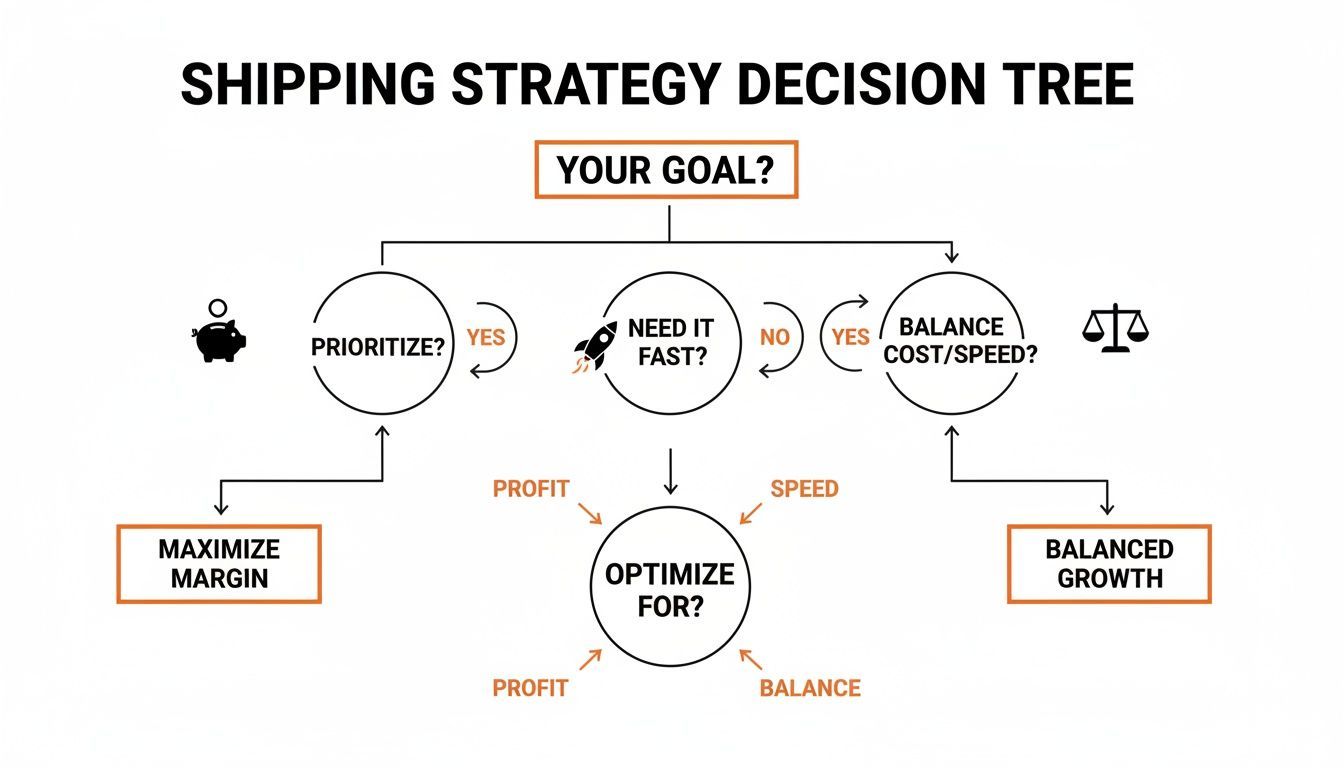
As you can see, if you’re racing to launch, air freight is your best bet. If maximizing profit is the name of the game, the cost savings of sea freight are impossible to ignore.
Air freight is your go-to when time is money. It’s worlds faster than sea, typically getting your inventory from a factory floor in China to an Amazon FBA warehouse in the US within 8-15 days. This lane is split into two main options.
Key Takeaway: Use air freight like a surgical tool, not a sledgehammer. It’s fantastic for product launches, market testing, or dodging a stockout, but relying on it for routine, bulk replenishment will absolutely crush your profit margins.
Sea freight is the workhorse for the vast majority of Amazon sellers sourcing from China. Yes, it’s slow. But the cost savings are huge, especially for bigger, heavier products. Shipping by sea gets you the lowest possible landed cost per unit, which is critical for staying competitive on price and keeping your margins healthy on Amazon.
The catch? Those long transit times demand much smarter inventory planning. While sea freight is hands-down the most cost-effective option for bulk shipments, the total journey has gotten longer. The average container trip from Asia to North America now clocks in at around 67 days, a huge jump from the 40-day average we saw pre-pandemic.
One clever trick to manage this is to use your Chinese supplier’s address when creating your shipment in Seller Central. This can sometimes grant you a longer 75-day delivery window, giving you more breathing room. For a deeper dive into these shipping dynamics, the team at UniCargo offers some great insights.
Sea freight comes in two main flavors:
To make a smart call, you need to look at the total landed cost and transit time for your specific product and business needs. Laying it all out in a simple comparison often makes the decision crystal clear.
Here’s a quick breakdown to help you compare your options for shipping from China to a US-based Amazon FBA center.
Shipping Method
Typical Cost
Transit Time
Ideal Shipment Size
Best For
Express Courier
High ($8-$15/kg)
3-7 Days
Under 150 kg
Urgent restocks, product samples, or initial small test orders.
Standard Air Freight
Medium ($5-$10/kg)
8-15 Days
150 kg – 500 kg
Time-sensitive launches or replenishing high-value, lightweight items.
Sea Freight (LCL/FCL)
Low ($1-$2/kg)
30-60+ Days
Over 2 CBM / 500+ kg
Bulk inventory replenishment where cost-efficiency is the top priority.
At the end of the day, picking the right method is a balancing act. Your decision needs to line up with your inventory strategy, cash flow, and business goals. The aim is to get your products checked in on time without sacrificing all your profit to shipping costs.
Getting your products across international borders is where many Amazon sellers hit their first major roadblock. Let’s be honest: customs clearance can feel like a black box. It’s a confusing world of jargon, surprise fees, and the constant threat of delays that can leave your inventory stuck in limbo.
But it doesn’t have to be that way. With the right know-how, you can turn this potential bottleneck into a smooth, predictable part of your supply chain. Think of customs as a gatekeeper. To get through, you just need the right keys, used in the right order. A single mistake, no matter how small, can get your shipment flagged, racking up storage fees and putting you at risk of a stockout.
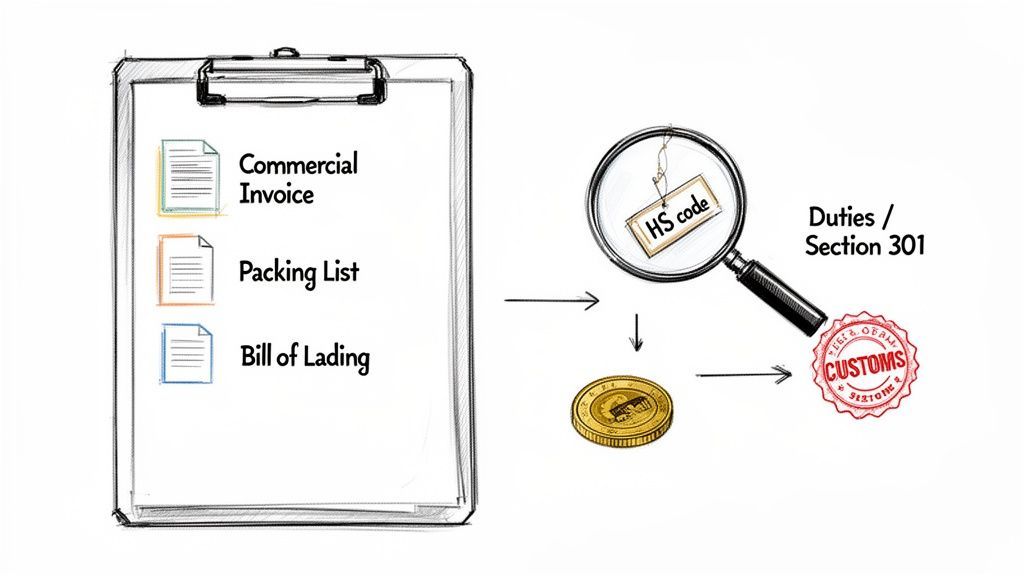
When it comes to customs, accuracy and attention to detail are your best friends. Your freight forwarder will guide you through the process, but the responsibility for providing correct information ultimately falls on you. Three core documents form the backbone of every international shipment.
Getting these documents right isn’t just about avoiding delays; it’s about financial accuracy. A simple typo in the declared value on your commercial invoice could lead to paying the wrong amount in duties or, worse, trigger a full customs inspection that holds up your goods for weeks.
The amount you pay in import duties boils down to one critical number: the Harmonized System (HS) code. This is a globally recognized code used to classify every product imaginable. Getting this code right is non-negotiable, as it directly determines the tariff rate applied to your goods.
Your supplier can often suggest an HS code, but it’s your responsibility as the importer to verify it. You can use the Harmonized Tariff Schedule search tool from the U.S. International Trade Commission to look it up. An incorrect HS code can lead to overpaying duties or, even worse, underpaying and facing hefty penalties down the road.
Customs duties are calculated as a percentage of your goods’ total value (the amount on your commercial invoice). For instance, if your product’s HS code has a 5% duty rate and your goods are valued at $10,000, your base duty is $500. But here’s the kicker for goods from China: you also have to factor in Section 301 tariffs, which can add a significant percentage on top of that base duty.
When you’re shipping from China to Amazon FBA, you’ll come across Incoterms that define who is responsible for what. For FBA sellers, the choice usually comes down to DDP versus DDU/DAP.
For sellers who want a smooth, predictable process, DDP is almost always the better choice. It minimizes your risk and keeps your shipment moving. The customs clearance process is a huge factor in your final landed costs, and using DDP terms is especially useful as it ensures your forwarder manages all duties and logistics. This makes your shipment Amazon-ready upon arrival and helps you dodge potential rejections for missed delivery appointments. The current US-China tariff situation has been extended, which provides some stability, but navigating it is still complex. You can find more details in this in-depth analysis of China tariff extensions from Tactical Logistic.
Ultimately, mastering customs paperwork and duties is all about taking control. By understanding the key documents, classifying your products correctly, and choosing the right shipping terms, you protect your business from the costly surprises that can derail an otherwise perfect FBA shipment.
Getting through customs feels like a huge win, but the final hurdle is often the most unforgiving: Amazon’s FBA warehouses. These fulfillment centers run with military-like precision, and their rulebook is notoriously strict. A single mistake in your prep or labeling can get your entire shipment rejected at the receiving dock, triggering costly delays, unplanned storage fees, and a frantic scramble to fix everything from thousands of miles away.
Getting this stage right isn’t just about following rules; it’s about protecting your investment. Think of it as the last line of defense for your quality control. When you’re shipping from China to Amazon FBA, ensuring your goods are perfectly prepped and labeled before they leave the country is one of the smartest moves you can make. This approach turns small, fixable issues into non-issues, rather than letting them become massive, expensive headaches stateside.
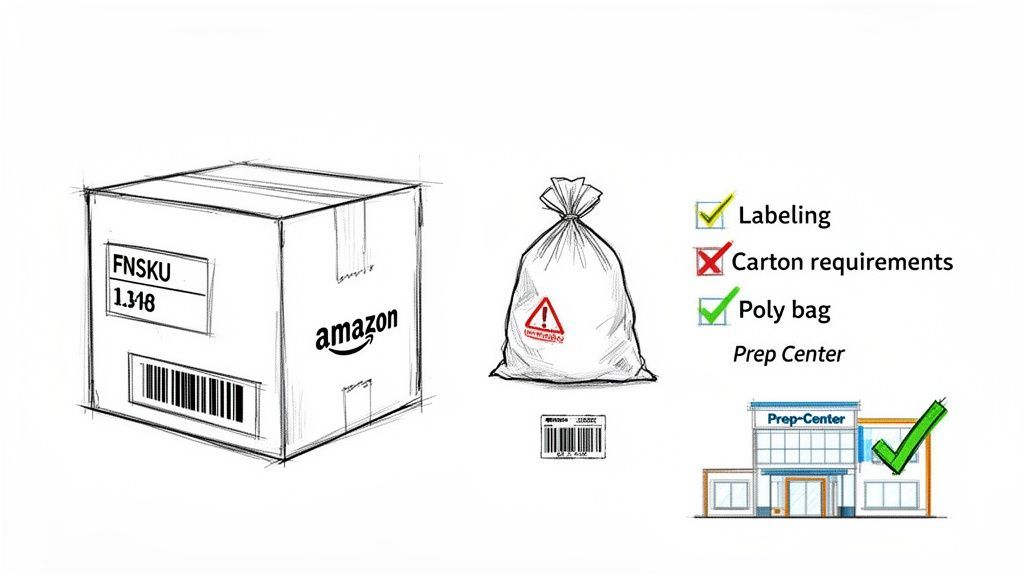
Amazon identifies every unit in its massive network using specific barcodes. Your job is to make sure every single one of your products has the correct label, applied perfectly.
Pro Tip: Never place carton labels over a box seam where they could get sliced open by a box cutter. A damaged barcode makes the carton unscannable, leading to immediate check-in problems. Always put it on a clean, flat surface of the box.
Beyond the labels, Amazon has very specific rules for how your products must be packaged. This is all about protecting the items and making sure they can be processed efficiently. Overlooking these details is a recipe for instant rejection.
Here are a few of the most common requirements:
Getting these small details right is mission-critical. If your supplier in China isn’t experienced with Amazon FBA standards, you are taking a huge risk by letting them handle this crucial step.
This is where a dedicated FBA prep center becomes your secret weapon. These specialized service providers are experts in Amazon’s ever-changing rulebook, and they act as an intermediary to ensure your inventory is 100% compliant before it ever reaches an Amazon facility. You can find them in China or in the US.
Using a prep center in China allows you to catch quality control problems at the source, saving you the massive expense of shipping defective goods across the ocean only to find out they’re unsellable. A US-based prep center, on the other hand, gives you a stateside hub to receive, inspect, and prep goods before forwarding them to various FBA warehouses, offering more flexibility if you need to split shipments.
A good prep center will handle all the tedious but vital work:
By outsourcing this detailed work, you effectively de-risk the final leg of your supply chain. You pay a small fee per unit, but you gain invaluable peace of mind, knowing your shipment won’t be turned away at Amazon’s door.
Choosing a freight forwarder is one of the biggest decisions you’ll make when shipping from China to Amazon FBA. This isn’t just about hiring a company to move your boxes from Point A to Point B. You’re looking for a strategic partner who can make or break your entire supply chain.
A great forwarder is your quarterback on the ground. They navigate the frustratingly complex world of logistics, customs, and Amazon’s ever-changing rules so you can focus on selling. A bad one, however, will drown you in surprise fees, missed delivery appointments, and shipments that vanish into customs purgatory for weeks. Your forwarder is the most critical link between your factory and Amazon’s fulfillment center—getting this relationship right is non-negotiable.
It’s tempting to just shop around for quotes and pick the cheapest one. We’ve all been there. But this is a classic rookie mistake that almost always costs more in the long run. The lowest price often masks incompetence, terrible communication, or a business model that relies on hitting you with surprise surcharges later.
Instead, you need to dig deeper. You need a partner who genuinely understands the specific, often maddening, details of shipping for Amazon FBA. Their expertise is the difference between a smooth, on-time delivery and a logistical nightmare that costs you thousands and tanks your IPI score.
Here are the questions I always ask that go way beyond a simple price sheet:
If a freight forwarder stumbles on these questions, run. Their hesitation is a preview of the radio silence you’ll get when your shipment is stuck and you’re desperate for answers.
Let me paint a picture for you, because I’ve seen this happen dozens of times. A seller finds a forwarder whose sea freight quote is $500 cheaper than everyone else’s. Looks like a steal. The problem? This forwarder has almost no FBA experience. They don’t know how to book a proper delivery appointment with Amazon, and they miss the delivery window.
Now what? The container is stuck at the port, racking up daily storage fees called demurrage. After just a week, those fees have climbed to over $1,500. The “cheaper” option has now cost the seller an extra $1,000, delayed their inventory by weeks, and caused them to stock out and lose sales rank. This isn’t a rare occurrence; it’s a predictable outcome of choosing price over competence.
This is a massive problem in the industry right now. Recent data shows that shipping delays have become so severe that 78% of sellers are seeing their profits shrink due to transit times that are now 23 days longer on average. As a direct result, 42% of sellers are losing the Buy Box because of stockouts. A good forwarder who manages DDP compliance and can even offer prep services is your best defense against these pitfalls. You can dig into more of these stats on the impact of shipping delays from AMZ Prep.
A truly great logistics partner does more than just move freight; they anticipate problems and bring you solutions. They effectively become an extension of your own team.
Here are the non-negotiable traits to look for:
Ultimately, choosing your freight forwarder is an investment in your business’s stability. A reliable partner will save you far more in avoided fees, stress, and lost sales than you could ever save by just picking the cheapest quote off a spreadsheet.
Even the most buttoned-up shipping plan runs into questions. When you’re dealing with the tangled web of international logistics, a few uncertainties are bound to pop up. Getting them sorted out is the difference between a shipment that sails through and one that gets stuck in a costly mess.
Let’s clear the air on some of the most common questions we hear from Amazon sellers.
First off, don’t panic. A customs flag is a normal, if annoying, part of the game. If U.S. Customs and Border Protection (CBP) decides to take a closer look at your container, your freight forwarder is the first to know. This is one of those moments you’ll be glad you picked a good one—they handle everything for you.
The inspection itself can be anything from a quick X-ray of the container to a full-blown “intensive exam,” where they physically unload and check your products. This can add a few days to your timeline, or in rare cases, a couple of weeks.
Here’s what you really need to know:
Think of shipping insurance as non-negotiable. Your inventory is about to travel thousands of miles, getting passed between trucks, cranes, and ships. Things go wrong. Containers get dropped, cargo gets damaged, and theft happens. Without proper insurance, you eat the entire loss.
Most forwarders offer cargo insurance, and it’s surprisingly affordable. The industry standard is to insure for 110% of the CIF value (Cost, Insurance, and Freight). This covers the cost of your goods and shipping, plus a 10% buffer for lost profits or other headaches.
Never, ever rely on the carrier’s basic liability coverage. It’s often just pennies on the dollar and won’t even come close to covering your actual inventory cost. Always buy dedicated cargo insurance for every single shipment.
Ah, the dreaded split shipment. You create your shipping plan in Seller Central, and Amazon tells you to send 300 units to California, 500 to Texas, and 200 to Pennsylvania. It’s great for their network efficiency, but a logistical nightmare for you.
You have three main ways to tackle this:
For most sellers, the US-based prep center offers the sweet spot between cost, control, and sanity. It keeps your international shipping from China to Amazon FBA leg simple while giving you the flexibility you need for the final domestic delivery.
At Clickstera Solutions LLC, we help great brands win bigger results and scale faster on Amazon. Our full-service account management, from supply chain planning to advanced PPC, ensures your operations are as profitable as your marketing. If you’re ready to align your ads, content, and logistics into a cohesive growth strategy, learn more about how we can help.
Talk to Clickstera and get a clear next-step plan to scale your performance marketing.