


Real e-commerce growth isn’t about chasing the latest shiny tactic. It’s built on a solid framework that works, plain and simple. Think of it like a three-legged stool: if one leg is wobbly, the whole thing comes crashing down. The most effective brands balance three core pillars: Visibility to get seen, Conversion to turn shoppers into customers, and Retention to keep them coming back.
This is your blueprint for scaling profitably, without the guesswork.
Building Your Growth Blueprint
Too many brands get caught up in a cycle of random acts of marketing, hoping something sticks. That’s a surefire way to burn through your budget and get nowhere fast. Sustainable growth demands a deliberate plan—a system where every part works together.
Think of your brand as a high-performance engine. You can pour the best fuel (ad spend) into it, but if the pistons (your product pages) aren’t firing correctly, you’ll never get the power you need. A structured blueprint makes sure your marketing, sales, and even your operations are all humming in sync, pushing toward one clear goal: profitable growth.
And the opportunity is massive. The global e-commerce market just blew past $6.86 trillion and is on track to top $8 trillion by 2027. That’s more than double the growth rate of traditional retail. With a clear plan, you can claim your piece of that pie. You can dig into more stats on e-commerce market expansion from SellersCommerce’s latest report.
The Three Pillars of E-commerce Growth
Every winning e-commerce strategy boils down to mastering three interconnected systems. Get these right, and you create a powerful growth loop. Neglect one, and the whole system suffers.
- Visibility: This is all about getting in front of the right people. It’s your SEO, your marketplace ads, your social media presence—everything that puts your product on a shopper’s radar. Without it, you’re invisible.
- Conversion: You’ve got their attention. Now what? Conversion is the art of turning that click into a sale. We’re talking killer product pages, crystal-clear calls-to-action, trust-building reviews, and a checkout process so smooth they don’t even think about it.
- Retention: Here’s a secret: your most profitable customer is usually one you already have. Retention is about building loyalty through great service, smart email marketing, and giving people a reason to buy again. This is how you maximize lifetime value.
This diagram breaks down how these three pillars work together to form a scalable growth plan.
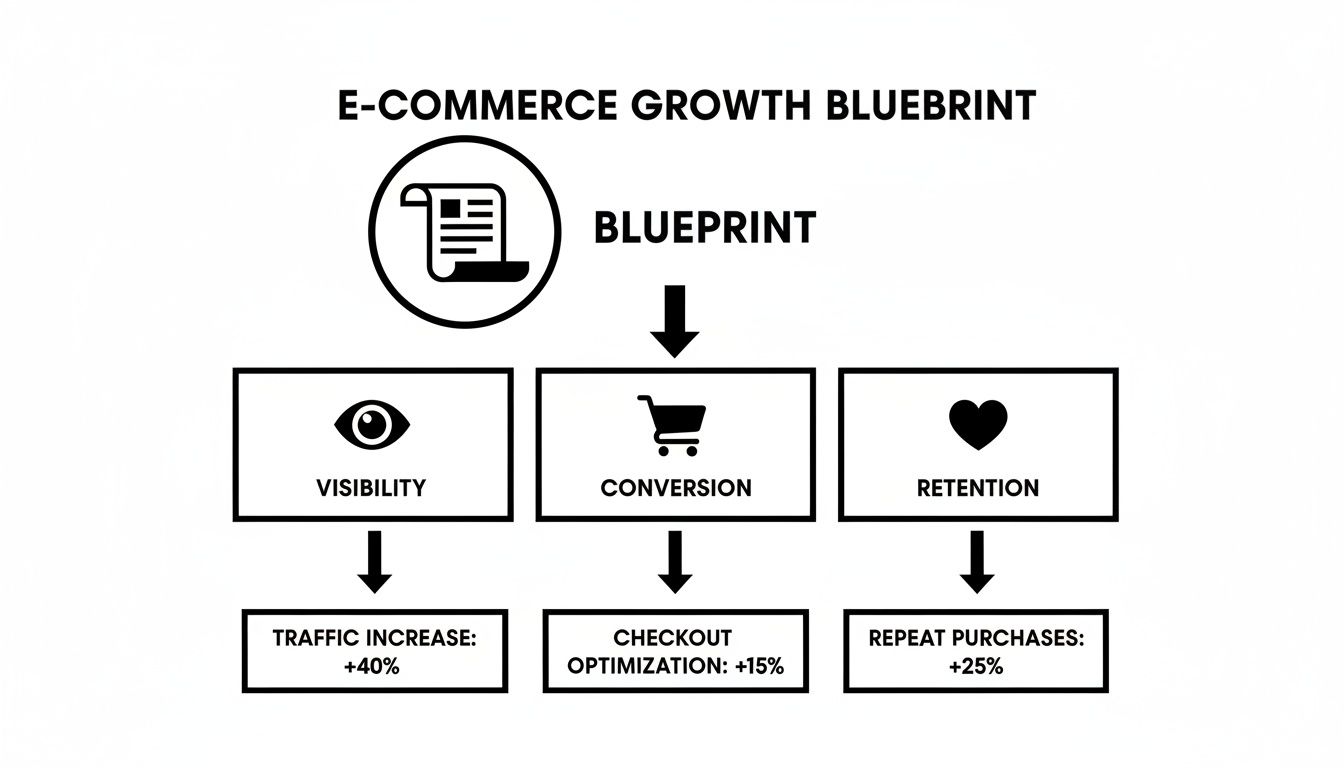
As you can see, it’s not a list of separate tasks but a cohesive system. A master blueprint guides everything, ensuring your efforts to attract, convert, and retain customers all feed into each other, creating a growth machine that practically runs itself.
Winning on Competitive Marketplaces
Standing out on a crowded marketplace like Amazon or Walmart can feel like trying to get noticed in a packed stadium. To win, you need a precise playbook that cuts through the noise. This comes down to a two-pronged approach that aligns perfectly with our core growth pillars: visibility and conversion.
It all starts with mastering the art and science of advanced product listing optimization. This isn’t just about stuffing keywords into a title; it’s about building a digital storefront that speaks fluently to both search algorithms and human shoppers. The real goal is to create an irresistible, informative experience that stops scrollers in their tracks.
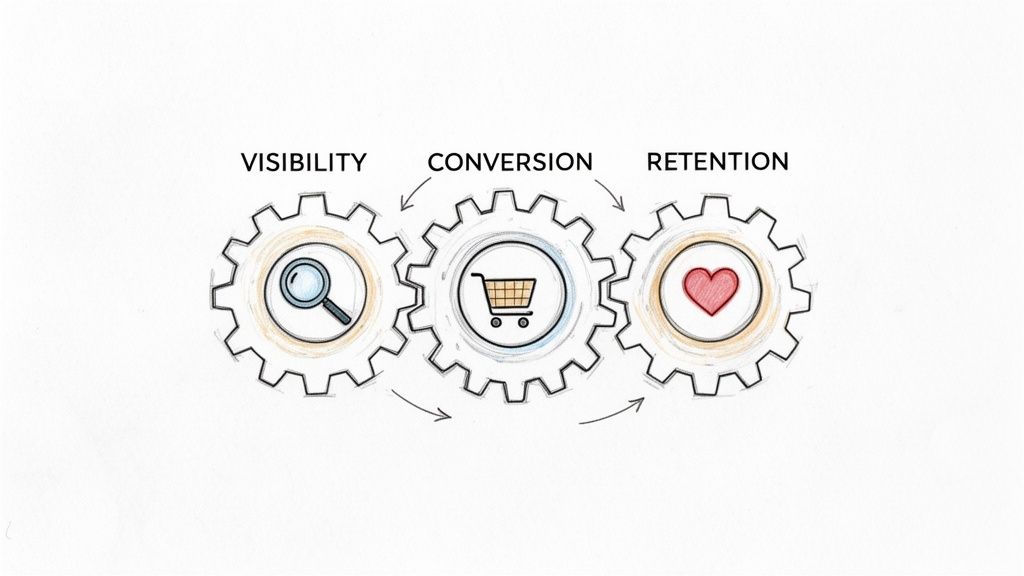
This process is a blend of technical SEO and compelling brand storytelling, making sure every single element of your listing works together to attract and persuade.
Mastering Visibility with Optimized Listings
Think of your product title as the most valuable piece of real estate on your listing. It needs to be a powerful mix of high-volume search terms and benefit-driven language that tells a customer exactly what they’re getting and why they should care. It’s your digital handshake—it has to be firm, clear, and confident.
Your bullet points are the next big opportunity. Don’t just list features; translate them into tangible benefits. Instead of saying “100% Cotton,” try “Breathable 100% Cotton for all-day comfort and cool wear.” Each bullet should anticipate and answer a customer’s question or solve a pain point, building trust and excitement at the same time.
Finally, you need to go deeper with enhanced content formats to tell your full story.
- A+ Content (Amazon) & Rich Media (Walmart): Use these modules to break down complex features with high-quality graphics, comparison charts, and lifestyle photos. This is where you overcome purchase hurdles visually.
- Brand Story: This is your chance to connect with shoppers on a human level. Share your brand’s mission, its values, and what makes your products different. A strong origin story is often a key differentiator.
A well-crafted listing does more than just describe a product; it builds an immersive shopping experience. It answers questions before they are asked and builds a bridge of trust between your brand and a new customer.
This meticulous approach is foundational. For those just getting their feet wet, understanding how to sell private label products on Amazon is the first step, and our guide offers a complete roadmap for that journey.
Turning Clicks into Customers with Conversion Tactics
Getting shoppers to your page is only half the battle. The next, and arguably harder, part is convincing them to click “Add to Cart.” This is where conversion rate optimization (CRO) becomes one of the most powerful tools in your e-commerce growth arsenal.
The single most effective way to boost conversion is through relentless testing. A/B testing, or split testing, lets you compare two versions of a listing element—like your main image, price, or bullet points—to see which one performs better. Even small, data-backed tweaks can lead to a huge lift in sales over time.
Social proof is another absolutely critical conversion lever. In e-commerce, reviews are the digital version of a trusted friend’s recommendation. Proactively managing them is non-negotiable.
- Encourage Feedback: Use automated follow-up emails to politely ask satisfied customers for a review.
- Address Negative Reviews: Always respond publicly to negative feedback in a professional, helpful way. It shows potential buyers you stand behind your product and care about customer happiness.
- Maintain High Ratings: A product rating that slips below 4.0 stars can seriously torpedo your conversion rate. Keeping a close eye on your review score is vital.
Lastly, nothing kills a conversion faster than an “Currently Unavailable” message. Pristine inventory health is crucial for winning and holding the Buy Box—the default purchase option on marketplaces. Use forecasting tools to avoid stockouts, especially during peak seasons, ensuring your best products are always ready to ship. This operational discipline directly fuels your growth engine.
Here’s a quick look at how these marketplace growth levers connect to the metrics that matter most.
Marketplace Growth Levers Impact on KPIs
This table outlines key optimization activities on marketplaces and their direct impact on critical performance indicators, helping brands prioritize their efforts.
| Growth Lever (Activity) | Primary Pillar | Impacts This KPI | Example Tactic |
|---|---|---|---|
| Title Optimization | Visibility | Click-Through Rate (CTR), Organic Rank | Front-loading primary keywords with benefit-driven copy. |
| Bullet Point & A+ Content | Conversion | Conversion Rate (CVR), Session Time | Using infographics and lifestyle images to show the product in use. |
| Image Stack Enhancement | Conversion | CVR, Add-to-Carts | Adding a video to the image gallery to demonstrate features. |
| Review Management | Conversion | CVR, Customer Lifetime Value (CLV) | Implementing an automated email sequence to request reviews post-purchase. |
| Inventory Forecasting | Conversion | Buy Box Win Rate, In-Stock Rate | Using software to predict demand for Q4 and ordering stock accordingly. |
| Price Testing | Conversion | CVR, Unit Session Percentage | A/B testing a $19.99 price point against a $21.99 price point. |
As you can see, every action you take—from rewriting a bullet point to managing your stock levels—has a direct and measurable effect on your growth. By focusing on these levers, you move from just existing on a marketplace to actively winning on it.
Scaling Revenue with Smart Advertising
Once your product listings are dialed in to convert, it’s time to pour some fuel on the fire. Smart advertising is one of the most powerful e-commerce growth strategies out there, letting you capture existing demand and even create new customer streams. We’re not talking about simply boosting a post here; this is about building a sophisticated, multi-layered advertising engine that scales revenue profitably.
To move beyond basic campaigns, you have to start thinking like a portfolio manager. You’ll be allocating your budget across different campaign types—some built for aggressive growth, others for steady defense—to hit a balanced and predictable return. This strategic mindset turns your ad spend from a simple line-item expense into a powerful investment in your market share.
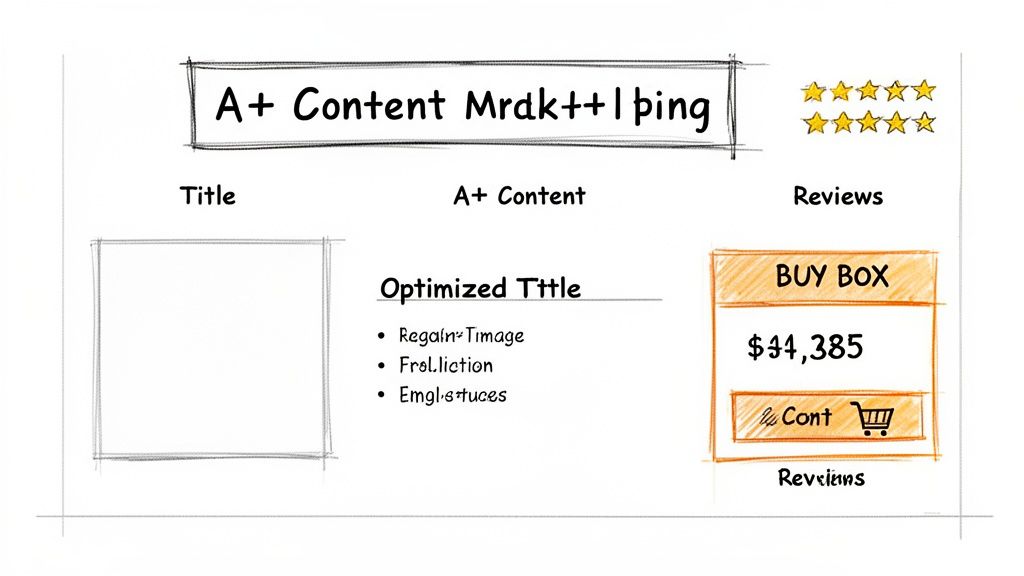
The opportunity here is immense. The global e-commerce world now includes 2.77 billion online shoppers—that’s over a third of the planet. This massive, active consumer base is the perfect arena for marketplace-focused growth, and a well-executed ad strategy is your key to reaching them. You can discover more insights about online retail trends on invespcro.com.
Advanced PPC for Marketplace Dominance
Pay-Per-Click (PPC) advertising on platforms like Amazon and Walmart is your number one tool for grabbing high-intent shoppers the exact moment they’re ready to pull out their wallets. But a “set it and forget it” approach will drain your budget faster than you can blink. Advanced PPC is all about precision, structure, and relentless optimization.
Think of your campaign structure like a fishing operation. You wouldn’t use the same net for every type of fish, right?
- Brand Defense Campaigns: These are your small, strong nets cast right around your boat. They target your own brand and product names, making sure competitors can’t poach customers who are specifically looking for you.
- Product Launch Campaigns: This is like exploring a new fishing ground. You’ll bid more aggressively on a mix of broad and specific keywords to gather data quickly, drive those crucial initial sales, and give the ranking algorithm a kickstart.
- Profitability Campaigns: Here, you’re fishing in your proven, most profitable spots. These campaigns are laser-focused on high-converting, long-tail keywords where you know you can lock in a low Advertising Cost of Sale (ACoS).
This structured approach gives you incredible control over your spend, letting you push for growth where it makes sense and protect profits everywhere else.
Uncovering Hidden Gold with Keyword Harvesting
One of the most effective techniques in the advanced PPC playbook is keyword harvesting. This is the process of using broad match or automatic campaigns to unearth new, high-performing search terms that your customers are actually using.
Here’s how it works:
- Discovery: Run an automatic campaign where the marketplace algorithm shows your ad for a wide range of relevant searches. Let it do the initial exploration.
- Analysis: Regularly pull the search term reports from this campaign. You’re looking for the exact queries that led to a click and, more importantly, a sale.
- Harvesting: “Harvest” those proven, converting keywords and move them into a manual, exact-match campaign. Now you can control the bid with surgical precision.
This process creates a virtuous cycle. Your discovery campaigns constantly feed your high-performance campaigns with new, profitable keywords, allowing you to expand your reach while simultaneously making your whole operation more efficient.
At the same time, you have to be ruthless with your negative keyword strategy. As you find irrelevant search terms in your reports—like a search for “kids shoes” triggering your ad for “men’s boots”—add them as negative keywords. This one simple action stops wasteful spending in its tracks and is absolutely essential for maintaining a healthy return on ad spend (ROAS). For a deeper dive, check out our complete strategy guide on how to lower ACoS and increase ROAS on Amazon PPC.
Expanding Your Reach with Demand-Side Platforms
If PPC is like fishing in a well-stocked pond (the marketplace itself), then a Demand-Side Platform (DSP) is like casting a net across the entire ocean. DSP advertising lets you programmatically buy ad placements across thousands of websites, apps, and platforms outside of the marketplace. This is how you find new customers who haven’t even started searching for your product yet.
DSP gives you the power to build highly specific audiences for two main types of campaigns:
- Retargeting: This lets you show ads to users who checked out your product but didn’t buy. It’s an incredibly effective way to bring shoppers back into the fold and close the sale.
- Prospecting: Here, you target “in-market” or “lifestyle” audiences—people whose browsing behavior suggests they’re likely interested in your product category. For instance, a brand selling hiking gear can target users who frequently visit outdoor adventure blogs.
By using DSP to build a larger audience, you create a bigger pool of potential customers to drive back to your marketplace listings. This off-platform activity not only generates direct sales but also fuels your on-platform growth by increasing traffic and sales velocity—which in turn boosts your organic search rankings. This holistic approach is a cornerstone of any truly scalable e-commerce growth strategy.
Tying Off-Platform Spend to On-Platform Results
For years, the biggest headache with this strategy was proving it actually worked. How could you be sure that your Facebook ad spend was the reason for a spike in Amazon sales? This is where modern measurement tools have completely changed the game.
Amazon Attribution is the answer. It’s a free tool that gives you unique tracking URLs to use in your off-platform campaigns. When someone clicks your TikTok ad and buys on Amazon, Attribution connects the dots. Suddenly, you have crystal-clear data on which ads are driving sales, add-to-carts, and even simple page views.
This closed-loop reporting turns your paid social budget from a guessing game into a measurable investment. You can finally calculate a true Return on Ad Spend (ROAS) for your off-platform efforts, giving you the confidence to scale what works.
With these tools in hand, paid social stops being a siloed, disconnected effort. It becomes a critical, provable piece of a unified plan to drive sales velocity and climb the organic ranks, creating a powerful, self-sustaining growth loop.
Building High-Converting Audiences for Your Marketplace
The real magic of platforms like Meta and TikTok is their insanely sophisticated audience-building tools. You can move way beyond generic targeting and reach people with surgical precision. This is absolutely essential for making sure the traffic you’re paying to send to your listings is qualified and ready to buy.
Here are a few powerful audience-building tactics that work wonders for e-commerce brands:
- Lookalike Audiences: This is arguably the most effective targeting weapon you have. You upload a list of your past Amazon customers, and the social platform’s algorithm goes out and finds new people with similar behaviors and interests. You’re essentially cloning your best customers.
- Interest and Behavior Targeting: Go deep. A brand selling premium coffee beans can target users who follow famous baristas, engage with coffee-themed content, and have a history of buying high-end kitchen gadgets.
- Retargeting Website Visitors: Have a DTC site? Perfect. You can retarget people who visited your website but didn’t buy, sending them to your Amazon listing where they can check out with the convenience and fast shipping they already trust.
These advanced targeting options ensure you’re not just spraying random clicks at your listings. You’re directing a curated stream of engaged shoppers, which is a far smarter use of your ad budget. This strategy perfectly complements your on-platform advertising, creating a full-funnel approach that captures customers at every single stage of their journey. To see how this fits into a bigger advertising ecosystem, you might find our guide on how Amazon DSP advertising can be simplified useful for expanding your brand’s reach even further.
Using Analytics to Make Better Decisions
Data without insight is just noise. In e-commerce, it’s incredibly easy to drown in a sea of metrics that look impressive on a spreadsheet but do absolutely nothing to help you grow. An effective analytics process is your filter, cutting through the static and amplifying the signals that lead to smarter, more profitable decisions.
The goal is to stop just collecting data and start asking it questions. This isn’t about becoming a data scientist overnight. It’s about building a simple, repeatable habit of using the tools you already have to get clear answers, turning analytics from a chore into your biggest competitive advantage.
From Vanity Metrics to Actionable Insights
First things first: stop chasing vanity metrics. High traffic numbers or thousands of impressions might feel good, but they don’t pay the bills. The real wins come from focusing on metrics tied directly to profitability and operational efficiency.
Data-driven decision-making is a cornerstone of modern business. By tracking customer behavior, sales trends, and website performance, you can uncover what’s working and what isn’t, allowing every decision to align closer with customer needs and achieve consistent success.
For example, instead of just celebrating total clicks, dig into your Click-Through Rate (CTR) on a keyword-by-keyword basis. A low CTR on a high-volume search term is a massive red flag. It tells you there’s a disconnect between what a shopper is looking for and what your product’s main image or title is promising. Now that is an actionable insight you can use to launch an A/B test and fix things immediately.
Leveraging Marketplace-Native Tools
You don’t need to shell out for expensive third-party software to get started. Marketplaces like Amazon provide powerful, built-in analytics suites that are criminally underused. Amazon Brand Analytics, for instance, is an absolute goldmine for strategic insights.
It helps you answer the kind of questions that can shape your entire strategy:
- Which search terms actually drive conversions? The Search Query Performance report shows you the exact keywords leading to sales, so you can double down on what works in your PPC campaigns.
- Where are my competitors winning? The Market Basket Analysis reveals which other products customers buy alongside yours, exposing huge cross-selling opportunities and competitive threats you never knew you had.
- What’s my real market share for a keyword? This tool shows your brand’s slice of the pie—your share of clicks and conversions for top search terms, giving you a crystal-clear picture of your position on the digital shelf.
Mastering these native tools is all it takes to build a reporting rhythm that delivers real, tangible value.
A Simple Framework for Weekly Reporting
To make data useful, you need a process. To avoid getting lost in endless spreadsheets, create a simple weekly dashboard that answers just three core questions. This discipline turns data analysis from a dreaded task into a quick, high-impact weekly habit.
- What Worked This Week? Identify your top-performing ad campaigns, keywords, and products. The goal isn’t just to see the win, but to understand the “why” behind it so you can do it again.
- What Didn’t Work This Week? Pinpoint the campaigns with high spend and low returns or the listings with a sudden drop in conversion rate. This is your diagnostic checklist for immediate troubleshooting.
- What Will We Do Next Week? Based on your findings, create clear, simple action items. This could be reallocating budget from a dud campaign to a winner or rewriting the bullet points on an underperforming listing.
This straightforward framework turns reporting from a passive activity into an active planning session. It ensures every piece of data you look at translates directly into an action designed to improve your bottom line, making analytics a true driver of your growth.
Avoiding Costly E-commerce Growth Pitfalls
The fastest way to accelerate growth is often to simply avoid the mistakes that sink other brands. While chasing new strategies is exciting, sidestepping common traps is what makes that growth last. Too many promising businesses get derailed by preventable errors that turn rapid scaling into a rapid decline.
Think of it as navigating a minefield. The goal isn’t just to run fast; it’s to follow a safe path. That means knowing exactly where the most common pitfalls are, from operational blunders to financial oversights. Ignoring them can undo all the hard work you’ve put into your marketing and sales.
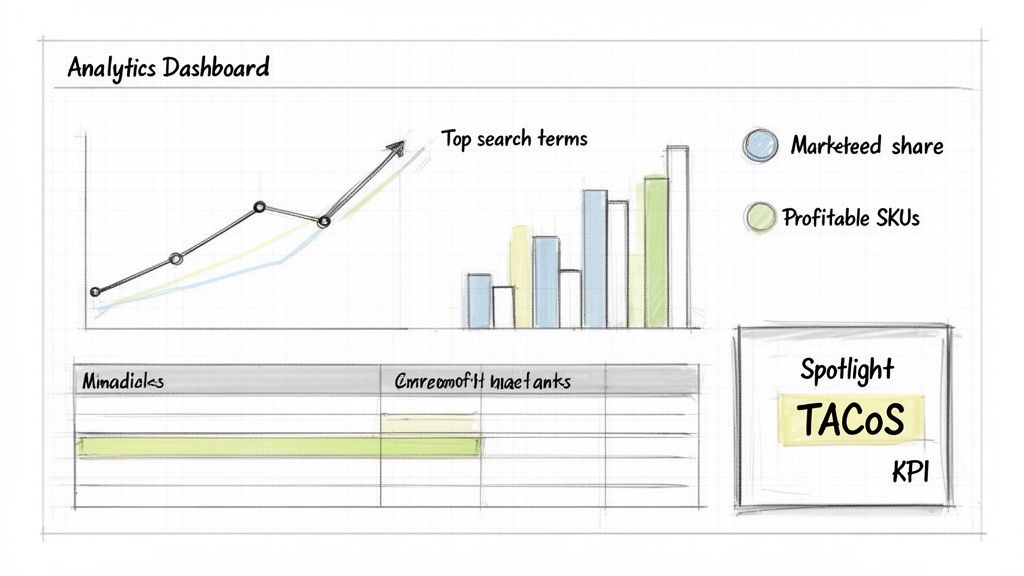
Let’s break down the most dangerous traps and, more importantly, how to steer clear of them.
Pitfall 1: The Inventory Mismanagement Trap
One of the quickest ways to kill your momentum is with sloppy inventory planning. Going out of stock on a best-seller is a disaster. You don’t just lose immediate sales; marketplaces like Amazon will penalize your listing’s organic rank, making it that much harder to recover once you’re back.
Imagine you launch a killer ad campaign that drives huge traffic, only for customers to hit an “out of stock” page. You’ve just paid to disappoint your audience and send them straight to your competitors.
Proactive Solution: Get a robust inventory forecasting system in place. Use historical sales data, seasonal trends, and upcoming promotions to predict future demand. You should also maintain a safety stock of at least 30 days for your key products to create a buffer against unexpected supply chain issues or sales spikes.
Pitfall 2: Chasing Revenue Over Profit
It’s so easy to get mesmerized by a skyrocketing revenue number. But aggressive ad spend and deep discounts can easily put you in a position where you’re actually losing money on every single sale. This “growth at all costs” mindset is a classic trap that leads directly to cash flow crises.
- The Scenario: A brand doubles its monthly revenue, but its profit margin shrinks from 25% to 5%. They’re selling a lot more, but earning a lot less.
- The Fix: Stop focusing only on ROAS (Return on Ad Spend) and start obsessing over TACoS (Total Advertising Cost of Sale). This metric measures your ad spend against your total revenue, giving you a much truer picture of profitable growth. Aim for a TACoS that leaves you with healthy net margins after all your costs are accounted for.
Pitfall 3: The Siloed Teams Breakdown
Finally, a lack of communication between your marketing, operations, and content teams will eventually create chaos. The ad team might run a massive promotion without telling the inventory manager, triggering a stockout. Or the content team could update a listing’s keywords without informing the PPC team, making active ad campaigns irrelevant overnight.
When this happens, each team is working in a vacuum, often accidentally undoing the progress of the others. To build a true growth engine, every part of your operation must be perfectly in sync.
Frequently Asked Questions
When you’re scaling an e-commerce brand, the same questions tend to pop up. Here are the big ones we hear from founders and brand leaders, along with clear, no-nonsense answers.
How Long Until These Growth Strategies Work?
This is the million-dollar question, and the honest answer is: it depends. But you should expect to see results in stages.
Think of it like planting a garden. Foundational tweaks—like sharpening your product titles or refreshing your A+ Content—are like preparing the soil. You can often see a tangible lift in metrics like Click-Through Rate (CTR) and conversions within a few weeks. Quick wins.
But the bigger, more impactful strategies are a different story. Building out a full-funnel DSP campaign, for instance, is like planting a tree. It requires a full quarter or even longer to gather data, build momentum, and deliver the kind of substantial, long-term returns that truly move the needle.
Should I Focus on Amazon or Expand to Other Marketplaces?
Before you jump to Walmart or Target Plus, ask yourself one critical question: have we completely dominated our primary channel? It’s so tempting to chase growth on new platforms, but spreading your resources too thin too early is a classic mistake.
A good rule of thumb is to make sure you’ve captured a dominant share of voice for your core keywords on Amazon before you even think about branching out. If your brand is consistently in the top three for your money terms and you’ve squeezed every drop of optimization out of your listings and ads, then it’s time to replicate that playbook elsewhere. If not, win the battle you’re in first.
What Is the Most Important KPI for Growth?
So many brands get fixated on Return on Ad Spend (ROAS), but it only tells you half the story. The single most important KPI for measuring real, profitable growth is Total Advertising Cost of Sale (TACOS).
Here’s why it’s a much smarter metric:
- ROAS only looks at ad revenue versus ad spend. A high ROAS looks great on paper, but it doesn’t tell you if your ads are actually lifting your total sales or just cannibalizing sales you would have gotten anyway.
- TACOS, on the other hand, measures your ad spend against your total revenue—both organic and ad-driven. This gives you the full picture of your marketing efficiency. A falling TACOS is the ultimate sign of health. It means your advertising is successfully boosting your organic sales and creating a powerful growth flywheel.
Focusing on TACOS ensures your strategy is building a sustainable, profitable brand for the long haul, not just buying sales for today.
Ready to build a growth blueprint that works?
Clickstera Solutions LLC is an Amazon Verified Partner that helps brands scale with data-driven marketplace management.
Learn more about how we can help you win at https://clickstera.com.


3 Responses