


Ready to scale on Amazon but not sure where to start? Forget the random checklists. What you need is a unified playbook that connects every part of your brand’s presence on the platform.
Growing your Amazon sales isn’t about finding one magic bullet. It’s about building a system where optimized product listings, targeted advertising, and sharp operations all work together. Think of it like a machine: great content pulls shoppers in, smart ads drive the right traffic, and solid inventory management means you’re always ready to make the sale.
This is the exact framework we use to help brands capture more market share. We’ll start by building a rock-solid foundation for your product listings and then layer on sophisticated advertising and operational excellence to create a growth flywheel that’s both profitable and built to last.
The Core Growth Framework
Real growth on Amazon comes from executing flawlessly across three interconnected pillars. When these elements are in sync, they create a powerful cycle that boosts your visibility, drives conversions, and builds the kind of customer loyalty that keeps you ahead of the competition.
This is the foundation of our entire approach.
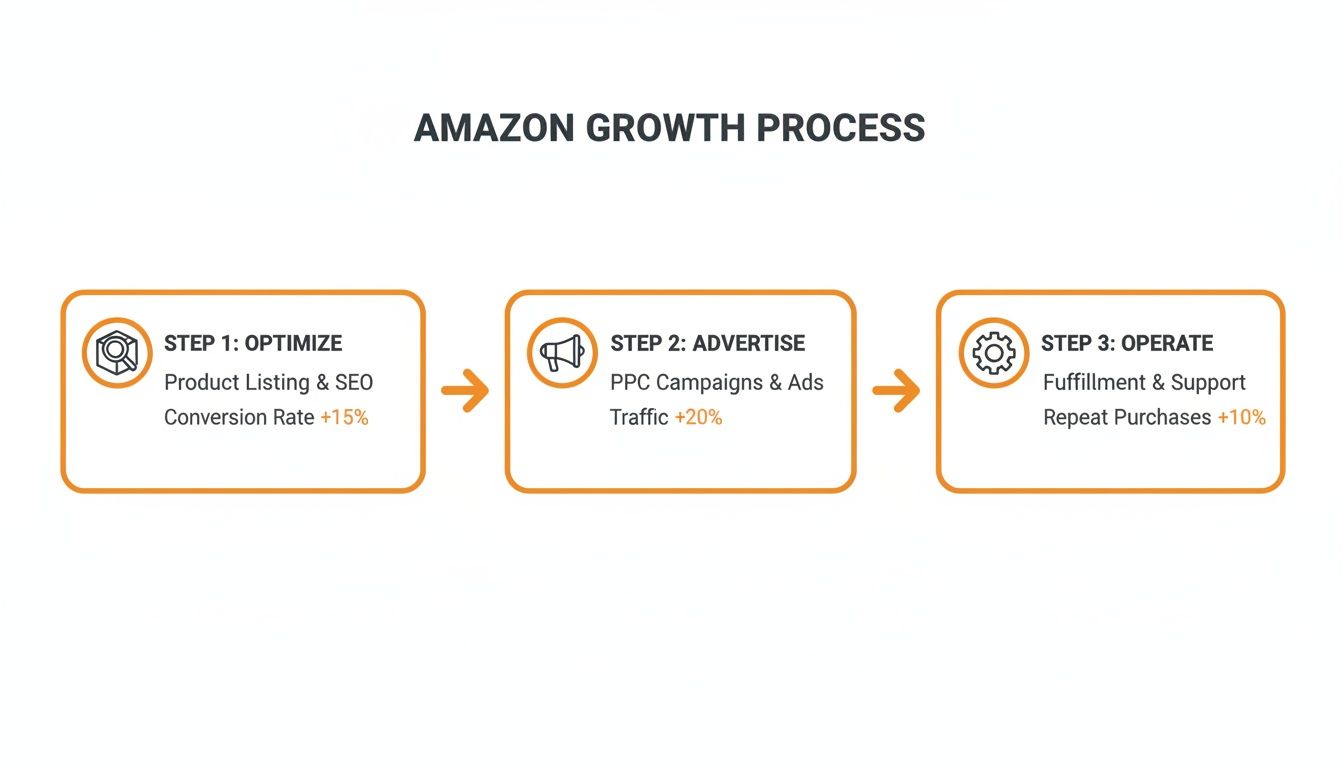
The key takeaway here? Your advertising and operations are only as good as the foundation they’re built on. That’s why we always start with optimization.
Optimizing Your Digital Shelf Space
Your product listing is your single most valuable asset on Amazon. It’s your storefront, your salesperson, and your brand ambassador all rolled into one. Optimizing it with high-quality images, video, and targeted keywords can have a massive impact on your sales.
It’s no secret that Amazon is a visual, search-driven marketplace. In fact, products with professional photos see conversion rates 20-30% higher than those with amateur shots. At Clickstera, we’ve seen clients get 25-40% sales lifts just from A/B testing their titles, weaving high-intent keywords into their bullet points, and maxing out their backend search terms to catch those long-tail searches. It turns a passive listing into an active sales machine.
Success on Amazon isn’t just about selling a product; it’s about selling a solution. Your listing must instantly answer the shopper’s unspoken question: “Why is this the best choice for me?” Every element—from the title to the last A+ Content module—must work together to provide that answer.
This foundational work is non-negotiable and ties directly into broader e-commerce growth strategies that go beyond just one marketplace. Without a listing that’s built to convert, any money you spend on ads is just flushing potential down the drain.
To give you a clearer picture, here’s a quick breakdown of the core growth levers we focus on.
Core Amazon Growth Levers at a Glance
This table summarizes the key strategies for increasing your Amazon sales and shows how each one impacts your bottom line.
| Growth Lever | Primary Goal | Key Actions | Expected Impact |
|---|---|---|---|
| Listing Optimization | Maximize Conversion Rate (CVR) | SEO keyword research, title/bullet optimization, A+ Content, high-quality images & video. | Higher CVR, improved organic rank, better ad performance (lower ACoS). |
| Advertising (PPC & DSP) | Drive Qualified Traffic & Sales | Sponsored Products, Sponsored Brands, Sponsored Display, and Amazon DSP campaigns. | Increased sales velocity, better keyword ranking, new customer acquisition. |
| Promotions & Pricing | Boost Sales Velocity & Visibility | Coupons, Prime Exclusive Deals, competitive pricing strategy, Subscribe & Save. | Short-term sales spikes, improved BSR, higher customer lifetime value. |
| Reviews & Social Proof | Build Trust & Credibility | Automated review requests, Vine program, excellent customer service, Q&A monitoring. | Higher CVR, increased shopper confidence, better product feedback loop. |
| Inventory & Operations | Maintain In-Stock Rate & Profitability | FBA inventory planning, demand forecasting, avoiding stockouts, supply chain efficiency. | Consistent sales, protection against BSR drops, improved IPI score, higher margins. |
Each lever is a crucial part of the puzzle. When you pull them all in the right order, you create a system that not only grows sales but also builds a defensible brand on the world’s biggest marketplace.
Crafting Product Listings That Convert
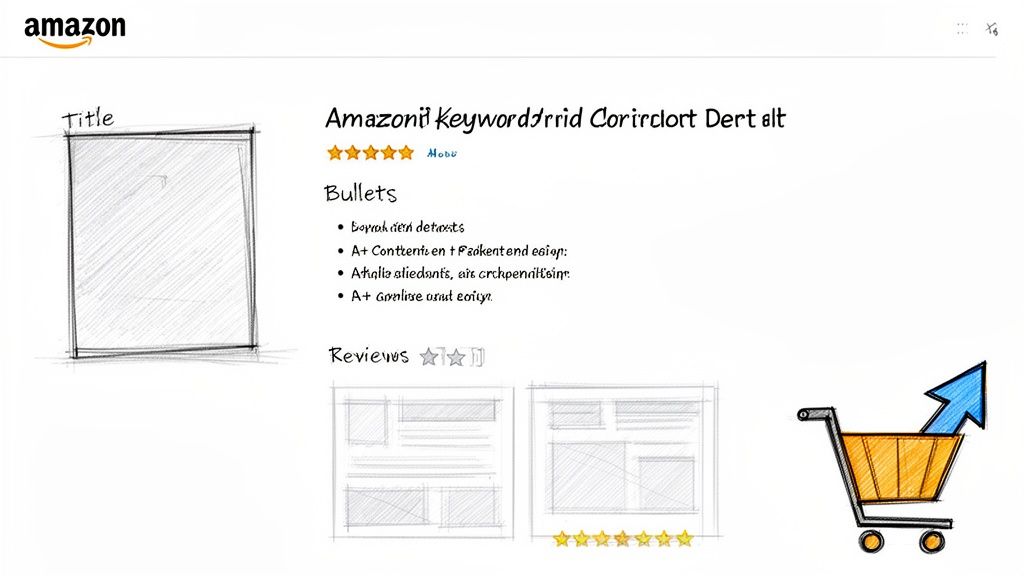
Think of your Amazon product detail page as your single most important piece of digital real estate. It’s your virtual storefront, your 24/7 salesperson, and your brand ambassador all rolled into one. To really move the needle on Amazon sales, you have to get past basic optimization and master the art of creating listings that don’t just attract shoppers but compel them to click “Add to Cart.”
A winning listing is a careful mix of art and science. It needs to speak the language of Amazon’s A9 search algorithm while connecting with the human on the other side of the screen. This means every single element has to work together, from the title all the way down to the hidden backend keywords.
Anatomy of a High-Converting Title
Your product title is the single most critical SEO element on your entire listing. Period. It’s the first thing a customer sees and a massive factor in Amazon’s ranking decisions. The goal here is to be discoverable by the algorithm and instantly understandable to a potential buyer scanning a crowded search page.
A powerful title structure usually includes these four things:
- Brand Name: Establishes recognition and trust right from the start.
- Main Keyword/Product Type: Clearly states what the product is (e.g., “collagen peptides powder”).
- Key Feature or Benefit: Answers the “why buy me?” question for the customer (e.g., “for hair, skin, nails”).
- Important Specs: Includes critical details like size, quantity, or color (e.g., “16 oz container”).
For example, a generic title like “Blue Pillow Cases” is going to get completely lost. A much stronger version, like “BrandName Silky Pillow Cases (Set of 2, Navy Blue, Queen Size),” gives both shoppers and the algorithm the crucial information they need. Aim for clarity and keyword relevance without stuffing it so much that it becomes unreadable.
Writing Bullet Points That Solve Problems
Those five bullet points are your prime real estate for selling the benefits, not just listing the features. This is where you get inside the customer’s head, address their pain points, and knock down their objections before they even fully form. Each bullet should be a mini sales pitch.
I see this mistake all the time: brands write bullets that are just a dry list of specs. You have to frame each feature as a direct solution to a customer’s problem. Connect the “what” (the feature) to the “so what” (the benefit).
Take a portable power bank, for instance:
- Weak Bullet: 10,000mAh capacity
- Strong Bullet: Never Run Out of Power: With a massive 10,000mAh capacity, you can charge your smartphone up to three full times, ensuring you stay connected on long travel days or during power outages.
See the difference? This approach transforms a simple number into a tangible benefit, painting a clear picture of how the product makes the customer’s life better. For a deeper dive, our complete guide to Amazon listing optimization covers more advanced techniques for writing copy that sells.
The Power of Backend Search Terms
Backend search terms are your secret weapon for scooping up extra traffic. These are keywords that are completely invisible to shoppers but are fully indexed by Amazon’s search algorithm. This is the perfect spot for all the relevant keywords that just didn’t fit naturally into your title or bullets.
Use this section strategically for:
- Synonyms and Variations: “Laptop stand,” “notebook riser,” “computer holder.”
- Common Misspellings: Don’t let a simple typo cost you a sale.
- Long-Tail Keywords: More specific search queries that signal someone is ready to buy.
- Spanish Keywords: A must-do if it’s relevant to your target audience in the US market.
Just be sure to avoid repeating keywords you’ve already used in your title or bullets, and don’t use commas—just separate every term with a single space. By maxing out your backend search terms, you expand your reach and make sure you’re showing up for every relevant query, which is a non-negotiable step in any serious plan to increase Amazon sales.
Scaling Revenue with Advanced Ad Strategies
If your product listings are the engine of your Amazon business, then your advertising strategy is the high-octane fuel that powers real growth. Simply setting up basic, auto-pilot campaigns won’t cut it if you want to increase Amazon sales in a meaningful, profitable way. This is where a full-funnel approach, combining advanced Pay-Per-Click (PPC) tactics with the powerful reach of Amazon’s Demand-Side Platform (DSP), becomes a total game-changer.
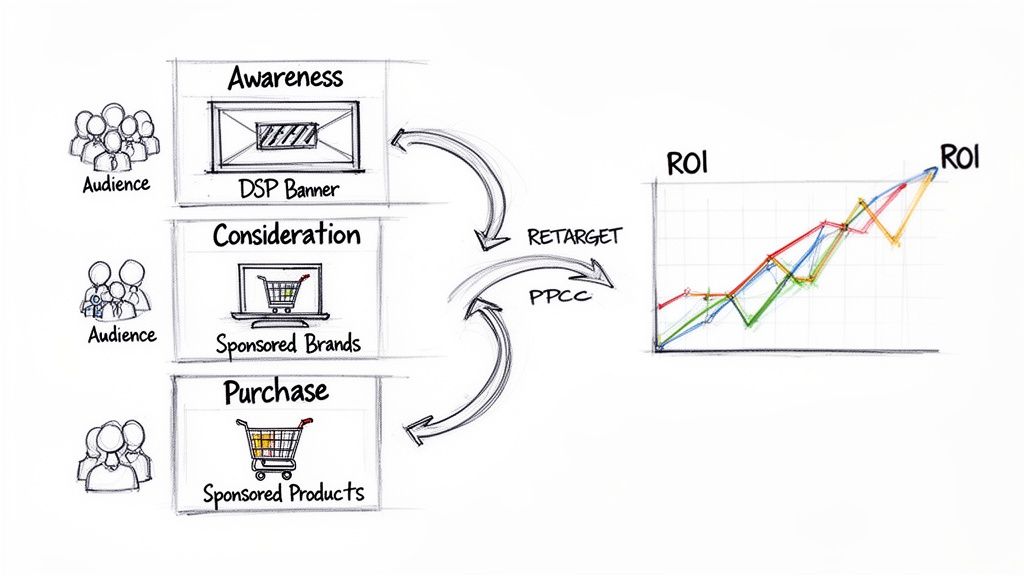
This integrated system is designed to capture shoppers at every single stage of their journey. You can attract brand-new customers just starting their search, re-engage the ones who showed interest but didn’t buy, and build the kind of long-term brand loyalty that creates repeat business. It’s about building a machine that consistently drives qualified traffic to your highly-optimized listings.
Mastering a Full-Funnel PPC Structure
One of the most common mistakes we see brands make is lumping all their keywords into one giant Sponsored Products campaign. This approach makes it impossible to control your budget or understand what’s actually working. A sophisticated, segmented structure, on the other hand, gives you precise control and actionable data.
Think of it like building a series of nets, each one designed to catch a different type of fish. Your campaign structure should be just as intentional, segmented to capture different kinds of customer intent.
A proven structure involves breaking out campaigns by:
- Match Type: You need separate campaigns for broad, phrase, and exact match keywords. This lets you pour your budget into the proven, high-converting exact match terms while still using broad match for discovery.
- Branded vs. Non-Branded: A campaign targeting your own brand name (“BrandName supplements”) is going to perform very differently than one targeting a generic term (“collagen powder for women”). Separating them is non-negotiable for accurate analysis.
- Product Category: If you sell different product lines, group them into their own campaigns. This stops your bestseller from eating the entire ad budget for a new product you’re trying to launch.
This level of organization is the first step toward profitable scaling. For a much deeper dive, you can check out our ultimate guide to Amazon PPC, which covers everything from initial setup to advanced optimization.
Expanding Your Reach with Sponsored Brands and Display
Once your Sponsored Products campaigns are humming along, it’s time to layer in other ad types to grab more digital real estate and engage shoppers in new ways.
Sponsored Brands ads sit right at the top of search results and are a fantastic tool for brand building. They let you showcase your logo, a custom headline, and multiple products. Use these to send traffic to your Amazon Storefront, creating a branded shopping experience that introduces customers to your whole catalog.
Sponsored Display ads take things a step further, allowing you to retarget shoppers who viewed your products but didn’t pull the trigger. These ads can follow potential customers both on and off Amazon, reminding them of your product and bringing them back to seal the deal.
Effective advertising isn’t just about getting the first click. It’s about staying top-of-mind. Sponsored Display retargeting is your tool for turning missed opportunities into recovered sales, a critical tactic for maximizing your overall return.
Unlocking Off-Amazon Audiences with DSP
The Amazon DSP (Demand-Side Platform) is where you graduate to enterprise-level advertising. Unlike PPC, which captures demand from shoppers already searching on Amazon, DSP lets you create demand by reaching relevant audiences across the web, on Amazon-owned sites like IMDb, and inside third-party apps.
With DSP, you can build incredibly specific audience segments based on:
- In-Market Audiences: Target shoppers who are actively browsing for products in your category.
- Lifestyle Audiences: Reach people based on their interests and hobbies (e.g., “fitness enthusiasts”).
- Lookalike Audiences: Find new shoppers who share characteristics with your existing best customers.
The real power of DSP comes from its retargeting. You can run campaigns to specifically target users who added your product to their cart but abandoned it—a hugely valuable audience. Running advanced PPC campaigns, especially when combined with DSP, is a proven method for surging sales, with some data suggesting advertisers can gain up to 50% more visibility in competitive categories. For example, retargeting cart abandoners via DSP can yield recovery rates as high as 20%, directly impacting your bottom line.
By layering these advanced strategies—a segmented PPC structure, a full-funnel use of ad types, and the expansive reach of DSP—you build a resilient and powerful advertising engine. This is how you stop just competing for clicks and start strategically building a dominant brand presence that consistently drives sales growth.
Using Promotions and Reviews to Fuel Growth
Driving traffic to a perfectly optimized listing is a huge win, but it’s only half the battle. To really accelerate growth and build a brand that lasts, you have to master two other critical levers: strategic promotions and a stellar reputation. These two elements work together to create the sales velocity and social proof that Amazon’s A9 algorithm absolutely loves.
A smart promotional strategy isn’t about constant, deep discounting that guts your margins. It’s about using the right tool for the right job at the right time. Whether you’re trying to get a new product off the ground or clear out seasonal inventory, Amazon gives you a whole toolkit to create urgency and push shoppers over the finish line.
Choosing Your Promotional Weapon
The key to an effective promo plan is knowing what each tool is designed for. They all serve a different purpose in your mission to increase Amazon sales, and mixing them up is where the magic happens.
- Coupons: Think of these as your attention-grabbers. They show up as bright orange badges on search results and your product page, making your listing pop. They’re fantastic for a quick lift in click-through rates and a temporary sales bump.
- Deals (e.g., Prime Exclusive Deals): These are the heavy hitters. As time-sensitive offers featured on Amazon’s popular Deals page, they can create a massive spike in sales velocity. Getting a product featured here is one of the fastest ways to improve your Best Seller Rank (BSR).
- Subscribe & Save: This isn’t a short-term play; it’s a long-term loyalty generator. Offering a small discount for recurring orders is a powerful way to build a predictable revenue stream and boost customer lifetime value, especially for consumables.
Promotions are accelerators, not a foundation. A well-timed deal can give a new product the initial sales history it needs to start ranking organically, but it can’t fix a fundamentally flawed listing or a poor-quality product. Use them to amplify what’s already working.
By strategically rotating these promotions, you can influence buying behavior without cheapening your brand. A coupon might be your go-to for everyday conversions, while a Prime Day Deal is saved for a major sales event.
The Undeniable Power of Customer Reviews
Once your promotions start driving those initial sales, reviews are what keep the momentum going. In the world of ecommerce, reviews are the ultimate form of social proof. A high star rating and a healthy number of reviews signal to both shoppers and Amazon that your product is a safe bet.
Just think about your own shopping habits. Are you more likely to buy the product with a 4.7-star rating and 1,000 reviews, or the one with zero feedback? It’s a no-brainer. A steady stream of positive reviews is directly tied to a higher conversion rate.
Building a Compliant Review Generation System
Getting reviews requires a proactive, compliant approach. Amazon’s rules are strict, so you absolutely have to play by the book. Never offer incentives for positive reviews or try to manipulate ratings in any way.
Here are the most effective, Amazon-approved methods:
- Amazon Vine Program: If you’re in Brand Registry, Vine lets you send free products to a hand-picked group of trusted reviewers. This is an invaluable tool for getting those crucial first 5-10 reviews on a brand-new listing.
- Request a Review Button: Inside Seller Central, you can manually trigger a standardized review request email for each order. It’s a bit of a grind, but it’s a simple and totally compliant way to nudge customers for feedback.
- Third-Party Automation: Tools can automate the “Request a Review” process, saving you countless hours while making sure every eligible customer gets a request. This is the most efficient way to build a consistent flow of new reviews.
When negative feedback inevitably shows up, address it professionally and publicly. A thoughtful response shows potential customers that you stand behind your product and actually listen. This simple act can turn a negative into an opportunity to showcase excellent customer service, which ultimately helps you increase your Amazon sales by building even more trust.
Aligning Your Operations for Profitable Scaling
Aggressive marketing and perfect listings are a powerful combo, but they’ll fall flat if your operational backbone can’t handle the heat. Your operations are the foundation of your entire Amazon business. If that foundation cracks, everything you’ve built on top of it is at risk. This is where your marketing efforts meet the physical reality of getting products into customers’ hands.
Truly profitable scaling isn’t just about selling more; it’s about selling more efficiently. That means building a resilient operational system that can support sales spikes, prevent costly mistakes, and keep customers happy long after they click “buy now.”
The High Cost of Stockouts
Running out of stock is one of the most damaging—and common—mistakes an Amazon brand can make. It’s not just about the sales you lose today. A stockout completely kills your sales velocity, which signals to Amazon’s A9 algorithm that your product is losing steam. As a result, your Best Seller Rank (BSR) plummets and your organic search rankings evaporate overnight.
When you finally restock, you’re basically starting from square one. You have to pour money back into ads just to regain the visibility you lost. This is especially dangerous during peak sales events like Prime Day or the Q4 holiday rush, when a stockout can wipe out a huge chunk of your annual revenue.
A stockout is a silent killer for Amazon brands. It erases all your hard-earned ranking momentum and forces you to re-invest time and money to get back to where you were. Consistent in-stock performance is non-negotiable for sustainable growth.
Effective demand forecasting is your best defense. Look at your sales data from last year, factor in your current growth rate, and account for any promotions you have planned. This data-driven approach turns inventory management from a guessing game into a real strategic advantage.
Mastering Your Inventory Performance Index
Amazon uses a metric called the Inventory Performance Index (IPI) to score how well you manage your FBA inventory. This single number, ranging from 0 to 1000, has a massive impact on your business. A healthy IPI score (usually above 400) grants you unlimited FBA storage space. But if you fall below that threshold, Amazon can slap you with strict storage limits, crippling your ability to send in enough stock to meet demand.
Your IPI score is driven by a few key factors:
- Excess Inventory: Don’t let products gather dust. This ties up capital and tanks your score.
- Sell-Through Rate: This compares units sold to your average inventory on hand. A high sell-through rate proves your products are in demand.
- Stranded Inventory: This is inventory sitting in a fulfillment center that can’t be sold due to a listing issue. Fix these problems immediately.
- In-Stock Inventory: Amazon rewards you for keeping your popular, replenishable products in stock.
Keep a close eye on your IPI dashboard in Seller Central. It gives you direct feedback on what you need to fix to keep your supply chain running smoothly and avoid painful penalties.
Synchronizing Ads with Inventory Flow
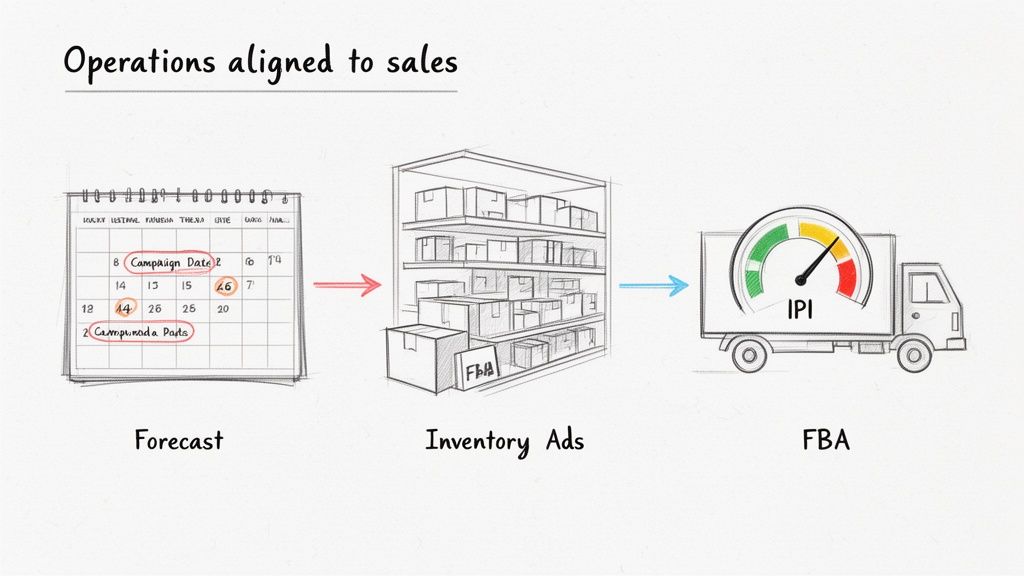
One of the most common and costly mistakes we see is brands running a massive ad campaign without checking their inventory levels first. Pouring ad spend into a product that only has a week of stock left is like setting money on fire. You’ll drive a huge sales spike, run out of stock, and completely waste the ranking momentum you just paid for.
Your advertising calendar and your inventory plan have to be perfectly in sync. Before you launch any major promotion or crank up your PPC budget, you need to ask:
- Do we have enough units to cover the projected sales lift for the next 30-60 days?
- Is our next shipment scheduled to land at the fulfillment center before we risk a stockout?
This synchronization is especially critical for big tentpole events. Getting it right for Prime Day can skyrocket sales, often doubling a brand’s baseline performance. But getting it wrong is just as dramatic—unprepared sellers can lose 30-50% of their potential revenue to stockouts during these peaks. Proactive management that aligns promotions with stock levels is how you turn a seasonal spike into sustained, year-round momentum. For a deeper dive, you can find more data by reading insights on Amazon’s sales performance and how top brands prepare.
By building a resilient operational foundation, you create a business that can not only handle growth but thrive on it. This alignment ensures every dollar you spend on marketing has the maximum possible impact, paving the way for profitable, long-term success.
Your Top Questions About Growing Amazon Sales, Answered
As you start putting these strategies into action—from optimizing your listings to tightening up your operations—you’re bound to hit some common roadblocks. Here are the answers to the questions we hear most often from brands getting serious about growth.
How Long Does It Take to See a Real Increase in Amazon Sales?
Everyone wants to know this, and the honest answer is: it depends, but you need to be in it for the long haul.
Sure, you can get quick wins. Tweaking a product title or launching a coupon might give you a nice little sales bump in as little as 30-60 days. But for a significant, sustainable increase in sales, you should plan on a 3-6 month runway.
Why so long? Because that’s the time it takes to gather enough meaningful data. You need performance metrics to properly optimize your ad campaigns, build social proof with customer reviews, and watch your organic search rankings start to climb.
Your specific timeline will hinge on a few key factors:
- Category Competitiveness: A brand in a niche space will see results faster than someone fighting giants in hyper-competitive categories like supplements or electronics.
- Budget Allocation: A more aggressive ad budget shortens the feedback loop, accelerating visibility and giving you data to work with much faster.
- Brand Authority: If you already have brand recognition, you’ll gain traction more easily than a completely new market entrant.
The key is consistency. Sporadic efforts get you sporadic results. It’s the sustained, multi-faceted approach that builds the momentum you need.
What Is a Good ACoS for My Amazon PPC Campaigns?
There’s no magic number here. A “good” Advertising Cost of Sale (ACoS) is completely tied to your product’s profit margins and your strategic goal at that moment. Stop chasing a universal number and start defining your target ACoS based on what you want to achieve.
A great starting point is calculating your break-even ACoS. If your product has a 30% profit margin before you factor in ad spend, then a 30% ACoS means you’re essentially getting that ad-driven sale for free.
From there, your target will shift based on your strategy:
- Launch Phase: For a new product, you might be perfectly happy with a sky-high ACoS (40-60% or more). The goal isn’t profit; it’s driving initial sales, generating reviews, and teaching the algorithm that your product is relevant.
- Growth Phase: For an established product, you’ll likely aim for a profitable ACoS, somewhere in the 15-25% range, to maximize your return on ad spend (ROAS).
The metric that matters most isn’t just ACoS; it’s your Total ACoS (TACoS). You calculate it as (Ad Spend ÷ Total Sales). TACoS shows you how advertising is impacting your entire business, not just the sales directly tied to an ad. If your TACoS is trending down over time, it’s a sign your ads are successfully lifting organic sales—and that’s the ultimate goal.
Should I Focus on Amazon SEO or PPC to Increase Sales?
This isn’t an either/or debate. It’s a “both, working together” strategy. Thinking of Amazon SEO (your listing optimization) and PPC as separate activities is one of the biggest mistakes sellers make. They are two sides of the same coin, and their real power is unlocked when they feed each other.
Think of Amazon SEO as your long-term foundation. It’s the unpaid, organic work that builds credibility and drives “free” traffic around the clock. A perfectly optimized listing is an asset that never stops working for you.
PPC advertising is your accelerator. It’s how you get immediate visibility, bypassing the slow climb up the organic rankings. You can instantly put your product at the top of page one for your most critical keywords.
The real magic happens when you create a flywheel effect. Use your PPC campaigns as a live research lab. The performance data from your ads—especially which keywords convert at the highest rate—is pure gold. Take those winning keywords and weave them back into your product title, bullet points, and backend search terms to strengthen your SEO.
PPC fuels the initial sales velocity that Amazon’s algorithm loves to see. Those ad-driven sales lead to more reviews and a stronger sales history, which in turn boosts your organic ranking. A better organic rank makes your PPC campaigns more efficient. It’s a self-reinforcing cycle of growth.
Ready to build a cohesive strategy that aligns your ads, content, and operations for maximum growth?
The team at Clickstera Solutions LLC has scaled over 100 brands by blending human expertise with data-driven insights.
Contact us today to discover how we can help you achieve better results.

One Response