
Loading article
Loading page...
A solid multi-channel marketing strategy is all about showing up on the platforms your customers already love, but it’s not about blasting the same message everywhere. It’s a smarter approach that optimizes each channel, whether it’s Amazon PPC, Google Ads, or Met,a to maximize your reach and give people different, compelling ways to connect with your brand.
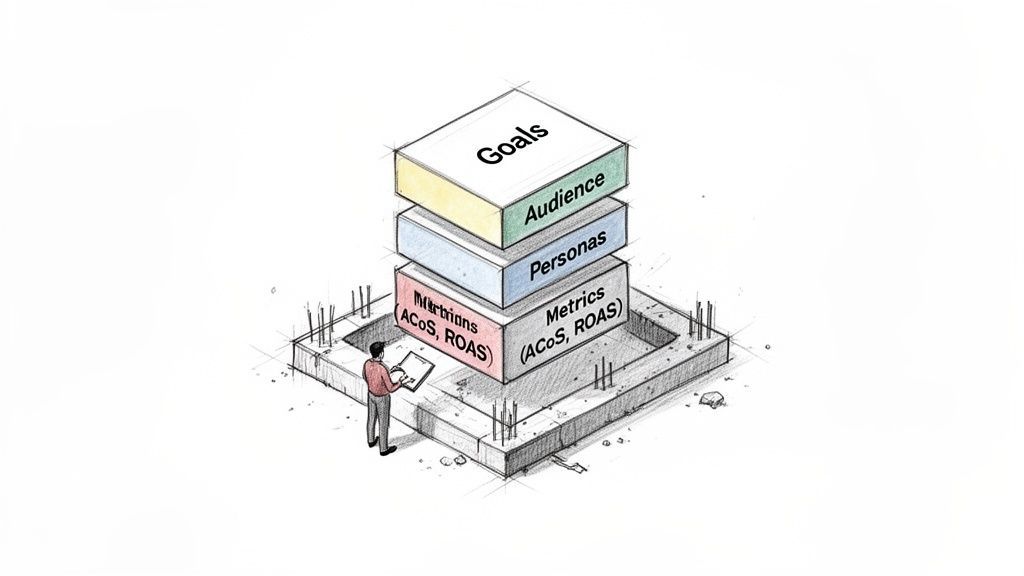
Before you even think about spending a single dollar on ads, you need a rock-solid foundation. The best marketplace brands know that a powerful multi-channel strategy isn’t just about being everywhere; it’s about being in the right places with the right message. This all starts with clear, measurable goals that go way beyond simple channel metrics.
Forget just aiming for a low Advertising Cost of Sale (ACoS) on Amazon. A real, foundational goal ties that metric to a bigger business objective. For example, your goal might be to grow market share in a key category by 5% within six months, using a target ACoS of 30% as a guardrail to keep you profitable. This simple shift ensures every marketing dollar you spend is directly tied to tangible business growth.
Setting the right goals is what keeps you from chasing vanity metrics that don’t actually move the needle. Every single campaign, keyword, and piece of creative should serve a specific purpose that rolls up to your main objectives. A mature multi-channel strategy relies on a clear hierarchy of goals that all work together.
Your foundational goals should look something like this:
When you structure your goals this way, optimizing your Amazon PPC bids is no longer an isolated task. It becomes a deliberate action that contributes directly to your larger market expansion goals. A well-defined foundation gives you the clarity to make smart budget and strategy decisions down the road. To get more granular on structuring these targets, check out these proven e-commerce growth strategies that connect marketing actions to bottom-line results.
The next critical layer of your foundation is a deep, almost obsessive understanding of your audience. The customer who’s scrolling through TikTok for product discovery is in a completely different headspace than the one typing a specific search into Amazon. A one-size-fits-all message is doomed to fail.
A common mistake is assuming your Amazon customer is the same as your Meta customer. The reality is that their intent, mindset, and expectations are completely different depending on the platform they’re on. Your strategy must reflect that nuance.
To build effective customer personas, you have to analyze the unique behaviors on each platform. An Amazon shopper usually has high purchase intent and is busy comparing prices and reviews. On the other hand, someone on Instagram might not be actively shopping at all but is open to discovering cool new products from brands that match their interests.
Let’s imagine you’re a brand selling premium coffee makers:
By mapping out these distinct personas, you can start tailoring your messaging, creative, and offers to what really resonates on each channel. This foundational work ensures your multi-channel strategy is built on a precise understanding of who you’re talking to and what they actually want to hear—dramatically increasing your chances of success.
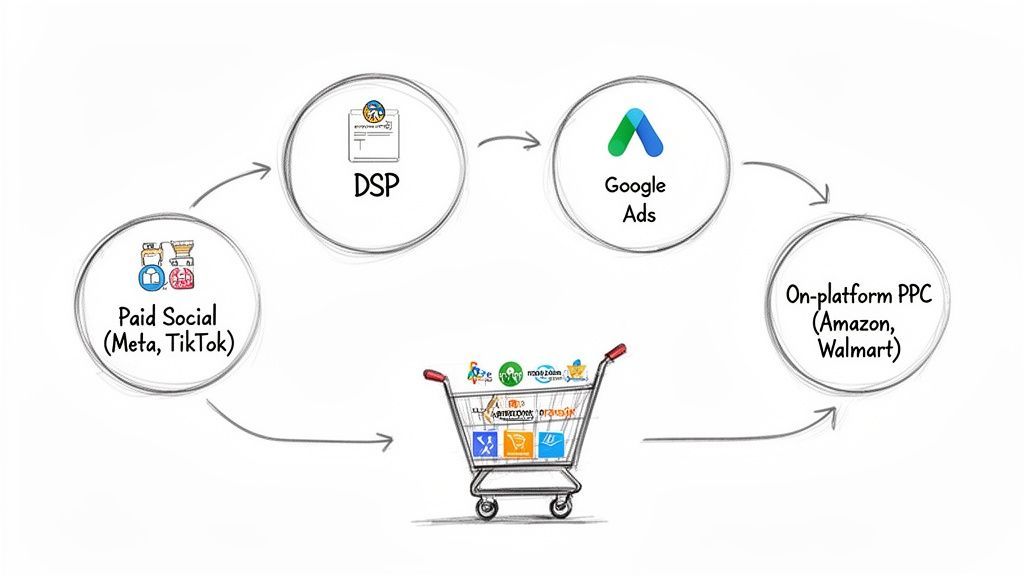
Now that you’ve pinned down your goals and audiences, it’s time to pick your channels. For a brand that lives and breathes on marketplaces, this isn’t about jumping on every popular platform. It’s about giving each channel a specific job to do and making sure they work in concert to funnel customers to your Amazon or Walmart listings.
A disconnected strategy, where your channels operate in silos, is just a fast track to wasted ad spend and a choppy customer journey.
Think of your channels like a relay team. Top-of-funnel platforms like Paid Social and Display Advertising (DSP) run the first leg of the race—they build awareness and introduce your brand to new audiences who aren’t even looking for you yet. Mid-funnel channels then retarget those curious shoppers, keeping you top of mind. Finally, your bottom-funnel powerhouses like on-platform PPC and Google Ads capture that pent-up demand right when someone is ready to pull out their wallet.
Building a cohesive multi channel marketing strategy means being intentional. You can’t expect your TikTok campaign to drive the same immediate, last-click sales as your Amazon Sponsored Products ads. Each channel has a different purpose, and if you measure them all with the same yardstick, you’re going to make some bad calls.
Here’s a practical look at what each channel should be doing for a marketplace-first brand:
The table below breaks down exactly how these channels fit together, mapping each one to a specific funnel stage, set of metrics, and audience type.
Channel
Primary Funnel Stage
Key Performance Indicators (KPIs)
Best For
Paid Social (Meta, TikTok)
Top of Funnel (Awareness)
Reach, Impressions, Video Views, Click-Through Rate (CTR)
Reaching new lookalike and interest-based audiences to build brand recognition.
Demand-Side Platform (DSP)
Top/Mid Funnel (Awareness & Consideration)
New-to-Brand Metrics, Add-to-Carts, Detail Page View Rate (DPVR)
Targeting in-market shoppers and retargeting engaged audiences across the web.
Google Ads (Search & Shopping)
Bottom of Funnel (Conversion)
Conversion Rate, Cost Per Acquisition (CPA), Return on Ad Spend (ROAS)
Capturing high-intent searchers actively looking for solutions you provide.
On-Platform PPC (Amazon/Walmart)
Bottom of Funnel (Conversion)
Advertising Cost of Sales (ACoS), Total ACoS (TACoS), Conversion Rate
Converting shoppers at the final point of purchase and defending brand position.
By defining these roles clearly, you ensure every ad dollar has a purpose, creating a system where each channel supports the others instead of competing with them.
Let’s walk through how this looks in the real world. Imagine you sell a high-performance blender.
This integrated flow makes sure every dollar serves a purpose, guiding the customer from “who are you?” to “take my money” without any friction. The numbers back this up, too. The multichannel marketing space is projected to hit $28.6 billion by 2030, and campaigns using at least four channels have been shown to outperform others by a staggering 300%.
If you want to dive deeper, check out these multichannel marketing trends and statistics to see just how critical this approach has become.
Running your paid media channels in disconnected silos is the fastest way to burn through your budget. A real multi channel marketing strategy isn’t just about being on Amazon, Google, and Meta; it’s about making them talk to each other. True orchestration creates a feedback loop where insights from one channel actively fuel the performance of another.
This synergy turns isolated campaigns into a coordinated effort that guides customers from discovery all the way to purchase. For example, the data you get from Google Search ads can uncover high-intent keywords you’re completely missing on Amazon. At the same time, audiences you build through Amazon DSP can be retargeted on paid social, creating a brand presence that feels both cohesive and persistent.
The heart of paid media orchestration is consistency. A customer who sees your ad on Facebook should get a familiar message and vibe when they later search for you on Amazon. When your messaging is all over the place, it creates a fractured experience and kills trust. A unified approach builds momentum.
Think about it from the customer’s point of view. They don’t see your marketing as separate “channels.” They just see your brand. A coordinated strategy ensures every touchpoint reinforces the same core promise, making the final decision to buy feel natural and inevitable.
Let’s walk through a real-world scenario. Imagine you sell premium, noise-canceling headphones.
In this setup, the two channels have distinct but complementary jobs. DSP plays offense to win new audiences, while Amazon PPC plays defense to protect and convert that interest. This is where the magic happens.
The most powerful multi-channel strategies are built on shared data. Insights should flow freely between platforms, creating a cycle of continuous improvement. The goal is to stop guessing and start making data-backed decisions across your entire media mix.
A classic example of this is the relationship between Google Ads and Amazon PPC. Your Google Search campaigns are a goldmine of customer intent. The search terms people use to find products like yours can—and should—directly inform your Amazon keyword strategy.
Don’t treat your channel data like it belongs to different companies. Your top-performing search query on Google is a direct signal of what a high-intent shopper wants. If you aren’t using that insight to inform your Amazon PPC bids, you’re leaving money on the table.
Here’s how you can build a simple but effective data feedback loop:
This process turns your Google ad spend into a research tool for your Amazon strategy, making sure your budget is focused on keywords with a proven track record.
In any modern multi-channel strategy, social media plays a central and vital role. It’s become the primary channel for discovery and engagement, directly influencing what people buy on marketplaces.
In fact, social media has emerged as the dominant multi-channel tactic, with 55% of marketing professionals reporting it has the biggest impact on their campaigns. On top of that, 91% of marketers now use social media as a core channel, which tells you everything you need to know. You can dig into these findings on multi channel marketing challenges for more detail.
For marketplace brands, this means platforms like Meta and TikTok are no longer just for brand awareness; they are powerful conversion drivers. The key is to use paid social to create a seamless journey—a shopper might discover your product in a TikTok video, get retargeted with an Instagram carousel ad, and then click a link that takes them straight to your Amazon page to buy. This flow meets customers where they are and gently guides them to conversion, making your entire paid media ecosystem more effective.
Executing a brilliant, cross-platform campaign is only half the battle. If you can’t prove that your TikTok ad drove a sale on Amazon, your entire strategy is built on guesswork, not data. This is where a lot of brands stumble—pouring money into channels without a clear picture of what’s actually moving the needle.
Connecting the dots between your off-marketplace ads and on-marketplace sales is the final, most critical piece of the puzzle. It requires a solid technical setup to track performance accurately and attribute conversions, turning murky data into clear, actionable insights.
This visualization breaks down how data from different platforms can work together to create a cohesive paid media strategy.
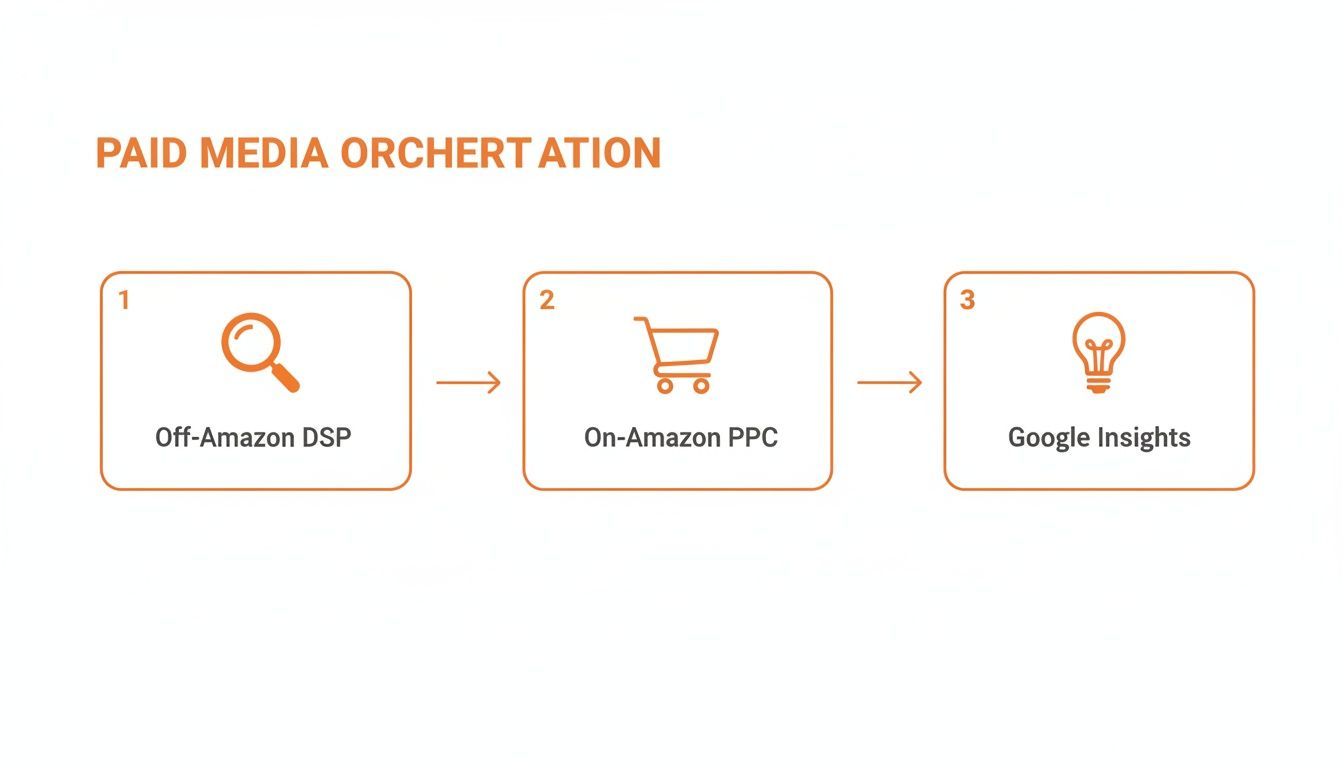
The flow here shows a key principle: insights from one channel, like Google, should directly fuel the tactics you use on others, like Amazon PPC and DSP. It’s all interconnected.
Before you can measure anything, you need the right tools locked in. For marketplace-first brands, the go-to stack is Google Analytics 4 (GA4) and Google Tag Manager (GTM). These two work in tandem to give you a centralized view of how users interact with your brand across the web before they land on your Amazon or Walmart page.
Setting up conversion tracking is non-negotiable. This means placing a small piece of code—a pixel or tag—from each ad platform onto your website. When someone clicks an ad and visits your site, that tag fires, sending data back to the ad platform and into GA4. This setup is the bedrock of effective attribution.
Attribution is just a fancy word for assigning credit. It’s the science of figuring out which marketing touchpoints get the credit for a sale. Without it, you might mistakenly give 100% of the credit to the last ad a customer clicked, completely ignoring all the other ads that warmed them up.
Choosing the right attribution model is like picking the right lens for a camera. A last-click model gives you a sharp but narrow view of the final action. A data-driven model provides a wider, more complete picture of the entire customer journey.
Let’s quickly break down the most common models you’ll encounter:
For any complex, multi-channel strategy, a data-driven model is almost always the right call. It helps you see how your awareness-focused DSP campaigns are assisting your conversion-focused Amazon PPC ads, allowing you to optimize your entire funnel, not just the final click.
Here’s the million-dollar question for marketplace sellers: how do you track a user who clicks a Google Ad but ends up converting on Amazon? For years, this was a frustrating black box. Thankfully, we finally have the tools to bridge this gap.
Amazon Attribution is a free tool that lets you create special tracking links for all your off-Amazon marketing—whether it’s Google Ads, Meta campaigns, or even email newsletters. When a shopper clicks one of these links and later buys something on Amazon, the sale gets credited back to the right source campaign.
This finally gives you the hard data you need to see exactly which of your off-Amazon channels are driving real, measurable sales. You can learn more about getting this dialed in with this complete guide to Amazon Attribution, the missing link between your ads and Amazon sales. This tool closes the loop, empowering you to confidently invest in top-of-funnel channels, knowing you can measure their direct impact on your marketplace revenue.
A perfectly executed, high-budget marketing campaign is a beautiful thing—until you run out of stock.
Even the most brilliant multi-channel marketing strategy will completely fall apart if your backend operations can’t keep up with the demand you’ve just created. This is where the slick marketing plan slams into the hard realities of inventory, fulfillment, and customer service.
When your ads are firing on all cylinders, the very last thing you want is a stockout on your top-selling SKU. It doesn’t just kill your sales momentum; it actively damages your marketplace ranking and evaporates customer trust. A sudden halt in sales can absolutely tank your Best Seller Rank (BSR) on Amazon, making it far harder and more expensive to claw your way back up once you’re in stock again.
Great inventory management is proactive, not reactive. It means your promotional calendar and your supply chain need to be in constant communication. A disconnect here is a recipe for disaster, especially during crunch time like Prime Day or the holiday season. You have to anticipate the demand your marketing is about to generate.
For example, if you’re planning a major push with Meta ads and an Amazon DSP campaign for a specific product, your inventory plan has to reflect that projected sales lift. Don’t just look at historical sales data; you need to layer your marketing forecast directly on top of it.
Your operational checklist should look something like this:
This kind of alignment prevents the soul-crushing mistake of spending ad dollars to drive excited customers to a product page that screams, “Currently unavailable.”
Your multi-channel strategy doesn’t end when a customer clicks “buy.” The experience that follows—from shipping to customer support—is just as crucial, if not more so. A customer who discovers your brand through a polished Instagram ad expects that same level of quality and care when their order from Walmart arrives.
Inconsistency erodes brand equity. Fast. If a customer has a great interaction on one channel but a poor one on another, the negative experience will almost always win out. It’s not just a feeling; studies have shown that a consistent brand presentation across all platforms can increase revenue by up to 23%. This consistency has to extend beyond your ads and into every single operational touchpoint.
Your brand is not just what you say in your ads; it’s the sum of every interaction a customer has with you. A seamless operational experience is one of the most powerful, yet often overlooked, parts of your marketing.
Imagine a customer buys your product on Amazon after seeing a TikTok video. If they have a question and reach out to your customer service, that team needs to be equipped to handle inquiries from any sales channel. They should be able to pull up order information regardless of where the purchase happened and provide the same friendly, helpful tone your brand projects online.
This unified approach ensures a customer’s journey is smooth, from their first ad impression to their post-purchase support ticket. It reinforces the promises your marketing makes, building the kind of long-term loyalty that turns one-time buyers into repeat customers and brand advocates. When you align your operations with your marketing, you’re not just selling a product; you’re building a resilient business that can actually handle success.
Navigating a multi-channel world is bound to bring up questions. Even the most experienced marketing teams get tripped up on the finer points of budget splits, channel selection, and the classic mistakes everyone seems to make. Let’s tackle some of the most common challenges brands run into when trying to build an integrated strategy.
Getting these fundamentals right ensures your multi channel marketing strategy is built on solid ground, ready to adapt and scale.
A smart place to start is with a 70/30 split. Plan on putting roughly 70% of your budget into bottom-of-the-funnel, high-intent channels. Think Amazon PPC, Walmart Ads, and Google Search. These are your workhorses, designed to capture demand that’s already there.
The other 30% should be invested in top-of-funnel channels built for awareness and discovery. This is where Meta, TikTok, and DSP campaigns come in. This slice of your budget is for planting seeds—introducing your brand to new audiences who will become tomorrow’s customers.
But here’s the key: don’t get stuck in a rigid allocation. Your initial split is a hypothesis, not a permanent rule. The real magic happens when you use data to constantly adjust your investments based on what’s actually working.
Once data starts rolling in from tools like Amazon Attribution, you can see which top-funnel channels are assisting conversions. If your TikTok ads are consistently bringing in new-to-brand customers who later convert through a branded search on Amazon, that’s a huge signal to double down. Your budget should be fluid, always guided by performance.
The single most damaging—and common—mistake is running marketing channels in complete isolation. It’s a classic symptom of siloed teams or agencies. The Amazon team has its goals, the social media team has theirs, and nobody is sharing data or strategy.
This disconnect creates a fragmented customer experience and wastes a massive amount of money. For instance, the social team might be driving traffic with a “20% Off” promotion while the Amazon ads are pushing a “Buy One, Get One” offer. It creates confusion, erodes trust, and kills conversion rates.
Real success comes from integration. Insights from one channel have to inform the strategy for another. When your Google Ads data helps you find winning keywords for Amazon, and your DSP audience segments are used for retargeting on Meta, you create a powerful synergy that makes every dollar you spend work harder.
For most brands that started on marketplaces, Paid Social (specifically Meta Ads) is the perfect entry point. Its sophisticated audience targeting gives you a powerful and relatively low-barrier way to dip your toes into off-marketplace advertising.
Right away, you can start building custom audiences and retargeting shoppers who visited your Amazon or Walmart pages but didn’t pull the trigger. It’s a simple, effective way to stay top-of-mind and guide them back to complete the purchase.
Starting with Meta provides a strong foundation for proving the concept. Once you’ve established a positive return there, you can expand into more complex channels like DSP or a broader Google Ads strategy with confidence.
Ready to stop guessing and start orchestrating a winning multi-channel strategy?
The team at Clickstera Solutions LLC blends expert management with data-driven insights to scale marketplace brands profitably.
Get in touch today to see how we can help you grow.
Talk to Clickstera and get a clear next-step plan to scale your performance marketing.