Loading article
Loading page...
Think of your Amazon Advertising Cost of Sales (ACOS) as the answer to one simple question: "For every dollar my ads generate, how much did I have to spend to earn it?"
In short, ACOS is a percentage that shows you exactly how efficient your advertising is. It’s the single most important metric for understanding the health of your Amazon PPC campaigns.
To get a real feel for ACOS, it helps to think of it as a "sales commission" you pay directly to Amazon. Every time a shopper clicks your ad and buys your product, a slice of that sale goes back to cover the ad cost. This one metric tells you, almost instantly, whether your campaigns are fueling profitable growth or just burning cash.
The calculation itself is refreshingly simple. You just take your total ad spend and divide it by the total sales your ads generated.
ACoS Formula: (Ad Spend ÷ Ad-Generated Sales) x 100
Let's say you sell high-end kitchen knives and decide to run a Sponsored Products campaign. You spend $100 on ads over a week. In that same timeframe, those ads directly bring in $400 in sales.
Plugging that into the formula:
What this means is that for every dollar you made from advertising, you spent 25 cents to get it. This percentage now becomes the compass for your entire Amazon PPC strategy, guiding every decision from keyword bids to your overall budget.
Getting a firm grip on your ACOS is the first real step toward scaling your ad efforts without breaking the bank. It creates a universal benchmark, allowing you to compare the performance of different campaigns, ad groups, and even individual keywords. Without it, you’re flying blind—unable to tell the difference between a profitable move and a costly mistake.
Of course, ACOS isn't static. It fluctuates based on competition and seasonality. Industry-wide, ACOS on Amazon typically hovers between 25% and 36%. You'll often see spikes around 29.89% during big shopping events like April's spring sales or the November Black Friday rush. On the flip side, things can quiet down to a yearly low in October. You can dive deeper into these trends with Amazon advertising stats from Ad Badger. Knowing these patterns helps you set realistic goals and adjust your strategy accordingly.
Understanding your ACOS is one thing, but knowing your break-even ACOS is what separates hopeful sellers from profitable ones. This single number is your ultimate financial guardrail—it tells you the absolute highest ACOS you can sustain before a campaign starts losing you money.
Think of it as the ceiling for your ad spend. Any ACOS below this number means your ad-generated sales are profitable. But the moment your ACOS creeps above it, every ad-driven sale is actively costing you money.
The good news is that this isn't a guess. It's a precise calculation grounded in your product's actual economics, and getting it right is the key to advertising with confidence.
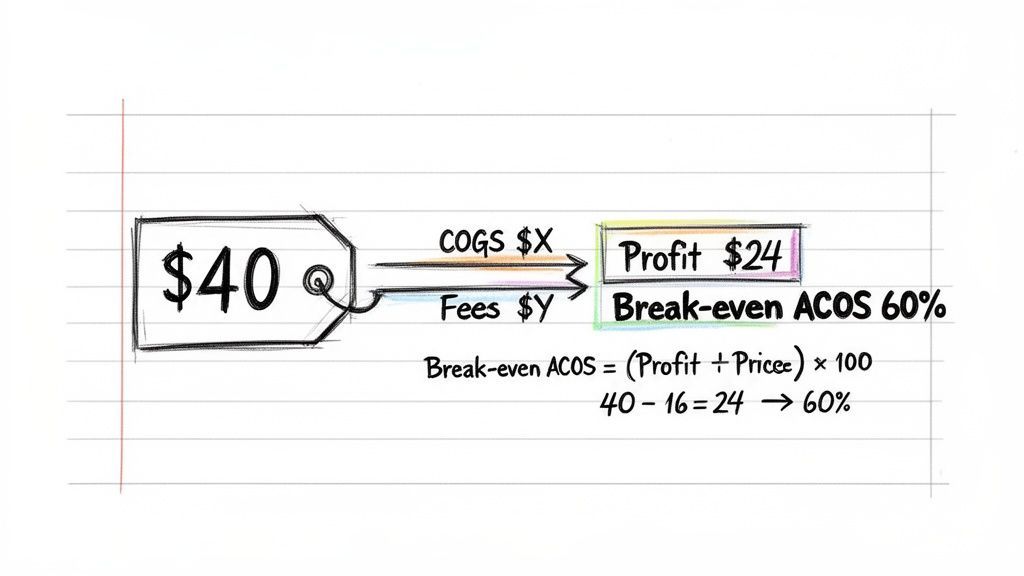
To find your break-even ACOS, you first need to figure out your product’s pre-ad profit margin. This is simply the money you have left from a sale after covering all costs except for advertising.
This leftover profit is the maximum amount you can afford to spend on ads to get that sale without going into the red. Here’s how you find it:
The number you’re left with is your pre-ad profit. When you express that profit as a percentage of your retail price, you’ve found your break-even ACOS.
Your Pre-Ad Profit Margin = Your Break-Even ACOS
This is your baseline. For a product with a 40% profit margin, the break-even ACOS is 40%. Anything below that is net profit. To build a healthy buffer for other business costs, most experts suggest targeting an ACOS that's 10-20% lower than your break-even point. You can learn more about effective ACOS targets on Headline Marketing.
Let's walk through this with a hypothetical supplement product to see how the numbers come together.
Metric
Amount
Calculation/Notes
Retail Price
$40.00
The price the customer pays on Amazon.
Cost of Goods Sold (COGS)
($8.00)
Includes manufacturing, ingredients, and packaging.
Amazon Fees
($8.00)
Includes referral fee (15%) and FBA fulfillment fee.
Pre-Ad Profit
$24.00
$40.00 – $8.00 – $8.00
Break-Even ACOS
60%
($24.00 Profit / $40.00 Price) x 100
As you can see, the final calculation is straightforward. In this scenario, your break-even ACOS is 60%. This means you can spend up to 60 cents on advertising for every dollar of ad-driven revenue and still not lose money on that specific sale.
Mastering this calculation empowers you to run campaigns with total confidence, knowing exactly where your profitability line is drawn.
One of the first questions sellers ask is, "What's a good ACOS on Amazon?" The only honest answer? It depends entirely on what you're trying to achieve with that specific product, right now. Applying a single, static ACOS target across your whole catalog is a surefire way to miss opportunities and burn through your budget.
A much smarter approach is dynamic, aligning your ad spend with where a product is in its lifecycle. Your goals for a brand-new launch are completely different from those for a category leader, and your ACOS targets need to reflect that reality.
When you first launch a product, your main goal isn't profit—it's momentum. You’re fighting for those first eyeballs, critical early reviews, and a foothold in Amazon’s search rankings. During this stage, your ad campaigns are an investment in data and market share, not a direct profit-maker.
For that reason, a high ACOS isn't just okay; it's often necessary.
Think of it like buying a billboard in Times Square. The immediate return won't cover the cost, but the brand awareness and market penetration it builds are priceless. In this phase, every sale you drive with ads helps prove your product’s worth to Amazon's algorithm.
Once your product has a steady sales flow, a handful of good reviews, and some organic ranking, your strategy has to shift. You’re no longer just shouting to be noticed; you’re now focused on scaling your sales as efficiently as you can. The mission is to capture as much market share as possible while keeping your margins healthy.
This is where your ACOS needs to get more disciplined. You’ll start pulling back from the aggressive spending of the launch and double down on the campaigns that are actually converting.
During the growth stage, your focus shifts from "sales at any cost" to "profitable, scalable growth." Your ACOS should be high enough to fuel expansion but low enough to protect your bottom line.
Here’s what you should be aiming for:
After a product is well-established, has a strong sales history, and holds a top organic spot for its main keywords, the advertising game changes again. By now, it has a powerful organic presence that brings in sales without you spending a dime. At this point, the role of PPC is to defend your turf and maximize profit.
Your ACOS target should be much lower, focusing only on the most profitable, high-converting keywords. The goal is no longer growth but pure efficiency. You're harvesting the rewards from the investments made during the launch and growth phases.
By tailoring your ACOS on Amazon to each product's unique stage, you turn it from a simple metric into a powerful strategic lever. This ensures every ad dollar is working toward the right objective at the right time.
Relying solely on ACOS is a bit like driving a car while only looking at the speedometer. It tells you your current speed—how efficiently your ads are converting right now—but it doesn't give you the full picture of your journey or your overall engine health. To truly understand your advertising performance, you need to look at a broader set of gauges.
This is where two complementary metrics come into play: Total Advertising Cost of Sales (TACoS) and Return on Ad Spend (ROAS). Together with ACOS, they provide a complete, three-dimensional view of your brand’s growth on Amazon.
This chart shows how your ACOS goals should evolve as your product moves from launch to maturity.
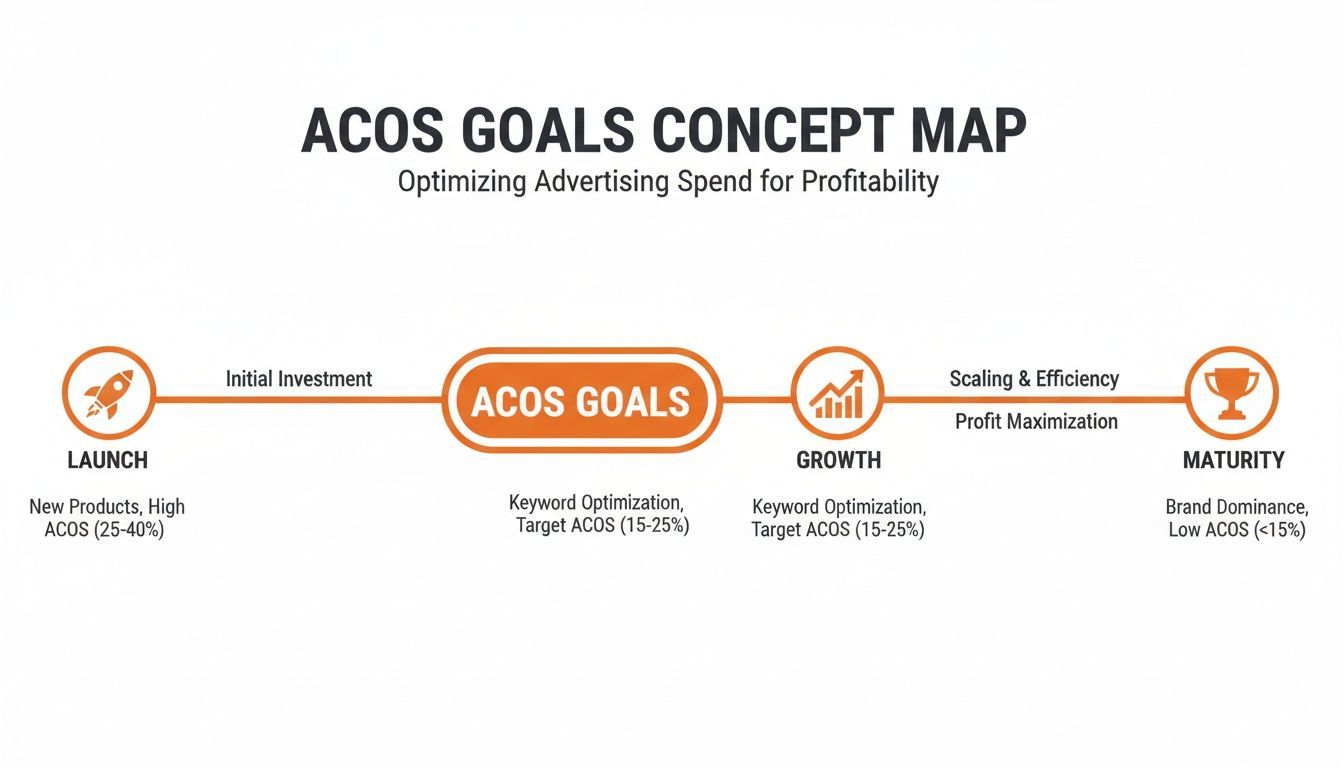
As you can see, a high ACOS isn't always a bad thing. It's often a strategic investment during a product launch. That goal shifts towards a balance during the growth phase and finally prioritizes pure profitability once your product is mature.
Total Advertising Cost of Sales (TACoS) zooms out to measure the relationship between your ad spend and your total sales revenue, which includes both ad-driven and organic sales. It answers a much more profound question than ACOS: "How much am I spending on ads as a percentage of my entire Amazon business?"
The formula is straightforward:
TACoS Formula: (Ad Spend ÷ Total Sales) x 100
Imagine your brand has a steady ACOS of 25%. On its own, that seems fine. But if your TACoS is simultaneously decreasing month after month, something incredible is happening. It means your advertising is successfully boosting your organic sales—the Amazon flywheel is spinning in your favor.
A falling TACoS is a clear sign that your ads are creating a "halo effect," improving your product's organic rank and driving sales that you don't have to pay for directly. This is the ultimate goal of any mature advertising strategy.
While ACOS and TACoS focus on cost, Return on Ad Spend (ROAS) flips the script to focus on revenue. It’s the direct inverse of ACOS and tells you exactly how many dollars you earn for every single dollar you spend on advertising.
It’s calculated simply:
ROAS Formula: Ad-Generated Sales ÷ Ad Spend
For instance, if you spend $100 on ads and generate $400 in sales, your ACOS is 25%. Your ROAS would be 4 ($400 / $100), meaning you earned $4 for every $1 spent.
ROAS is often a more intuitive metric for stakeholders and leadership because it speaks the language of investment returns, not just costs. Presenting a ROAS of 4x sounds much more powerful than a 25% cost, even though they represent the exact same performance.
These three metrics tell a complete story when you analyze them together. They let you diagnose your advertising health with precision and make smarter strategic decisions.
Here’s a quick-reference table to clarify how they differ and what they tell you.
Metric
Formula
Primary Business Question
ACOS
(Ad Spend ÷ Ad Sales) x 100
How efficient are my individual ad campaigns?
TACoS
(Ad Spend ÷ Total Sales) x 100
Are my ads driving overall, sustainable business growth?
ROAS
Ad Sales ÷ Ad Spend
What is the direct revenue return on my ad investment?
A brand might accept a high ACOS during a product launch if it leads to a lower TACoS over time, proving the initial investment is building long-term organic strength. At the same time, they can report a positive ROAS to show that even with aggressive spending, the campaigns are generating more revenue than they cost.
By moving beyond ACOS, you shift from simply managing ad costs to strategically investing in your brand’s total Amazon presence.
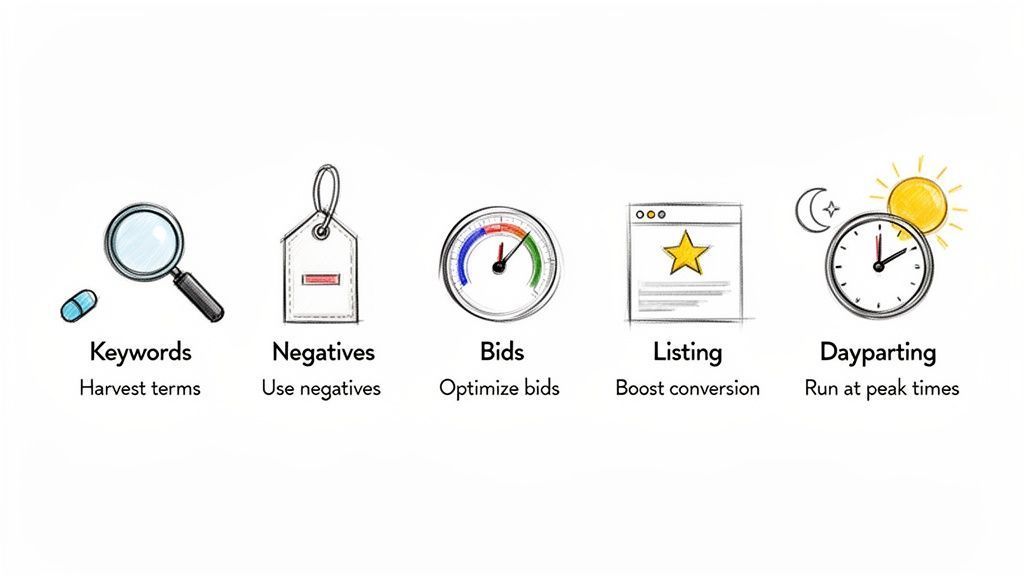
Knowing your target ACOS is one thing, but actually hitting it requires a solid, actionable game plan. Lowering your ACOS isn't about blindly slashing your ad budget; it's about making every single dollar you spend work smarter and harder for you.
Think of it like tuning a high-performance engine. You're not just slamming the gas pedal; you're making precise adjustments to multiple components to get more power and efficiency out of the fuel you use. This means cutting out the waste, dialing in your targeting, and boosting your conversion rates. Let's get into five proven strategies that will give you a clear roadmap to a more profitable advertising machine.
Your keyword strategy is the absolute foundation of your entire PPC performance. Nearly all wasted ad spend can be traced back to targeting the wrong search terms. The goal here is simple: focus your budget only on keywords that have a high probability of converting into a sale.
A two-pronged attack works best. First, get into the habit of digging through your Search Term Report to "harvest" high-performing customer searches and add them as exact match keywords. These are your proven winners. Second, you need to be relentless with negative keywords.
An effective negative keyword strategy is like a filter, stopping your ads from showing up for irrelevant searches that just drain your budget without ever leading to a sale. This is the fastest way to cut wasted spend.
For example, if you sell premium leather boots, you should immediately add terms like "vegan," "cheap," or "repair" to your negative keyword list. This simple move stops you from paying for clicks from shoppers who aren't looking for what you sell, which will instantly start improving your ACOS.
Your bidding strategy is the lever that directly controls how much you pay per click (CPC), a critical piece of the ACOS puzzle. "Set it and forget it" is a recipe for burning cash. Instead, you need a dynamic approach that adapts to real-time performance.
A great starting point is using Amazon's dynamic bidding options. The "Down only" setting is a safe bet for most, as Amazon will automatically lower your bids on clicks that are less likely to convert. "Up and down" can be powerful for aggressive growth, but you have to watch it closely to make sure it doesn't inflate your ACOS.
Beyond that, you need to use placement modifiers. If you see in your reports that your ads are converting exceptionally well at the "Top of search" or on "Product pages," you can increase your bids for just those spots. This focuses your ad spend exactly where it's getting the best return, helping you drive down your overall ACOS.
Remember, ACOS is a function of both ad spend and ad sales. You can lower it not just by spending less, but by selling more from the same number of clicks. Your product detail page is your final sales pitch, and a poor conversion rate will kill even the most brilliant ad campaign.
A high-quality listing builds the trust and confidence needed to make a purchase, which drives your ACOS down. Focus on these key elements:
When your listing is optimized, more of the shoppers who click your ad will actually buy something. This increases your ad sales from the same spend, directly lowering your ACOS.
Beyond just keywords, Sponsored Display and Sponsored Brands ads let you target specific audiences. This is a massive opportunity to reach highly relevant shoppers and cut down on spend from unqualified clicks. Instead of just showing your ad to anyone who types in a keyword, you can get much more precise.
For instance, you can retarget shoppers who have viewed your product detail page but didn't buy. This audience has already shown interest, making them far more likely to convert than someone seeing your brand for the first time. You can also target audiences based on their shopping habits, like people who have bought from a competitor or are browsing in a related category.
By layering audience targeting onto your campaigns, you make sure your ad budget is being spent on shoppers who are primed to be interested in your products, leading to a much more efficient ACOS.
Not all hours of the day are created equal for sales. Your customers almost certainly have specific shopping patterns, often buying more in the evenings or over the weekend. Dayparting is the tactic of scheduling your ads to run only during these peak conversion windows.
By analyzing your hourly sales data, you can pinpoint the times when your conversion rates are at their highest. By pausing your campaigns or lowering bids during the slow, low-converting hours (like 2 AM to 6 AM), you save your budget for the times it will have the biggest impact.
This ensures you have enough budget to stay competitive during peak traffic periods when shoppers are most active and ready to pull out their credit cards. It’s another powerful lever you can pull to stop wasting money on clicks that are less likely to convert and drive down your ACOS.
Once you’ve done the math on your break-even point and mapped out your goals, the real work begins. Managing ACOS day-to-day is where the theory hits the pavement, and it's rarely a smooth ride.
This is where the most common (and frustrating) questions pop up. Let's tackle them head-on with clear answers to help you navigate the tricky situations that always come up.
This is one of the most maddening scenarios for any Amazon advertiser. You've been careful, setting low bids to keep your ad spend in check, but your ACOS is still through the roof. It feels like a puzzle with a missing piece, but the culprit is almost always the same: a low conversion rate.
Think of ACOS as a simple seesaw. On one side, you have your cost-per-click (CPC), and on the other, your conversion rate. Low bids can keep your CPC down, but they’re powerless against a product page that isn't convincing shoppers to actually buy.
Let's say you get 100 clicks on an ad for your $40 product.
When your ACOS is high but your bids are low, the problem isn't your ads—it's your listing. A weak conversion rate means you're just paying for window shoppers, making a profitable ACOS impossible to achieve.
Stop tweaking your bids and start auditing your product detail page. Look at your main image, title, bullet points, and A+ Content. Most importantly, check your customer reviews. A low star rating or a lack of social proof is often the single biggest reason shoppers click away without buying.
Optimizing your ACOS isn't a "set it and forget it" task—it's a constant process. But reacting too quickly can be just as bad as doing nothing at all. Amazon's attribution data can take up to 72 hours to fully populate, so making daily, knee-jerk changes based on partial data is a recipe for chasing your own tail.
The key is to find a rhythm. A structured, two-tiered schedule lets you be responsive without outsmarting yourself.
The Weekly Tactical Check-in: Once a week, get into your Search Term Reports. This is your time to hunt down and negate irrelevant search terms that are bleeding your budget dry. You can also make small, smart bid adjustments on your top keywords based on a full seven days of reliable data.
The Monthly Strategic Overview: Once a month, zoom out. How are your campaigns performing against your overall goals? This is when you make bigger moves, like shifting budget from underperforming campaigns to your proven winners or adjusting your strategy as a product moves from its launch phase into a growth phase.
This disciplined approach ensures you’re making decisions based on solid data, not panic. It keeps you from over-managing your campaigns into the ground.
It sounds crazy, but yes—your ACOS can absolutely be too low. A super-low ACOS of, say, under 10% looks fantastic on a report and makes you feel like a profitability genius. But it can also be a massive red flag.
Often, it means your campaigns are running so lean that you're leaving a huge amount of potential sales on the table.
A hyper-efficient ACOS usually comes from bidding only on a tiny handful of exact-match, slam-dunk keywords—probably including your own brand name. While that’s profitable, it's also incredibly restrictive. You're completely invisible to the much larger audience of shoppers who are using broader, discovery-focused terms to find products like yours.
Think of it like this: you're fishing in a tiny, well-stocked pond. You’ll catch fish easily (low ACOS), but you’re missing out on the massive lake full of new opportunities just over the hill. By refusing to bid on keywords that aren't a guaranteed win, you sacrifice sales volume and market share for the sake of extreme efficiency.
For products in their launch or growth stages, a rock-bottom ACOS is especially dangerous. It starves them of the visibility they need to build sales momentum and climb the organic rankings. The perfect ACOS isn't the lowest number you can get; it's the number that aligns with your real goal, whether that's maximizing profit, driving aggressive growth, or launching a new product with a bang.
Ready to stop guessing and start scaling your Amazon advertising with a proven strategy? Clickstera Solutions LLC offers full-service account management that aligns every aspect of your marketplace presence—from advanced PPC campaigns to conversion-focused creative. Let our team of experts build a profitable growth plan for your brand. Schedule your free consultation with Clickstera today and see what a performance-driven partner can do for you.
Talk to Clickstera and get a clear next-step plan to scale your performance marketing.