Loading article
Loading page...
Figuring out your Amazon advertising costs isn't as simple as finding a single magic number. It's more like stepping into a dynamic auction where prices are always in flux. On average, you can expect to pay anywhere from $0.80 to over $2.50 per click, but that number is heavily influenced by your product category, how fierce the competition is, and the strategy you bring to the table.
Think of Amazon advertising costs like the price of gas—it changes daily based on supply and demand. But instead of oil, the commodities are keywords and ad placements. Your goal isn't just to buy ads; it's to invest in clicks that turn into profitable sales. Getting a grip on the core metrics is the first step to making your budget work for you, not against you.
The entire Amazon Ads ecosystem is built on a handful of key performance indicators (KPIs). These aren't just industry jargon; they are the dials and gauges you'll use to steer your campaigns toward profitability. If you're serious about growing on Amazon, mastering them is non-negotiable.
Every dollar you put into Amazon ads is measured through one of these lenses. Each one tells a slightly different part of your performance story.
This infographic breaks down these fundamental metrics that define your Amazon advertising costs.
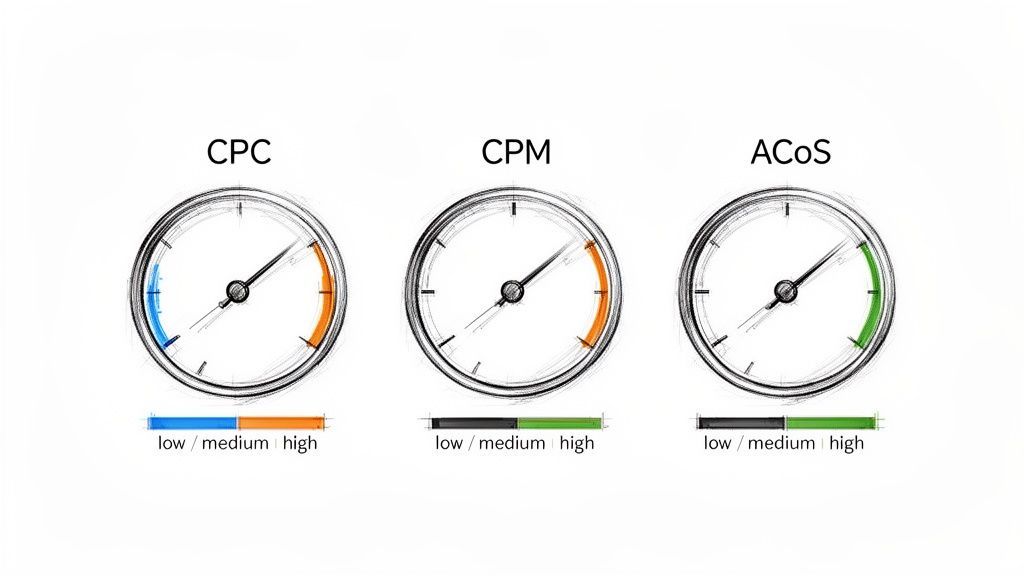
As you can see, CPC measures the cost of direct interaction, CPM tracks your exposure, and ACoS is the ultimate bottom-line metric connecting ad spend directly to revenue.
To give you a clearer picture, here’s a quick summary of these essential metrics and what you can generally expect to see in the wild.
Metric
What It Measures
Typical Benchmark Range
Cost-Per-Click (CPC)
The cost for a single click on your ad.
$0.75 – $3.00
Cost-Per-Mille (CPM)
The cost for 1,000 ad impressions (views).
$5.00 – $38.00
Advertising Cost of Sale (ACoS)
Ad spend as a percentage of ad revenue.
15% – 35%
These benchmarks can vary quite a bit depending on your category, but they provide a solid starting point for evaluating your own campaign performance.
Let's be blunt: competition on Amazon is tougher than ever, and that has a direct impact on how much you need to invest. Recent data shows the average CPC on Amazon Ads has climbed to $1.12, which is a 15.5% jump from the previous year. This surge underscores just how crowded the marketplace has become, forcing sellers to be much smarter with their bidding strategies if they want to scale. You can dig deeper into these advertising statistics to understand current market trends.
Your break-even ACoS is your financial North Star. It’s the highest ACoS you can sustain without losing money on a sale. Knowing this number—calculated from your product's profit margin—is the difference between guessing and making data-driven budgeting decisions.
Ultimately, your costs are a direct reflection of your strategy and the market you're playing in. By understanding these core concepts, you can move from simply spending money to making calculated investments that actually fuel your growth.
How you spend your ad budget matters just as much as how much you spend. Think of Amazon's ad formats like a specialized toolbox—each tool is built for a specific job. Trying to hammer a nail with a screwdriver is not just inefficient; it's a surefire way to waste money.
Each ad type comes with its own purpose and cost structure, designed to hit different business goals. Getting a handle on these differences is the first step to building a smart campaign portfolio that drives immediate sales and builds long-term brand equity without burning through your cash.
Sponsored Products are the power drills of your advertising arsenal. They have one clear mission: drive direct sales by targeting shoppers who are already deep in the buying cycle. These ads pop up right in the search results and on product detail pages, making them perfect for snagging customers the moment they’re ready to pull the trigger.
Because the goal is conversion, they run on a Cost-Per-Click (CPC) model. You only pay when a shopper is interested enough to click. This makes them incredibly efficient for product launches, clearing out old inventory, or just pushing sales for your bestsellers. On average, expect the CPC for Sponsored Products to be somewhere between $0.81 and $1.30, but watch out—this can swing wildly depending on how competitive your keywords are.
If Sponsored Products are your power drill, Sponsored Brands are your broad-stroke paint roller. These ads are all about building brand awareness and grabbing attention at the very top of the search results page. They feature your logo, a custom headline, and a collection of your products, essentially acting as a digital storefront billboard.
These ads also use a CPC model but tend to cost more, typically ranging from $1.10 to $2.50 per click. You're paying a premium for that prime real estate and creative control, but it’s worth it to establish brand recognition and funnel traffic to your Amazon Store. They’re ideal for any brand trying to carve out a dominant spot in its category.
For a deeper dive into driving traffic to your listings, you can learn more about how to use Google Ads to support your Amazon strategy in our related guides.
Sponsored Display ads are the precision screwdrivers in your toolkit. Their real power is their ability to reach shoppers both on and off Amazon based on their past browsing behavior. This makes them a killer tool for retargeting customers who checked out your product but didn't buy, or for targeting audiences interested in similar categories.
This ad type gives you flexible pricing, running on either a CPC or a Cost-Per-Mille (vCPM) model, where you pay for every 1,000 viewable impressions. This dual-cost structure lets you tailor campaigns to different goals:
Sponsored Display campaigns let you follow up with warm leads across their entire digital journey. A shopper who browsed your coffee makers on Amazon might see your ad an hour later while reading a news article. This keeps your brand top-of-mind and gently pulls them back to finish the purchase.
By strategically spreading your budget across these three core ad types, you create a balanced attack. You can drive sales now with Sponsored Products, build lasting brand memory with Sponsored Brands, and recapture lost opportunities with Sponsored Display. This multi-pronged strategy ensures every dollar is working as hard as possible to hit your goals.
Ever feel like you’re wrestling with your Amazon ad costs? One week your campaigns are humming along, and the next, your spend spikes for no clear reason. It’s a common frustration, but the problem often isn’t your bids. It’s the invisible forces working behind the scenes.
Getting a handle on these dynamics is like being a detective for your own ad account. A sharp investigator looks past the obvious suspect, and a smart advertiser learns to see beyond the bid to find the real drivers of high costs. Let’s pull back the curtain on the factors that have the biggest impact on your bottom line.
Think of the Amazon marketplace like real estate. Bidding on a popular, high-volume keyword like "organic supplements" in the fiercely competitive Health & Personal Care category is like trying to rent a storefront in Times Square. The rent—or in this case, the Cost-Per-Click (CPC)—is going to be sky-high because everyone wants that prime real estate.
On the other hand, a niche keyword for a specific industrial part is more like a warehouse in a quiet suburb. It gets less foot traffic, but with minimal competition, the cost to advertise there is significantly lower. It’s the simple law of supply and demand: the more sellers fighting for the same eyeballs, the more you'll pay for every click.
This is especially true as more brands flood the platform. Mid-market and emerging consumer brands, particularly in hot categories like beauty and electronics, are pouring money into Amazon PPC. They’re all chasing the same high-intent shoppers—64% of whom start their product searches right on Amazon. To stay profitable, sellers often need to aim for an ACoS between 25-36%, a moving target that shifts with market demand. You can explore more about these critical Amazon advertising statistics to see how your own category measures up.
Your ad costs don’t exist in a bubble; they rise and fall with the retail calendar. Predictable events can send costs soaring.
Think of ad placement like seating at a concert. A front-row seat (top-of-search) gives you the best view and experience, but it comes at a much higher price than a seat in the back row (bottom of the page). Both get you into the show, but the impact and cost are worlds apart.
Finally, there’s a factor that’s often overlooked but is entirely within your control: your product listing quality. Amazon's algorithm doesn't just look at how much you're willing to pay. It also judges how relevant and well-built your listing is to decide your ad's rank and cost.
A clean, well-optimized product detail page—with crisp images, relevant keywords in the title and bullets, and strong customer reviews—acts like a good credit score. It signals to Amazon that your product is a great match for a customer’s search, which can earn you a better ad position at a lower cost. A weak listing, however, gets penalized, forcing you to bid higher just to get the same visibility. This makes optimizing your listing not just a conversion tactic, but a critical cost-control strategy.

Trying to set an ad budget without knowing your numbers can feel like throwing darts in the dark. A truly effective budget isn't a guess; it's a strategic calculation anchored in one critical figure: your product’s profit margin.
Making the switch from random spending to a data-driven approach is the single most important step you can take. It’s how you ensure your ads are actually building your business, not just draining your bank account.
The foundation of any profitable ad strategy is understanding your break-even point. Before you spend a single dollar on a click, you have to know exactly how much you can afford to acquire a customer without losing money. This is where your break-even Advertising Cost of Sale (ACoS) comes in.
Think of your break-even ACoS as your financial North Star. It’s the absolute maximum percentage of a sale you can spend on advertising before a transaction turns unprofitable. Figuring it out is simpler than you think and starts with your pre-ad profit margin.
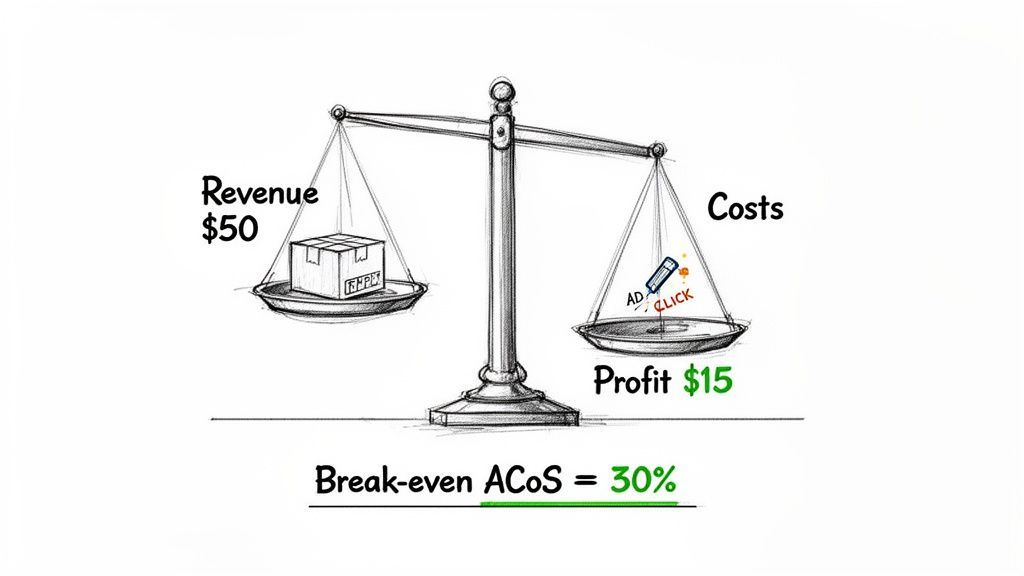
Let’s say you sell a premium coffee grinder for $50. After you account for the cost of goods, Amazon fees, and shipping, you’re left with $15 in profit per unit. Your pre-ad profit margin is 30% ($15 profit / $50 revenue).
This 30% is your break-even ACoS.
If your ads hit a 30% ACoS on this product, you've successfully broken even on that sale. Any ACoS below 30% means you’re making a profit on the ad-driven sale. Anything above it means you're officially losing money.
Knowing this number empowers you to set realistic campaign goals. Instead of chasing a generic "low ACoS," you can aim for a specific target that protects your bottom line.
While ACoS measures your costs as a percentage of revenue, Return on Ad Spend (ROAS) flips the script. It tells you how many dollars you earn for every dollar you spend on ads. It's a direct measure of efficiency and is calculated by dividing your ad-generated revenue by your ad spend.
For our coffee grinder example:
ACoS and ROAS are just two different ways of looking at the same data. Many advertisers prefer ROAS because it frames performance in terms of returns, which can feel more intuitive for budgeting and goal-setting.
To make this crystal clear, here are a few examples showing how the two metrics relate.
Ad Spend
Ad-Generated Revenue
ACoS Calculation (Ad Spend / Revenue)
ROAS Calculation (Revenue / Ad Spend)
$200
$1,000
20% ($200 / $1,000)
5x ($1,000 / $200)
$350
$1,000
35% ($350 / $1,000)
2.86x ($1,000 / $350)
$100
$2,000
5% ($100 / $2,000)
20x ($2,000 / $100)
As you can see, a lower ACoS always corresponds to a higher ROAS. They are inverse reflections of your campaign efficiency.
Once you know your profitability targets, you can pick a budgeting model that actually fits your business goals. There isn't a one-size-fits-all approach; the right model depends on your scale, objectives, and market position.
Here are a few popular methods we see brands use successfully:
Percentage of Revenue: This is a straightforward model where you allocate a fixed percentage of your total monthly or quarterly revenue to advertising. For example, if you generate $20,000 in monthly revenue and set a 10% ad budget, you’d spend $2,000 on ads. It’s simple and scales with your business.
Objective-Based Budgeting: This approach is perfect for specific goals, like a new product launch. You define the objective—say, achieving a top-three search rank within 60 days—and allocate a dedicated budget to hit that specific target, independent of overall revenue.
Tiered Budgeting: For sellers with a diverse catalog, you can assign different ACoS targets and budgets to different product groups. Your bestsellers might get an aggressive budget to defend their rank, while newer products run on a leaner, profitability-focused budget to prove themselves.
By grounding your budget in real numbers like profit margins and break-even ACoS, you transform your advertising from a cost center into a predictable, scalable growth engine.
Moving beyond basic budgeting and bidding is where the top sellers create their competitive edge. Mastering advanced tactics lets you surgically cut wasted spend, amplify your returns, and turn your campaigns from just "running" to exceptionally profitable. It's all about precision, control, and seeing the full customer journey.
Think of your first ad campaigns like casting a wide net. You'll catch some fish, sure, but you also snag a lot of old boots and seaweed. Advanced strategies are about patching the holes in that net, reinforcing the strong spots, and learning exactly where the best fish are swimming.
This proactive approach is essential in a marketplace where Amazon’s own ad investments are enormous. The platform's internal ad and promo spend recently swelled to $21.4 billion, a massive jump from $3.4 billion back in 2017. This investment fuels the very tools we use, and knowing how to navigate this ecosystem is key. You can dig into more data on Amazon's ad revenue growth on Statista.com to truly grasp the scale we're playing on.
One of the fastest ways to improve your ROI is to simply stop paying for clicks that will never convert. Negative keywords are your first line of defense against this, blocking your ads from showing up for irrelevant searches. If you sell premium leather wallets, you'd add terms like "cheap," "free," or "synthetic" as negatives to make sure you only pay for clicks from shoppers looking for quality.
Regularly mining your search term reports for junk queries is a non-negotiable task. A solid negative keyword strategy can slash wasted ad spend by up to 30% in competitive niches, directly boosting your profitability without ever touching your budget.
Relying only on automatic campaigns or tossing all your keywords into one bucket is a recipe for inefficiency. For ultimate control over your Amazon advertising costs, you need to segment your campaigns by keyword match type. This structure lets you allocate budget and set bids with incredible accuracy.
Here’s a tried-and-true structure that works:
By systematically funneling keywords through this structure, you ensure your best performers get the resources they deserve while you continuously mine for new opportunities at a low cost. For those looking to take their operations to the next level, our guide on how to become an Amazon Verified Partner can offer valuable insights.
Amazon’s bidding options are powerful levers. The right one to pull depends entirely on your campaign's goal.
Pro Tip: Don't forget about dayparting. This is where you schedule your ads to run only during peak conversion hours. Analyze your hourly sales data to see when your customers are most active, then pause campaigns during quiet periods to save your budget for when it truly matters.
While your standard PPC ads are great for capturing existing demand on Amazon, the Demand-Side Platform (DSP) lets you go out and create it. Amazon DSP allows you to programmatically buy ad placements across the web, reaching audiences both on and off Amazon.
It’s an incredibly powerful tool for full-funnel marketing, especially for retargeting shoppers who viewed your products but didn't pull the trigger. By combining meticulous keyword management with smart bidding and full-funnel retargeting, you can dramatically lower your Amazon advertising costs and maximize the return on every single dollar you spend.
Is your ad spend actually working? It’s a simple question, but if you’re only looking at the metrics inside your Amazon Ads dashboard, like ACoS, you’re not getting the full answer. Relying only on ACoS is like judging a chef’s skill by tasting just one ingredient. You miss the whole meal.
To really understand what your advertising dollars are doing, you need to measure how they lift your entire business—not just the sales directly tied to a click. The Amazon algorithm loves sales velocity, and a well-run ad campaign creates a powerful halo effect, pushing up your organic rankings and driving sales that never even get attributed to an ad.
This is where smart sellers start tracking Total Advertising Cost of Sale (TACoS). Instead of measuring your ad spend against just your ad revenue, TACoS measures it against your total revenue, which includes both ad-generated and organic sales.
The formula is straightforward: (Total Ad Spend / Total Revenue) x 100.
A declining TACoS over time is one of the best signs your strategy is working. It means your ad spend isn't just buying sales; it's building momentum. Your ads are creating a flywheel effect that strengthens your brand and makes you less dependent on paid clicks to keep the sales coming in.
Let’s say you spend $2,000 on ads and bring in $20,000 in total sales for the month. Your TACoS is 10%. The next month, you spend the same $2,000, but your total sales jump to $25,000. Now your TACoS has dropped to 8%. That’s proof your advertising is building sustainable, organic growth. You can dive deeper into various data-driven strategies for Amazon ad ROI to fine-tune this even further.
But the real, game-changing insight comes from looking beyond Amazon’s world altogether. Think about how people shop today. The customer journey is messy and rarely happens on a single platform. A shopper might see your ad on Instagram, search for your brand on Google a day later, and then finally click “buy” on Amazon.
Without a way to connect those dots, you’re flying blind. You can't accurately prove that your social media campaigns or your Google ads are actually driving sales on Amazon. This is a huge problem for any brand selling across multiple channels.
This is where a holistic attribution model becomes absolutely essential. By implementing advanced tracking, you can finally see the complete path to purchase and get a full-spectrum view of your advertising performance. It helps you understand how all your marketing channels work together to drive sales, ensuring every dollar you spend is accounted for and optimized for true business growth.
Jumping into Amazon advertising always brings up a few key questions. Here are some straight answers to the most common ones we hear from sellers, designed to give you more clarity and confidence in managing your ad spend.
If you're just starting out, a budget of $500–$1,000 per month is a solid place to begin. This gives you enough runway to collect meaningful data on what’s working without taking a huge risk right out of the gate.
Trying to skate by with too little is a common mistake. You won't generate enough clicks to tell if a keyword is a winner or a dud, leaving you guessing instead of making data-backed decisions.
Honestly, there's no magic number for a "good" ACoS. The only thing that matters is your product's profit margin. A great ACoS is simply any number that falls below your break-even point.
For example, if your product has a 30% profit margin before you spend a dime on ads, any ACoS under 30% means you're making money on that sale. A well-established product might shoot for a lean 15-25% ACoS, but a new product launch might push that number higher temporarily just to get the sales engine running and build momentum.
Your ACoS target is a strategic choice, not a universal benchmark. It should directly align with your business goals, whether that's maximizing profit, liquidating inventory, or aggressively gaining market share for a new launch.
Seeing your Amazon advertising costs jump overnight can be jarring, but there's usually a logical reason. More often than not, it boils down to one of these culprits:
Keeping a close eye on these factors will help you spot trouble and react before rising costs start eating into your profits.
Ready to stop guessing and start growing? Clickstera Solutions LLC offers full-service Amazon account management, from advanced PPC and DSP campaigns to holistic growth strategies. As an Amazon Verified Partner, we blend expert insights with powerful analytics to scale brands profitably. Book a discovery call today and see how we build winning strategies for brands like yours.
Talk to Clickstera and get a clear next-step plan to scale your performance marketing.