Loading article
Loading page...
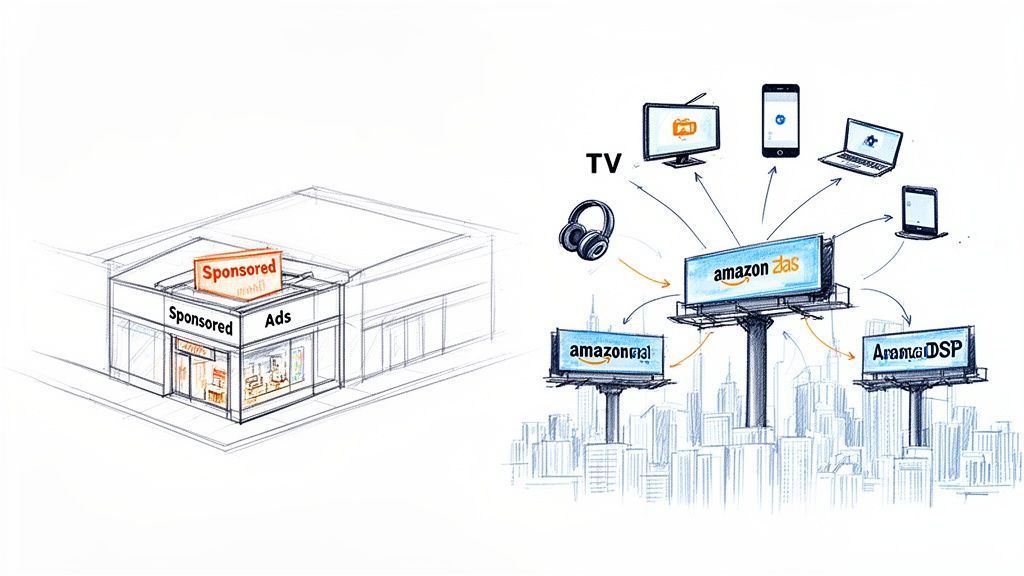
If you think of Amazon’s Sponsored Ads as a premium kiosk inside a bustling mall, then Amazon DSP advertising is like placing billboards and running TV commercials all across the digital city. It’s the tool that lets you connect with potential customers not just while they’re actively shopping on Amazon, but also when they’re reading the news, browsing websites, or streaming their favorite shows.
The Amazon Demand-Side Platform (DSP) is a game-changer because it moves beyond waiting for a shopper to type in a keyword. Instead of reacting to a search, you can proactively reach audiences based on their past buying habits, browsing behavior, and demographic profiles—all powered by the kind of rich, first-party data that only Amazon has at this scale.
It’s a fundamental shift from capturing existing demand to creating it.
The real power of DSP is its ability to manage the entire customer journey. It’s not just about driving that final sale; it’s about building a relationship with a consumer from their very first touchpoint with your brand. This full-funnel approach is what sets it apart.
Think about it in stages:
This layered strategy ensures your brand stays visible at every critical moment. You’re no longer just competing for clicks on Amazon; you’re building brand equity all over the web.
At its core, Amazon DSP works so well because it taps into Amazon’s massive pool of first-party shopper data. This isn’t just generic demographic info; it’s concrete data on what people actually search for, browse, and—most importantly—buy.
Amazon DSP gives advertisers a unique key to unlock Amazon’s proprietary browsing, shopping, and streaming insights. This allows for incredibly precise and efficient campaigns across both Amazon-owned properties and third-party inventory, driving performance-based advertising that’s hard to replicate anywhere else.
This level of precision means less wasted ad spend and more relevant messaging. You can target audiences who recently bought a competitor’s product, find users who are “in-market” for something specific like a new laptop, or build “lookalike” audiences modeled after your best customers.
For brands looking to scale beyond the Amazon marketplace, this isn’t just a nice-to-have feature—it’s a non-negotiable growth lever. It turns advertising from a reactive tactic into a proactive strategy for building a lasting brand.
One of the biggest eye-openers for brands new to Amazon DSP advertising is just how far its reach extends. Unlike Sponsored Ads, which live exclusively within Amazon’s marketplace, DSP campaigns can follow your ideal customer all across the internet. This power is split into two distinct, yet complementary, playgrounds for your ads.
Think of it like promoting a concert. On-Amazon ads are like putting up posters and running promos inside the venue—you’re reaching people who are already there and ready to engage. Off-Amazon ads are like running TV commercials and radio spots across the city to draw a bigger crowd to the venue in the first place.
Using both isn’t just a good idea; it’s the key to a full-funnel strategy that both captures existing demand and creates brand new customers from scratch.
On-Amazon inventory covers all ad placements across Amazon’s owned-and-operated digital properties. This is where you connect with shoppers who have high purchase intent at the most critical moments of their buying journey.
Your ads can show up in some seriously powerful spots, including:
Placing ads here is perfect for lower-funnel tactics. Think retargeting customers who viewed your product but didn’t buy, or cross-selling to shoppers who bought a related item. It’s all about being visible and persuasive right at the point of sale.
This is where Amazon DSP really flexes its muscles. Off-Amazon inventory is the massive network of third-party websites, apps, and streaming services where you can run ads through Amazon’s programmatic partnerships. It lets you find audiences based on their Amazon shopping behaviors, even when they’re miles away from the marketplace.
The core idea is simple but profound: use Amazon’s unmatched shopper data to find your perfect customer, no matter where they are on the web. This turns the entire internet into a potential touchpoint for your brand.
The scale of this network is immense. Amazon DSP has fueled explosive growth in Amazon’s advertising empire, with revenues soaring to $17.7 billion in Q3 2025 alone—a 24% surge from the previous year. This growth is powered by partnerships with giants like Netflix, Roku (reaching 80 million households), Spotify (with its 696 million users), and SiriusXM. You can even run video ads on Prime Video, Hulu, and during Thursday Night Football streams. You can discover more about Amazon’s advertising statistics and its massive reach.
To make sense of these two powerful options, here’s a quick breakdown of how they compare and when to use each one.
Inventory Type
Where Ads Appear
Primary Goal
Example Use Case
On-Amazon
Amazon.com, Amazon devices (Fire TV, Kindle), Amazon apps, IMDb, Twitch, Goodreads
Conversion & Retargeting
Showing a dynamic ad for a specific pair of running shoes to someone who viewed them yesterday.
Off-Amazon
Third-party websites, mobile apps, streaming services (Hulu, Roku, Spotify)
Awareness & Consideration
Running a video ad for a new line of organic dog food on a popular pet care blog, targeting past purchasers of premium pet products.
By seeing them side-by-side, it’s clear they aren’t competing—they’re collaborating to build a complete customer journey.
The real magic happens when you weave both inventory types together to guide a customer from discovery all the way to purchase.
Imagine a kitchenware brand launching a new high-end blender. Here’s how they could use both:
Success with Amazon DSP advertising really comes down to two things: reaching the right people and showing them the right message. This is where Amazon’s mountain of shopper data stops being a buzzword and becomes a real, tangible advantage. It lets you move past broad demographics and start talking to audiences based on what they actually do.
Think of it like being a personal shopper. You don’t just know a customer’s age and location; you know what they’ve browsed, what they’ve added to their cart, and what they’ve bought before. That level of precision is what makes your ad strategy not just targeted, but truly effective.
This map gives you a good visual of how DSP connects the dots, using both on- and off-Amazon inventory to create one seamless customer journey.
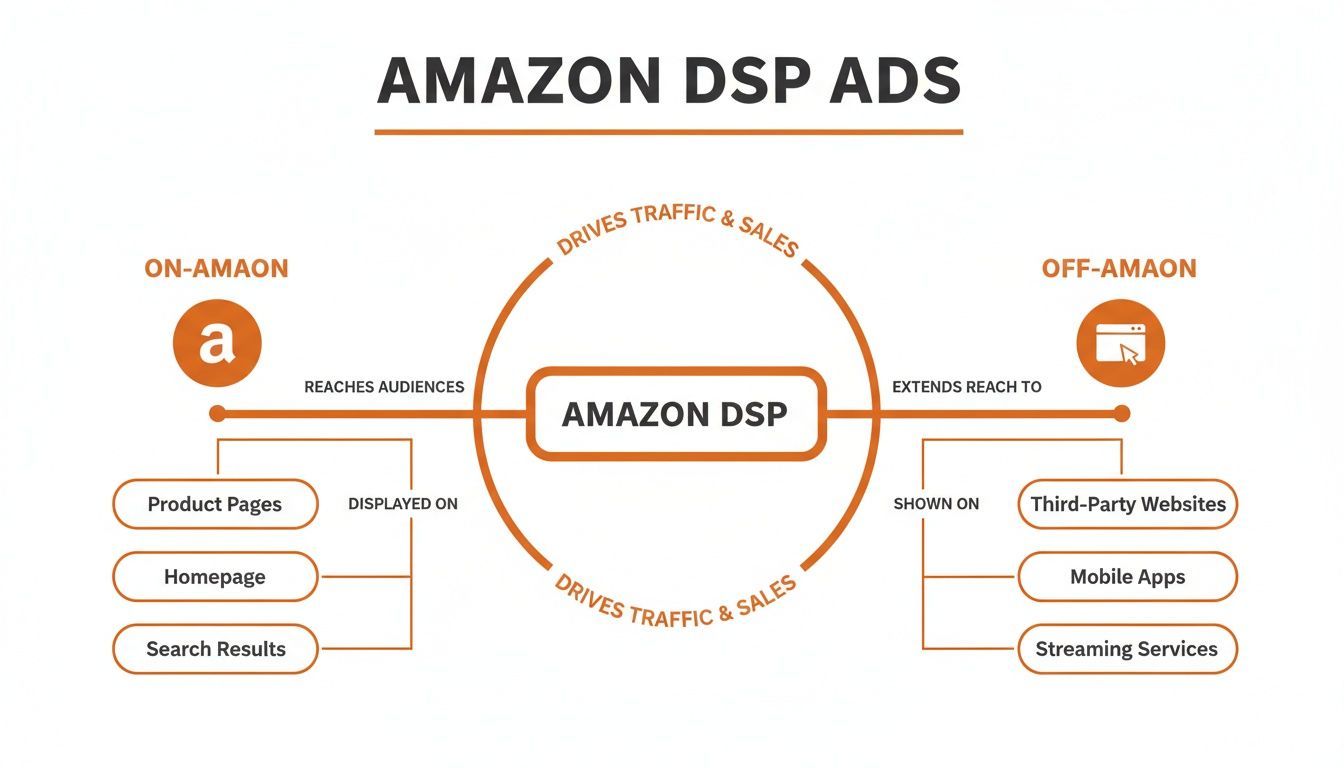
As you can see, it doesn’t matter if someone is on an Amazon page or browsing a completely separate website—DSP ads can guide them right back to your product listings, closing the loop and building a full-funnel experience.
Amazon DSP offers a rich menu of targeting options, each built for a different stage of the buying journey. By layering these, you can build a complete strategy that nurtures leads from their first glance all the way to purchase and beyond.
Here are the core audiences you can start with:
These segments are just the starting point. The real magic happens when you start layering them and building custom retargeting strategies to re-engage shoppers at exactly the right moment.
For many brands, retargeting is where they see the highest return on their DSP investment. It’s your opportunity to reconnect with people who have already shown they’re interested in what you sell.
The most effective Amazon DSP campaigns don’t just find new customers; they master the art of bringing interested shoppers back to complete their purchase. This focused re-engagement is often the difference between a forgotten cart and a loyal customer.
Here are a few high-impact retargeting tactics to try:
Your targeting strategy is only as good as the creative you pair it with. Different ad formats are built for different jobs, and matching your creative to your campaign goal is critical for getting the most out of your budget.
By matching the right audience with the right creative, you build a seamless and persuasive experience that walks customers from discovery to purchase. This strategic alignment is the key to mastering your Amazon DSP advertising efforts and driving real, meaningful growth.
A great strategy is just an idea until you fund it correctly. Getting a real-world return on Amazon DSP advertising comes down to how you handle the financial levers—your budget, your bidding model, and the way you measure success. This isn’t just about spending money; it’s about investing it wisely to turn campaigns into a profitable growth engine.
Think of your budget as the fuel for your campaign and your bidding strategy as the engine’s settings. You wouldn’t use the same settings for a short drag race (driving immediate sales) as you would for a long-distance road trip (building brand awareness). Each goal demands a different approach to get the most out of every dollar.
Your campaign goals have to drive your bidding strategy—no exceptions. While Amazon DSP offers a few options, two primary models cover most brand objectives:
For instance, a new beverage brand might use a vCPM strategy for a video campaign on Fire TV just to introduce its product to the world. A few weeks later, they could switch to a CPC model for a retargeting campaign, showing display ads to everyone who watched that video to nudge them toward a click and a sale on Amazon.
The most common mistake we see is applying a conversion-focused metric like ROAS to a pure awareness campaign. Success at the top of the funnel isn’t a direct sale—it’s a high video completion rate or a noticeable lift in branded search volume. You have to align your KPIs with your goal.
Amazon DSP’s real power is its ability to influence the entire customer journey, which makes measurement a bit more complex than a simple last-click model. A customer might see your ad on a third-party website, forget about it, then search for your brand directly on Amazon a day later to buy. A traditional attribution model would completely miss that critical first touchpoint.
This is why it’s so important to understand Amazon’s attribution model. DSP campaigns typically use a 14-day view-through attribution window. This means if someone sees your ad and then buys your product within 14 days (even without clicking), that sale gets credited back to the DSP campaign. This approach finally captures the ad’s influence on shoppers who don’t click but are still persuaded to buy.
To get the full picture, you have to track a combination of metrics that tell the complete story of your campaign’s impact. The performance numbers we’re seeing prove why this is such a game-changer. Retargeting campaigns are hitting a Return on Ad Spend (ROAS) of 3-5x, while prospecting new customers still delivers a healthy 1.5-2.5x. And DSP video ads on platforms like Prime Video and Twitch are clocking a 0.42% click-through rate—easily beating standard display—while delivering a 10-15% lift in brand awareness. You can dive deeper into these Amazon DSP performance metrics to see what’s possible.
To track this properly, you need to monitor metrics across the entire funnel:
By using tools like the Amazon Marketing Cloud, you can stitch all these data points together. You can finally see how an off-Amazon ad view on a news site led to a branded search and, ultimately, a sale. That holistic view is the key to measuring the true ROI of your Amazon DSP advertising and making smarter decisions to scale your brand.
Even seasoned advertisers can get tripped up by Amazon DSP. The platform is incredibly powerful, but that power comes with complexity. A few common missteps can drain your budget in a hurry and undermine your entire strategy. Learning to navigate these challenges is the key to turning your ad spend into a profitable investment instead of just a costly experiment.
Think of it like flying a high-performance jet. You have amazing capabilities at your fingertips, but you absolutely need to know which buttons to press—and which ones to leave alone—to guarantee a smooth flight. This is your pre-flight checklist for avoiding the most frequent and expensive errors.
One of the easiest ways to get things wrong is to set unrealistic goals for a campaign. For example, judging a top-of-funnel awareness campaign purely by its direct Return on Ad Spend (ROAS) is like judging a movie trailer based on ticket sales. The trailer’s job is to build hype and get people excited to see the movie later, not to sell tickets on the spot.
An awareness campaign’s entire purpose is to introduce your brand to new people, not to drive immediate sales. Its success should be measured with metrics like video completion rates, reach, and any lift you see in branded search terms—not by last-click ROAS.
To get this right, you need to segment your campaigns by their place in the funnel and assign the right Key Performance Indicators (KPIs) to each stage.
Blasting the same ad at the same person twenty times a day isn’t persuasive; it’s just plain annoying. Ad fatigue is a very real problem that will cause your campaign performance to tank as users start to tune you out completely. This is exactly where frequency caps become your best friend.
A frequency cap simply limits how many times a single user sees your ad in a given timeframe. Forgetting to set one is like a radio station playing the same commercial every five minutes—listeners will just change the channel. Set reasonable caps (something like 3-5 impressions per user per day is a good starting point) to keep your message from getting stale and your audience from getting irritated.
Your creative is your brand’s frontline ambassador. Using a generic, one-size-fits-all ad for every audience and every placement is a recipe for wasted spend. That awesome lifestyle video that’s crushing it in your top-of-funnel Hulu campaign will fall completely flat in a bottom-funnel retargeting ad that needs to show a specific product.
You have to tailor your creative to the audience and their stage in the journey. Use compelling lifestyle imagery and video to connect with new prospects at the top of the funnel. Then, switch to dynamic e-commerce ads that showcase specific products for your lower-funnel retargeting audiences who are much closer to making a purchase.
Finally, there’s one surprisingly common mistake that can be devastating: misaligning your ad strategy with your inventory. Pouring thousands of dollars into promoting a product that’s about to go out of stock isn’t just wasted ad spend—it creates a terrible customer experience that can seriously damage your brand’s reputation. Make sure your advertising plans are always in sync with your operational reality.
Jumping into Amazon DSP advertising can feel like a massive step, but a clear plan makes all the difference. Instead of getting bogged down by all the options, a simple checklist ensures you nail the fundamentals from day one.
Think of it as a roadmap, guiding you from initial strategy to a confident launch. This isn’t just about flipping a switch—it’s about setting yourself up for success you can actually measure.
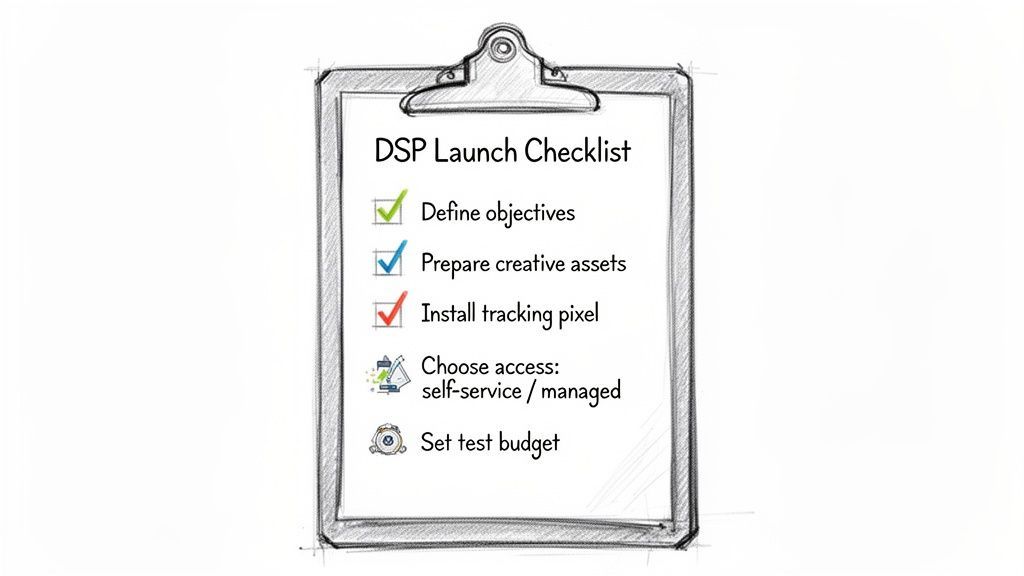
This process aligns your goals, creative, and tracking to build a campaign that genuinely moves the needle for your brand.
Before you spend a single dollar, you need a solid game plan. This phase is all about defining what victory looks like and figuring out exactly who you’re trying to reach.
Define Clear and Measurable Objectives: What’s the main goal here? “Increase sales” is too vague. Get specific. A much better objective is, “Increase new-to-brand customer purchases by 15% this quarter” or “Hit a 20% video completion rate on our top-of-funnel awareness campaign.”
Identify Your Initial Target Audiences: Start with what you already know works. A great first step is a high-intent retargeting audience, like users who viewed your product pages in the last 30 days. For prospecting, pick a core in-market or lifestyle segment that mirrors your ideal customer.
Establish a Smart Test Budget: You don’t need a massive budget to get started. Set aside a reasonable test budget that’s big enough to gather meaningful data. A typical test runs for about four to six weeks, giving the algorithms enough time to learn and start optimizing.
With your strategy locked in, it’s time to get your assets ready and make sure your tracking is flawless. This part is non-negotiable for measuring the true impact of your off-Amazon ads.
The most common technical failure is neglecting the Amazon Ads pixel. Without it, you are flying blind on off-site performance, unable to measure how your ads on third-party sites are actually influencing on-Amazon purchases.
How you actually manage the DSP platform is a big decision. You have two main options, and the right choice depends entirely on your team’s bandwidth and expertise.
Amazon’s recent overhaul of DSP, especially with AI-powered tools like Performance+ and Brand+, has made the platform incredibly powerful. These tools have been shown to deliver a 51% drop in customer acquisition costs and boost ROAS by up to 34%. Given that potential, picking the right management model is crucial. Discover more about Amazon’s Q4 2025 ad enhancements to see just how much the platform is evolving.
Here’s a quick breakdown of your choices:
Access Model
Best For
Key Considerations
Self-Service
Brands with an experienced in-house team and the time to manage campaigns daily.
Requires deep platform knowledge, ongoing optimization, and a direct relationship with Amazon.
Managed Service
Brands that want expert strategy and execution without building an in-house team.
Involves partnering with an agency or a provider holding an Amazon Verified Partner badge for specialized expertise.
For most brands, going with a managed service through an agency partner accelerates results. It gives you immediate access to seasoned strategists who live and breathe this platform every day. It’s a structured approach that ensures your ads, content, and operations are all aligned for sustainable growth.
Even with a solid game plan, it’s natural to have a few lingering questions before you dive into Amazon DSP. Let’s clear up some of the most common ones we hear from brands every day.
This is always the first question, and the answer really depends on how you get access. If you’re a brand going the self-service route directly with Amazon, you’ll typically need to commit to a minimum ad spend of $50,000.
But here’s the good news: working with an Amazon Verified Partner agency like us gives you much more flexibility. Agencies often pool their clients’ ad spend, which means we can get you onto the platform with a much lower starting budget. This opens the door for emerging brands to test the waters without a massive upfront investment.
Nope, you don’t. While DSP is an absolute powerhouse for brands selling on Amazon, it’s also a fantastic tool for advertisers who don’t have a presence on the marketplace at all. You can use it to drive highly qualified traffic directly to your own website.
That said, the magic really happens when you combine Amazon’s rich shopper data with on-platform sales attribution. Brands that sell on Amazon get a crystal-clear view of how their ad spend translates directly into purchases, making the entire strategy more connected and measurable.
The real secret sauce of Amazon DSP is its access to Amazon’s first-party data on what people browse, buy, and watch. This is what enables such precise and effective campaigns, whether you’re pointing shoppers to an Amazon listing or your own DTC site.
Think of it this way: Sponsored Ads are like fishing, while DSP is like farming.
Sponsored Ads are all about capturing existing demand. You’re essentially “fishing” where the fish are already biting—placing your ads (the bait) in front of shoppers who are actively searching for products like yours on Amazon. It’s a reactive strategy, and it’s great for capitalizing on in-the-moment purchase intent.
Amazon DSP, on the other hand, is about creating new demand. You’re “farming”—proactively planting seeds with awareness ads across the web, nurturing those leads with retargeting, and then harvesting the results when they’re ready to buy. It’s a proactive strategy for building a customer base, not just converting the one you already have.
Ready to build a full-funnel strategy that drives real growth? Clickstera Solutions LLC is an Amazon Verified Partner specializing in advanced DSP campaigns that deliver measurable results. We help brands scale with expert management and data-driven insights. Schedule your free consultation with Clickstera today.
Talk to Clickstera and get a clear next-step plan to scale your performance marketing.