
Loading article
Loading page...
The real debate between Amazon FBA vs FBM boils down to a simple question: who handles the work? With Fulfillment by Amazon (FBA), you pay Amazon to take on your storage, packing, shipping, and even customer service. But with Fulfillment by Merchant (FBM), you’re in the driver’s seat for the entire process, giving you total control but also total responsibility.
This choice is one of the first and most important decisions you’ll make. It directly shapes your profit margins, day-to-day operations, and how fast you can grow.
Deciding between FBA and FBM is more than just logistics. It’s a strategic move that defines your brand’s future on Amazon. One path gives you access to Amazon’s massive fulfillment network and the coveted Prime badge. The other offers you complete control over your brand experience and the potential for better margins. This guide goes beyond the basic pros and cons to give you the insights needed to make the right call for your business.
Let’s break down the two models:
The decision is almost always a trade-off. FBA delivers operational simplicity and the undeniable marketing power of Prime. FBM, on the other hand, gives you more control over your inventory, branding, and costs, which often translates to higher profit margins if you can manage the complexity.
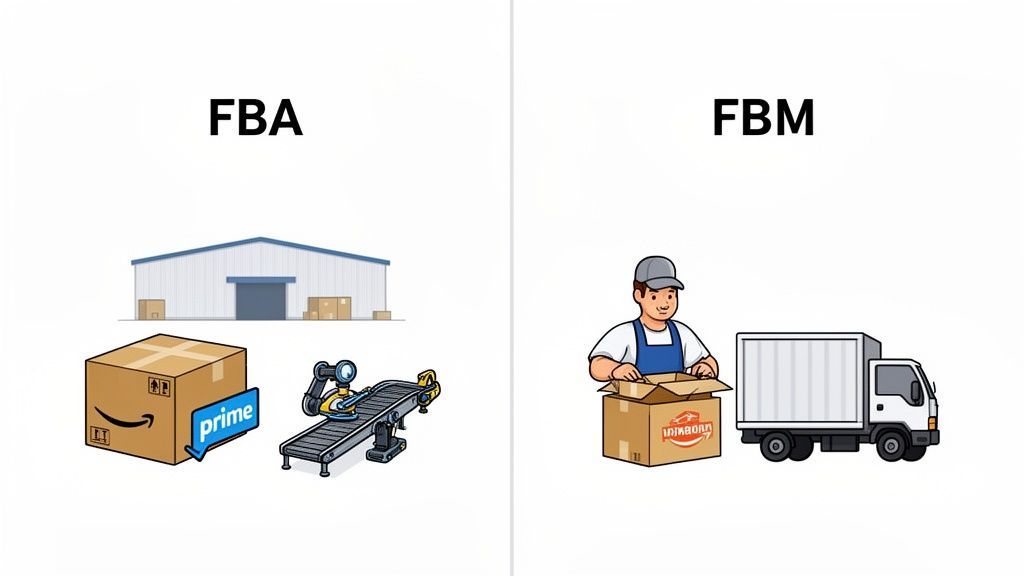
This graphic gets to the heart of FBA’s appeal: you get to tap into Amazon’s world-class infrastructure to reach more customers through Prime. But this convenience isn’t free—it comes with a complex fee structure and strict operational rules that you need to weigh against the freedom and control FBM provides.
To help frame the decision, let’s start with a high-level look at how the two models compare on the things that matter most.
Feature
Fulfillment by Amazon (FBA)
Fulfillment by Merchant (FBM)
Prime Eligibility
Automatic, giving you instant access to millions of Prime members.
Possible via Seller Fulfilled Prime (SFP), but the performance bar is incredibly high.
Shipping & Logistics
Completely managed by Amazon’s global network.
Handled by you or a third-party logistics (3PL) partner.
Inventory Storage
Stored in Amazon’s fulfillment centers for a fee.
Stored in your own warehouse, home, or with a 3PL.
Customer Service
Handled by Amazon for all fulfillment-related questions.
Handled entirely by you, for every customer inquiry.
Cost Structure
Per-unit fulfillment fees, monthly storage fees, and other service fees.
Costs include warehousing, packaging, shipping rates, and labor.
Control Over Branding
Limited. Products arrive in Amazon-branded boxes.
Full control over custom packaging, inserts, and the unboxing experience.
As Amazon puts it, the FBA program is built to let you focus on growing your business while they take care of the logistics. This can be a game-changer, but it’s crucial to understand what you’re giving up in exchange for that convenience.
Before we get into a detailed cost breakdown, it’s crucial to understand the real operational differences between Fulfillment by Amazon (FBA) and Fulfillment by Merchant (FBM). These aren’t just shipping methods; they’re fundamentally different business models that shape how you handle inventory, talk to customers, and grow your brand. The Amazon FBA vs FBM decision really sets the stage for your entire marketplace strategy.
With FBA, you’re essentially handing over your entire logistics operation to Amazon. You ship your products in bulk to their massive fulfillment centers, and from there, their network takes over completely. They store your inventory, pick and pack orders the moment they come in, and manage all the shipping directly to the customer.
More importantly, this model instantly qualifies your products for the coveted Prime badge—a massive driver of sales and visibility on the platform. Amazon also takes care of customer service and returns for any fulfillment-related issues, which frees up your team to concentrate on marketing and product innovation.
FBM, on the other hand, puts you squarely in the driver’s seat for the entire fulfillment process. Once a customer clicks “buy,” you’re responsible for everything that follows. This means storing your own inventory, whether that’s in a dedicated warehouse, with a third-party logistics (3PL) partner, or even out of your own garage.
When an order is placed, it’s on your team to pick the right item, pack it safely, and get it shipped out with a carrier. You are also the primary point of contact for every customer service question, from “Where is my order?” to handling returns and refunds. This direct oversight is what allows for custom packaging and a more personal touch with your customers.
Key Insight: The choice is a strategic trade-off. FBA gives you scalability and the power of Prime, but you sacrifice control and potentially pay higher fees. FBM offers total control over your brand and margins, but it requires a serious in-house or 3PL operation to keep up.
The old “FBA by default” mindset is fading. Today, the choice is a far more strategic, margin-focused decision, especially for mid-market brands feeling the pressure to boost profitability. The data backs this up: while 78% of Amazon sellers use FBA in some form, 34% are using FBM, and 22% are actively running a hybrid model to protect their margins and avoid stockouts. You can explore more seller statistics to see these trends firsthand. This shift shows that the modern approach isn’t about picking one or the other, but about using the right model for the right product.
A specialized version of FBM is Seller Fulfilled Prime (SFP). This is a demanding program that lets top-tier FBM sellers earn the Prime badge while still managing their own logistics. To qualify, you have to consistently hit Amazon’s incredibly strict, Prime-level targets for shipping speed and reliability. SFP acts as a bridge between the two models—offering the brand control of FBM with the sales boost of Prime—but it’s reserved for sellers with nearly perfect fulfillment operations.
Ultimately, the choice between Amazon FBA and FBM boils down to your unit economics. This isn’t just an operational decision; it’s a financial one that hits your P&L directly. To figure out which path is more profitable, you need to do a serious financial teardown of both models.
With FBA, you’re essentially buying a full-service fulfillment package, and the fees reflect that. The cost structure is layered, going way beyond a simple pick-and-pack fee. On the other hand, FBM lets you swap Amazon’s fees for your own operational costs, which you’ll need to track meticulously.
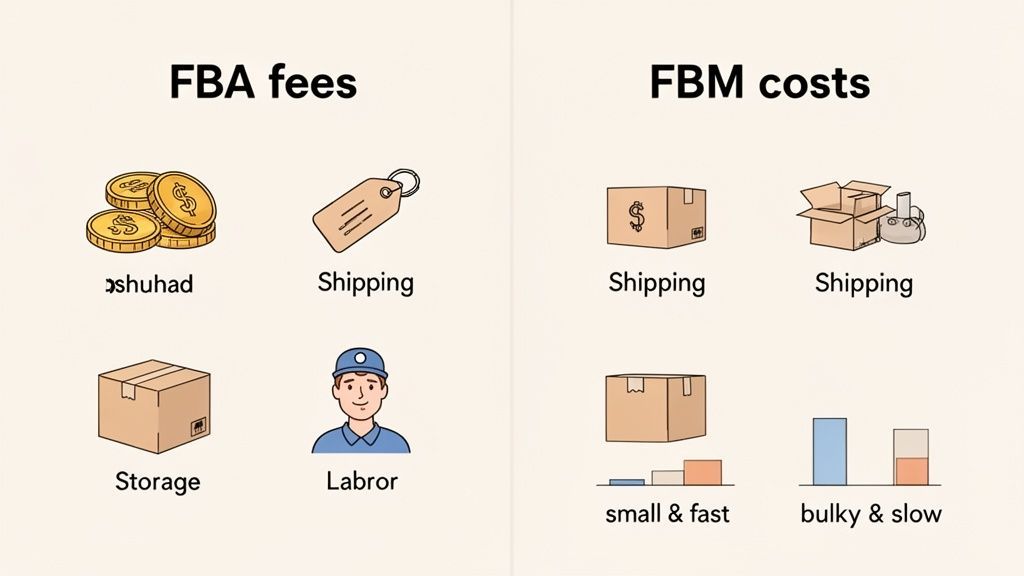
This diagram gets to the heart of it: FBA fees are predictable but stacked, while FBM costs are all on you and depend on how efficiently you can run your own show.
FBA fees aren’t just a single line item. They’re a collection of different charges that can seriously eat into your margins if you don’t understand them inside and out.
Here are the main costs you’ll run into:
And it doesn’t stop there. Many sellers get caught off guard by ancillary costs like removal order fees (to get your inventory back), inventory placement fees (to send shipments to just one warehouse), and returns processing fees.
Choosing FBM means you’re in the driver’s seat of your expenses. This can absolutely lead to better margins, but it also means you’re responsible for your own cost structure. You’re basically running a mini-logistics company.
Your main FBM expenses will include:
For many brands, the financial analysis reveals a clear divergence. FBA offers a turn-key solution with scalable, albeit complex, costs. FBM provides a path to potentially better margins but demands a significant investment in operational resources and expertise.
The profitability of FBA vs FBM can swing wildly depending on the product itself. A small, lightweight, fast-moving item has a completely different financial profile than something bulky and slow to sell.
Let’s take a small, standard-size product that flies off the shelves. For this kind of item, FBA is often the more cost-effective route. The fulfillment fees are pretty low, and since it sells fast, you don’t have to worry about long-term storage fees. The convenience and Prime eligibility easily justify the costs.
Now, imagine a large, oversized, or heavy product. FBA fees for these items can be astronomical, wiping out your profit in a heartbeat. In this scenario, FBM is the clear financial winner. By negotiating better shipping rates for bulky items and managing your own storage, you can protect your margins.
To give you a clearer picture, let’s walk through a hypothetical SKU. This side-by-side comparison shows how the numbers can stack up for a typical product.
Cost Component
FBA Example Cost
FBM Example Cost
Notes & Considerations
Product Cost
$10.00
$10.00
Cost of goods sold (COGS).
Retail Price
$39.99
$39.99
The price the customer pays on Amazon.
Amazon Referral Fee (15%)
$6.00
$6.00
This fee applies to both FBA and FBM sellers.
FBA Fulfillment Fee
$4.75
N/A
Based on standard size, 1-2 lb item. Varies by size/weight.
Monthly Storage Fee
$0.25
N/A
Assumes item sells within 1 month.
Warehouse/Storage (FBM)
N/A
$0.75
Your cost for storage space, whether owned, rented, or 3PL.
Shipping & Handling (FBM)
N/A
$5.50
Includes carrier fees and labor for pick/pack.
Packaging Materials (FBM)
N/A
$0.50
Cost of boxes, tape, filler, etc.
Total Fulfillment Cost
$11.00
$12.75
Total cost to fulfill one unit (excluding product cost).
Net Profit Per Unit
$18.99
$17.24
(Retail Price – Product Cost – Total Fulfillment Cost)
Net Profit Margin
47.5%
43.1%
(Net Profit / Retail Price)
As the model shows, for a standard, fast-moving item, FBA can edge out FBM on profitability due to Amazon’s efficient logistics network. However, if your FBM shipping or warehousing costs were lower—or if the FBA fees for your specific item were higher—the tables could easily turn.
Recent data shows average FBA fulfillment fees are around $3.22 per unit for standard-size items, with storage costs between $0.87 to $2.40 per cubic foot, plus a slew of surcharges. For many brands, these layered fees can squeeze margins down into the 15–25% range. In contrast, a well-run FBM operation is often 18–25% cheaper per unit for specific products, especially oversized or custom-packaged goods. You can find more insights on these cost comparisons to inform your own financial models. This all just highlights why a one-size-fits-all approach is a recipe for failure; every single SKU needs its own P&L analysis.
Every fulfillment choice comes down to a fundamental trade-off: convenience versus control. Deciding between Amazon FBA vs FBM isn’t just about who ships the box—it’s about defining your brand’s entire operational DNA. One path offers incredible, hands-off growth, while the other gives you complete command over your customer experience.
Fulfillment by Amazon (FBA) is an engine built for pure scalability. It lets your brand ramp up sales volume exponentially without the massive capital investment of building out a logistics operation. You’re effectively tapping into Amazon’s world-class network, renting a supply chain that can handle thousands of orders a day without you ever touching a roll of tape.
Of course, that convenience comes at a price, and that price is control. With FBA, you surrender authority over critical brand touchpoints. Your products show up in standard Amazon boxes, you can’t slip in personalized marketing inserts, and you have limited oversight of how your inventory is handled day-to-day.
Fulfillment by Merchant (FBM) flips this dynamic on its head. This model gives you total authority over the entire post-purchase journey. You call the shots on packaging, pick the shipping carrier, and decide on any branded materials you want to include. For certain brands, this level of control isn’t just a preference; it’s a powerful competitive advantage.
A high-end skincare company, for example, can use custom-branded boxes with tissue paper and include a sample of a new product. That creates a memorable unboxing experience that reinforces brand value—something completely lost in the FBA ecosystem.
But this control demands a serious investment. To scale an FBM operation, you either have to build your own warehouse infrastructure or partner with a reliable third-party logistics (3PL) provider, which introduces its own set of costs and management overhead.
The core dilemma is this: FBA lets you scale sales volume with ease, but you sacrifice brand control. FBM gives you total brand control, but scaling that operation requires a deliberate and often costly logistical strategy.
In some scenarios, holding onto fulfillment control isn’t just a nice-to-have—it’s a critical business necessity. The ability to manage your own logistics can protect your products, elevate your brand, and open up sales strategies that are impossible with FBA.
Think about these use cases where FBM provides a clear advantage:
On the flip side, FBA’s superpower is its ability to handle high sales velocity without a single hiccup. If your products are standard-sized, durable, and move fast, outsourcing to Amazon is often the most efficient path to growth. The Prime badge alone can boost sales so dramatically that it justifies the fees for many sellers.
A brand selling a popular phone accessory, for instance, can ship thousands of units to Amazon and let the FBA machine manage the daily crush of orders. That operational simplicity frees the brand to focus entirely on marketing and inventory planning, rather than getting bogged down in picking and packing.
Ultimately, the right choice depends on whether your business gains more from operational ease or from a meticulously controlled brand experience.
The sharpest sellers know the Amazon FBA vs FBM debate isn’t a binary choice. Instead of seeing them as opposing forces, they treat these fulfillment models as tools in their operational toolbox, picking the right one for the right job. It’s about moving past a one-size-fits-all mentality and matching the fulfillment method to the specific product and business goal.
For some products, the decision is a no-brainer. FBA is the undisputed champ for high-velocity, standard-sized items where the Prime badge is essential to compete. For others, like oversized or low-margin products where FBA fees would kill profitability, FBM is the clear winner. But the real magic happens when you start blending these models intelligently.
Fulfillment by Amazon is your go-to when the primary mission is rapid growth, maximum visibility, and keeping operations simple. It’s built for your best-selling products—the ones that are lightweight, durable, and fit neatly into Amazon’s standard size tiers.
FBA becomes the obvious choice in these scenarios:
Fulfillment by Merchant is the path to take when you need absolute control over the customer experience and want to protect your profit margins. It shines for products that don’t fit into Amazon’s cookie-cutter system or where the FBA fees are just too steep to make sense.
FBM is the smarter move in these situations:
This decision tree gives you a visual gut-check for choosing the right fulfillment path based on your products and goals.
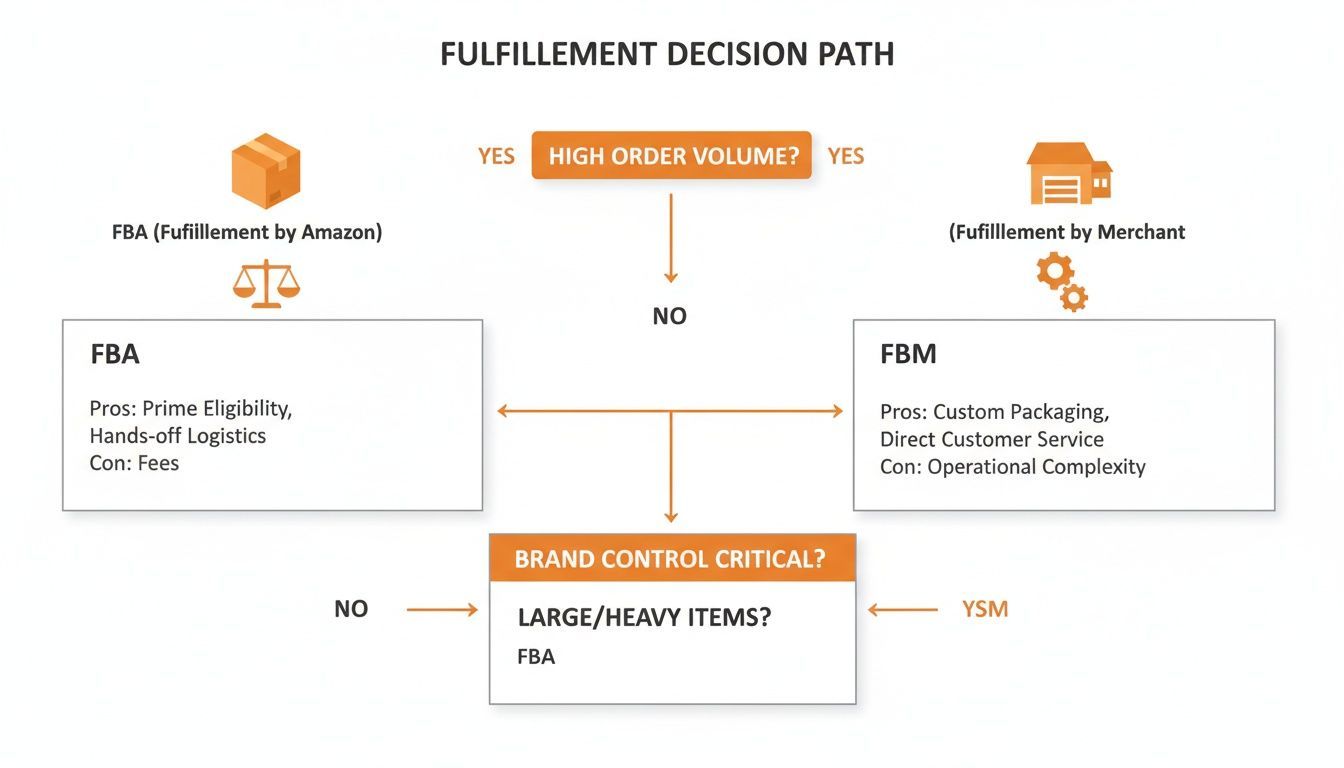
As the flowchart shows, factors like sales velocity and product size should point you toward either FBA’s scale or FBM’s control, reinforcing a strategic, SKU-by-SKU approach.
The most sophisticated brands almost never go all-in on a single model. A hybrid strategy—using FBA for your heroes and FBM for your niche products—truly offers the best of both worlds. This approach lets you maximize sales on your bestsellers while protecting profitability across your entire catalog.
A hybrid model isn’t just a strategy—it’s an insurance policy. Using FBM as a backup for your FBA listings ensures you never go out of stock during peak seasons or when faced with unexpected FBA inventory restrictions, protecting your sales rank and revenue.
The data shows a clear trend toward this blended approach. A 2025 marketplace report found that 34% of sellers use FBM for flexibility, while 22% explicitly run both FBA and FBM to hedge against risks like fee hikes and stockouts. Other analysis shows that nearly one in ten private-label brands has diversified beyond relying solely on FBA. You can discover more insights about fulfillment trends that back up this strategic shift. This isn’t a niche tactic anymore; it’s becoming standard practice for resilient, profitable brands.
Making the right call between Amazon FBA vs FBM always brings up a few key questions. Getting straight answers is the only way to build a fulfillment strategy that actually grows your brand, protects your margins, and keeps customers happy. Here are the questions we hear most often from brands trying to figure this out.
Yes, absolutely. Amazon’s platform is built for flexibility. You can switch any product from one fulfillment method to another by simply creating a new SKU for the same ASIN and setting it to your preferred channel.
But this isn’t just about making a permanent change. Many savvy sellers keep both an FBA and an FBM offer active for the same product. This hybrid strategy is a lifesaver, ensuring you never stock out, especially when FBA inventory is running low or stuck in a receiving bottleneck.
Think of Seller Fulfilled Prime (SFP) as the expert-level bridge between FBA and FBM. Under SFP, you handle all your own logistics but must meet Amazon’s incredibly demanding Prime shipping standards. In return, your listings get the coveted Prime badge.
SFP gives you the control and branding freedom of FBM with the massive visibility and sales lift that comes with Prime. But it’s not for the faint of heart. The program is really designed for established sellers who have already dialed in their fulfillment operations and can hit Amazon’s tough performance metrics without fail.
The single most expensive mistake we see is brands applying a one-size-fits-all fulfillment model to their entire catalog. They either go all-in on FBA or stick completely to FBM without digging into the unit economics of each individual SKU.
A hybrid model is almost always more profitable. For instance, you could use FBA for your fast-moving, standard-sized bestsellers to maximize Prime eligibility and sales velocity. At the same time, you could use FBM for your bulky, slow-moving, or lower-margin items to control costs. It takes more analysis upfront, but the long-term payoff in profitability is huge.
Outsourcing your FBM operations to a third-party logistics (3PL) provider can be a fantastic middle ground. Instead of doing everything in-house, a 3PL partner takes on the physical work of storing, picking, packing, and shipping your FBM orders.
This approach gives you far more control over branding and packaging than FBA ever could, and it’s often more cost-effective, especially if you sell across multiple channels. The trade-off? Unlike FBA’s all-in-one package, you’re responsible for finding, vetting, and managing a reliable logistics partner, which adds a layer of operational oversight to your plate.
Figuring out these fulfillment decisions is critical to scaling your brand profitably on Amazon. Clickstera Solutions LLC specializes in building cohesive marketplace strategies that align your advertising, content, and operations. Our full-service account management helps you create a resilient and efficient fulfillment model designed around your unique product catalog and business goals.
Discover how Clickstera can optimize your Amazon operations for sustainable growth.
Talk to Clickstera and get a clear next-step plan to scale your performance marketing.