Loading article
Loading page...
So, what exactly is Amazon listing optimization? It's the art and science of fine-tuning your product pages to rank higher in search, get more clicks, and ultimately, convert more shoppers. This isn't just a simple checklist; it's a strategic blend of keyword research, persuasive copywriting, killer visuals, and smart backend data management. The goal is to win over both the customer and Amazon's A10 algorithm.
A top-performing Amazon listing is much more than a jumble of keywords and photos. Think of it as a complete ecosystem where every single element works in harmony. Your title, images, bullet points, and A+ Content all need to be perfectly aligned to guide a customer from "just browsing" to "add to cart."
This is about crafting a seamless, persuasive sales pitch that answers questions before a shopper even thinks to ask them.
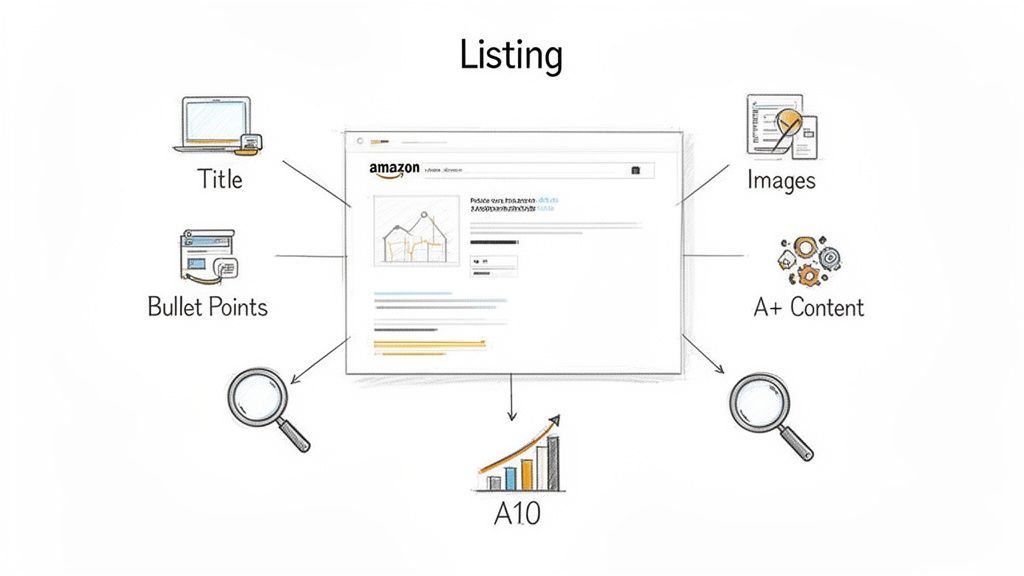
When you approach it this way, you move beyond just "doing SEO" and start creating a genuine retail experience. This focus drives sales velocity, which is one of the heaviest-weighted ranking signals Amazon pays attention to. A listing that converts like crazy tells Amazon it's a great match for what customers are looking for, rewarding you with better organic placement.
To help you visualize how all these pieces fit together, here's a quick breakdown of the core components and their impact.
Listing Element
Primary SEO Impact
Primary Conversion Impact
Title
High (Primary keyword relevance)
High (Grabs attention, sets expectations)
Bullet Points
Medium (Secondary keywords, feature indexing)
High (Highlights benefits, overcomes objections)
Main Image
Medium (Indirectly impacts CTR, a ranking signal)
Very High (First impression, critical for clicks)
Secondary Images
Low (Not directly indexed for keywords)
Very High (Showcases use cases, builds trust)
A+ Content
Medium (Indexed, boosts relevance)
High (Tells brand story, increases conversion rate)
Backend Keywords
High (Indexes for terms not visible on the front end)
None (Not visible to customers)
Reviews & Ratings
Medium (Conversion rate is a ranking signal)
Very High (Social proof, trust factor)
Each element has a job to do, contributing to both your search visibility (SEO) and your ability to turn that visibility into sales (conversion).
The single biggest mistake I see sellers make is focusing on what they want to say about their product, not what the customer actually needs to hear. This is where a simple but powerful framework called intent-scenario mapping comes into play.
Instead of just stuffing in a generic term like "running shoes," you connect your product's features to specific problems your customers are trying to solve. For example, a shopper isn't just buying "running shoes." They're looking for a solution. Your job is to map your product to their specific need:
This shift in thinking is non-negotiable now. The old days of keyword stuffing are long gone. With Amazon rolling out advanced systems like the COSMO algorithm and the Rufus AI assistant, low-quality, overstuffed content gets penalized. In fact, real-world data shows listings optimized for this kind of intent-scenario mapping can see up to 40% higher visibility in AI-powered recommendations.
A great listing anticipates and resolves a customer's core problem. When you solve for the customer, you are simultaneously solving for the algorithm, as high conversion rates are the most powerful signal you can send.
A perfectly optimized listing is a powerful engine, but it won't go anywhere without fuel. It needs traffic and sales momentum to really take off. The smartest sellers I know strategically set aside a 20-30% margin for promotions and advertising (PPC), especially when launching a new product.
This budget isn't just an expense—it's the investment required to get the sales velocity flywheel spinning.
Here's how that investment kickstarts the process:
Understanding this cycle is the key to sustainable, long-term growth on the platform. As an Amazon Verified Partner, we've seen this exact strategy propel countless brands to the top of their categories. Building a solid foundation with both on-page optimization and a savvy ad budget is how you set the stage to win.
Keyword research is the absolute foundation of a successful Amazon listing. Get this wrong, and nothing else matters. It’s not about guessing what people search for or just swiping your competitor's top terms; it's about digging into the shopper’s mindset to find the exact phrases they use when they're ready to pull out their credit card.
You have to understand that not all keywords are created equal. Broad, one-word terms like "blender" are for window shoppers. The real money is in the long-tail phrases like "quiet blender for morning smoothies"—that’s a search from someone who knows exactly what they want. Your job is to find that perfect balance between high-volume search terms and these high-intent, ready-to-buy phrases.
Forget the third-party keyword tools that just give you vague estimates. Your most powerful weapon is sitting right inside your Seller Central account: the Search Query Performance (SQP) report. This isn't guesswork; it's Amazon's own data showing you what real customers searched for right before they found, clicked, and bought your product.
The SQP report is pure gold because it cuts through the noise. By digging into this data, you can:
Your Search Query Performance report is the single source of truth for keyword research. It’s not an estimate or an industry average—it’s a direct reflection of real customer behavior for your products. Nothing else comes close to its power for refining your SEO.
Making a habit of checking this report lets you build a keyword strategy that moves with your customers, keeping your listing perfectly aligned with what people are actually searching for right now.
Your product title is the most important piece of SEO real estate on your entire listing. Period. It carries the most weight with the A10 algorithm and, more importantly, it's what makes a shopper click on your product instead of the one next to it. A sloppy title is a death sentence for your click-through rate.
The trick is to strike a balance between feeding the algorithm the keywords it wants and giving human shoppers the clear, benefit-driven info they need. And always, always write with a mobile-first mindset. Most people are shopping on their phones, where your title will get cut off. You have to make those first few words count.
Here's a simple but effective formula we use:
– with , , [# of Items/Size]
Let's see it in action:
The optimized version doesn't just stuff in keywords like "Electric Burr Coffee Grinder" and "Espresso and Drip Coffee Grinder." It immediately communicates value with "35 Grind Settings" and premium features, answering a shopper's questions before they even click. That's how you win in the search results.
While your title, bullets, and A+ Content are for your customer-facing keywords, the backend search term fields are where you get to clean up. This is your chance to capture all the traffic from keywords that didn't quite fit on the front end of your listing.
Think of this section as your keyword overflow bucket. It's the perfect spot for:
There’s one critical rule here: no repeats. Amazon only needs to see a keyword once per listing to index you for it. Repeating words from your title or bullets in the backend is a complete waste of space. Use this field to cast a wider net and maximize every possible opportunity for a shopper to find you.
On Amazon, your visuals are your sales pitch. While keywords get shoppers to your page, it’s the images and rich content that actually convince them to buy.
A weak visual strategy is like having a silent salesperson; you're leaving the most crucial part of the transaction completely to chance. This is where a thoughtful approach to your creative assets transforms casual browsers into loyal buyers.
Think beyond just snapping a few photos of your product. Your goal is to build a complete visual story that answers questions before they're asked, shows undeniable value, and builds a genuine connection with the shopper. Every single image—from the main hero shot to the last lifestyle photo—has a specific job to do in your amazon listing optimization strategy.

This conceptual workflow illustrates how all the pieces, especially strong visuals, come together to build a listing that actually converts.
Your image block is prime real estate—it’s the most viewed part of your entire listing. It needs to work hard to stop the scroll and immediately communicate why your product is the only choice that makes sense. A well-rounded image stack should tell a complete story at a glance.
Here’s a structure that we've seen work time and time again:
A pro tip for your infographics: Amazon's AI, including tools like Rufus, is getting much smarter at "reading" images through Optical Character Recognition (OCR). Design your infographics with large, clean fonts and high-contrast text to make sure the algorithm correctly interprets your product's best features and benefits.
A+ Content (what used to be called Enhanced Brand Content) is your chance to build a branded storefront right on your product detail page. It’s where you move beyond simple bullet points to tell your brand's story, dive deep into product features, and overcome any final purchase hesitations.
If you're enrolled in Brand Registry, using A+ Content isn't optional—it's a must-have tool for standing out.
Effective A+ Content isn't just about making things look pretty; it's a powerful conversion driver. By using a strategic mix of modules, you can create a visually engaging experience that holds a shopper's attention and guides them straight to that "Add to Cart" button.
The best A+ Content layouts use a variety of modules to break up information and keep the reader engaged. Don't just throw up one giant image banner and call it a day. Instead, create a logical flow that walks the customer through everything they need to know.
The payoff for this effort is huge. Internal Amazon data shows that listings with A+ Content can see 3-10% higher conversion rates and traffic increases of 5-8%. In hyper-competitive categories like supplements or beauty, this lift is often what separates the top sellers from everyone else. This extra sales velocity signals to the A9 algorithm that your product is delivering a great customer experience, which in turn fuels better organic rankings.
A strong visual strategy is an essential component, and you can explore more about building a compelling brand presence on Amazon here.
Some of the most powerful levers you can pull to win on Amazon are completely invisible to shoppers. While your copy and images do the heavy lifting on the front end, your backend is where you feed Amazon’s A10 algorithm the critical data it needs to boost your visibility and search performance.
This is a core part of Amazon listing optimization that so many sellers either rush through or ignore completely.
When a customer uses the filters on the left-hand side of a search page—filtering by color, material, or size—Amazon pulls that information directly from your backend fields. If you leave them blank, your product simply vanishes from those refined searches. You're losing out on sales from high-intent buyers who know exactly what they want.
Think of your backend attributes as a detailed checklist for the algorithm. You need to be diligent about filling out every relevant field, from "Target Audience" to "Special Features." This extra context helps Amazon match your product with a much wider range of customer searches. It even influences how AI assistants like Rufus categorize and recommend your product.
Beyond the standard fields, here's an advanced tactic: proactively manage your Customer Questions & Answers section. Don't just wait for customers to start asking things.
It's a quiet advantage that builds trust with shoppers while directly feeding Amazon's information-gathering systems.
Price is one of the most dynamic, and dangerous, factors in the Amazon ecosystem. Your goal isn't just to be the cheapest; it's to be priced competitively while fiercely protecting your margins. A race to the bottom is a race you'll eventually lose, permanently devaluing your product and destroying profitability.
Instead, think dynamically. Use a repricing tool to automatically adjust your price within a safe range based on what your competitors are doing and who owns the Buy Box. This lets you stay competitive 24/7 without having to manually watch every listing. Remember, pricing is a powerful conversion lever—a product with a fair price and a high review count signals incredible value to both shoppers and the algorithm.
Social proof is the currency of e-commerce. A product with a 4.6-star rating from 500 reviews will almost always outsell a product with a 5-star rating from just five reviews. Velocity and volume build trust.
Generating a steady stream of reviews is how you build that social proof. Positive reviews have a massive impact on your conversion rate, which is one of the biggest ranking signals for Amazon. The more efficiently your listing turns visitors into buyers, the higher Amazon will push you in the search results.
Let's be clear: never, ever incentivize reviews with free products or discounts outside of approved Amazon programs. It's the fastest way to get your account suspended. Instead, focus on these ethical, compliant methods to encourage feedback.
By mastering these behind-the-scenes elements—from detailed backend attributes to smart pricing and review generation—you build a powerful foundation that sets you up for long-term, sustainable success on Amazon.
A masterfully optimized product listing is the engine of your Amazon business, but it doesn't run in a vacuum. Think of it as the central hub where all your advertising traffic lands. This makes its performance directly tied to the efficiency of every dollar you spend on ads. Real Amazon listing optimization isn't just about keywords; it's the fuel for your PPC campaigns and the foundation for meaningful analytics.
Your listing has one primary job: convert the traffic your ads bring in. If your PPC campaigns are sending high-intent shoppers to a page that doesn't answer their questions, build trust, or look professional, you're not just losing a sale. You're actively torching your ad budget and signaling to Amazon's algorithm that your product isn't relevant.
The relationship between your listing and your Pay-Per-Click (PPC) campaigns is direct, measurable, and immediate. Amazon's ad algorithm doesn't just look at how much you're willing to bid; it heavily weighs the relevance of your product to whatever the shopper searched for. A well-optimized listing screams relevance, and Amazon rewards that with better ad placements at a lower cost.
When your listing is perfectly aligned with the keywords you're bidding on, a few key things happen:
A well-optimized listing is your best defense against rising ad costs. It improves your organic relevance, which in turn makes your paid advertising more efficient. You pay less per click and convert more of the traffic you do pay for.
This synergy creates a powerful growth loop. Paid traffic boosts your sales velocity, which improves your organic rank. A better organic rank then allows you to strategically pull back on ad dependency, improving your overall profitability.
Your brand's messaging shouldn't start and end on Amazon. For sellers running Demand-Side Platform (DSP) ads or campaigns on social media, consistency is everything. The visuals, headlines, and promises you make in your off-Amazon ads must create a seamless, trustworthy handoff when a user clicks through to your product listing.
Imagine a customer sees a slick DSP ad showing your product's durability with a specific lifestyle image. When they click and land on your Amazon page, they should immediately see that same imagery and messaging reinforced. Any disconnect creates friction and confusion, which is an absolute conversion killer. Aligning these elements makes the customer journey feel intuitive and builds instant trust.
To see just how direct this relationship is, let’s look at how specific on-page changes impact your paid campaigns.
This table breaks down the cause-and-effect relationship between your listing and your ad performance.
Listing Optimization Action
Affected PPC Metric
Expected Outcome
Adding a key benefit to the title
Click-Through Rate (CTR)
Increased ad clicks and relevance score
Adding a lifestyle image for a key use case
Conversion Rate (CVR)
More sales from ad-generated traffic
Including long-tail keywords in bullets
Relevance Score
Lower Cost-Per-Click (CPC) on those terms
Improving A+ Content with a comparison chart
Conversion Rate (CVR)
Reduced ACoS by closing more sales
As you can see, every improvement you make to the listing has a direct, positive impact on your ad account's bottom line.
For brands that sell both on and off Amazon, understanding the complete customer path to purchase is a massive competitive advantage. Shoppers rarely operate in a single channel; they might discover your brand on Instagram, research it on Google, and finally buy on Amazon. If you can't connect those dots, you're flying blind.
This is where integrating analytics tools becomes non-negotiable. For brands driving external traffic, it's possible to gain much deeper insights into user behavior. For instance, learning how users move from discovery to purchase can be a game-changer. You can find more information about connecting different analytics platforms like Google Analytics to track these multi-channel journeys.

By tracking the full funnel, you can finally answer critical business questions like:
This integrated view empowers you to make smarter, data-driven decisions. You can allocate your marketing budget where it truly works, optimize campaigns based on full-funnel performance, and scale your brand's growth profitably—just like the top 1% of sellers do.
Getting your optimized listing live isn’t the finish line—it’s the starting line. The real work begins now, shifting from creator to analyst. This is where you use Amazon's own data to prove your strategy is working and find the next opportunity to get ahead. A data-backed process is what separates sellers who sustain growth from those who fade away.
Your command center for this is Seller Central. Forget vanity metrics; the only numbers that matter are the ones that directly impact your bottom line.
This constant feedback loop is where the magic happens. A killer listing makes your ads cheaper and more effective, while your ad data tells you exactly how real customers are reacting to your copy and creative.
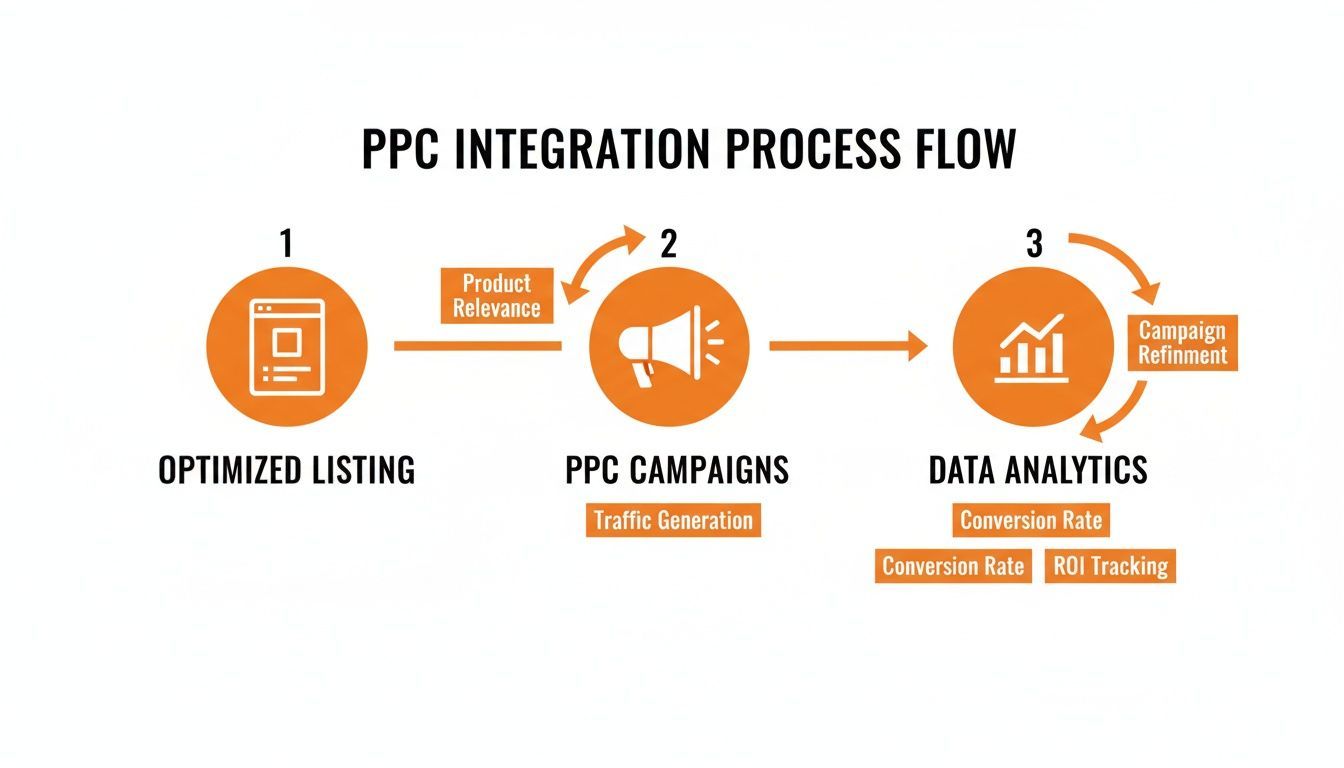
They fuel each other. A strong listing makes ads more efficient, and ad performance reveals what to tweak next on your listing.
To really know if your Amazon listing optimization efforts are paying off, you need to live in your reports. The story of your performance is told by the relationship between three core metrics:
I see this all the time: a seller has high impressions but a painfully low CTR. That’s a classic sign their backend keywords are firing correctly—people are seeing the listing—but the front-end elements like the main image or title just aren't strong enough to earn the click. It’s a crystal-clear signal telling you exactly where to focus your next A/B test.
Guesswork has no place in a winning Amazon strategy. For Brand Registered sellers, Amazon's "Manage Your Experiments" tool is your best friend. It lets you run direct split tests on your title, main image, or A+ Content, giving you undeniable proof of what your customers prefer.
You could, for example, test a title that screams benefits against one that’s packed with features. Let it run, and Amazon will declare a winner based on statistically significant data. No more debates, just facts. This is how you stack small wins that lead to massive, long-term growth.
Just be patient. You might see a bump in metrics like CTR within a week or two, but significant ranking changes often take 4-6 weeks. Amazon's algorithm needs time to collect enough sales data to re-evaluate your listing's authority for key search terms.
When you commit to this process, you can realistically improve organic CTR and conversions by 25-40%. It’s easily one of the highest-return activities you can focus on. For a deeper dive into current timelines and performance benchmarks, you can discover more insights about optimization returns.
When you're deep in the trenches of Amazon listing optimization, a few questions always seem to pop up. Here are some quick, no-nonsense answers to the ones we hear most often from sellers.
This is a big one. You definitely want to avoid making constant, small tweaks. Every time you change your listing, you can temporarily disrupt its ranking momentum, so tinkering too often can do more harm than good.
A much better approach is to schedule a major audit and refresh every quarter or, at the very least, twice a year. This rhythm lets you stay ahead of seasonal trends, adapt to any Amazon algorithm updates, and capitalize on new search behaviors you've uncovered in your reports.
That said, you should be checking your Search Query Performance (SQP) reports every couple of weeks. This is your early warning system—it helps you spot emerging keywords and trends that might be worth a quick, surgical update to your backend search terms or maybe a bullet point.
If I had to pick just one, it would be the product title. Hands down. It carries the most weight for both search visibility and getting shoppers to actually click on your product. Think about it—it’s the first thing both the A10 algorithm and a human customer see.
A well-crafted title that balances your most critical keywords with clear, compelling benefits gives you the highest return on your optimization efforts. In a sea of search results, your title is what makes a shopper click on your product instead of the dozen others surrounding it. It's that powerful.
No, absolutely not. This is one of the most common mistakes we see, and it's a huge waste of valuable digital real estate. Amazon's algorithm only needs to index a keyword once per listing to make you eligible to rank for it. Stuffing the same terms over and over again offers zero extra benefit.
A smarter strategy is to use each section of your listing—title, bullets, description, and backend search terms—to target different sets of relevant keywords. This approach maximizes your overall search footprint and makes your product discoverable for a much wider range of customer queries.
At Clickstera Solutions LLC, we turn these insights into profitable growth. Our full-service account management and advanced advertising strategies are designed to scale brands on Amazon and beyond. Discover how our team can build a cohesive strategy to drive your visibility and sales. Learn more about our performance-driven approach at https://clickstera.com.
Talk to Clickstera and get a clear next-step plan to scale your performance marketing.