Loading article
Loading page...
An Amazon PPC agency is a team of specialists who live and breathe Amazon advertising. They’re not just managing campaigns; they’re acting as a strategic partner to turn your ad spend from a necessary cost into a powerful engine for growing revenue, grabbing market share, and boosting your brand.
In a marketplace as crowded as Amazon, running ads has gone from a simple task to a full-blown strategic challenge. For many brands, trying to navigate this alone is like trying to drive a race car without a pit crew—you might stay on the track, but you’re definitely not winning the race.
This is where a dedicated agency comes in. Think of them as your strategic pit crew and race strategist all in one. They don’t just "run ads." They’re digging into market trends, keeping a close eye on what your competitors are doing, and constantly fine-tuning your campaigns to squeeze every last drop of performance out of your budget. Their entire job is to make your ad spend a predictable driver of growth.
The need for expert management has become undeniable as the platform gets more competitive. The Amazon advertising space has seen some serious cost inflation through 2025, with the average Cost Per Click (CPC) hitting $1.12—a steep 15.5% jump from the previous year. This is happening because third-party sellers now make up roughly 61-62% of all paid units sold. For brands spending significant money on ads, that inflation means you’re paying a lot more just to get the same number of clicks.
An experienced agency knows how to shield your budget from this. They use advanced bidding strategies, build hyper-efficient campaign structures, and rely on data-driven optimizations that a busy in-house team simply doesn't have the time to uncover.
Ultimately, partnering with an agency is about getting better business outcomes. Their expertise translates directly into real results that go way beyond simple ad metrics. A top-tier agency delivers value in a few key ways:
By hiring a team that lives and breathes Amazon advertising, you get a partner dedicated to making every ad dollar work harder to scale your brand profitably. These agencies, especially those recognized by the Amazon Verified Partner program, have the specialized skills needed to not just compete, but to win.
Before deciding if an agency is right for you, it helps to see a side-by-side comparison of what each path looks like.
Aspect
In-House Team
Specialized Agency Partner
Expertise
General marketing knowledge; may lack deep Amazon-specific experience.
Deep, specialized expertise in Amazon's ad platform and algorithm.
Technology
Limited to standard tools or requires expensive software subscriptions.
Access to advanced, proprietary, and enterprise-level advertising tools.
Focus
Juggles multiple marketing responsibilities, diluting focus on PPC.
100% focused on optimizing and scaling Amazon advertising campaigns.
Cost
Full-time salaries, benefits, and overhead for one or more employees.
A predictable monthly retainer or performance-based fee, often lower than FTE.
Strategy
Often reactive, focused on day-to-day management and hitting ACoS.
Proactive and strategic, focused on long-term growth, market share, and TACoS.
Accountability
Performance can be difficult to isolate from other marketing efforts.
Directly accountable for PPC results with clear, data-driven reporting.
While an in-house team offers direct control, an agency partner brings a level of specialized expertise, technology, and strategic focus that's tough to replicate internally without a significant investment. For brands serious about scaling, an agency can be the catalyst that turns potential into profit.
So, what does a great Amazon PPC agency actually do all day? It's a fair question, and the answer goes way beyond just launching campaigns and tweaking bids. A top-tier agency acts as a dedicated growth team, managing a whole suite of services designed to drive sales, steal market share, and build your brand on the world's biggest digital shelf.
Think of it like building a house. You wouldn’t just start throwing up walls without a solid foundation and a detailed blueprint. In the same way, a skilled agency starts with deep strategic work before a single dollar of your ad budget is spent. This foundational planning is what separates basic management from a true growth partnership.
This is how it all connects—the agency becomes the engine that turns your brand's goals into real, measurable outcomes like revenue, market share, and visibility.
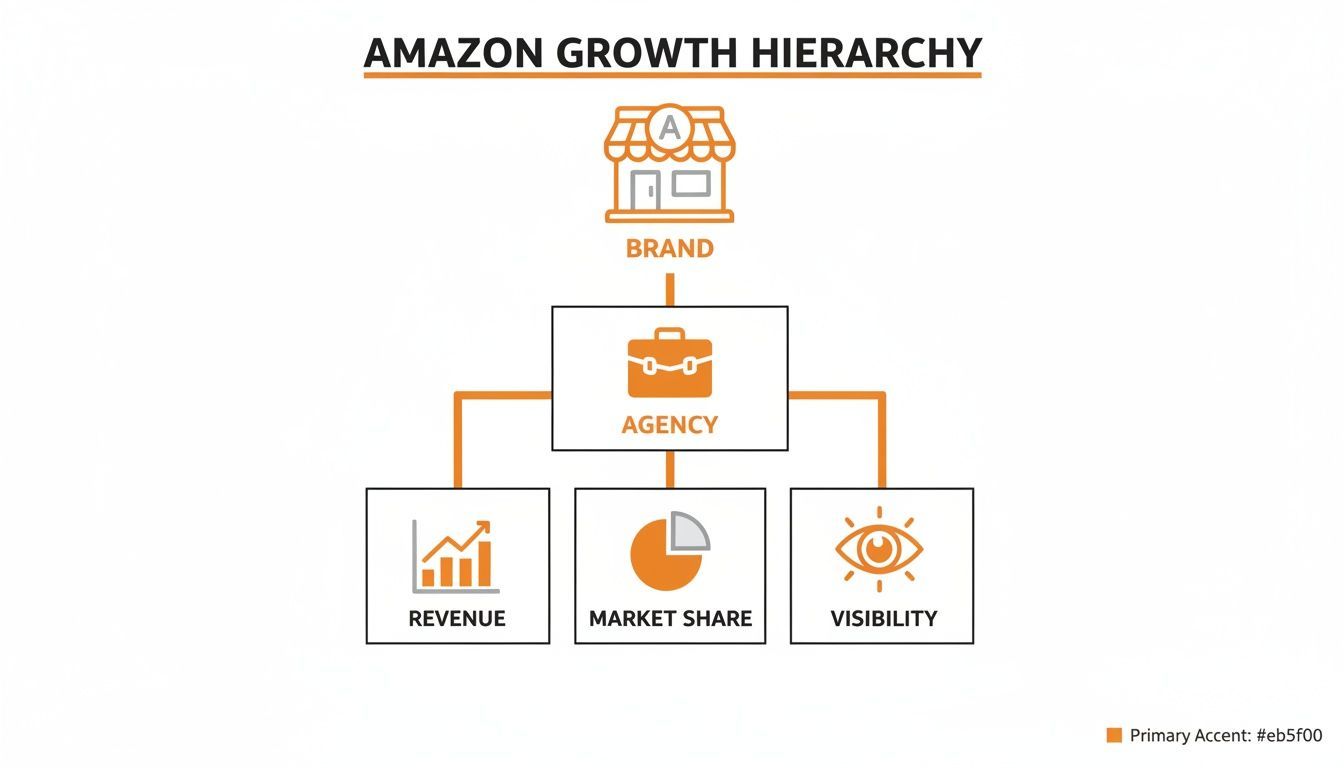
The agency is the critical link, translating your high-level objectives into the nitty-gritty actions that define success on Amazon.
Before a single ad goes live, a sharp agency invests heavily in understanding the battlefield. This isn't just a quick keyword search; it’s a deep-dive analysis that pieces together the whole puzzle.
This initial grind provides the data needed to build campaigns that are effective from day one, not just active.
With a solid strategy in place, the agency shifts to execution. They design a tough, scalable campaign structure that uses Amazon's different ad types to catch shoppers at every stage of their buying journey.
A classic mistake sellers make is cramming too many products and keywords into one campaign. An agency builds a granular structure where every campaign, ad group, and keyword has a specific job. This gives them precise control over budget and bidding.
The core ad types they manage include:
For brands ready to get aggressive, a premier Amazon PPC agency will bring Amazon DSP (Demand-Side Platform) to the table. This is where their expertise really flexes. Unlike the ads managed in Seller Central, Amazon DSP lets brands programmatically buy ad placements across the entire web—including Amazon-owned sites like IMDb and Twitch, plus thousands of other websites and apps.
This is a game-changer for reaching audiences before they even start searching on Amazon. An agency uses DSP to build massive brand awareness, target competitor audiences, and create powerful retargeting funnels that pull shoppers back to your listings.
Getting clicks is only half the battle. A truly great agency knows that a click is worthless if it doesn't turn into a sale. That's why their work often includes optimizing everything a shopper sees after the click.
This focus on conversion is what makes the platform so powerful. In fact, Amazon PPC conversion rates averaged around 11.1% in 2025—more than eight times higher than the typical e-commerce website conversion rate of 1.33%. Why? Because people come to Amazon ready to buy. You can dig into more of these powerful Amazon advertising statistics and what they mean for sellers.
To capitalize on this high-intent traffic, an agency will often help with:
By tying strategic advertising together with conversion-focused creative, a top-tier agency delivers a complete growth system that turns ad spend into sustainable, profitable revenue.
An expert agency speaks Amazon's data language fluently, but their real value is in translating that data into a smart business strategy. Your Seller Central dashboard is filled with acronyms, and knowing how to read between the lines is what separates wasteful spending from a genuine investment. A skilled Amazon PPC agency doesn't just use these metrics to report on the past—they use them to chart a course for your future growth.
They go beyond surface-level numbers to connect your ad performance directly to your company's bottom line.
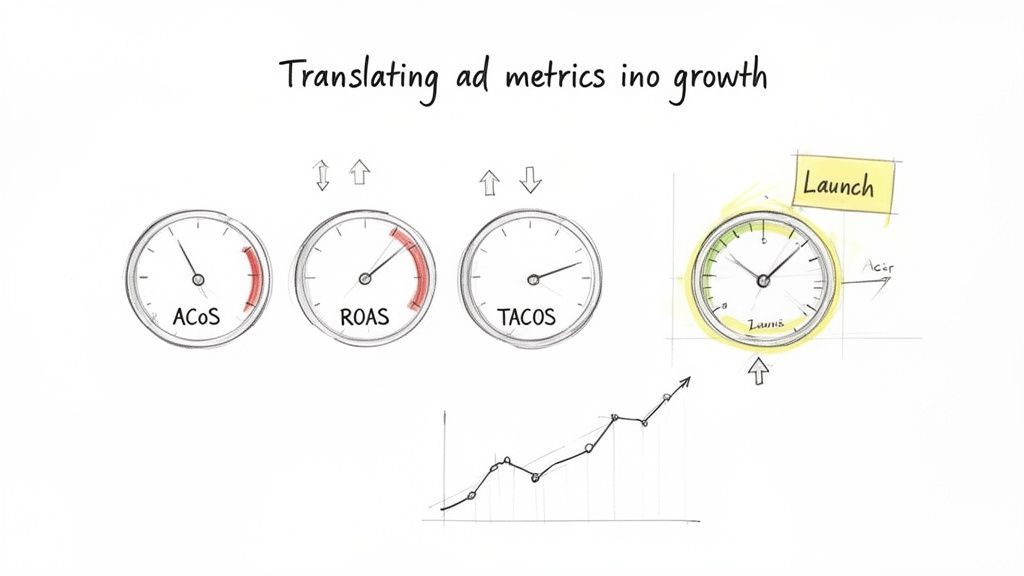
Almost every seller knows ACoS (Advertising Cost of Sales) and ROAS (Return on Ad Spend). They're just two sides of the same coin—ACoS measures cost as a percentage of ad revenue, while ROAS measures revenue as a multiple of your ad spend. But here's what many miss: a "good" ACoS or ROAS is completely relative to your business goals.
For example, a high ACoS isn't automatically a red flag. If you're launching a new product, running an aggressive ACoS is often a strategic move to grab early sales velocity, lock in those first crucial reviews, and climb the organic search rankings. In that context, the ad spend is an investment in long-term visibility.
On the flip side, for a mature, profitable product, the goal shifts. You're no longer chasing rank; you're maximizing profit. That means driving ACoS down and ROAS up. The agency’s job is to know exactly when to hit the accelerator and when to focus on fuel efficiency.
While ACoS tells you how efficiently your ads are performing against ad-driven sales, TACOS (Total Advertising Cost of Sales) gives you the bigger picture. It measures your ad spend against your total sales—including all the organic ones.
TACOS is the North Star metric for sustainable growth. It tells you if your advertising is creating a "halo effect"—driving enough momentum to lift your organic sales and reduce your overall dependency on paid ads over time. A decreasing TACOS is a clear sign of a healthy brand.
A sharp agency uses TACOS to answer the questions that really matter:
This holistic view ensures that your ad spend is building a long-term asset, not just generating expensive, short-term sales. It’s the difference between buying customers and building a real brand.
Another powerful tool in an agency's arsenal is New-to-Brand (NTB) data. These metrics pinpoint customers who are buying your brand’s products on Amazon for the first time in the last year. This is gold for understanding whether your campaigns are actually acquiring new customers or just recycling your existing ones.
An agency uses NTB data to fine-tune strategies based on specific objectives.
Business Objective
How an Agency Uses NTB Data
Market Share Expansion
They’ll push campaigns (like Sponsored Brands and DSP) that consistently bring in a high percentage of NTB orders, aiming to steal customers from competitors.
Customer Loyalty
For brands focused on repeat business, they might shift the budget to re-engage past buyers, knowing the NTB rate will be lower.
Audience Discovery
If certain keywords or targeting tactics show surprisingly high NTB rates, it signals a new, untapped customer segment to explore.
By digging into these advanced metrics, an Amazon PPC agency turns raw data into a clear story about your brand's health and direction. They make sure every dollar you spend is tied to a measurable business outcome, whether that's aggressive market entry, profitable scaling, or long-term brand building.
Picking an Amazon PPC agency is one of the biggest decisions you'll make for your brand’s growth. This isn't just about handing off bid management; it's about finding a strategic partner who genuinely understands your business and can turn your goals into profitable advertising.
A great agency feels like an extension of your team. A bad one? They can burn through your budget with little to show for it. To make the right call, you need to look past the sales pitch and dig into their actual process, expertise, and track record.
A solid evaluation process is your best defense against a bad partnership. Before you even think about signing a contract, put every potential agency through its paces with a checklist designed to separate the talkers from the doers.
Understanding how an agency structures its fees is critical. It helps you budget properly and, more importantly, ensures their incentives are aligned with yours. Most agencies use one of a few common models, each with its own pros and cons.
Generally, you'll find agencies charging between 10-20% of your monthly ad spend or a flat retainer from $2,000 to $10,000+ depending on the complexity. Most reputable agencies require a minimum ad spend of $5,000-$10,000 per month and might charge a one-time setup fee of $1,000 to $5,000 to build out your initial campaigns. In return, strong partnerships often deliver ACoS reductions of 15-30% within the first 60-90 days. You can find more details about typical agency pricing structures and what to expect.
To help you sort through the options, here’s a breakdown of the most common pricing structures you’ll encounter.
This table offers a clear breakdown of the most common agency fee structures, designed to help you understand what you are paying for and which model aligns best with your business goals.
Pricing Model
How It Works
Best For
Potential Drawback
Percentage of Ad Spend
The agency charges a set percentage of your total monthly ad spend.
Brands with large, scaling budgets where management complexity grows with spend.
Can incentivize agencies to increase your spend, even if it's not the most profitable strategy.
Flat Monthly Retainer
You pay a fixed fee each month, regardless of your ad spend.
Brands with stable budgets who want predictable monthly costs.
The fee is fixed even if your ad spend decreases, and may not scale with your needs.
Hybrid Model
A combination of a flat retainer plus a smaller percentage of ad spend.
Brands who want predictability but also want the agency to be invested in scaling spend.
Can be more complex to budget for and requires clear terms in the contract.
Performance-Based
The fee is tied directly to hitting specific performance targets, like ROAS or sales growth.
Brands who want to minimize risk and pay only for tangible results.
Less common and often comes with a higher potential fee if goals are exceeded.
Ultimately, the best model is the one that fits your budget, growth stage, and overall business objectives. Be sure to have a frank conversation about this before committing.
While you’re vetting potential partners, keep your eyes peeled for warning signs. Spotting these red flags early can save you a world of headache and wasted ad spend down the road.
An agency that promises specific results, like a "guaranteed #1 rank" or a "50% ACoS reduction in 30 days," is a major red flag. Amazon advertising is dynamic and complex; no one can guarantee specific outcomes. Look for partners who promise a sound strategy and a data-driven process, not impossible results.
Here are a few other warnings to watch out for:
Trust your gut. If a conversation feels more like a high-pressure sales call than a strategic consultation, it’s probably time to walk away. The relationship with your agency should feel like a partnership built on mutual trust from day one. For brands also exploring paid search, you might be interested in our guide on choosing a Google Ads partner.
Once the contract is signed, the real work begins. The first three months with a new Amazon PPC agency are a critical period of discovery, planning, and laying the groundwork. A great agency doesn't just "turn on" campaigns and hope for the best; they follow a meticulous process designed to build a profitable, long-term advertising strategy from the ground up.
Think of this period as building the engine for your growth. The first 30 days are all about disassembly and inspection—understanding every single component of your existing account. The next 30 are about reassembly and blueprinting—designing a new, more powerful structure. The final 30 days are the first test drive, where we gather initial data and make precise adjustments.
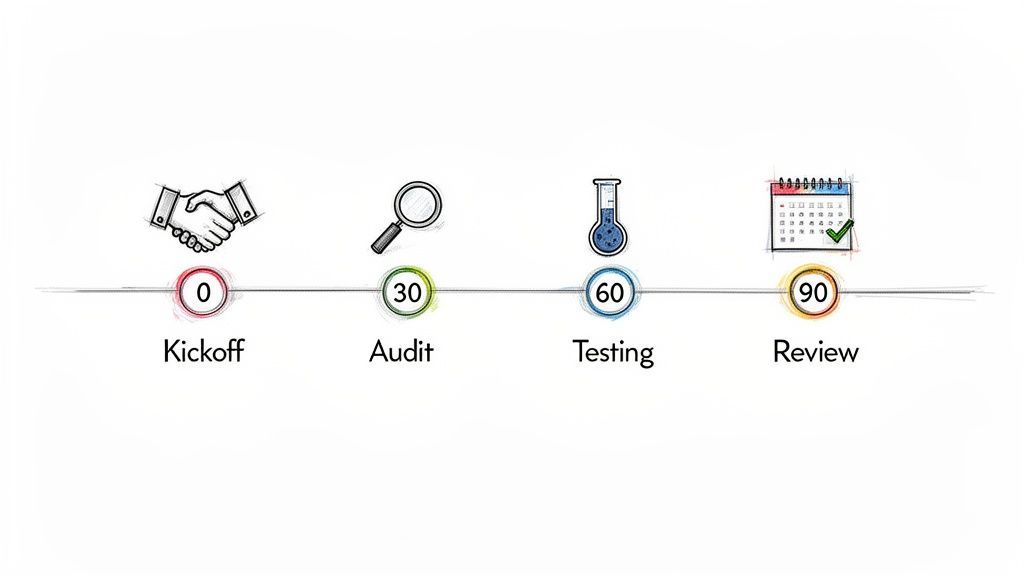
This structured approach ensures every decision is backed by solid data and fully aligned with your brand's unique goals, setting the stage for scalable success down the road.
The first 30 days are dedicated almost entirely to deep learning and analysis. Your new agency partners will immerse themselves in your business, your products, and your competitive landscape to understand exactly where you stand and where you need to go.
This phase kicks off with a detailed onboarding call to define key objectives, establish communication rhythms, and grant account access. From there, the team digs into a comprehensive audit of your advertising history, identifying what worked, what failed, and where the immediate opportunities for improvement lie.
The initial audit isn't just about finding wasted ad spend. It's about uncovering the story your data is telling—from hidden keyword opportunities to misunderstood customer search behavior. A skilled agency uses this story to write the next chapter of your brand's growth.
With a clear picture of your account's history and potential, the second month shifts from analysis to action. Your agency will present a formal strategy document outlining their proposed campaign architecture, budget allocation, and target KPIs for the months ahead. This is a collaborative process where your feedback is essential.
Once the strategy gets the green light, the heavy lifting begins. The team will meticulously build out new campaigns, following proven best practices. This often involves:
This restructuring is the blueprint for all future optimizations. It’s absolutely crucial for getting clean data and scaling efficiently.
In the final phase of this initial period, the new campaigns go live and the data starts flowing in. The main goal of month three isn't immediate profitability—it's about establishing a reliable performance baseline. The agency will be watching key metrics like a hawk, making small, iterative adjustments to bids and budgets.
Expect frequent communication during this time, including weekly check-in calls and detailed performance reports. This month is all about gathering intelligence. We’re learning how shoppers respond to the new structure and identifying the keywords and ad placements that will become the cornerstones of your long-term growth. This foundational work paves the way for the aggressive scaling to come.
You now have the complete playbook on what a real Amazon PPC agency does and, just as importantly, how to spot a great one. Making the leap from DIY ads to bringing in a strategic partner is a big step, but it’s often the exact move that separates brands that plateau from the ones that become market leaders.
Remember, a top-tier agency doesn’t just manage your campaigns; they translate your business goals into a profitable advertising machine. They're your growth partners, not just button-pushers. They turn messy data into smart decisions that actually grow your bottom line, steal market share, and build a brand that lasts on Amazon.
Making the right choice starts with doing your homework. Don't just jump on a dozen sales calls unprepared. Walk in ready, and you'll control the conversation, allowing you to evaluate agencies on your own terms.
Here’s a simple checklist to get you started:
The goal isn’t to find the cheapest agency; it’s to find the partner who delivers the most value. Think of a great agency as an investment in your brand’s future—the strategic horsepower you need to navigate Amazon's jungle and unlock your true potential.
Armed with this roadmap, you’re now ready to find an Amazon PPC agency that feels less like a vendor and more like an extension of your own team—one that’s laser-focused on driving real, profitable growth for years to come.
Here are a few of the most common questions brands ask when they're thinking about working with an Amazon PPC agency.
While you'll often see initial improvements in efficiency metrics like ACoS within the first 30-60 days, the real, sustainable business growth—like a steady climb in sales and better total profitability (TACoS)—usually takes about 3-6 months to lock in. It’s best to think of the first month as a discovery and rebuilding phase.
This initial period is all about the deep work: a thorough account audit, redesigning campaign structures from the ground up, and gathering clean baseline data. The months that follow are for strategic testing, scaling what works, and fine-tuning the approach based on what the numbers tell us. Patience here is everything; it’s how you build a foundation that can actually support long-term growth.
It's a common misconception that an agency can just flip a switch and double your sales overnight. The reality is a methodical process. Quick wins are great, but sustainable growth is built on the strategic groundwork laid in the first 90 days.
This is a critical distinction to make. PPC software gives you powerful automation for tasks like bid adjustments, pulling new keywords, and generating reports. But at the end of the day, it's still just a tool. It needs a human strategist to interpret the data, define the high-level goals, and make the creative calls that software simply can't.
An Amazon PPC agency, on the other hand, brings that human expertise and pairs it with advanced software. The agency provides the critical thinking, the competitive analysis, and the creative problem-solving that technology can't replicate. They tell the software what to do, not the other way around, making sure the tools are always serving your specific business goals.
Think of it this way: the software is a high-performance race car, but the agency is the experienced driver who knows the track, anticipates the turns, and ultimately wins the race.
Yes, any reputable agency that’s serious about getting results will need user permissions for your Seller Central account. This is the only way they can effectively manage your campaigns and analyze performance data. The good news is, you always keep full ownership and control over who has access and what they can see.
You never give them your main login credentials. Instead, you grant them specific, limited permissions as a secondary user. To make fully informed decisions, they'll typically need access to:
This level of transparency is non-negotiable for a true partnership. It lets your agency operate with a complete view of the data, ensuring their strategies are based on the full picture of your brand's performance.
Ready to turn your ad spend into a predictable engine for growth? The team at Clickstera Solutions LLC combines expert strategy with advanced technology to help great brands win on Amazon. Schedule your free growth analysis today and see what a true performance partner can do for you.
Talk to Clickstera and get a clear next-step plan to scale your performance marketing.