
Loading article
Loading page...

#AmazonPPC #PPCManagement #EcommerceAdvertising #AmazonSponsoredAds
Amazon PPC management has become the dividing line between sellers who thrive and those who merely survive in today’s hyper-competitive marketplace. With more than 9.7 million sellers fighting for visibility, relying on organic rankings alone is no longer enough. Advertising is no longer optional; it is a critical growth driver for any seller who wants to build a sustainable and profitable business on Amazon.
The challenge most sellers face is simple but costly: they pour money into advertising without understanding how to make it profitable. They treat PPC as an unavoidable expense instead of a strategic system designed to multiply revenue. The result is predictable campaigns run without direction, budgets are wasted, and performance barely improves. Meanwhile, advanced sellers treat PPC as a performance engine. They measure everything, optimize continuously, and follow structured methods that turn ad spend into long-term profitability.
“What gets measured gets managed.”
Peter Drucker
In Amazon advertising, this principle separates six-figure sellers from seven-figure sellers. The difference is never about spending more; it’s about spending with intention, consistently testing, and refining strategies based on real performance data. This guide explains how top Amazon PPC experts structure campaigns that don’t just generate clicks but produce reliable, scalable, and sustainable profit.
Amazon PPC (Pay-Per-Click) is Amazon’s internal advertising system where sellers bid on keywords to appear in strategically placed ads across search results and product pages. The model is straightforward: you pay only when a shopper clicks the ad, making it performance-driven and measurable.
The mechanism behind PPC is a rapid, intelligent auction that takes place in milliseconds. When a customer searches for something such as “stainless steel water bottle”, Amazon evaluates every seller bidding on that keyword. It considers your bid, product relevance, listing strength, conversion history, and your likelihood of satisfying the shopper’s intent. This evaluation happens instantly before the page loads, determining which ads appear and in what order.
What makes Amazon PPC fundamentally different from social platforms is the level of purchase intent. Amazon users are not browsing passively; they are actively shopping. Each search carries clear buying intent, and PPC lets you position your product precisely at that decision-making moment.
Amazon PPC revolves around three primary ad types: Sponsored Products, Sponsored Brands, and Sponsored Display. Each has a defined purpose but works together to improve visibility, conversions, and brand reach. Sponsored Products are designed to drive direct sales and typically deliver the highest return. Sponsored Brands build recognition and authority, especially for catalogues with multiple products. Sponsored Display extends reach by retargeting audiences both on and beyond Amazon.
Targeting is the backbone of Amazon PPC. Automatic targeting allows Amazon’s algorithm to test search queries and identify relevant opportunities. Manual targeting gives direct control over keyword selection. Professional PPC managers run both automatic campaigns for continuous keyword discovery and manual campaigns for maximising proven, high-value terms.
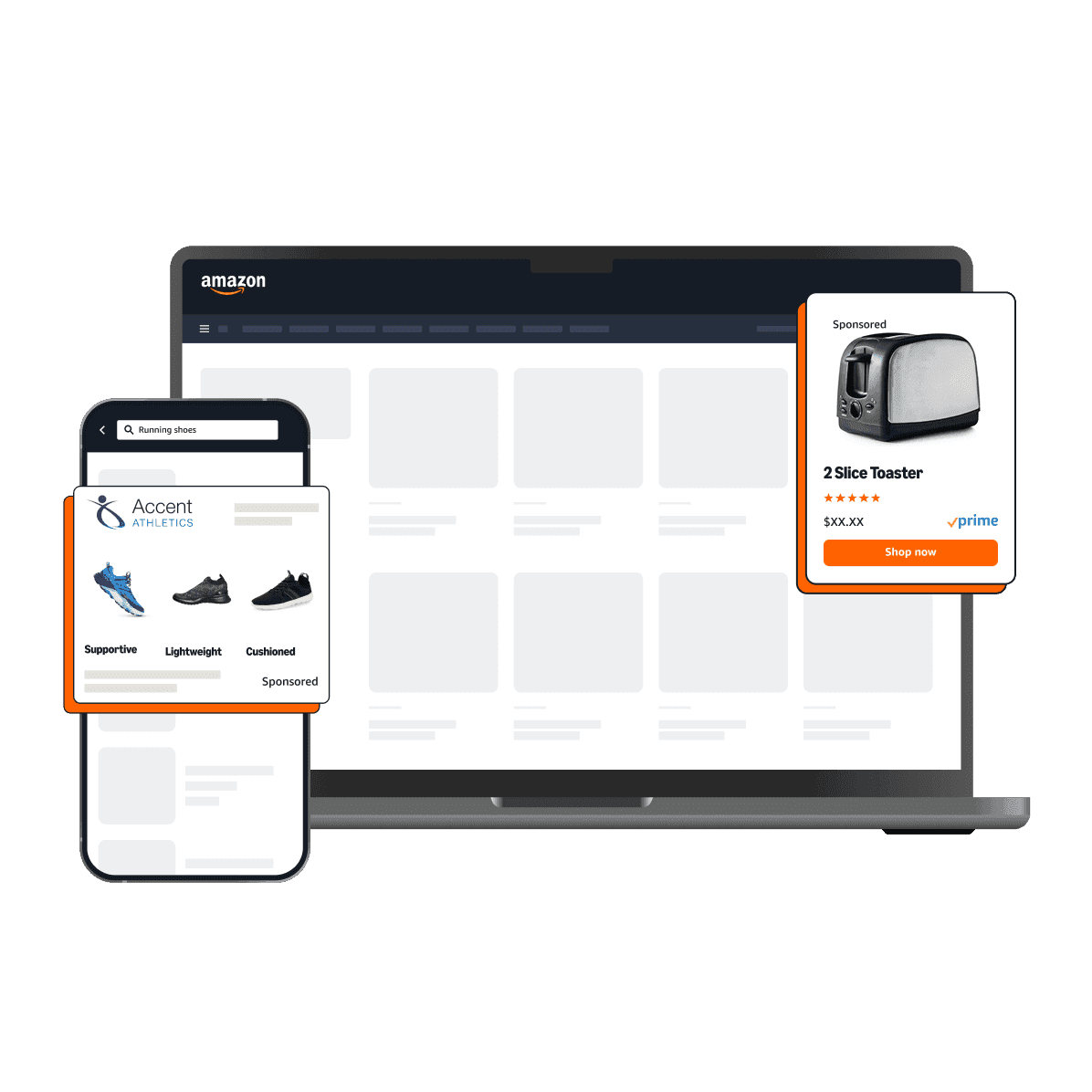
Showcasing the power of Amazon’s core Sponsored Ads reaching customers across Desktop, Mobile, and Search with highly targeted placements that drive visibility and sales.
Sponsored Products remain the centrepiece of any Amazon PPC strategy because they reach shoppers with strong purchase intent. When someone searches for an “ergonomic office chair,” they aren’t browsing casually; they’re actively seeking a solution. Showing up at that moment can determine who wins the sale.
A powerful approach to maximising Sponsored Products is combining automatic and manual targeting intelligently. Automatic campaigns gather real shopper data, and within a few weeks, you can identify profitable keywords. These keywords are then moved into manual campaigns for precise bidding and stronger control. This creates a continuous loop of discovery, refinement, and scaling.
Professional Amazon PPC agencies follow highly structured setups to ensure accurate tracking and controlled optimization. Products are separated by category, margin level, and performance behaviour because each behaves differently. High-margin products allow more aggressive bidding, while low-margin items demand strict efficiency and conservative spending.
This segmentation keeps campaign management clean and ensures decisions are based on accurate performance data rather than blended averages. Electronics, home goods, beauty items, and supplements all carry different cost structures and competitive pressures. Proper separation ensures both higher performance and better profitability.
Keywords connect shopper intent with your product. Many sellers mistakenly believe that targeting more keywords automatically increases traffic. In reality, true profitability comes from identifying the keywords where your product aligns directly with what shoppers are actively searching for.
Keywords fall into three important categories.
Your search term report is your most valuable resource for identifying profitable keywords. It reveals exactly what shoppers typed before clicking your ad and whether that click resulted in a sale. Regularly reviewing these reports uncovers patterns that drive growth. Negative keywords are equally important. Eliminating terms that generate clicks without conversions protects your budget and ensures ads appear only for relevant shoppers.
Bid strategies require ongoing adjustments based on performance, competition, and profit margins. ACoS (Advertising Cost of Sale) is the core metric guiding these decisions, calculated by dividing ad spend by ad-attributed revenue. Your target ACoS should always align with your product’s margin. For instance, a product with a 40% margin can comfortably sustain a 25–30% ACoS while remaining profitable.
However, even the strongest campaign structures cannot succeed if the listing is weak. Your main image, title, bullets, and A+ Content directly influence whether a click converts into a sale. Weak visuals, unclear value propositions, or benefit-poor bullets can cost you sales and waste your ad spend. Optimizing your listing ensures every paid click has the highest chance of turning into revenue.
Advanced sellers apply performance-based segmentation. High-performing products receive most of the budget because they generate predictable returns. Moderate performers receive balanced optimization, while new products receive controlled budgets to gather necessary data.
Scaling PPC campaigns is never about increasing budgets blindly. True scaling requires a disciplined optimization rhythm. Reviewing search terms early in the week, adjusting bids mid-week, and harvesting winners at week’s end creates a consistent improvement cycle. Over time, these incremental refinements compound into major performance gains.
Dayparting is another advanced strategy. By analysing the hours when your ads convert best, you can increase bids during high-performance times and reduce them during low-conversion periods. This ensures your budget is always allocated where it produces the strongest return.
Sophisticated advertisers focus on how different ad types support each other. Sponsored Products drive conversions, Sponsored Brands build visibility, and Sponsored Display retargets high-intent shoppers. When used together, they create a complete funnel strategy that boosts both paid and organic performance.
At this stage, TACoS (Total Advertising Cost of Sale) becomes critically important. It measures advertising’s impact on total revenue, not just ad-attributed revenue. PPC performance intersects with pricing, reviews, competition, and inventory. Sustainable growth comes from understanding these interconnections, rather than treating PPC as an isolated activity.
A well-run PPC strategy isn’t just about lowering ACoS—it’s about unlocking growth you can’t reach alone. When experts take over the heavy lifting, your ad spend becomes smarter, your margins get healthier, and your time goes back into scaling the business. The difference between managing PPC yourself and hiring specialists is often the difference between “maintaining” and truly “growing.”
Ready to transform your Amazon advertising from expense to profit centre? Our Amazon PPC management services combine data-driven strategy with hands-on optimization to maximise ROI. Contact us today for a free campaign audit and discover how much profit you’re leaving on the table.
What is Amazon PPC management and why is it important?
Amazon PPC management involves creating, optimizing, and scaling ad campaigns to control costs while driving sales. It’s important because proper management improves visibility, increases conversions, and protects profitability.
How often should Amazon PPC campaigns be optimized?
Amazon PPC campaigns should be reviewed weekly for bids, keywords, and performance trends, with deeper optimizations done monthly to ensure consistent results.
How does listing optimization impact Amazon PPC performance?
Well-optimized listings improve conversion rates, which lowers ACoS and helps ads perform better by turning clicks into sales more efficiently.
When should sellers use advanced Amazon PPC strategies?
Advanced strategies are best used once baseline campaigns are stable, allowing sellers to scale profitably through refined targeting, automation, and data-driven optimizations.
Amazon PPC management involves creating, optimizing, and scaling ad campaigns to control costs while driving sales. It’s important because proper management improves visibility, increases conversions, and protects profitability.
Amazon PPC campaigns should be reviewed weekly for bids, keywords, and performance trends, with deeper optimizations done monthly to ensure consistent results.
Well-optimized listings improve conversion rates, which lowers ACoS and helps ads perform better by turning clicks into sales more efficiently.
Advanced strategies are best used once baseline campaigns are stable, allowing sellers to scale profitably through refined targeting, automation, and data-driven optimizations.
Talk to Clickstera and get a clear next-step plan to scale your performance marketing.