Loading article
Loading page...
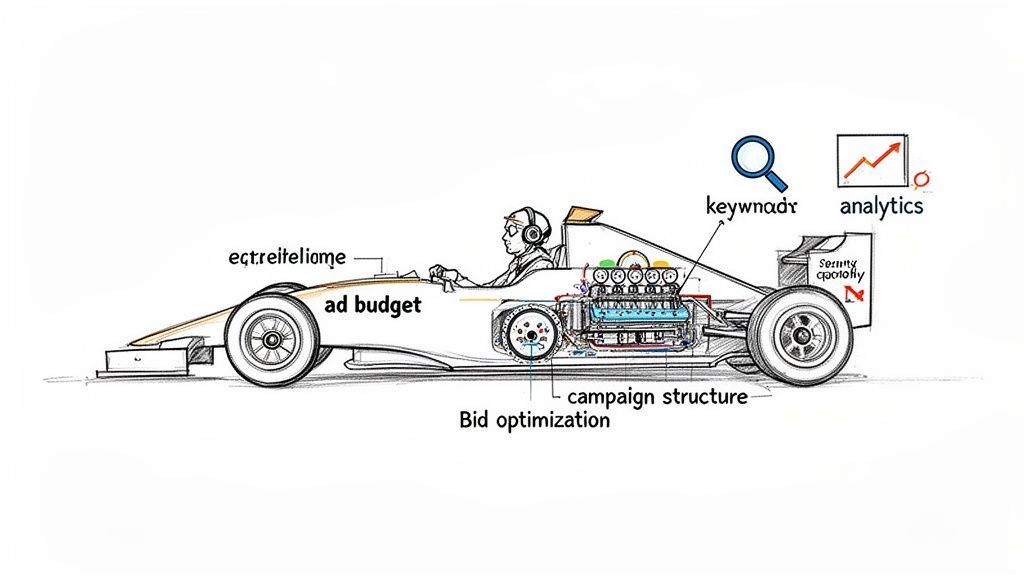
So, what exactly are Amazon PPC management services? In short, they’re specialized agencies or experts who take the wheel of your brand's advertising on Amazon. Think of them as your dedicated race team; they handle everything from building the car (campaign setup) to navigating the track (keyword selection), optimizing fuel efficiency (bid management), and analyzing lap times (performance analytics). Their goal is to make sure your ad spend leads to profitable growth, not just empty clicks.
Trying to run Amazon ads without an expert is like attempting to fly a commercial airliner with just a driver’s license. Sure, you might get it off the ground, but you don't have the training, tools, or real-world experience to handle turbulence, optimize your route, or stick the landing. The Amazon marketplace is a fiercely competitive space, with millions of sellers all fighting for the same shopper's attention.
Just launching a campaign and hoping for the best is one of the fastest ways to burn through your budget with almost nothing to show for it. This is where professional Amazon PPC management services come in, acting as your seasoned pilot and flight crew.
A top-tier team does a lot more than just push buttons. They manage the complex, time-consuming, and highly strategic work that separates the brands that succeed from the ones that just scrape by. Their job is to turn your ad budget from a line-item expense into a powerful investment that drives sustainable, long-term revenue.
This isn't a one-and-done task. It’s a constant cycle of planning, executing, and refining across several key areas:
By handing these functions over, you aren’t just saving time—you’re gaining a strategic partner whose entire focus is navigating the complexities of Amazon's algorithm. Their only job is to turn your advertising into a predictable engine for sales growth.
Ultimately, working with a management service lets you get back to what you do best—creating amazing products. You can rest easy knowing they’re making sure those products get seen by the right customers, at exactly the right moment. They're the essential co-pilot for any brand that's serious about winning on Amazon.
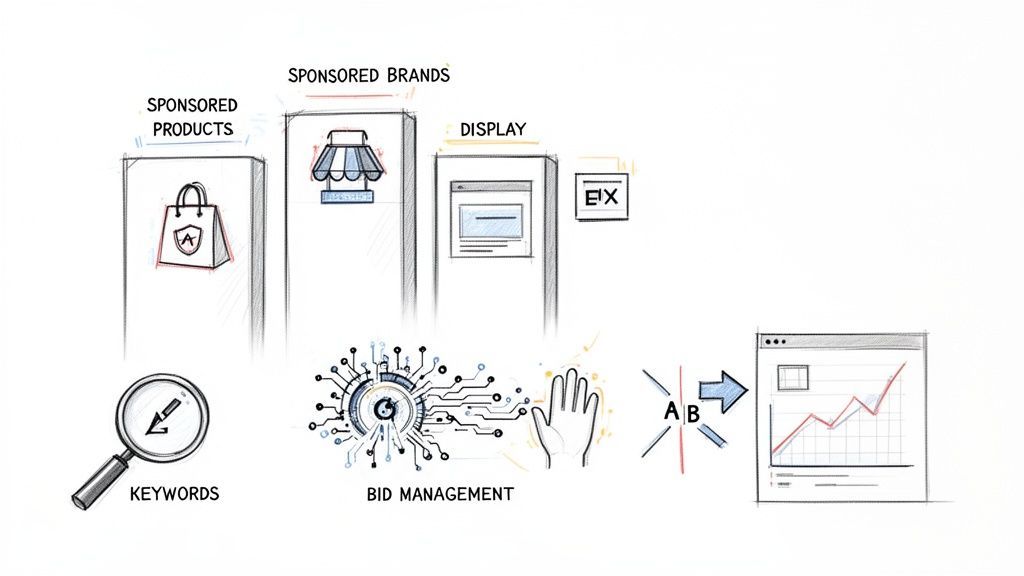
Running successful Amazon PPC campaigns isn't about flipping a switch and hoping for the best. It’s more like building a sophisticated, multi-layered machine where every single gear has to work in harmony. When you partner with an Amazon PPC management service, they become the chief engineer, making sure every part is finely tuned to deliver peak performance.
These core components are the pillars holding up all your growth. If you neglect even one, the entire structure can get wobbly, leading to wasted ad spend and a ton of missed opportunities. Let’s break down the essential elements a professional team will build and manage for your brand.
Imagine trying to build a house without a blueprint. You'd probably end up with a kitchen in the bedroom and doors leading nowhere. That's exactly the kind of chaos that happens when Amazon campaigns are launched without a clear structure—a common problem we call poor campaign architecture.
A professional agency starts by designing a logical framework. They’ll separate campaigns by product, strategy, and ad type (like Sponsored Products, Brands, or Display). This isn't just about being tidy; it's absolutely crucial for controlling your budget, analyzing performance accurately, and knowing exactly what to scale. A well-designed architecture means every dollar has a purpose.
This structure allows for a clear separation between different goals:
Without this separation, the budget you've set aside for your proven, money-making keywords could easily be drained by less effective discovery efforts, crippling your overall profitability.
Keywords are the language your customers speak. Getting this right is the difference between attracting shoppers who are ready to buy and paying for clicks from people who are just window shopping. Basic keyword research, using only the most obvious terms, just doesn't cut it anymore in such a crowded market.
Expert Amazon PPC management services dig much deeper. They use advanced tools to uncover long-tail keywords—those longer, more specific phrases that signal very high purchase intent. For example, instead of just targeting "running shoes," they’ll find and target something like "lightweight trail running shoes for wide feet."
This precision is then sharpened by mastering match types:
Just as importantly, they build robust negative keyword lists. These lists stop your ads from showing up for irrelevant searches, like adding "free" or "used" as negatives for a brand-new, premium product. This one step can save thousands of dollars in wasted ad spend.
A winning keyword strategy isn't about finding thousands of terms; it's about finding the right terms and telling Amazon exactly how and when to use them. This is where expert analysis provides a massive competitive edge.
Once your campaigns and keywords are set up, the real game begins: bid management. If you bid too high, you’re just wasting money. But if you bid too low, you lose visibility and sales to your competitors. Finding that perfect balance is a constant, dynamic process that needs a smart mix of technology and human strategy.
Top-tier agencies don't just "set and forget" their bids. They use AI-powered platforms to make thousands of tiny adjustments every day based on performance data, time of day, and what your competitors are doing. This algorithmic approach is then guided by a human strategist who understands your brand’s unique goals and profit margins.
This is critical in today's competitive environment. The average cost per click (CPC) for Amazon PPC ads has climbed to around $1.12, driven by the sheer volume of over 9.7 million global sellers. Unoptimized campaigns in this environment can destroy your margins in a heartbeat. In contrast, professionally managed accounts can deliver a 4.2x ROI, showing how expert oversight turns a rising expense into a predictable profit driver. Discover more insights about these Amazon advertising statistics and see how proactive management ensures sustainable growth.
The Amazon marketplace is always in flux. What worked like a charm last month might be completely ineffective today. That’s why continuous testing and data analysis are non-negotiable for any successful strategy.
A professional service never assumes; it tests everything. This includes A/B testing different elements to see what truly resonates with shoppers:
The insights from these tests are then translated into clear, actionable reports. A good partner won't just dump a spreadsheet full of acronyms on you. They’ll provide a clear analysis that explains what the data actually means for your business, turning metrics like ACoS and TACoS into a straightforward roadmap for future growth.
Deciding whether to manage your PPC in-house or partner with an agency is a major strategic choice. For some, the control of a DIY approach is appealing, but for others, the expertise and resources of a dedicated team are essential for scaling. The table below breaks down the key differences to help you see where the real value lies.
Aspect
DIY PPC Management
Professional Agency Management
Resources
Limited to in-house knowledge and standard tools. High learning curve.
Access to advanced software, proprietary data, and a team of specialists.
Time Investment
Significant daily time commitment for monitoring, optimizing, and reporting.
Frees up your team to focus on core business activities like product development.
Keyword Strategy
Often relies on basic research and surface-level search term reports.
Deep keyword mining, competitor analysis, and robust negative keyword lists.
Bid Management
Manual adjustments or basic automation. Prone to reactive, emotional decisions.
AI-powered bidding layered with expert human oversight for proactive optimization.
Strategy & Testing
Limited to familiar tactics. A/B testing can be slow and inconsistent.
Continuous A/B testing of creative, copy, and targeting. Advanced funnel strategies.
Reporting
Basic Amazon reports. Can be difficult to translate data into actionable insights.
Custom reports that connect ad performance directly to business goals and profitability.
Typical Outcome
Can work for small-scale operations but often hits a growth ceiling or wastes budget.
Scalable, profitable growth with improved ROI and a clear path to market leadership.
As you can see, while managing PPC yourself is possible, partnering with a professional service provides the strategic depth, advanced tools, and dedicated expertise needed to navigate the complexities of Amazon's advertising platform and achieve sustainable, profitable growth.
Standard Amazon PPC is fantastic for capturing existing demand—targeting shoppers who are already searching for products like yours. But what about creating new customers? The ones who don't even know they need your product yet?
That's where a more advanced tool comes in, one that expert Amazon PPC management services use to go beyond the search bar.
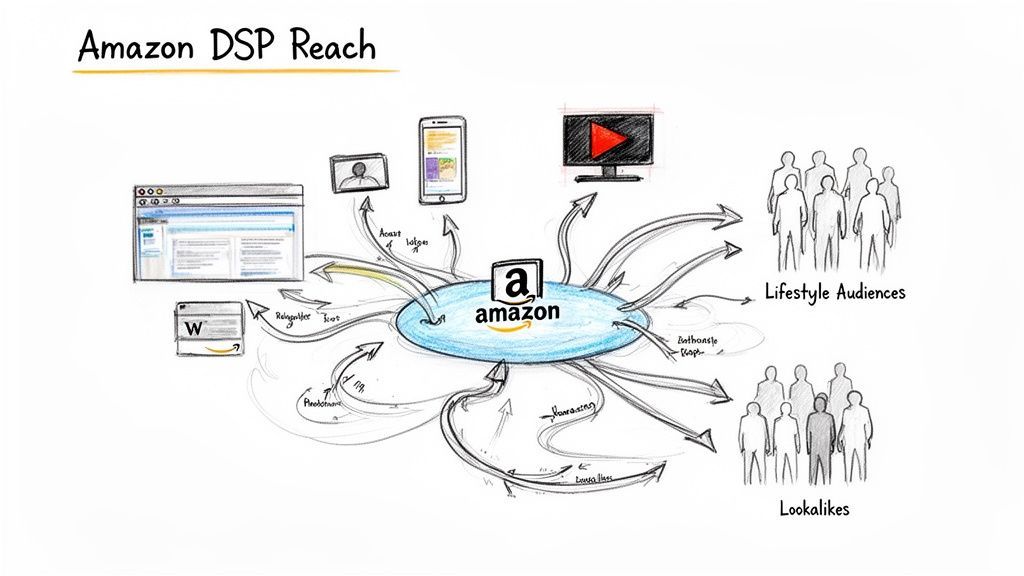
Enter the Amazon Demand-Side Platform (DSP). If PPC is like fishing in a well-stocked pond where customers are actively looking for your bait, DSP is like building new rivers that guide customers from all over the internet directly to your pond. It’s about proactively finding and engaging potential buyers before they even think to search.
With Amazon DSP, your brand can run programmatic display and video ads that reach audiences both on and off Amazon. This means showing up on Amazon-owned sites like IMDb and Twitch, plus a massive network of third-party websites and apps. It’s a full-funnel strategy designed to build awareness and drive consideration long before a customer types a keyword into the search box.
The real magic of Amazon DSP is its sophisticated audience targeting, which taps into Amazon's treasure trove of first-party shopping data. Instead of just targeting keywords, you can target people based on what they actually do and what they're interested in.
A professional management service uses DSP to connect with incredibly specific user segments, making your advertising far more efficient and impactful.
Key DSP targeting strategies include:
Using these methods, you can introduce your brand to relevant new customers who are highly likely to be interested in what you sell, effectively filling your funnel from the very top.
One of the most valuable jobs of Amazon DSP is running powerful retargeting campaigns. Ever looked at a product on Amazon, only to see an ad for it on a completely different website later that day? That’s DSP retargeting in action.
This strategy lets you re-engage shoppers who showed interest but didn’t complete the purchase. To see how this fits into a broader advertising framework, you can check out our guide on Google ads for Amazon sellers.
Retargeting with DSP is about finishing the conversation. It brings back high-intent shoppers who viewed your product, added it to their cart, or even searched for your brand, reminding them why they were interested in the first place and closing the sale.
This isn't just limited to Amazon's platform. DSP lets you retarget users who visited your own brand website, serving them ads as they browse other sites across the web. This creates a seamless, multi-channel experience that keeps your brand top-of-mind and guides shoppers back to your product listings when they're finally ready to buy. It’s the final piece of the puzzle for achieving full-funnel dominance and maximizing your advertising ROI.
Picking an agency is one of the biggest calls you'll make for your brand’s future on Amazon. This isn't just about handing off a to-do list; it’s about finding a growth partner whose expertise, tech, and communication style are a perfect match for your business goals. Get it wrong, and you’ll burn through ad spend with months of stagnant growth to show for it.
To make the right choice, you need a playbook that cuts through the sales pitches. A great partner should feel like an extension of your team—a group of specialists who are just as invested in your success as you are. Here’s a practical guide for vetting potential Amazon PPC management services to find that perfect fit.
First things first: an agency’s past performance is the best predictor of future results. Don't just take their word for it. You need to see concrete proof that they know how to deliver.
A truly experienced partner will be eager to share their wins. When you're digging into their history, look for:
Doing this homework confirms they have hands-on experience solving the exact kinds of problems your brand is facing right now.
In today's market, you can't manage bids and analyze data at scale without advanced software. But technology alone isn’t a strategy. The best Amazon PPC management services combine powerful tools with the strategic oversight of seasoned human experts.
Think of it this way: AI is the co-pilot, crunching numbers and making micro-adjustments at lightning speed. But the human strategist is the captain, using their experience and deep understanding of your brand to set the course and navigate around unexpected turbulence. A great agency has both.
A partner who relies solely on software will miss the nuances of your brand's unique position in the market. Conversely, one without advanced tools can't keep up with the pace of Amazon. The ideal partner strikes the perfect balance, using technology to execute and human intelligence to strategize.
Miscommunication will kill a partnership, plain and simple. Before you sign anything, get crystal clear on how the agency will communicate with you. A great partner should deliver proactive insights, not just data dumps.
Ask them directly about their communication style. Will you get a dedicated account manager? How often will you meet? What do their performance reports actually look like? A good report doesn't just show you metrics; it tells you what those metrics mean and spells out the strategic next steps. For example, if you want to know how a partner has been vetted, look for credentials like the
which signals a high level of expertise.
Choosing the right partner requires asking the right questions. This checklist is designed to help you dig deeper than the surface-level pitch and truly understand if an agency is the right fit for your brand's long-term growth.
Evaluation Category
Critical Question
What to Look For in a Response
Experience & Track Record
"Can you show me case studies from brands similar to mine in size and category?"
Specific, data-backed examples with clear metrics (e.g., ACoS reduction, sales growth). Avoid vague success stories. They should demonstrate relevant experience.
Strategy & Expertise
"What's your process for the first 90 days? How do you balance automation with human strategy?"
A clear, structured onboarding plan. Look for a balance—they should use tech for efficiency but have human experts setting the overarching strategy and making key decisions.
Communication & Reporting
"Who will be my main point of contact, and how often will we communicate? Can I see a sample report?"
A dedicated account manager and a regular meeting cadence (weekly or bi-weekly). Reports should offer insights and next steps, not just raw data.
Pricing & Alignment
"How is your pricing structured, and how does it align with our growth goals?"
Transparency is key. Whether it's a flat fee, % of ad spend, or hybrid, the model should incentivize them to grow your profit, not just your ad budget.
Cultural Fit & Partnership
"What do you see as your role in our team? How do you handle disagreements or underperformance?"
They should see themselves as an extension of your team, not just a vendor. Look for honesty, proactivity, and a commitment to solving problems together.
Use these questions as a starting point. The goal is to find a partner whose answers give you confidence that they understand your business and are equipped to help you win on Amazon.
Finally, you need to understand how the agency's pricing aligns with your goals. The two most common models are a flat monthly retainer and a percentage of ad spend. Each has its pros and cons, and the right one for you depends on your needs.
Some agencies offer a hybrid model that combines a base retainer with a performance-based fee. Whichever model you consider, make sure it creates a win-win where the agency is rewarded for driving the results that actually matter to your bottom line. A true partner’s success should be directly tied to yours.
Working with an agency on your Amazon PPC isn’t an overnight flip of a switch. It's a strategic process, and the first 90 days are all about building a solid, data-driven foundation for long-term growth. Think of it like building a house—you need a solid blueprint and foundation before you can start hanging pictures on the wall.
This timeline shows how a professional partner methodically moves from initial evaluation to strategic alignment, ensuring every action is deliberate and aimed at your brand's specific goals.
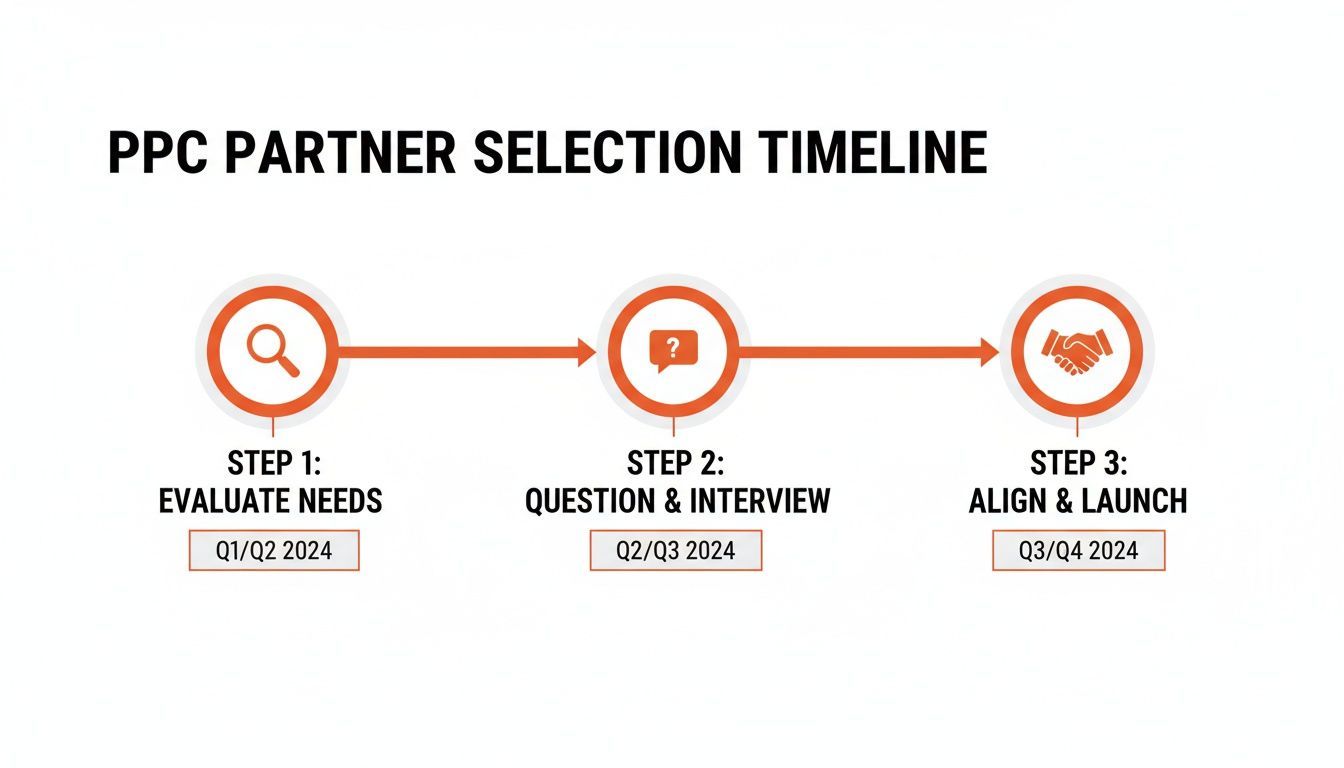
This structured approach makes sure that from day one, every move is intentional and directly supports your brand's growth targets.
The first 30 days are all about deep-dive analysis and planning. Your new agency becomes a detective, digging into every corner of your account to understand its history, what’s worked, and where the money has been wasted.
This phase isn't about launching new ads; it's about gathering intelligence.
Key activities this month include:
With a clear strategy locked in, month two is all about execution. Your agency will start rebuilding and restructuring your campaigns based on the insights from the discovery phase. This is where the new, more efficient architecture gets built.
The main goal here is to launch the restructured campaigns and start collecting clean, reliable performance data. Early results are monitored closely, but the real focus is on gathering enough information to make smart, data-backed decisions down the road. You can learn more about our data-driven approach to PPC in our detailed guides.
This methodical rollout is essential. Launching everything at once without a structured plan creates chaotic data, making it impossible to tell which changes are actually driving results. A controlled implementation provides the clarity needed for effective optimization.
By the third month, your agency has gathered enough performance data to shift from implementation to active optimization and scaling. The initial data starts to reveal which keywords, ads, and targeting strategies are delivering the goods.
This is where the expertise of professional Amazon PPC management services really starts to pay off. They analyze the early trends to:
This 90-day process ensures your advertising investment is built on a solid foundation of strategy and data, setting you up for predictable, long-term success on the Amazon marketplace.
When you're thinking about bringing in an agency, a lot of questions come up. Making a smart decision means getting straight, clear answers. Here are some of the most common things brands ask us about professional Amazon PPC management services, so you know exactly what to expect.
There’s no magic number here. A "good" Advertising Cost of Sale (ACoS) depends entirely on your product’s profit margin and what you’re trying to achieve right now. It's a moving target, not a set-it-and-forget-it metric.
For instance, if you're launching a new product, you might be perfectly happy with a high ACoS—even 40% or more. The goal isn't profit; it's about breaking into the market, getting seen, and racking up those first crucial sales and reviews. But for a mature, best-selling product, the focus shifts to maximizing profit, so you'd want a much lower ACoS, probably under 20%.
A good agency doesn’t chase a generic ACoS target. They work backward from your profit margin to figure out your breakeven point. From there, they set ACoS goals for each product based on its lifecycle stage and your goals—whether that's aggressive growth, pure profitability, or defending your market share.
Figuring out the right budget is a huge hurdle for many brands. A solid rule of thumb is to set aside around 10-15% of your total Amazon revenue for advertising. But treat that as a starting point, because your category changes everything.
Super competitive spaces like supplements or electronics might require a much bigger investment, sometimes closer to 25% of revenue, just to stay in the game. On the other hand, if you're in a niche market with less competition, you can often get great results with a smaller spend. An experienced Amazon PPC management service will dig into your account and size up the competition to recommend a budget that fuels real growth without wasting a dime.
Yes, absolutely. This is what we call the "flywheel effect," and it’s one of the most powerful benefits of a smart PPC strategy. When your ad campaigns consistently drive traffic and sales, you're sending strong, positive signals to Amazon's A10 search algorithm.
That steady sales velocity tells Amazon your product is a hit for certain keywords. The algorithm takes notice and starts rewarding your listing with higher organic rankings for those exact terms. Over time, strong PPC performance directly feeds your organic visibility, creating a self-reinforcing cycle where your paid ads make your organic presence stronger and stronger.
You'll likely see some quick wins and efficiency gains within the first 30 days, but getting to significant, stable, and scalable results usually takes a full 90-day cycle. Being patient during this initial phase is key to building a foundation for long-term success.
Here's how it usually breaks down:
This structured approach makes sure every decision is backed by data, leading to far more predictable and sustainable results.
Ready to turn your ad spend into predictable, profitable growth? The team at Clickstera Solutions LLC combines expert strategy with advanced technology to help great brands win on Amazon. Schedule a free consultation with us today and discover your brand's full potential.
Talk to Clickstera and get a clear next-step plan to scale your performance marketing.