Loading article
Loading page...
Think of Amazon PPC services as hiring a dedicated marketing team whose only job is to get your products noticed and purchased. It’s a full-service management solution built to turn your advertising budget into a predictable stream of revenue.
Imagine your product is sitting on a shelf in a store the size of a city, packed with millions of other items. Even a fantastic product can get lost in the noise. Amazon PPC services act as your in-store promoter, grabbing shoppers by the hand and leading them straight to your listing.
This isn't just about "boosting" a product or throwing money at generic ads. A real PPC service manages the entire advertising process from start to finish. It’s a mix of strategic thinking and data science, requiring deep expertise to win on a platform where the competition is relentless.
The ultimate mission is to drive profitable growth. Clicks and impressions are nice, but they don't pay the bills. An effective PPC service turns your ad spend into a powerful growth engine by focusing on a few core functions:
The true value of a PPC agency isn't just in the day-to-day management of bids and keywords. It’s in providing the strategic oversight that ensures your ad spend is directly fueling your bigger business goals—whether that’s launching a new product, stealing market share, or just making your entire Amazon account more profitable.

The need for a professional hand on the wheel has never been more critical. Competition on Amazon is fierce, with over 9.7 million global sellers all fighting for the same eyeballs. This has pushed the average cost per click (CPC) up to $1.12—a 15.5% jump.
In competitive categories like electronics or health and beauty, it’s not uncommon to see clicks costing well over $1.50. At those prices, inefficient ad spend isn't just a small leak; it's a hole in your bottom line.
Ultimately, working with a PPC service is about gaining a serious competitive advantage. You get access to specialized knowledge, advanced software, and the strategic foresight needed to get the absolute most out of every dollar you spend. This is how you transform advertising from a necessary evil into your most reliable source of growth.
To really understand what Amazon PPC services do, you have to get familiar with the tools in their toolbox. Think of Amazon’s advertising platform as a workshop with three core machines, each built for a specific job but most powerful when they all run in sync. These are Sponsored Products, Sponsored Brands, and Sponsored Display.
Expert management isn't just about switching these ads on. It’s about weaving them into a cohesive strategy where each ad type lifts the others up. This ensures your products show up at every step of a customer's journey, from their first curious search to the final click of the "buy" button.
This visual map breaks down how all the pieces of a professional PPC service—like keyword research, campaign tweaks, and performance reports—fit together to drive real results.
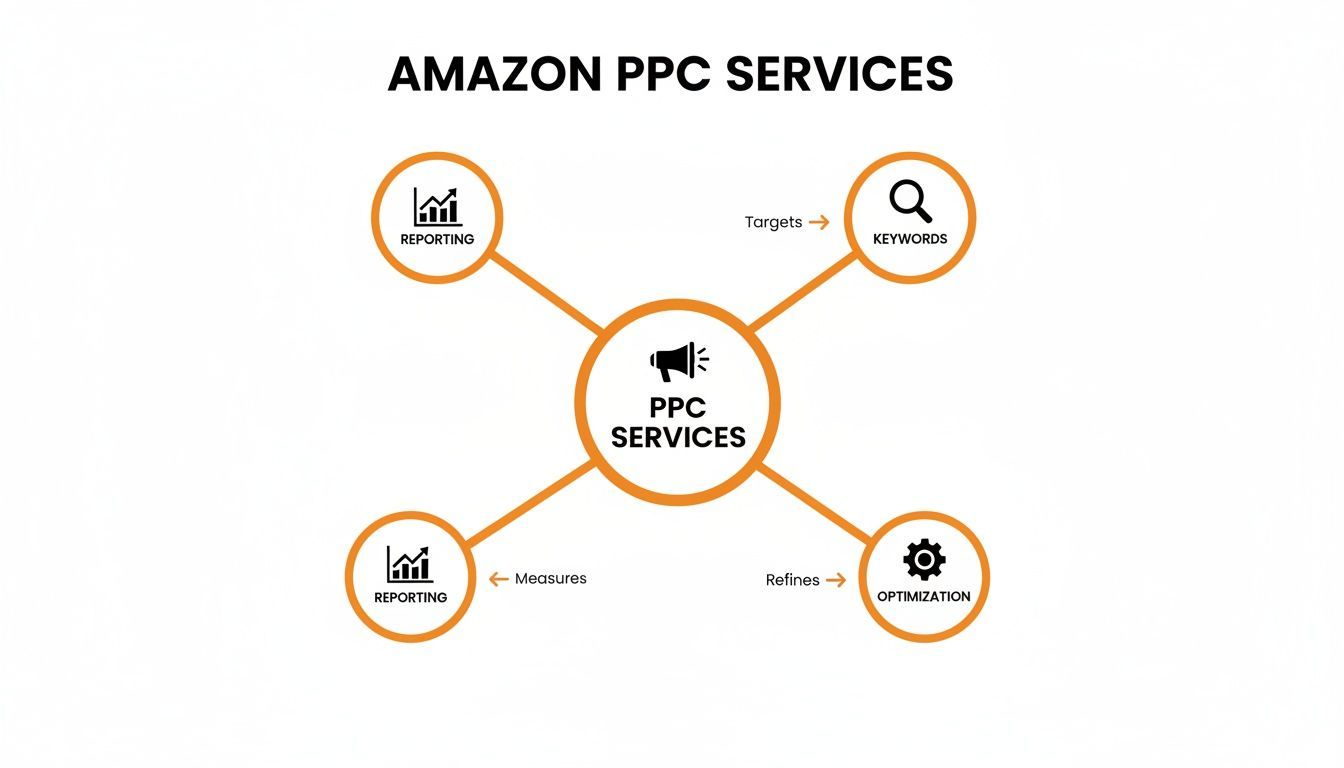
As the diagram shows, a winning campaign is never just one action. It's a continuous cycle where data from reporting fuels the next round of optimizations and keyword adjustments.
Sponsored Products are the absolute workhorse of Amazon advertising. The best way to think of them is as premium shelf space in a physical store. When a shopper types in "noise-canceling headphones," these ads put your product right in the middle of the search results, often on the very first page.
These ads are so effective because they catch customers who are ready to buy—the person is actively hunting for a product just like yours, right now. An Amazon PPC service meticulously manages these campaigns by:
At their heart, Sponsored Products are all about conversion. They exist to solve a customer's immediate need and are almost always the biggest driver of direct, measurable sales from your ad spend.
If Sponsored Products are the best shelf space, then Sponsored Brands are the giant digital billboard at the front of the store. You've seen them—they're the banners that often appear at the very top of the search results, showing off a brand logo, a custom headline, and a handful of related products.
Their main job is to build brand awareness and get shoppers to consider you. When someone sees your brand name again and again at the top of relevant searches, it builds trust and makes you memorable. A smart agency uses Sponsored Brands to tell a story, maybe by grouping complementary products or shining a spotlight on a new launch. This helps you win market share for your whole brand, not just one product.
Sponsored Display ads are your smart reminder system. These work a little differently because they can follow customers both on and off Amazon. Ever looked at a product on Amazon, thought "maybe later," and then seen an ad for that exact same item while scrolling through a news site? That’s Sponsored Display in action.
This ad type is a game-changer for retargeting—bringing back shoppers who showed interest but got distracted. Amazon PPC services use this to pull potential customers back to your page, which is incredibly effective since these people are already familiar with what you're selling. Key tactics include:
By combining all three ad types, an agency builds a full-funnel machine. Sponsored Brands create that first spark of awareness, Sponsored Products capture shoppers ready to buy, and Sponsored Display brings back anyone who hesitated, closing the loop and maximizing your return on ad spend.
Once you've got a handle on the core ad types, it's time to dig into the advanced tactics that performance partners use to really carve out market share and drive growth. Standard PPC is fantastic, but it’s a bit like fishing in a well-stocked pond—you're limited to shoppers already searching on Amazon. Advanced strategies, especially the Amazon Demand-Side Platform (DSP), let you fish in the entire ocean.
This is where a dedicated Amazon PPC service shows its real value. We're moving beyond just capturing existing demand and starting to actively create it for your brand.
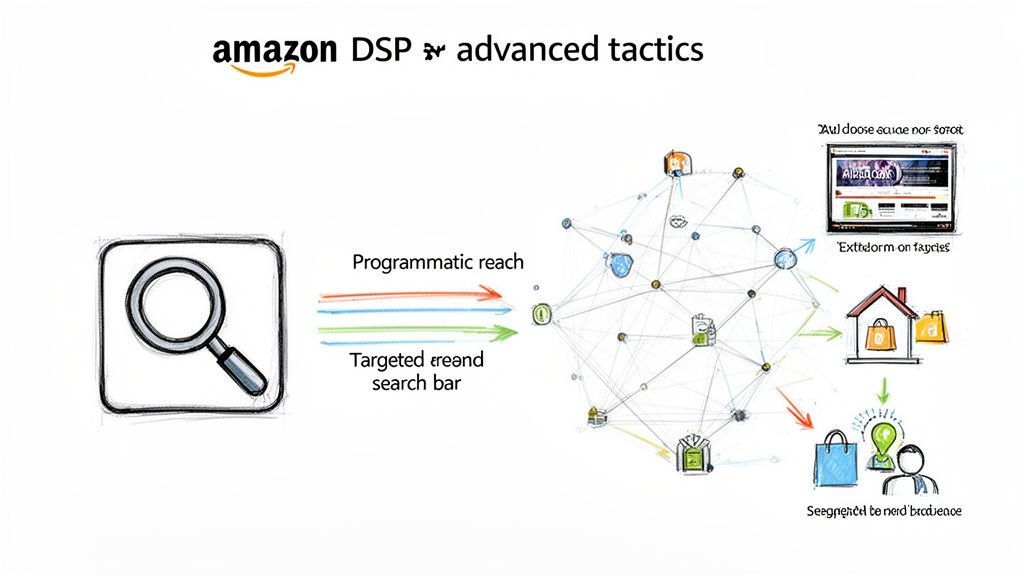
Think of standard PPC like an announcer standing inside Amazon, calling out to shoppers who are already looking for products. Amazon DSP is like an advertiser that can step outside the store and place ads across thousands of other websites, apps, and platforms, all while using Amazon’s rich customer data to find the perfect audience.
Unlike keyword-based PPC, DSP is entirely audience-based. It lets you programmatically reach potential customers based on their lifestyles, what they’ve bought in the past, and how they browse online. It's a total game-changer for building brand awareness and reaching new customer segments that aren't even thinking about your products yet.
Amazon DSP lets you proactively find and engage your ideal customer wherever they hang out online—before they even think to search for a competitor. It transforms advertising from a reactive tool into a proactive growth engine.
Beyond DSP, expert agencies have a whole toolkit of advanced strategies to make every dollar of your ad spend work harder. These tactics are about being smarter, not just spending more.
These advanced tools don't operate in a vacuum. A skilled Amazon PPC service integrates them into a single, cohesive strategy. For example, they might use DSP to introduce your brand to a new audience of hiking enthusiasts. When one of those users later searches "waterproof backpack" on Amazon, they see your Sponsored Brand ad at the top, recognize the name, and are way more likely to click.
This multi-layered approach makes sure your brand is visible at every stage of the customer journey, from that first moment of discovery off-Amazon to the final purchase decision on the platform. It's how small brands become household names and how established brands defend their turf. You can explore a deeper dive into how different platforms integrate in our guide to off-Amazon advertising strategies. By combining on-platform precision with off-platform reach, you create a powerful, sustainable growth machine.
It’s easy to drown in a sea of data when you're running Amazon ads. You'll see clicks, impressions, and click-through rates, but those numbers don't answer the most important question: are your ads actually making you money? A professional Amazon PPC service cuts through the noise and zeroes in on the key performance indicators (KPIs) that directly track profitability.
These are the metrics that tell the real story of your ad spend’s impact on your bottom line. Getting a handle on them is the first step toward making smart, strategic decisions that drive real growth—not just chasing vanity metrics.
Advertising Cost of Sale (ACoS) is the metric you'll hear about most often. It’s a straightforward measure of efficiency, showing how much you spent on advertising for every dollar of revenue those ads generated.
The formula is simple: ACoS = (Ad Spend ÷ Ad Revenue) x 100
So, if you spend $20 on ads and that brings in a $100 sale, your ACoS is 20%. It’s tempting to think the goal is to get this number as low as possible, but that’s not always the right move. An extremely low ACoS might mean you’re only bidding on obvious, super-specific keywords, leaving a ton of potential new customers on the table who are searching for broader terms.
Think of ACoS like the fuel efficiency of a car. A lower number is generally better, but if your goal is to win a race—like launching a new product or grabbing market share—you might need to burn more fuel to get the speed you need.
While ACoS is great for judging individual campaign efficiency, it only tells part of the story. Total Advertising Cost of Sale (TACoS) gives you a much bigger picture by comparing your ad spend to your total revenue, not just the sales that came directly from ads.
Here’s the formula: TACoS = (Ad Spend ÷ Total Revenue) x 100
TACoS helps you see if your PPC efforts are creating a "flywheel effect" where your paid ads actually boost your organic sales over time. A healthy, decreasing TACoS is a fantastic sign. It shows your ad spend is successfully improving your organic rank and brand recognition, making your business less dependent on ads for every single sale. A skilled agency lives and breathes this metric to make sure your campaigns are strengthening your entire business.
Return on Ad Spend (ROAS) flips the ACoS formula on its head. Instead of showing cost, it shows return, which is why it’s a favorite for people who think like investors. It answers one simple question: "For every dollar I put into ads, how many dollars do I get back?"
The calculation is just as simple: ROAS = Ad Revenue ÷ Ad Spend
Using our earlier example, $100 in ad revenue from $20 in ad spend gives you a ROAS of 5. This means you earned $5 for every $1 you spent—a clean, intuitive way to gauge profitability. This metric is especially powerful on Amazon, a platform built for shoppers ready to buy. In fact, Amazon PPC boasts an average conversion rate between 10.33% and 11.1%, which completely blows away the typical 1.33% seen on other e-commerce sites. You can find more details about Amazon's powerful conversion rates on adbadger.com.
To really get a grip on your campaign health, you need to track these core metrics consistently. Here’s a quick-reference table that breaks them down.
Metric (KPI)
How to Calculate It
What It Tells You
ACoS
(Ad Spend ÷ Ad Revenue) x 100
Measures the efficiency of your ad spend. A lower ACoS means your ads are more efficient, but it shouldn't be the only goal.
TACoS
(Ad Spend ÷ Total Revenue) x 100
Shows the impact of advertising on your overall business health. A decreasing TACoS indicates your organic sales are growing alongside paid efforts.
ROAS
Ad Revenue ÷ Ad Spend
Calculates the direct return from your advertising investment. It answers, "For every $1 spent, how many dollars did I make?"
CTR
(Clicks ÷ Impressions) x 100
Measures how often shoppers click your ad after seeing it. A high CTR suggests your ad creative and targeting are compelling.
CVR
(Orders ÷ Clicks) x 100
Shows the percentage of clicks that turn into a sale. A high CVR means your product page is effectively converting traffic.
By keeping an eye on these KPIs, you move beyond just "running ads" and start building a strategic, profitable advertising engine for your brand. They provide the clarity needed to know what’s working, what isn’t, and where your next dollar should be spent.
One of the biggest decisions a brand makes is who will actually run their Amazon advertising. This isn't just about operations; it's a strategic choice that shapes your budget, your growth, and how you stack up against the competition. It really comes down to two paths: building your own team or hiring a specialized Amazon PPC services agency.
Each option comes with its own set of trade-offs in control, expertise, cost, and the ability to scale. Getting this right means aligning your advertising approach with your bigger business goals.
Bringing your Amazon PPC in-house gives you the ultimate control. Your team lives and breathes your brand every single day, which means they have an unmatched, singular focus on your products and goals. Communication is instant, and you can pivot on a dime without waiting on an external team's workflow.
But that level of control comes with a hefty price tag. The heavy lifting includes:
This route usually makes the most sense for huge enterprises that have the cash to build and support a full-blown, multi-person advertising department. For most growing brands, the overhead and steep learning curve can quickly drain precious resources.
Working with an Amazon PPC agency is like plugging your brand directly into a high-performance advertising engine. Instead of trying to build everything from the ground up, you get instant access to a team of specialists who manage campaigns across dozens of industries, day in and day out.
An agency isn't just an outsourced task-doer; they're a strategic extension of your team. They bring a wide market perspective, battle-tested strategies, and an efficiency that's almost impossible to build internally without a massive investment.
This approach flips a huge fixed cost (salaries, software, training) into a much more predictable variable expense. An agency gives you an immediate upgrade in a few critical areas:
Deep Expertise: Agency teams have managed millions in ad spend. They spot patterns, solve problems, and find growth opportunities way faster because, chances are, they've seen it all before.
Advanced Tools: They show up on day one with enterprise-level software for keyword research, bid automation, and competitive analysis—tools that are often too pricey for one company to license alone.
Strategic Scalability: As your business grows, a great agency scales your campaigns right alongside you. They have the people and systems ready to handle more complexity without skipping a beat.
Cross-Industry Insights: By working with brands in different categories, agencies see trends emerging early. They can apply a winning tactic from one industry to yours, giving you a serious competitive edge. Many top-tier agencies are also an official
, which is Amazon's way of signaling a high level of expertise and trust.
At the end of the day, the right choice comes down to where your brand is now and where you want it to be. If you have deep pockets and the time to build a dedicated internal unit, the in-house path offers maximum control. But for most brands focused on smart, expert-led growth, partnering with a specialized agency is the fastest way to get scalable, profitable results.
Handing over the keys to your Amazon advertising can feel like a massive leap of faith. But a good agency won’t just ask for your login and disappear. They’ll guide you through a clear, structured onboarding process designed to build a solid foundation for a profitable, long-term partnership. Knowing what’s coming demystifies the whole thing and sets everyone up for success from day one.
It all starts with a discovery call, which is far more than just a meet-and-greet. This is where the agency digs deep. Be ready to share your brand’s story, which products are your cash cows, your target profit margins, and what your biggest growth goals are. Think of it like giving an architect the blueprints to your house—they need to understand the structure before they can start building.
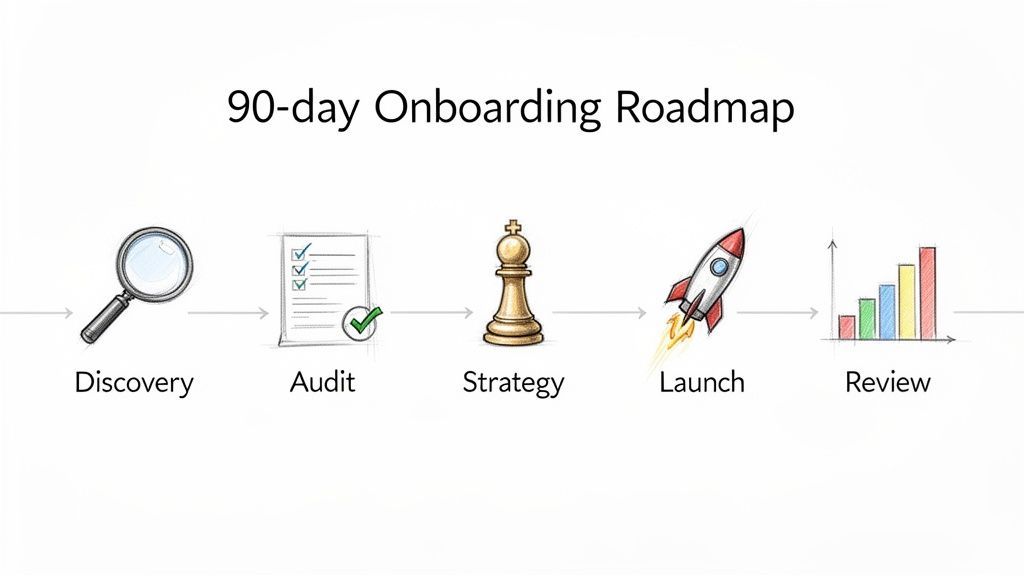
Once you’ve had that initial chat, the first month is all about getting under the hood. Your new agency will perform a top-to-bottom audit of your existing Amazon ad account. They’ll pick apart every campaign, keyword, and bid to figure out what’s working, what’s burning cash, and where the hidden pockets of opportunity are.
This deep dive flows directly into building a custom strategy and a 90-day roadmap. This isn’t some cookie-cutter template. It's a specific, actionable plan that outlines the exact campaigns they intend to build, the keywords they’ll target, and the key performance indicators (KPIs) they’ll use to track progress.
A professional onboarding process is a two-way street. Your job is to provide clear business goals and margin data. The agency's job is to turn that into a data-driven advertising plan with transparent goals and consistent communication.
With a solid strategy locked in, it’s time to execute. The agency will start launching new campaigns and restructuring old ones based on the roadmap. Those first few weeks are a critical data-gathering phase. They’ll be testing different ad formats, bidding strategies, and targeting methods to see what your customers actually respond to.
You shouldn't be left wondering what's happening. Proactive communication is a must during this period. A typical rhythm looks something like this:
This structured approach means you’re never in the dark. It turns the first 90 days from a period of uncertainty into a collaborative launchpad for sustainable growth. By the end of this initial phase, you’ll have a crystal-clear picture of your campaign performance and a strong foundation to start scaling your brand profitably on Amazon.
Diving into the world of Amazon advertising always brings up good questions about cost, timelines, and what you should really expect from a partner. Getting straight answers is the first step to making a smart decision that actually helps your brand grow. Let's tackle some of the most common questions we hear from brands.
While you might see some small wins within a few weeks, the real, substantial results from professionally managed campaigns typically start showing up around the 45-60 day mark. Why? It's all about data. Amazon’s algorithm needs enough conversion data to learn what works and start making intelligent optimizations.
If your campaigns are getting fewer than 10-15 sales per week, it can take a bit longer to get that traction. Early signs you're on the right track include a rising conversion rate on your most important keywords and a steadily dropping ACoS. It's always best to give a new strategy a full quarter to really mature before making any big calls.
There's no single magic number, but for Amazon's more advanced automation tools to work their magic, they need data to chew on. As a practical starting point, campaigns spending less than $1,000 per month often struggle to generate enough data for the algorithms to find reliable patterns.
For brands just getting started, it's often smarter to begin with manual campaigns. Once you're consistently hitting 15-20 orders per week from PPC, that's when automation and more advanced strategies become seriously powerful tools for scaling up.
This isn't an either/or question—a great strategy uses both, and they work together. A skilled agency knows how to leverage each for what it does best:
This hybrid approach combines the raw discovery power of machine learning with the strategic oversight of a human expert. It creates a system that's both smart and efficient.
The best Amazon PPC services don't just pick one campaign type; they create a synergistic system. Automatic campaigns feed crucial intelligence to manual campaigns, which then turn that data into highly profitable, scalable growth.
It's a common fear—that an agency will just tell you to spend more money. A reputable partner's goal isn't to inflate your budget; it's to improve your return on ad spend (ROAS). A performance-focused agency always starts with efficiency, making sure your current budget is working as hard as it possibly can.
They do this by cutting out wasted spend on irrelevant keywords, optimizing bids for maximum profit, and improving your conversion rates. Only after your campaigns are running like a well-oiled machine will they present a data-backed case for scaling your budget to grab more market share and fuel real growth.
Ready to turn your ad spend into a predictable growth engine? Clickstera Solutions LLC is an Amazon Verified Partner that combines deep expertise with proactive communication to help great brands win bigger results. Learn how we can scale your brand profitably.
Talk to Clickstera and get a clear next-step plan to scale your performance marketing.