
Loading article
Loading page...
#AmazonSEO #AmazonPPC #AmazonMarketing #EcommerceGrowth #ListingOptimization
Growing on Amazon doesn’t happen by chance. It happens when you combine long-term strategy with real-time insights. That’s exactly what Amazon SEO and Amazon PPC offer when paired correctly. SEO helps your products rise naturally in search results, while PPC gives you immediate visibility, keyword data, and the push needed to start generating sales.With Amazon’s average conversion rate sitting around 9–10%, far ahead of traditional eCommerce, the brands that win are the ones that use both strategies together. When SEO builds the foundation and PPC fuels the momentum, your listing enters a cycle of visibility, sales, and ranking improvements that compound over time.
Amazon’s algorithm, often referred to as A9, isn’t complicated once you understand what it aims to do. Its goal is simple: show shoppers the product they are most likely to buy. That means your listing needs to satisfy both relevance and performance.
Strong Amazon SEO optimisation starts with a complete, keyword-rich listing, but it goes far beyond that. Amazon wants to see how customers respond to your product. Are people clicking it? Are they buying it? Are they returning it? These signals tell Amazon whether your product is a good fit for future shoppers.
A listing with solid SEO doesn’t just get more impressions, it stays visible even when ads are paused. It also helps reduce PPC costs because Amazon rewards relevance with cheaper clicks and higher visibility.
“TACoS typically drops 15–30% when organic rankings improve through SEO.”
While there are hundreds of micro-signals, Amazon consistently prioritises:
The better your listing performs, the more Amazon pushes it up. This is why SEO and PPC work hand-in-hand: PPC drives early conversions, which improves rank, while SEO makes those clicks more likely to convert.
“80% of Amazon shoppers never scroll past the first page of search results.”
Amazon PPC is your shortcut to visibility. Instead of waiting weeks or months for organic ranking, PPC puts your product in front of shoppers immediately. It also gives you data no keyword tool can match, real search terms and real buying behaviour.
Amazon offers multiple ad formats, each serving a unique purpose. Sponsored Products help generate direct sales, Sponsored Brands build recognition, Sponsored Display retargets warm audiences, and Amazon DSP takes things even further with programmatic targeting.
When campaigns are set up well, PPC often delivers a 200% ROI, while SEO continues to compound over time. That’s why sellers who combine both strategies scale faster than those relying on just one.A great example is a brand that started with a product buried deep in search results. After running targeted PPC campaigns and optimising their listing using PPC-validated keywords, they moved from zero traction to 24 orders per day and reached page one, position six in four months.
Think of your listing as your storefront. No matter how much traffic PPC brings, it won’t convert if your listing doesn’t look credible, convincing, or keyword-rich. A well-built listing helps both SEO performance and PPC efficiency.Every element plays a role:
Your title influences click-through rates.
Bullet points answer customer objections.
Descriptions tell your story and build trust.
Backend keywords expand your reach.
Images determine how customers feel about the product before reading a single word.
When all these components work together, your listing becomes both discoverable and persuasive, the two things Amazon rewards the most.
Key Elements You Must Optimise
Around 93% of online shoppers say images influence their decision to buy. This makes your visual storytelling just as important as your written content.
Use:
High-quality visuals reduce hesitation and encourage conversions, which ultimately boosts your organic ranking.
Keyword research isn’t about chasing the highest-volume terms. It’s about identifying what customers actually search when they’re ready to buy. This is where SEO and PPC blend beautifully.
Tools like Helium 10, Jungle Scout, and SellerApp are helpful, but your PPC campaigns give you something more valuable: real, authentic search behaviour. When a keyword converts through PPC, you know it deserves a place in your title, bullets, or backend terms.
As of 2025, Amazon’s average CPC is $1.04, and well-optimised campaigns convert at 10–30%. This makes PPC a cost-effective testing ground for discovering the most profitable keywords for your listing.
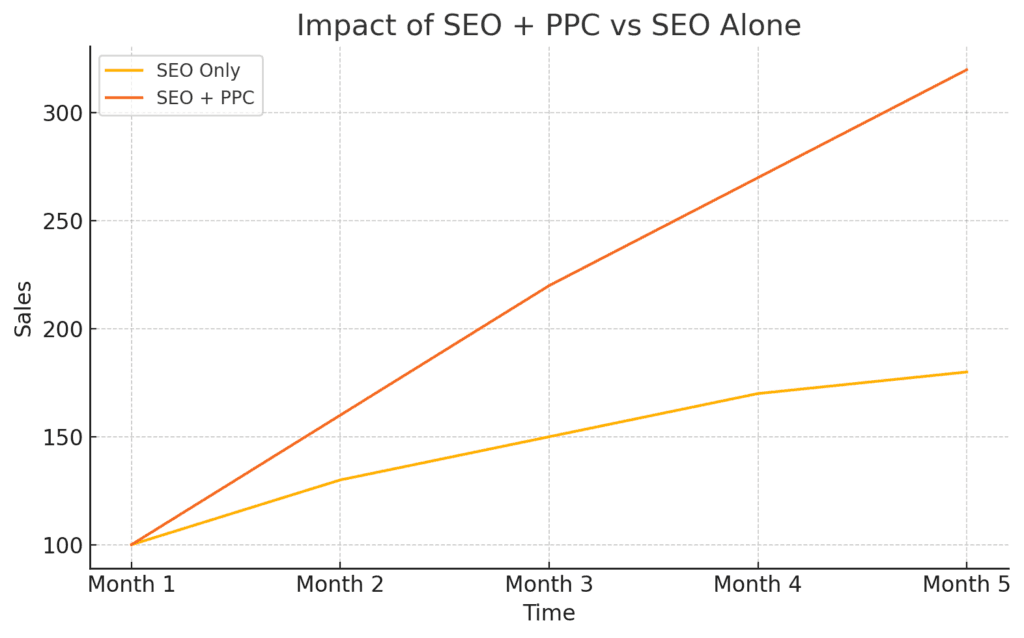
The graph shows that “SEO alone leads to slow, steady sales growth, while combining SEO + PPC results in much faster and higher sales over the same period. PPC accelerates visibility and conversions, which boosts organic ranking — leading to 2–3× more sales compared to relying on SEO alone.”
Amazon PPC validates keywords before adding them to your listing. Broad or phrase match campaigns reveal terms that actually convert. Once identified, integrating these keywords into your listing improves relevance and boosts organic ranking.
Casestudy
“A skincare brand used PPC to test keywords before adding them to their listing. After identifying high-converting terms and integrating them into their title and bullets, organic ranking moved from page 6 to page 1, and TACoS dropped from 38% to 19%.”
One of the biggest misunderstandings among new sellers is treating SEO and PPC as separate strategies. In reality, they feed into each other.
Here’s how the flywheel works:
This cycle continues until your product becomes a strong contender on page one.
A case study showed a brand doubling its revenue in 100 days simply by aligning PPC data with SEO improvements. That’s the compounding effect of using both strategies correctly.
You can’t improve what you don’t measure. To understand whether your combined SEO + PPC strategy is working, there are a few metrics that matter more than others.
Conversion Rate: A strong listing should hit 10–15% or higher.
ACoS: This should decrease as organic visibility improves.
TACoS: The best indicator of true profitability.
Organic Sales %: Ideally stabilises at 60–70%.
CTR: Higher CTR means your listing resonates with shoppers.
Keyword Rankings: A direct reflection of your SEO efforts.
When your TACoS starts dropping, it’s a sign that your organic engine is getting stronger which means your SEO work is paying off.
Success on Amazon comes from a balance of long-term strategy and short-term momentum. SEO gives your listing stability and compounding visibility, while PPC gives you speed, insights, and the push needed to rise above competitors.
Start with a strong listing, use PPC to uncover what shoppers really search for, and keep refining your content based on performance data. As your organic rankings grow, you can gradually reduce PPC spend while maintaining strong sales. This balance ensures sustainable growth, healthier margins, and a brand that stands out in a crowded marketplace.
Need support with Amazon growth? Tap here to get started.
How do Amazon SEO and PPC work together?
Amazon PPC drives immediate traffic and sales, while Amazon SEO improves organic rankings over time; together, they increase visibility, conversions, and overall sales performance.
Can Amazon PPC improve organic rankings?
Yes, PPC can indirectly boost organic rankings by increasing sales velocity and engagement signals that Amazon’s algorithm considers for ranking products.
Should sellers focus on Amazon SEO or PPC first?
Ideally, sellers should use both together, PPC for quick visibility and data, and SEO to build long-term, sustainable organic traffic.
How do I track the performance of Amazon SEO and PPC together?
Performance can be tracked by monitoring keyword rankings, conversion rates, sales velocity, ACoS, and ROAS to understand how paid and organic efforts support each other.
Talk to Clickstera and get a clear next-step plan to scale your performance marketing.