Loading article
Loading page...
An Amazon US agency is a company that helps brands manage and grow their business on Amazon.com. These agencies understand Amazon’s systems, rules, and best practices, which helps brands avoid mistakes and improve performance.
Imagine trying to launch a successful retail store in a foreign country. Many sellers struggle to understand Amazon policies, competition, and customer expectations.
You might make a bit of progress, but you’d almost certainly run into costly mistakes and missed opportunities. For many brands, that’s exactly what selling on the Amazon US marketplace feels like. Amazon agencies understand how the Amazon search algorithm works and stay updated with policy changes. These agencies focus specifically on Amazon instead of general digital marketing.
While a standard marketing firm might juggle broad strategies like social media or Google Ads, an Amazon-specific agency dedicates its whole focus to this single, incredibly powerful platform.
There is a clear difference between general marketing agencies and agencies that specialize in Amazon.
A generalist sees Amazon as just another sales channel on a long list. An Amazon US agency understands it’s a complete business environment with its own unique set of rules for:
Logistics and Inventory: Managing FBA inventory, avoiding stock shortages, and maintaining good inventory performance scores.
Advertising: Managing Amazon PPC and DSP campaigns, which require different strategies compared to other advertising platforms.
Content and Conversion: Crafting A+ Content and product listings optimized to win over both the algorithm and actual human shoppers.
Amazon requires consistent monitoring and strategy to perform well. It demands dedicated expertise to unlock its full potential and sidestep the pitfalls that can easily derail an otherwise great brand.
Specialized Amazon knowledge helps brands compete more effectively in a large marketplace. Amazon’s dominance is staggering—it captures 37.6% of the total US e-commerce market, which works out to an estimated $447.4 billion in platform revenue. A dedicated agency uses its deep knowledge to help brands claim a bigger slice of that pie,helping brands improve visibility and sales despite marketplace competition. You can learn more about Amazon’s market share and what it means for sellers on Red Stag Fulfillment’s blog.
A strong Amazon agency typically offers multiple services that work together to improve account performance. When these services are combined, they usually improve overall results over time.
Let’s break down the essential pieces that work together to drive your business forward. These aren’t separate tasks checked off a list; they’re interconnected functions managed under one unified strategy. This is how you turn Amazon’s complexity into your competitive edge.
This service manages the overall strategy and daily account operations.Full-service account management is so much more than just glancing at sales figures. It’s the strategic oversight that keeps all the other services—ads, creative, logistics—aligned and aimed at the same target: profitable growth.
Your agency partner essentially becomes an extension of your team, handling the relentless day-to-day grind of the marketplace.
This includes:
Without this central hub, even the most brilliant ad campaign or stunning A+ Content will eventually fall flat. It’s the glue holding everything together, making sure execution is consistent and problems are solved proactively. It’s the difference between just being on Amazon and actually winning on Amazon.
Advertising plays a major role in improving visibility on Amazon. If you want visibility and sales velocity, a smart advertising strategy isn’t just nice to have—it’s non-negotiable. A specialized Amazon US agency runs a sophisticated, multi-layered ad approach that grabs customers at every single stage of their buying journey.
This boils down to two main platforms:
This diagram shows how an agency pulls the levers across Amazon’s interconnected ecosystem to get real results.
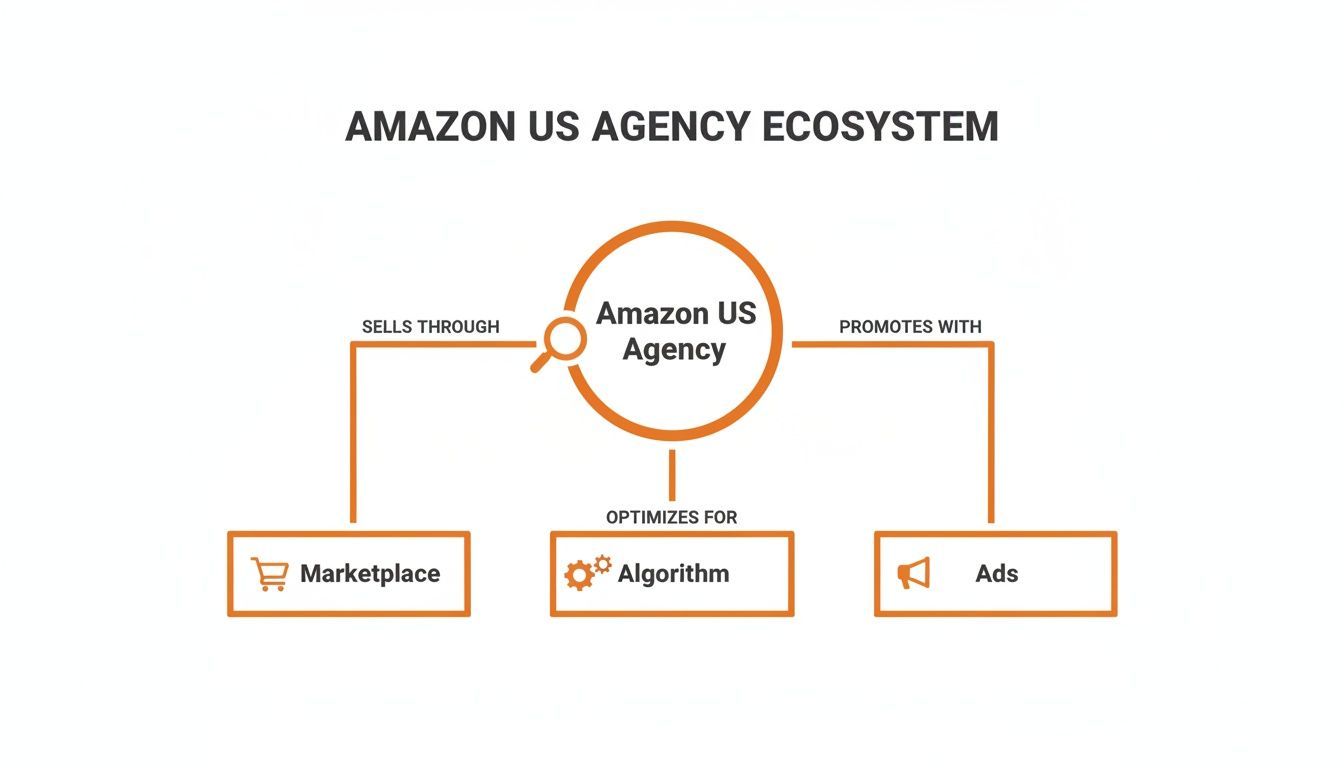
As you can see, a winning strategy demands deep expertise across the marketplace, the A9 algorithm, and the ad platforms to create one cohesive growth plan.
Your product detail page is where customers learn about your product and decide whether to purchase. It’s where a casual browser decides to become a paying customer. An agency’s job here is to maximize your conversion rate by making your listings as persuasive and helpful as humanly possible.
A great product listing does more than just list features. It tells a story, solves a problem, and builds trust with a shopper before they even think about clicking “Add to Cart.”
Key creative services include:
This is where that flywheel effect really kicks in. Better content improves your conversion rate. A higher conversion rate makes your PPC ads more profitable. Amazon’s algorithm sees all this positive activity and rewards you with better organic rankings, creating a virtuous cycle of growth. If you want to go deeper, check out our guide on optimizing Amazon product listings for maximum impact.
Finally, none of this matters if your products aren’t in stock. A top-tier Amazon US agency provides crucial support for the operational backbone of your business, making sure your supply chain runs like a well-oiled machine.
This critical service involves:
Inventory Forecasting: Using sales data and seasonal trends to predict demand and prevent those brutal, costly stockouts that kill your sales momentum and tank your keyword rankings.
Fulfillment Strategy: Managing your FBA inventory, advising on logistics, and keeping your Inventory Performance Index (IPI) score healthy.
Customer Service and Review Management: Handling customer questions and strategically managing product reviews to protect your hard-earned brand reputation.
When these services are managed together, they can help improve long-term sales and account stability on Amazon.
Let’s cut through the noise. Partnering with a sharp Amazon US agency isn’t about outsourcing tasks—it’s about plugging your brand into a growth engine. The real value shows up in tangible, measurable returns that are tough, if not impossible, to achieve on your own. It’s about transforming your Amazon channel from a time-sucking operational headache into a serious profit center.
Instead of vague promises, think about the real-world impact. “Saving time” means your team gets back 20+ hours per week. Those are hours they can pour back into what they do best—product innovation, brand building, and high-level strategy—while the agency handles the day-to-day grind of the marketplace. This isn’t a small shift; it turns a resource drain into a focused engine for business development.
Results may vary depending on product category, pricing, and competition levels.
Hiring an agency is like instantly downloading a decade of experience. A seasoned Amazon US agency has already scaled hundreds of brands, navigated countless algorithm updates, and resolved thousands of thorny support cases. You get the benefit of their proven playbook from day one, skipping the costly and painful trial-and-error phase.
This deep expertise shows up in a few key ways:
This is especially critical today. Third-party sellers now drive over 60% of all sales in the Amazon store, and US-based sellers are averaging more than $290,000 in annual sales. An agency’s focused knowledge is what helps you compete effectively and carve out your piece of this massive pie. You can find more insights on the growth of independent sellers on Amazon.com.
Many brands get hung up on the cost of an agency, but a closer look almost always reveals significant savings. Think about the true cost of building an equivalent in-house team: full-time salaries for a PPC manager, a logistics expert, a copywriter, and a graphic designer, not to mention the expensive software subscriptions needed to keep the operation running.
An agency gives you access to that entire skillset for a fraction of what it costs to hire full-time employees.
The question isn’t whether you can afford an agency; it’s whether you can afford the cost of not having one. The opportunity cost of slow growth, missed sales, and inefficient ad spend often far outweighs the agency’s fee.
This efficiency goes beyond just payroll. A skilled team can tighten up your ad spend to hit a lower ACoS (Advertising Cost of Sale), fine-tune your inventory forecasting to slash storage fees, and lift conversion rates to get more value out of every single visitor. These small wins add up, making a substantial impact on your bottom line.
At the end of the day, an agency partnership is about scaling your brand faster and more strategically than you could alone. With the operational weight of Amazon lifted off your shoulders, your leadership team is free to focus on the big picture.
You can finally think about new product development, expanding into international markets, or building a stronger brand identity. The agency handles the “how,” letting you concentrate on the “what” and “why.” This creates a powerful alliance where everyone is laser-focused on the same goal: sustainable, profitable growth.
Picking an Amazon US agency is one of the biggest calls you’ll make for your brand. This isn’t just about hiring a service provider—it’s about choosing a strategic partner who gets direct control over your sales, reputation, and profitability on the world’s biggest marketplace.
Get it right, and you’re set up for scalable growth. Get it wrong, and you’re looking at wasted ad spend, stalled sales, and months of pure frustration. The decision demands more than falling for a slick sales pitch. You need to dig into their track record, test their strategic thinking, and make sure their approach truly lines up with where you want to go.
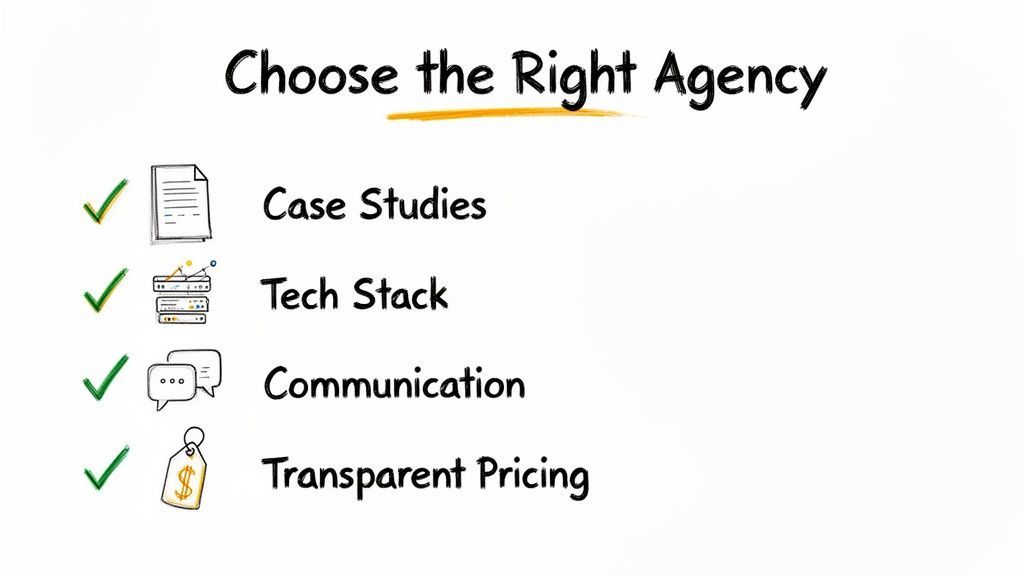
Every agency will say they’re an expert. Real expertise isn’t declared; it’s demonstrated. The first step is to hunt for concrete, verifiable proof of what they can actually do. Start by asking for case studies directly relevant to your industry and your business’s current stage.
A great case study does more than show a chart going up and to the right. It tells a story. What was the specific problem the brand was facing? What was the agency’s diagnosis? What exact steps did they take, and what were the measurable results? If you sell high-end supplements, a case study about scaling a cheap electronics brand just isn’t that relevant. You need proof they get the nuances of your category.
Crucial Question to Ask: “Walk me through a time you revived a struggling account in our category. What were the first 90 days like, what levers did you pull, and what was the outcome?”
Their answer will show you everything about their problem-solving process. You’re looking for a partner who thinks strategically about profitability and brand building, not just short-term sales spikes. Amazon’s own history—from its first profitable quarter back in Q4 2001 to its massive valuation today—proves the power of long-term strategy. It’s a principle any good agency should be applying to your brand. You can discover more about Amazon’s journey to success and the strategic lessons it offers.
The best agencies are a blend of sharp human expertise and powerful technology. Ask potential partners what tools they’re using for keyword research, performance analytics, and inventory management. The pros use a solid tech stack to automate the grunt work and pull out insights that are impossible to spot manually.
But technology is only half the battle. The other half is how they communicate those insights back to you. Reporting needs to be clear, consistent, and zeroed in on the metrics that actually matter to the health of your business.
Ask for a sample report and judge it on these points:
Transparent, proactive communication is the foundation of any good partnership. You should know exactly what their reporting rhythm is—weekly, bi-weekly, or monthly—and who your dedicated point of contact will be.
Agency pricing models vary a lot, so it’s critical to find one that fits your financial goals. The usual suspects are a flat monthly retainer, a percentage of ad spend, a percentage of total sales, or some kind of hybrid model. There’s no single “best” option; the right choice hinges on your budget, scale, and growth plans.
Be skeptical of agencies offering suspiciously low prices—it’s often a red flag for shoddy service or an overloaded team. On the flip side, a high price tag doesn’t automatically mean better results. The key is value. A great Amazon US agency will clearly justify their fee by connecting it directly to the expected return and the work involved. It’s also wise to check their credentials, like looking for an official Amazon Verified Partner badge, which signals a level of expertise Amazon itself recognizes.
Finally, remember that you’re looking for a partner, not just another vendor. During your talks, try to get a feel for their enthusiasm for your brand. Are they asking smart questions? Do they seem genuinely invested in your success? The best agency relationships are collaborative, built on mutual trust and a shared drive to hit ambitious goals. Choose the team that feels like a true extension of your own.
To help you organize your thoughts, use this checklist to score and compare the agencies you’re talking to.
Evaluation Criteria
What to Look For
Red Flags to Avoid
Relevant Case Studies
Proof of success in your specific category and with similar-sized brands. Clear before-and-after metrics.
Vague success stories, irrelevant examples, or an unwillingness to share specific data.
Strategic Depth
They ask deep questions about your business goals, margins, and brand vision beyond just Amazon.
A purely tactical focus on ACoS or keywords without connecting it to your overall business health.
Technology Stack
Use of well-regarded industry tools (e.g., Helium 10, Jungle Scout) for data-driven decisions.
Relying solely on manual processes or being secretive about the tools they use.
Reporting & Communication
Clear, actionable reports delivered on a consistent schedule. A dedicated point of contact who is responsive.
Data dumps with no analysis, infrequent communication, or constantly changing contacts.
Pricing Transparency
A clear pricing structure that aligns with your growth. They can justify their fees with expected value.
Hidden fees, confusing models, or pricing that seems too good to be true.
Partnership Vibe
They show genuine excitement for your products and seem invested in a long-term relationship.
A transactional, vendor-like attitude. They feel like salespeople, not partners.
This framework isn't just about ticking boxes; it's about finding a team you can trust to navigate the complexities of Amazon and grow alongside your brand. A little due diligence upfront will save you a world of headaches down the road.
So, how do you actually know if an Amazon US agency is worth the investment? The answer is in the numbers—but not just any numbers. Real success isn't about chasing vanity metrics like clicks or even just top-line sales. It's about building a profitable, healthy, and sustainable brand on Amazon.
A great agency partner knows this and moves way beyond surface-level stats. They focus on a balanced scorecard that tells the complete story of your brand's performance. This ensures you’re both perfectly aligned on what winning looks like and how to measure it transparently.
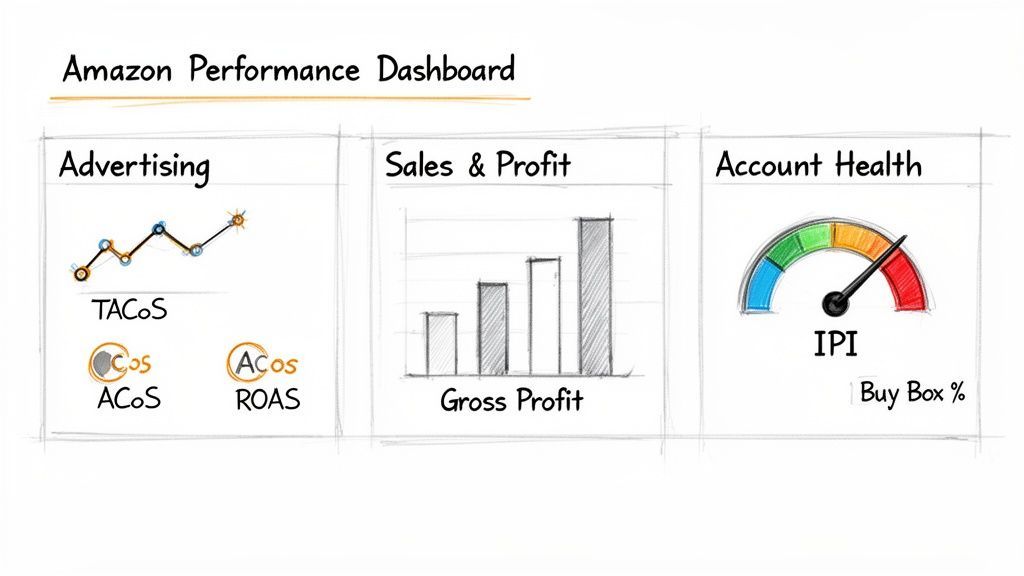
Think of your advertising as the fuel for your growth engine. But fuel without efficiency is just wasted money. These KPIs measure how effectively your ad dollars are being spent to drive overall business growth, not just clicks.
These three metrics tell a story together. A low ACoS is great, but if your TACoS is flat, it means your ads are just propping up sales without improving your organic footing. A skilled agency knows how to balance these for long-term brand health.
A focus solely on ACoS is like a pilot only watching their fuel gauge. It’s important, but without also checking altitude and direction (TACoS), you have no idea if you’re actually getting closer to your destination.
At the end of the day, you're in business to make money, not just move units. These KPIs cut straight to the bottom line, making sure your growth is actually profitable. Any Amazon US agency that isn’t reporting on profitability is hiding the most important part of the picture.
Tracking these numbers is non-negotiable. They ensure your scaling efforts are feeding your company's financial health, not just creating a "revenue-rich, profit-poor" trap. You can get more ideas for improving your digital marketing ROI by checking out this guide on key performance metrics.
Finally, these KPIs measure the underlying strength of your Amazon account. Think of them as leading indicators of future success, revealing how well you're managing inventory and beating the competition day-to-day.
Stepping into a partnership with an Amazon US agency is a big move. It’s smart to have questions and want some real clarity before you commit. This section cuts through the noise and tackles the most common questions we hear from brand owners and marketing leaders, giving you straightforward answers so you can decide with confidence.
This is usually the first question on everyone's mind, and the honest answer is that real, sustainable growth doesn't happen overnight. While every account is unique, a good partnership usually follows a 90-day ramp-up period where the results show up in two clear phases.
The first 30-60 days are all about laying the groundwork and cleaning things up. During this time, you’ll see improvements in what we call leading indicators. These are the early green shoots that tell you the strategy is taking hold, even if they haven't turned into a massive sales spike just yet.
These leading indicators include:
After that initial phase, you’ll start seeing movement in the lagging indicators—the big-picture results that directly impact your bottom line. This is where the early momentum translates into tangible growth, usually becoming clear around day 60-90 and beyond. We’re talking about stronger organic sales, a lower Total Advertising Cost of Sale (TACoS), and, most importantly, a healthier gross profit.
It's tempting to think any digital marketing agency can just "do Amazon," but that's a critical mistake. A specialized Amazon US agency is a different breed entirely. The difference is their deep, almost obsessive focus on a single, incredibly complex platform.
Think of it like this: a general marketing agency is your family doctor. They know a little about everything, but for serious heart surgery, they’ll send you to a specialist. The Amazon agency is the surgeon who has performed that one complex operation hundreds of times.
A general digital marketing agency sees Amazon as just another channel in the marketing mix. A specialized Amazon agency understands Amazon isn't a channel; it's a complete ecosystem with its own search algorithm, ad platforms, and compliance laws that have no parallel anywhere else.
This specialization is everything for a few key reasons:
A generalist firm just can't bring that level of battle-tested expertise to the table.
A common worry is that hiring an agency means losing control or, even worse, creating more work for your internal team. In reality, the best agency partnerships feel like a seamless extension of your own team, creating a powerful dynamic where everyone sticks to what they do best.
Your team’s involvement should be strategic, not tactical. You’re the expert on your brand, your products, and your customers. The agency is the expert on getting things done on the Amazon marketplace.
Here’s what that ideal collaboration looks like:
This setup frees your team from the granular, time-sucking tasks of managing the marketplace. It lets them concentrate on growth initiatives. The agency handles the "how" so you can focus on the "what" and "why."
This last question is a big one, and the answer needs to be brutally honest. No reputable Amazon US agency can or should guarantee a specific sales number or growth percentage. The marketplace is just too dynamic. There are too many variables—from what your competitors do to sudden algorithm shifts—for any such promise to be credible.
If an agency offers you a hard guarantee, that’s a massive red flag. They are either inexperienced or just telling you what you want to hear to get the contract signed.
So, what can a top-tier agency guarantee? They can guarantee a proven process, strategic expertise, and a relentless drive to optimize. They commit to:
In short, they can’t guarantee a specific outcome, but they can guarantee a world-class effort designed to achieve that outcome. They promise the quality of the inputs, because they know it’s the only reliable path to delivering the best possible results.
Ready to partner with an Amazon Verified Partner that combines deep expertise with transparent, results-driven strategies? At Clickstera Solutions LLC, we build customized growth plans that align ads, content, and operations to help great brands scale faster and more profitably. Learn more and schedule your free consultation with Clickstera Solutions LLC today!
Talk to Clickstera and get a clear next-step plan to scale your performance marketing.