Loading article
Loading page...
Effective brand protection on Amazon isn't just about playing defense—it's the active, ongoing process of protecting your intellectual property from the hijackers, counterfeiters, and unauthorized sellers who threaten your revenue and reputation.
It’s a multi-layered strategy that starts with getting your legal ducks in a row and then using Amazon's own tools to prevent, find, and shut down threats.
Before you can even think about fighting counterfeiters, you need to establish undeniable authority over your brand within Amazon’s world. This is about building a digital fortress so strong that most bad actors will see it and move on to an easier target.
And the cornerstone of that fortress? Your registered trademark.
Without it, you’re basically invisible to Amazon’s best protection programs. It's the absolute, non-negotiable first step that unlocks Amazon Brand Registry, which is the command center for every serious enforcement action you'll take.
Think of your trademark as the deed to your property on Amazon. It’s the legal proof you need to claim ownership over your brand name, logo, and listings. Trying to protect your brand without one is like trying to report a trespasser on land you don't officially own—your complaints have no weight and are easily brushed aside.
The process involves registering your brand with the right intellectual property office, like the United States Patent and Trademark Office (USPTO). This can take a while, but programs like Amazon's IP Accelerator can give you early access to Brand Registry tools while your official registration is pending.
Once your trademark is secured, enrolling in Amazon Brand Registry is your very next move. This is where you connect that trademark to your seller account, officially telling Amazon, "This brand is mine, and I have the right to defend it."
Getting into Brand Registry immediately hands you a suite of powerful tools designed to help you control how your brand appears on the marketplace.
The key benefits are huge:
I see this mistake all the time: brands wait until they have a counterfeit problem to get a trademark. The hard truth is, by the time you spot a hijacker, you're already playing catch-up. A proactive approach means getting your trademark and Brand Registry enrollment done before you start to scale.
Here's a quick look at Amazon's core brand protection programs and who they're for.
Program
Primary Function
Best For Brands That…
Amazon Brand Registry
Provides foundational tools to manage and protect a brand's IP, control listings, and report violations.
All brands with a registered trademark. This is the non-negotiable starting point.
Project Zero
An invite-only program that gives brands the power to remove counterfeit listings themselves without waiting for Amazon.
Have a high volume of counterfeit issues and a strong track record of accurate infringement reporting (90% accuracy required).
Amazon Transparency
A product serialization service. Brands apply a unique code to each unit, which is scanned to verify authenticity before shipping.
Are dealing with counterfeit products entering the FBA system and want to stop fakes before they reach the customer.
Amazon Counterfeit Crimes Unit (ACCU)
A global team that investigates and pursues legal action against counterfeiters.
Have significant, large-scale counterfeiting operations targeting their brand and need to escalate beyond standard takedowns.
These programs build on each other, starting with the essential foundation of Brand Registry and adding more layers of protection as your brand grows and your needs become more complex.
Don't forget that your physical product and its packaging are powerful deterrents. Counterfeiters want to replicate products as cheaply and quickly as possible. When you make your product genuinely hard to copy, you build a physical moat around your brand.
Think about integrating unique features that counterfeiters can't easily duplicate without a serious investment. This could be anything from custom-molded packaging inserts to a unique holographic sticker. Even something as simple as bundling multiple items into a unique kit can create a new ASIN that's much harder for a hijacker to source and replicate.
For example, a premium skincare brand I worked with used a custom-embossed glass bottle and packaged it in a box with a magnetic closure and a serialized authenticity card. A hijacker trying to sell a cheap knockoff in a generic plastic bottle and flimsy box was immediately flagged as fraudulent by both Amazon and savvy customers.
By focusing on these proactive measures, your brand protection on Amazon strategy becomes a real asset for long-term growth. To add another layer of authority, you might also look into becoming an Amazon Verified Partner to signal credibility.
True brand protection on Amazon isn’t just about playing defense. While takedowns are a necessary part of the game, the real win is stopping infringers before they make a single sale. This is how you protect your revenue and, just as importantly, the trust you’ve worked so hard to build with your customers.
This is where you shift from defense to offense. Amazon's proactive programs are designed to build a fortress around your brand, making you a much harder—and less profitable—target for counterfeiters. With tools like Project Zero and Transparency, you can automate your defenses and physically prevent fakes from ever reaching a customer's doorstep.
Amazon Project Zero is an invitation-only program that puts an incredible amount of power directly into your hands. Instead of filing an infringement report and waiting for Amazon to take action, Project Zero lets you remove counterfeit listings yourself. Instantly.
This is a complete game-changer. Imagine spotting a fake listing and, rather than waiting days for a response, you remove it in minutes. Amazon grants this authority to brands that have proven their accuracy, typically requiring a 90% success rate on past infringement reports. They trust you to police your own brand.
The program works through three core features:
This program is a massive signal of Amazon's commitment to fighting fakes. In fact, these efforts have been so effective that Project Zero now boasts a 99% automatic removal rate for listings identified by its automated protections. You can learn more about the impact of these anti-counterfeit measures on VasoGroup.com.
Here’s a quick look at the Project Zero dashboard, which gives you a clear view of its key benefits.
As you can see, the interface is built around those three pillars, giving you a straightforward way to manage automated scanning, self-service removals, and product serialization for total protection.
If Project Zero is your digital police force, then Amazon Transparency is your physical gatekeeper. It’s a serialization service that stops counterfeits cold at the warehouse door, guaranteeing only authentic products are shipped to your customers.
The process is simple but incredibly effective.
Once you enroll a product in Transparency, you apply a unique 2D barcode—a Transparency code—to every single unit you produce. These aren't just standard barcodes; each one is completely unique to that individual item.
When your products arrive at an Amazon fulfillment center, they get scanned.
This creates a nearly impenetrable checkpoint. For a counterfeiter to get past it, they'd have to guess and print a valid, unused Transparency code for every fake unit they make, which is practically impossible.
The real power of Transparency is that it solves the commingled inventory problem for FBA sellers. Even if another seller sends in counterfeit versions of your product, Transparency ensures their fake units are caught at check-in, protecting your customers and your brand's reputation from negative reviews caused by inauthentic products.
Enrolling in Transparency effectively shuts down counterfeit sales for that ASIN. Bad actors simply can't get their fake inventory into the FBA system. This is one of the most definitive steps you can take for your brand protection on Amazon strategy. You're no longer just reporting infringers; you're physically blocking them from the supply chain. This is how you win the war, not just the occasional battle.
Proactive tools give you a powerful shield, but even the best defenses need an active patrol. True brand protection on Amazon isn’t a set-it-and-forget-it task; it’s about building a consistent rhythm of monitoring and enforcement to stamp out threats the moment they appear. This is less about a once-a-month check-in and more about daily and weekly habits that keep your brand clean and your revenue flowing.
Your active defense begins with a structured monitoring routine. Think of it as a daily security sweep of your digital storefront. It means dedicating time each day to scan your key ASINs for unauthorized sellers hijacking the Buy Box, sudden price dives that make no sense, or any sneaky changes to your listing content.
A solid monitoring workflow is your early warning system. Too many brands fall into the trap of only acting when a customer complains or sales suddenly crater. By then, the damage is done. A disciplined cadence helps you spot the smoke before it turns into a fire.
Here’s what a practical weekly monitoring checklist actually looks like in practice:
The goal here isn't to spend hours staring at your listings. It's about creating a quick, repeatable process. A focused five or ten minutes each morning can catch 90% of common hijacking and infringement issues before they can poison your brand's reputation or kill your sales velocity.
This visual really drives home how powerful proactive systems are at stopping counterfeits before they ever reach a customer.
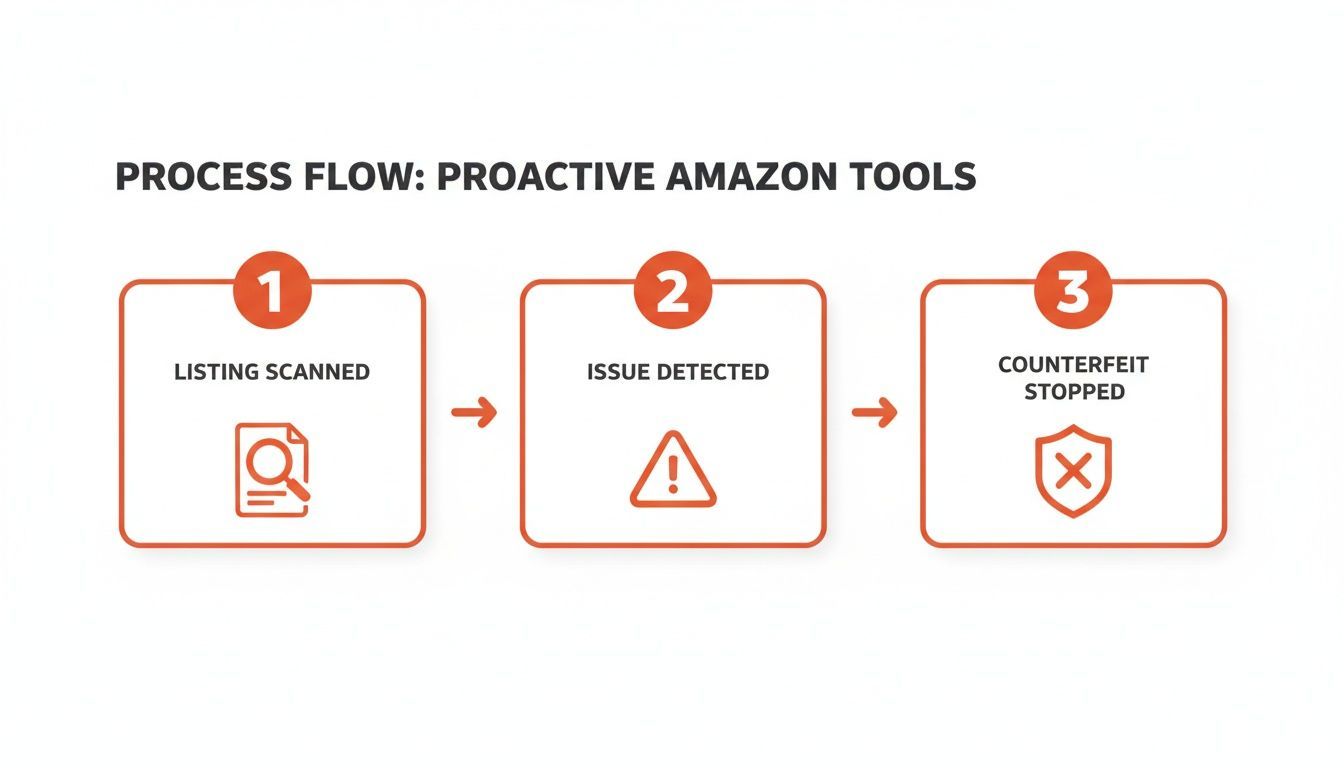
This process is essentially a digital filter. It automatically scans for threats and blocks them, protecting both your brand and your customers from ever having to deal with the fallout.
Once you spot an infringement, your next move is the "Report a Violation" tool inside Amazon Brand Registry. This is your direct line to Amazon's enforcement teams, and the way you frame your claim is the difference between a swift takedown and a frustrating, drawn-out email chain.
Vague claims like "this seller is fake" get you nowhere fast. They’re almost always rejected. You need to come with clear, undeniable evidence.
This methodical approach shifts your position from a frantic brand owner to a professional partner helping Amazon police its own marketplace. And thankfully, Amazon is constantly improving these tools. Recent updates have started turning Brand Registry from a reactive tool into a proactive one. The Brand Catalog Lock feature, for example, now lets you prevent unauthorized changes to your listings—a huge win for maintaining brand consistency. You can find more on these Amazon trademark enhancements on Dickinson-Wright.com. You can also learn more about optimizing your digital marketing assets in our guide.
After you hit submit, keep an eye on the case in your Brand Registry dashboard. A well-documented claim is often handled within 24-48 hours. This disciplined detect-and-report workflow is the engine that powers a successful brand protection strategy on Amazon.
Lasting brand protection on Amazon isn't about picking one tool and hoping it solves everything. It's about building an interconnected system where each program covers the weaknesses of the others. This creates a multi-layered defense that actually scales with your brand.
Relying on Brand Registry alone is like having a great lock on your front door but leaving all the windows wide open. It’s a start, but it’s not a complete strategy.
The real power move is combining Amazon's key programs: Brand Registry, Project Zero, and Transparency. Think of them as a team working in concert. Brand Registry is your foundational intelligence hub, Project Zero is your rapid-response takedown unit, and Transparency is your impenetrable physical checkpoint at the warehouse door.
This integrated approach creates a powerful synergistic effect. It’s how you stop playing constant defense and start proactively shaping a secure, trustworthy marketplace for your products.
When you use these programs together, you unlock a wealth of data that's far more valuable than the sum of its parts. Each tool gives you a different piece of the puzzle. Your job is to put them together to see the full picture of the threats you’re facing.
For example, you might see a sudden spike in self-service takedowns through Project Zero. That alone tells you something is up. But what if, at the same time, you get a report from the Transparency program about a batch of failed authentications at a specific fulfillment center? Now you can connect the dots.
This combined data helps you spot systemic risks you’d otherwise miss entirely.
This holistic view is a fundamental shift in mindset. You're no longer just putting out individual fires. You're becoming a data-driven analyst of your own brand's security, identifying the arsonists before they even get a chance to strike.
Integrating these tools means each one makes the others stronger. It’s a closed loop of protection that feeds itself.
Transparency codes physically stop fake products from ever entering the FBA system. This directly reduces the number of counterfeit listings you need to chase down with Project Zero. A high success rate with your Project Zero takedowns, in turn, strengthens your brand's reputation with Amazon, potentially giving you faster support when you really need it.
This interconnectedness is vital because Amazon itself is taking a more layered approach. Their systems are now continuously evaluating authenticity signals across ASINs and sellers, analyzing everything from price anomalies to seller behavior patterns. To fully benefit from these automated protections, brands have to be actively enrolled in Brand Registry, Project Zero, and the Transparency program. Passive strategies just don't cut it anymore. You can find more details on how Amazon’s systems are evolving on PalmettoDigitalMarketingGroup.com.
The ultimate goal here is simple: make your brand an unprofitable and frustrating target for bad actors. When counterfeiters see your listings are locked down, your inventory is serialized, and infringements disappear within hours, they will move on to easier prey. This is the essence of a successful, integrated brand protection Amazon strategy. And for those looking to further optimize their presence, it's wise to explore how you can enhance your brand's SEO performance with Rank Math.
How do you prove any of this is actually working? Without clear data, your brand protection efforts feel like a game of whack-a-mole—just a series of disconnected actions. To show real ROI and make smarter decisions, you need a way to measure success and a clear playbook for when the standard process falls short.
This is where you move beyond gut feelings and into Key Performance Indicators (KPIs). Tracking the right metrics turns brand protection from a cost center into something that actively drives value. You can finally answer the question, "Is what we're doing making a difference?"
You don’t need a fancy business intelligence tool to get started. Honestly, a simple spreadsheet is more than enough to monitor the health of your brand on Amazon. The goal here is to track trends over time, not just react to isolated incidents.
Your dashboard should focus on a handful of metrics that tell a clear story.
The metric most people miss is the "Rate of Repeat Offenders." When you take down a seller, do they just pop back up a week later under a new storefront? Tracking this helps you spot the more sophisticated networks that need a much more aggressive strategy.
By keeping an eye on these KPIs, you can build a clear narrative around your work. You can walk into a meeting and show stakeholders that your investment in brand protection is directly contributing to stable pricing, better customer trust, and protected revenue.
Sometimes, just clicking "Report a Violation" isn't going to cut it. You'll run into stubborn infringers, weird legal situations, or cases where you need a real human from a specialized Amazon team to step in. Knowing the right way to escalate is what separates the pros from the amateurs.
Your first stop for tricky situations should always be Amazon Brand Registry Support. This is a level above standard Seller Support. These guys are better equipped to handle nuanced IP issues and can often give you more clarity on why a claim might have been rejected. Pro tip: always reference your original case ID when you open a new case with them.
For bigger, more systemic problems, you need to engage the teams behind Amazon's programs.
Finally, you have to know when it's time to call in your own legal team. This usually happens when an infringer completely ignores your takedown notices and cease-and-desist letters, or when you're dealing with a counterfeiting ring that requires legal muscle outside of Amazon's ecosystem. Your dashboard and data will be your best friend here, giving you all the ammo you need to make a strong case to your legal counsel and prove the financial and reputational damage being done.
Navigating brand protection on Amazon can feel like a maze, but getting the fundamentals right is the first step toward building a solid defense. Here are some straight answers to the questions we hear most often from brands getting serious about their security.
Getting fully protected on Amazon isn't an overnight thing; it's a process you build in stages. The first and most important step, securing a registered trademark, can traditionally take anywhere from 12 to 18 months. But there's a shortcut.
By using Amazon's IP Accelerator program, many brands can get access to Brand Registry and its foundational tools in just a few weeks—long before the trademark is officially granted. Once you're in, you can immediately start using the "Report a Violation" tool to take down infringers.
From there, you graduate to the more advanced programs.
So, while you can get basic protection in a matter of weeks, building a truly comprehensive, layered defense with all of Amazon's tools is a journey that often takes several months to fully lock in.
Technically, you can file some basic, public-facing infringement claims. But in reality, trying to achieve effective brand protection on Amazon without a registered trademark is nearly impossible. A trademark is the golden key that unlocks Amazon Brand Registry.
And Brand Registry is the only way to access Amazon’s most powerful protection tools.
Without Brand Registry, you’re locked out. No automated protections, no Brand Catalog Lock, no Project Zero, and no official "Report a Violation" tool. You're stuck using slow, ineffective public forms that offer zero proactive power to stop counterfeiters before they gut your sales and reputation.
Getting a trademark isn't just a legal hoop to jump through. It's the single most critical investment for any serious brand on the platform. It's the difference between having a voice and just shouting into the void.
They're both powerful brand protection tools, but Project Zero and Transparency tackle the counterfeit problem from two totally different angles—one digital, the other physical.
Project Zero is your digital enforcement tool. It uses machine learning to proactively scan listings and automatically remove suspected fakes. The real game-changer, though, is that it gives you the power to remove counterfeit listings yourself, instantly, without waiting for Amazon to investigate. Think of it as your brand's own online police force.
Transparency is your physical prevention tool. It’s a serialization service where you stick a unique QR-style code on every single unit you make. When a product arrives at an Amazon warehouse, it gets scanned. If that code is missing or invalid, the product is stopped in its tracks, investigated, and never makes it to a customer. It’s a physical gatekeeper at the fulfillment center door.
The smartest brands use both. Transparency stops fake physical products from ever entering the supply chain, while Project Zero wipes the fake digital listings off the marketplace.
Finding a hijacker selling fakes of your product demands a fast, methodical response. Panicking and firing off vague complaints will get you absolutely nowhere with Amazon.
Follow these exact steps for the best results:
Ready to stop reacting and start preventing? Clickstera Solutions LLC builds proactive, multi-layered brand protection strategies that defend your revenue and reputation on Amazon. As an Amazon Verified Partner, we integrate the right tools and workflows to make your brand an unprofitable target for bad actors.
Schedule your free brand protection audit with Clickstera Solutions LLC today and let our experts build your fortress.
Talk to Clickstera and get a clear next-step plan to scale your performance marketing.