Loading article
Loading page...
Ecommerce growth isn't about one-off campaigns or chasing trends. It's about building a deliberate, coordinated plan to boost sales, grab market share, and drive real profitability. The brands winning today aren't just running ads; they're creating a sustainable growth engine that combines marketplace dominance with a powerful direct-to-consumer (DTC) channel.
In the fast-paced world of online retail, reacting to the latest trend is a recipe for getting left behind. True, long-term success comes from a solid, intentional foundation. Think of it like building a skyscraper—you can't just keep adding floors and hope the structure holds. You need deep, reinforced footings to support that kind of scale. The same exact principle applies to your ecommerce business.
A modern growth framework doesn't force you to choose between giants like Amazon and Walmart or your own DTC store. It's not an "either/or" situation; it's a "both/and" strategy. When you create a cohesive engine, every part of your business—from marketing and inventory to customer service—works together toward a single, unified goal.
A well-structured framework provides a clear roadmap, turning scattered tactics into a powerful, predictable system for growth. Below is a breakdown of the essential pillars that make up a modern ecommerce strategy.
Pillar
Objective
Key Channels & Tactics
Traffic Generation
Attract high-intent shoppers to product pages and your website.
Paid media (PPC, DSP), content marketing, SEO, social media, affiliate programs.
Conversion Optimization
Persuade visitors to make a purchase and maximize average order value.
Listing optimization, A/B testing, compelling copywriting, high-quality visuals, streamlined checkout.
Customer Retention
Encourage repeat purchases and increase lifetime value (LTV).
Email marketing, loyalty programs, subscription models, exceptional customer service.
This integrated approach ensures that you're not just acquiring customers but building a loyal base that fuels sustainable, long-term success.
To build this foundation right, you need to focus on three core pillars that work in tandem to create a predictable, scalable model. Mastering these areas helps you move beyond chasing fleeting wins and start architecting real, sustainable growth.
Attracting High-Intent Traffic: This is all about getting in front of the right people at the right time. It involves a smart mix of paid media, organic search, and social channels to bring qualified shoppers directly to your product pages and website.
Converting Shoppers with Precision: Once you have their attention, the real work begins. This pillar is focused on turning clicks into customers by optimizing everything from your product listings and website experience to the checkout process itself.
Maximizing Customer Lifetime Value: This is where profitability really kicks in. It’s almost always cheaper to sell to an existing customer than to acquire a new one. This pillar is all about retention, using email marketing, loyalty programs, and top-tier service to keep customers coming back.
The global e-commerce market is growing at a staggering rate, projected to jump from USD 36.21 trillion in 2026 to an incredible USD 77.58 trillion by 2031. This explosive expansion, fueled by a 16.46% compound annual growth rate, makes it clear: brands need an aggressive and well-structured growth strategy right now to claim their piece of the pie.
The most effective growth strategies don't just find customers; they build a system that consistently attracts, converts, and retains them. It’s about creating a flywheel where each part of the business reinforces the others, generating momentum that is difficult for competitors to replicate.
By defining clear business goals and mapping the customer journey across every platform, you can transform your brand from a collection of siloed channels into a single, powerful growth machine. As an Amazon Verified Partner, we've seen this foundational approach deliver consistent, scalable results time and time again.
One of the first big decisions every ecommerce brand has to make is where to invest the next dollar. It’s the classic standoff: third-party marketplaces like Amazon versus your own Direct-to-Consumer (DTC) website. This choice dictates everything—customer acquisition costs, brand control, access to data, and how high you can ultimately scale. There's no single right answer, just a series of strategic trade-offs.
Think of marketplaces as a stall in a world-famous, bustling city market. They come with immense built-in foot traffic; after all, over 60% of consumers kick off their product searches right on Amazon. Launching there gives you instant access to a massive, high-intent audience, which cuts down the friction of finding those first customers. It’s a powerful way to get into the market fast and see if your product has legs.
But that borrowed traffic comes at a cost. You’re essentially renting space in someone else’s city, which means you play by their rules, pay their fees, and you’re jammed in right next to countless other vendors on the same block.
The marketplace vs. DTC dilemma isn't just about sales channels; it’s about your long-term vision. An "Amazon-first" strategy can light a fire under your revenue and visibility right away, making it a fantastic launchpad. On the other hand, a "DTC-centric" approach is a slower burn—an investment in building a defensible brand and owning the customer relationship from the first click to the final delivery.
Choosing your primary sales channel is like deciding between opening a stall in a world-famous market or building your own flagship store on a main street. The market guarantees visitors but offers little brand identity, while your own store requires you to attract every single customer but gives you complete control over their experience.
This decision tree helps visualize where to put your energy based on what you need to achieve right now—whether that's attracting new traffic, nailing the conversion, or keeping customers coming back.
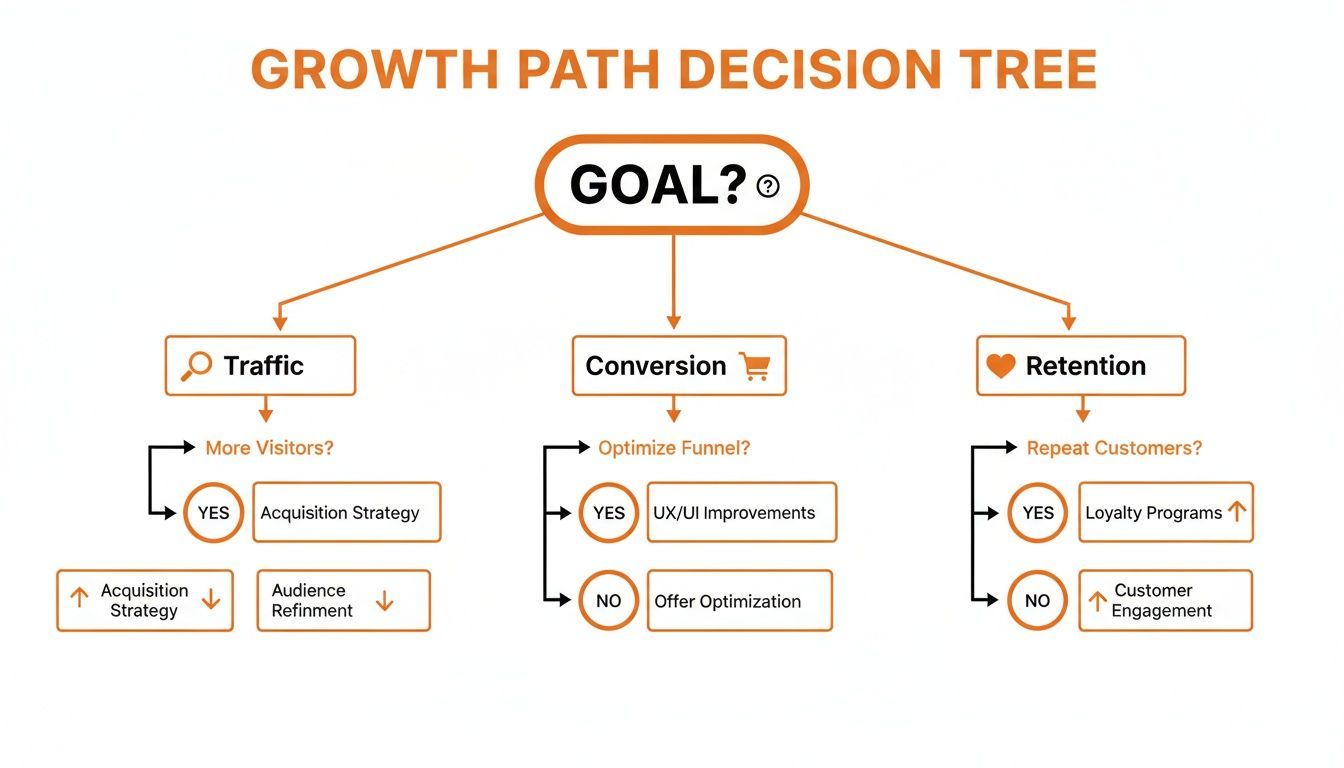
As the visual shows, your immediate goal—be it discovery, purchase optimization, or loyalty—should steer where you allocate your time and money.
For many brands, the winning move isn’t choosing one over the other. It’s about making them work together in a symbiotic relationship. This powerful hybrid model uses marketplaces as a top-of-funnel discovery engine while driving long-term loyalty and healthier margins through the DTC site.
Here’s how this integrated approach works in the real world:
This model lets you capture the best of both worlds. The marketplace fuels that initial growth and brand awareness, while your DTC site becomes the hub for building real brand equity and maximizing customer lifetime value (CLV).
To break it down, here are the trade-offs at a glance:
Feature
Marketplace (e.g., Amazon)
Direct-to-Consumer (DTC)
Customer Acquisition
Lower initial cost thanks to built-in traffic.
Higher initial cost; you're on the hook for all traffic generation.
Brand Control
Limited; you have to fit into the marketplace's templates and rules.
Complete control over branding, messaging, and user experience.
Customer Data
Minimal access; the marketplace owns the customer relationship.
Full ownership of customer data for retargeting and analysis.
Profit Margins
Lower due to referral fees, FBA costs, and ad spend.
Higher; no third-party fees eating into your revenue.
Scaling Speed
Faster initial scaling is possible due to existing infrastructure.
Slower to start, but offers greater long-term defensibility.
Ultimately, deciding where to put your budget and your team's focus comes down to understanding these dynamics. Are you chasing immediate sales volume or building long-term brand value? By thoughtfully combining marketplaces and DTC, you can build a resilient and profitable ecommerce business that delivers on both.
On a crowded marketplace like Amazon or Walmart, a great product isn't enough to get you noticed. Paid advertising isn't just another box to check in your growth strategy—it's the engine that powers discovery and sales. Without a smart ad plan, your products are likely to get buried on page ten, where shoppers rarely go.
The key is knowing how to use the two main weapons in your advertising arsenal: Pay-Per-Click (PPC) and Demand-Side Platforms (DSP). Too many brands treat them like they're the same thing, but they serve completely different strategic roles. To truly dominate your category, you need to master both.
Here’s a simple way to think about it.
PPC is like casting a line into a well-stocked pond where you know the fish are hungry for specific bait. You're capturing existing demand from shoppers already searching for what you sell.
DSP is like using a sonar system to find new fishing spots and then attracting fish there. You're creating new demand by reaching ideal audiences across the web and bringing them to your product page.
Pay-Per-Click is the foundation of any marketplace ad strategy. When a customer types "organic dog treats" into the Amazon search bar, PPC ads decide which brands show up at the top. But effective PPC isn’t just about bidding on keywords; it’s about structuring campaigns to squeeze every last drop of value from your ad spend (ROAS).
A high-performing PPC setup requires a smart approach to keyword management. This usually involves:
A well-oiled PPC machine does more than just drive sales—it creates a virtuous cycle. More ad-driven sales lead to a higher organic search ranking. A better organic rank brings in more sales with a lower advertising cost. This "flywheel effect" is the real secret to long-term profitability on these platforms.
While PPC is busy catching shoppers who are ready to buy, DSP and paid social ads are your tools for building an audience. These platforms let you step outside the marketplace to find your next customer before they even realize they need your product.
DSP lets you target users based on their browsing and shopping habits, both on and off Amazon. For instance, a brand selling high-end coffee makers could use DSP to show ads to people who have recently read coffee blogs, bought premium coffee beans, or even visited a competitor's website. It's a powerful way to get your brand in front of high-intent audiences and pull them toward your product page.
Similarly, paid social ads on platforms like Meta and TikTok can give your marketplace sales a serious boost. You can run campaigns that send traffic directly to your Amazon or Walmart listings. This tactic is a game-changer for a few key moments:
By weaving PPC, DSP, and paid social together, you build a full-funnel advertising machine. You capture the shoppers who are ready to buy right now, while also building a pipeline of future customers. This complete approach ensures your brand isn't just fighting for today's sales—it's building the market share of tomorrow.
Getting traffic to your product pages is an expensive, never-ending battle. But all that ad spend goes right down the drain if the visitors who show up don't actually buy anything. This is where conversion rate optimization (CRO) becomes one of the most profitable skills you can master.
Think of your product detail page as your #1 salesperson—it works 24/7 to close the deal.
For years, brands got stuck in the old mindset of keyword stuffing, cramming every possible search term into their listings hoping to get found. While discoverability is obviously important, real conversion happens when your page speaks directly to a customer's needs, builds their trust, and gives them a compelling reason to buy your product. It’s about turning a curious click into a confident purchase.
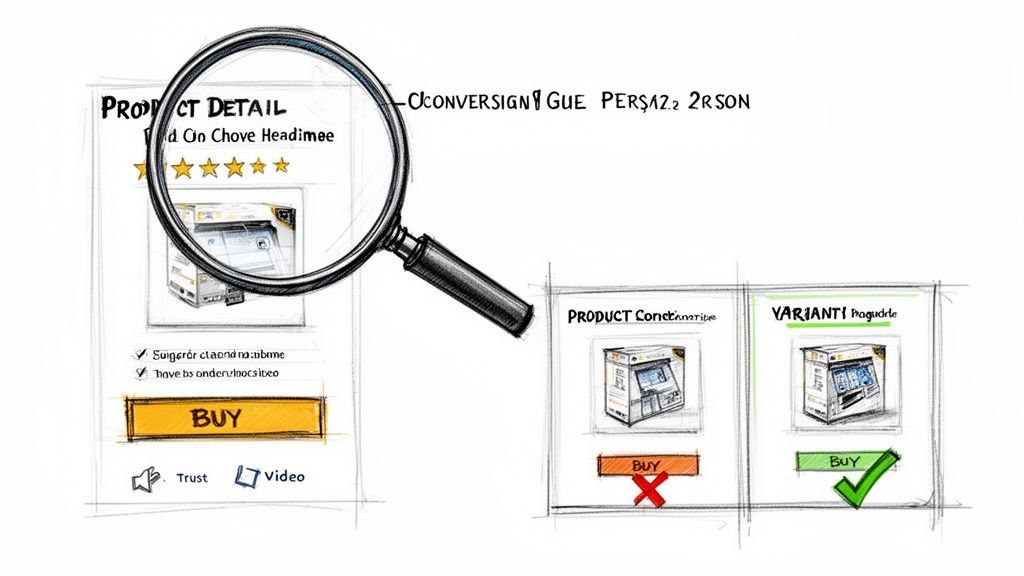
This whole process is about methodically looking at every single element on the page, making sure each part works together to guide the shopper straight to that "Add to Cart" button.
Your product title and bullet points are prime real estate. They're often the first—and sometimes only—text a shopper reads. Instead of just rattling off features, you need to translate them into real-world benefits that solve a problem or fulfill a desire for your ideal customer.
For example, a generic title like "10,000mAh Power Bank" is forgettable. A conversion-focused title, however, would be "Ultra-Slim 10,000mAh Power Bank – Full Day Power for iPhone & Android." The second one instantly tells the shopper the core benefit (all-day power) and who it's for.
Here’s how to craft copy that actually moves the needle:
In ecommerce, customers can't touch or feel your product. That means your images and videos have to do all the heavy lifting to show off quality, highlight features, and build enough trust to make a sale. A product with blurry, low-res images is instantly seen as lower quality, no matter how great the item actually is.
Shoppers overwhelmingly prefer to buy from brands that offer a rich, visual experience. Your main image must grab attention in crowded search results, while your secondary images, A+ Content (on Amazon), and videos must tell a complete story that makes the customer feel confident in their decision.
You need to invest in a professional suite of visual assets. No shortcuts here.
Listing optimization isn't a one-and-done task. The brands that win treat it as a constant process of testing and refining. By systematically A/B testing different parts of your product page, you can collect real-world data on what truly resonates with your audience.
Start by creating a testing roadmap. Don't try to change everything at once, or you'll never know what actually worked. Isolate one variable at a time—maybe the main image, the product title, the price point, or the first bullet point.
Over time, these small, data-backed tweaks can lead to massive lifts in your conversion rate, turning your product pages into ruthlessly efficient selling machines.
A killer marketing campaign driving thousands of clicks means nothing if you can’t deliver the product. The most common reason fast-growing ecommerce brands fail isn't a bad ad or a weak product page—it's a supply chain that cracks under pressure. This is where your backend operations become the unsung hero of your ecommerce growth.
Think of your supply chain as the foundation of a house. It doesn't matter how great your marketing decorates the rooms; if the foundation is weak, the whole thing eventually comes tumbling down. Getting your inventory, fulfillment, and customer service in sync with your marketing isn't just a good idea—it's non-negotiable for lasting growth.
On competitive marketplaces like Amazon, the stakes are even higher. Going out of stock isn’t a temporary dip in sales. It's a disaster for your sales velocity and search rank. Amazon's algorithm rewards consistency, and a stockout sends a huge negative signal that your product is unreliable. Your hard-earned ranking can plummet, and clawing your way back can take weeks or even months of aggressive ad spend.
One of the biggest mistakes brands make is running advertising and inventory in separate silos. They’ll launch a huge promotion or crank up PPC spend for a peak season, only to sell out halfway through. This doesn't just waste ad dollars; it leaves a trail of disappointed customers and damages your brand's reputation.
A stockout is the ultimate conversion killer. You spend money to get a customer to your page, they arrive ready to buy, and you have nothing to sell them. Even worse, you just paid to send a motivated buyer straight to your competitor's doorstep.
True operational alignment means your ad spend is tied directly to your inventory levels. This requires serious planning and communication between your marketing and supply chain teams. Before you even think about launching a major campaign, you need solid answers to a few key questions.
For most sellers, mastering Fulfillment by Amazon (FBA) is a must. It unlocks Prime shipping, which is a massive conversion driver. But FBA isn't a "set it and forget it" solution—it comes with its own rulebook, including inventory storage limits and painful receiving delays during busy seasons. A core strategy here is to maintain a healthy Inventory Performance Index (IPI) score to avoid getting hit with storage restrictions.
Beyond just getting products out the door, your customer service is the final piece of the operational puzzle. Great service protects your crucial seller metrics, like your Order Defect Rate and customer feedback ratings. Let those slip, and you risk getting your listings suppressed or, in the worst-case scenario, your entire account suspended.
When you align these pieces—inventory, fulfillment, and service—with your marketing, you build a resilient system. It’s a system that ensures the promises you make in your ads are flawlessly kept for every customer, turning growth from a risky bet into a predictable outcome.
In ecommerce, you are what you measure. It’s easy to get a rush from seeing traffic and sales numbers climb, but without the right metrics, you could just be scaling an unprofitable business. Too many brands fall into the trap of chasing vanity metrics like impressions or clicks, which say nothing about the actual health of their operations.
To build a brand that lasts, you have to shift focus to the key performance indicators (KPIs) that actually predict and drive profitability. This means looking past surface-level numbers to understand the entire financial loop of your marketing. It’s the difference between knowing you spent money on ads and knowing exactly how much profit each dollar of that ad spend generated across your entire business. That deeper insight is the bedrock of any solid ecommerce growth strategy.
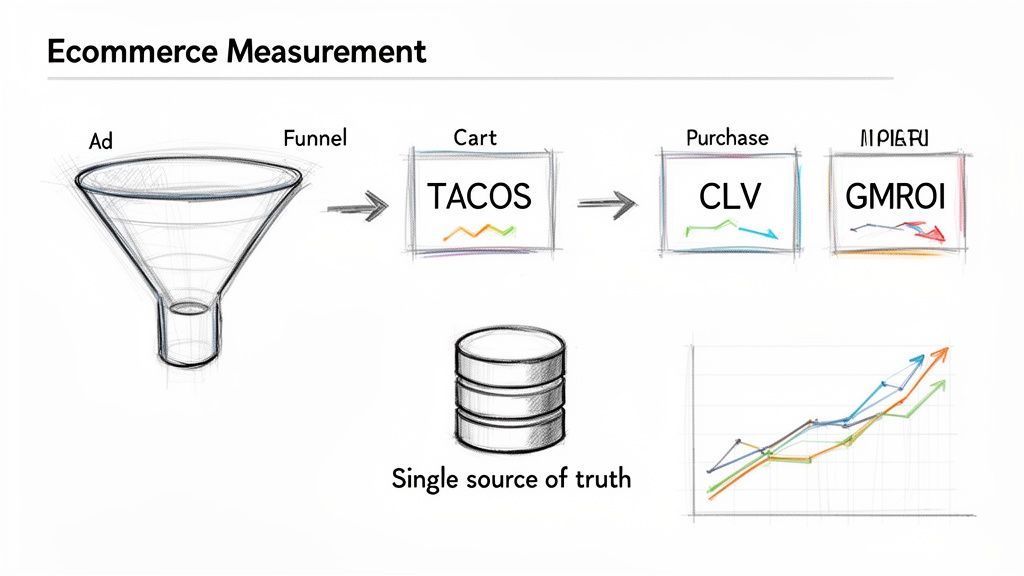
This shift in perspective is what empowers you to make sharp, data-driven decisions, prove the ROI of your efforts, and steer your brand toward sustainable, long-term growth.
While Return on Ad Spend (ROAS) is a decent starting point for campaign performance, it absolutely does not tell the whole story. To get a complete picture of your financial health, you need to embrace metrics that connect your advertising directly to the bottom line. These are the numbers that matter most to growth-focused brands.
The table below breaks down the essential KPIs that move you beyond surface-level analysis and into a clear view of your business's true profitability and potential for scale.
KPI
What It Measures
Why It's Important
Total Advertising Cost of Sale (TACOS)
Your total ad spend as a percentage of your total revenue (both organic and ad-driven).
It reveals if your ads are creating a "flywheel effect" by boosting organic sales, showing the true health of your marketing ecosystem.
Customer Lifetime Value (CLV)
The total profit you can expect from a single customer over their entire relationship with your brand.
A high CLV means your customers are loyal and keep coming back, making your initial acquisition costs far more efficient over time.
Gross Margin Return on Investment (GMROI)
How much gross margin you earn for every dollar you have invested in inventory.
This is a critical sign of operational health. A high GMROI means you're efficiently turning your stock into cash.
These indicators shift your perspective from a narrow, campaign-centric view to a holistic, business-centric one—which is exactly where you need to be to scale responsibly. For a deeper dive into how data can shape your strategy, check out our article on the power of Google's analytics tools.
To track these advanced metrics accurately, you need a system that stitches together data from multiple touchpoints. The modern customer journey is messy and rarely linear. A shopper might see a TikTok ad, search on Google, and finally purchase on Amazon. Your job is to connect those dots.
Your goal is to build a unified view of the customer journey, from the first ad impression to the final marketplace purchase. Without this single source of truth, you're making decisions based on incomplete and often misleading data.
This is where platforms like Google Analytics 4 (GA4) and Google Tag Manager become indispensable. They allow you to track user interactions across your DTC site, social channels, and even link them to marketplace activities, giving you a full-funnel view of performance. This is more important than ever, with global social commerce sales projected to rocket past $1.17 trillion in 2026 and mobile devices now driving nearly 59% of all online retail sales. You can explore more about these ecommerce trends from Flowlu.
By implementing proper tracking, you can finally attribute sales to their true source, understand which channels deliver the most valuable customers (highest CLV), and optimize your budget for maximum profitability. This data-driven foundation is what separates brands that guess from brands that grow.
When you're scaling an ecommerce brand, the same questions tend to pop up again and again. Let's cut through the noise and get straight to the answers brand leaders need.
While everyone loves talking about ROAS, the single most important KPI is your Total Advertising Cost of Sale (TACOS). Here’s why: ROAS only tells you how your ads are performing in a vacuum, but TACOS shows you how they're impacting your entire business.
A falling TACOS is the ultimate sign of health. It means your ad spend isn't just driving ad sales; it's creating a "flywheel effect" that lifts brand awareness and boosts your organic sales, too. That's the real measure of profitable, long-term growth.
This is the classic "it depends" question, but here’s a realistic breakdown. You can get quick wins from things like listing optimization or a sharp PPC campaign in just a few weeks. But building a real growth engine is a marathon, not a sprint.
Expect foundational work—like climbing the organic ranks and building a solid brand footprint—to take a good three to six months to really gain traction. In ecommerce, consistency will always beat short-term intensity.
For most brands just starting out, launching on a marketplace like Amazon is the smarter play. It gives you instant access to a massive audience of shoppers ready to buy, letting you prove your product and build sales velocity without the crushing cost of generating your own traffic.
Once you’ve carved out your space and have consistent cash flow, you can channel that momentum into building your DTC site. Think of it as your brand's home base, a place for building loyalty and capturing higher margins. The two channels should feed each other, not fight for resources.
Ready to stop guessing and start growing? Clickstera Solutions LLC builds and executes cohesive ecommerce growth strategies that drive real profitability on Amazon, Walmart, and beyond. Let's build your success story together. Learn more at https://clickstera.com.
Talk to Clickstera and get a clear next-step plan to scale your performance marketing.