
Loading article
Loading page...
Growing sales on Amazon really comes down to a simple, powerful formula: get more traffic, and turn more of that traffic into buyers. Nail this, and you've got a scalable business. Everything else—from your PPC campaigns to your inventory planning—is built on this foundation.
It all starts with disciplined research to figure out what your customers actually want, followed by relentless optimization to convince them your product is the one to buy.
Before you even think about scaling, you need to build a rock-solid foundation. This isn't about finding a magic bullet; it's about executing on the core principles that consistently separate the thriving brands from the ones that stall out. Your journey to more sales always begins with understanding the battlefield you're competing on.
This whole process can be broken down into three core pillars: deep market research, sharp competitive analysis, and strategic listing optimization.
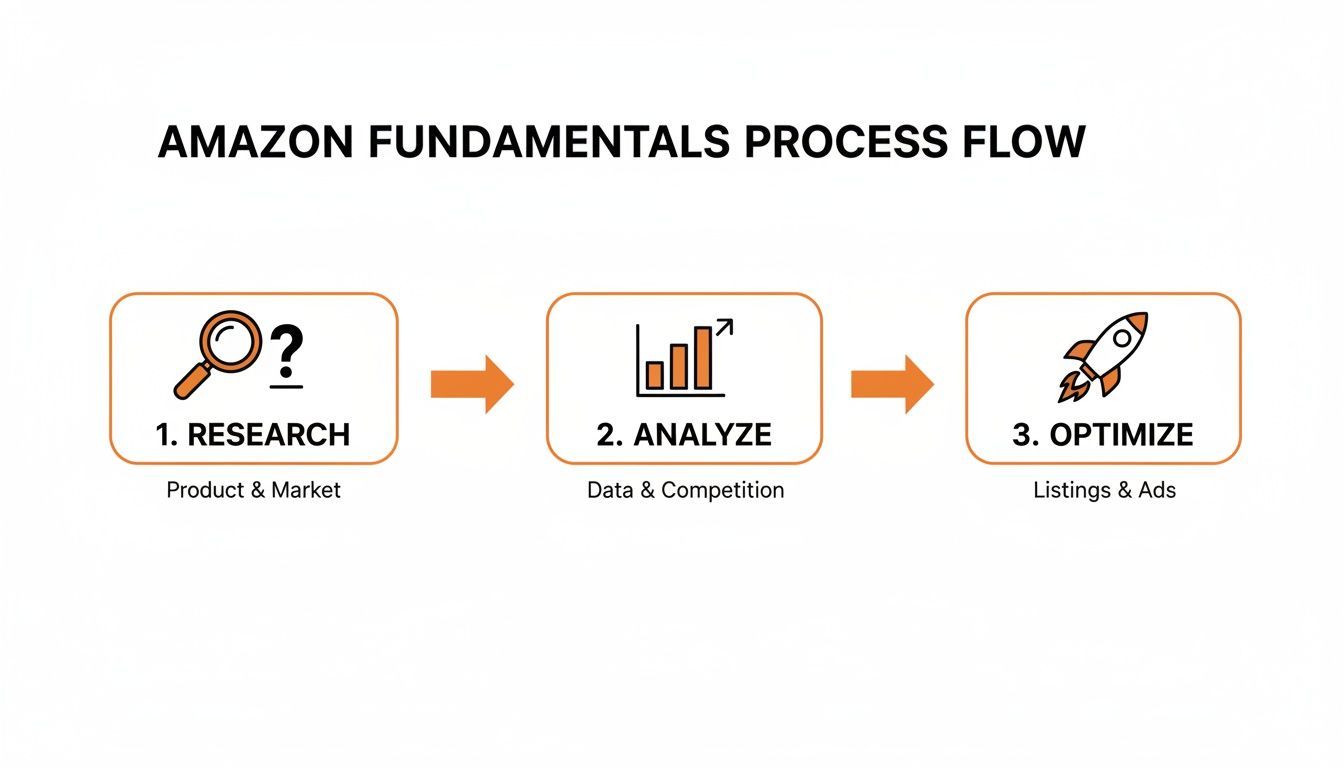
This workflow makes it clear that success on Amazon isn’t random. It’s the direct result of a systematic approach where each step informs the next, creating a powerful feedback loop that fuels growth.
To get you started, here's a quick reference guide summarizing the core pillars.
Growth Pillar
Primary Action
Expected Impact
Market & Keyword Research
Uncover high-intent search terms your customers use.
Increased organic visibility and traffic from qualified shoppers.
Competitor Analysis
Identify weaknesses in top sellers' listings and reviews.
A clear roadmap to creating a superior, more persuasive product page.
Listing Optimization
Craft compelling titles, bullets, and images that convert.
Higher click-through rates and conversion, leading to better rankings.
This table provides a high-level overview, but the real magic happens when you dive into the details of execution.
First things first: you have to become an expert on what your potential customers are searching for. This means uncovering the exact language they use when looking for a solution to their problem. Don't just guess a few obvious terms.
Get your hands on specialized tools like Helium 10 or Jungle Scout to find a wide range of keywords, including:
For example, a brand selling coffee makers might find out that a surprising number of people are searching for "quiet single serve coffee maker for office." That's a goldmine. This insight allows them to tailor their product title and bullet points to directly address a specific, underserved need.
Your goal isn't just to find keywords; it's to understand the intent behind them. Is the shopper just browsing, comparing options, or ready to pull out their credit card? Answering that question will shape every single part of your listing.
Once you know what customers are looking for, you need to see who already owns that digital shelf space. Go scrutinize the top-ranking competitors for your most important keywords. Don't just glance at their prices—dissect every single element of their listings.
Pay close attention to their:
This kind of analysis helps you find the strategic gaps. If the top sellers have grainy images or fail to answer key questions in their bullet points, you have a clear path to creating a superior listing that will win the click and, ultimately, the sale. This methodical approach ensures your product is positioned for success from day one, creating the momentum you need for every other growth tactic to work.
Your Amazon product listing is your single most valuable digital asset. It's your 24/7 salesperson, your brand ambassador, and the final hurdle a customer crosses before hitting "Add to Cart." A well-crafted listing doesn’t just describe a product; it creates desire, builds trust, and actively persuades shoppers to buy. This is where you move from basic keyword stuffing to building a true conversion engine.
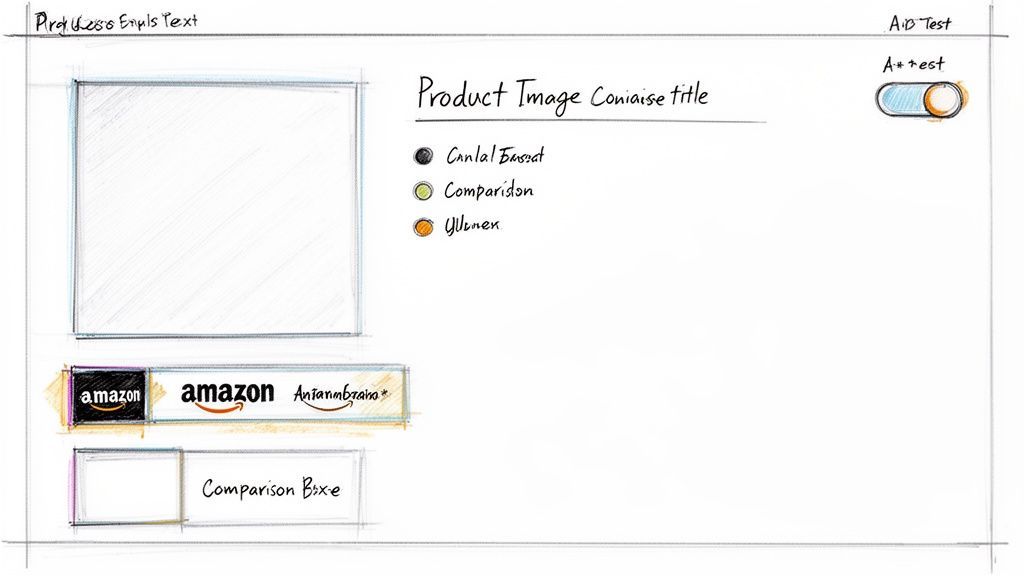
This wireframe gets it right—every element, from the main image to the bullet points, is a distinct opportunity to test, learn, and improve your conversion rate.
Think of it this way: if your listing converts at 15% and a competitor's converts at 20%, they are generating far more sales from the exact same amount of traffic. Over time, that gap becomes a chasm. The key is to treat your listing not as a static page, but as a dynamic tool you can continuously sharpen.
Words are important, but on Amazon, people buy with their eyes first. High-quality images and videos are non-negotiable, but the real game-changer for brand-registered sellers is A+ Content. This is your chance to go beyond simple text and transform the bottom half of your detail page into a rich, visual brand experience.
Effective A+ Content helps you:
The impact of this visual storytelling is huge. When you combine strong content with targeted ads, you create a powerful sales accelerator. In fact, just implementing Basic A+ Content can deliver up to an 8% sales increase and improve repeat purchases. Well-optimized strategies can yield 1.8x higher conversions on average.
With independent sellers now averaging over $290K in yearly revenue—and many clearing $1M—prioritizing these optimizations is no longer optional. If you're curious about how top sellers are performing, you can discover more Amazon stats and insights.
Guesswork has no place in a strategy designed for growth. The most successful brands make decisions based on data, and Amazon gives you a powerful, free tool to do just that: Manage Your Experiments. This feature lets you A/B test critical elements of your listing to see what truly resonates with your customers.
You can systematically test different versions of your:
The golden rule of A/B testing is to change only one variable at a time. If you change both the title and the main image, you'll never know which change was responsible for the lift in sales.
For example, a brand selling high-end kitchen knives might test two main images. Version A shows the knife on a clean, white background. Version B shows the knife in a chef's hand, cleanly slicing through a tomato. After running the experiment for four weeks, the data might reveal that Version B increased the unit session percentage (your conversion rate) by 12%.
That's a data-backed improvement you can implement with confidence. This methodical process of testing, learning, and iterating is exactly how you build a listing that consistently outperforms the competition and turns clicks into loyal customers.
Once your product listing is dialed in for conversions, paid advertising is the jet fuel you need to really take off. But moving beyond a simple "set it and forget it" auto campaign is how you actually take control of the flight. A smart advertising strategy doesn't just chase random clicks; it builds a full-funnel ecosystem that guides shoppers from their first glance all the way to becoming repeat customers.
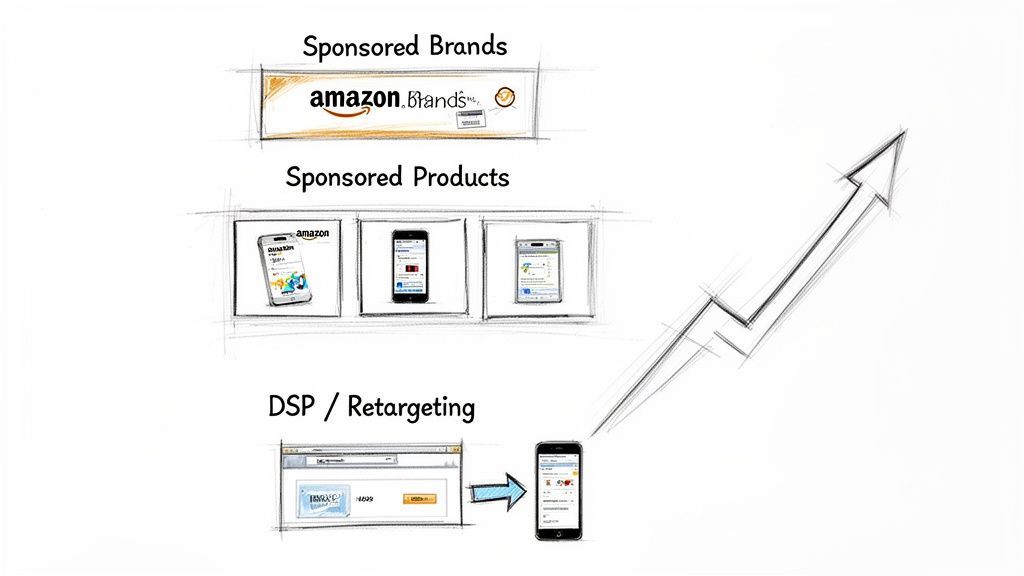
The real goal here is to build a cohesive ad structure where every campaign type—from Sponsored Products to Amazon DSP—has a specific job. This ensures you're not just spending money, but investing in a system that finds new audiences, defends your brand turf, and drives profitable, scalable growth.
Sponsored Products are the workhorse of Amazon advertising, but a single, messy "auto" campaign just won't cut it when you're trying to scale. The secret to profitability and control is a tiered campaign structure designed to continuously harvest keywords and optimize your spend.
This structure relies on three distinct campaign types working in harmony:
This tiered system creates a one-way flow of data. Keywords are tested in auto, proven in broad/phrase, and scaled in exact. It’s a methodical process that stops you from wasting ad spend and concentrates your budget on what actually works.
While Sponsored Products are fantastic for capturing shoppers ready to buy right now, Sponsored Brands and Sponsored Display help you build your brand and reach people earlier in their journey. Think of it as moving up the funnel to plant the seeds of awareness and consideration.
Sponsored Brands are those banner ads you see at the very top of search results. They let you show off a custom headline, your logo, and a few of your products. They’re perfect for:
Sponsored Display ads take things a step further, letting you reach shoppers both on and off Amazon. You can target people based on what they’ve looked at—like someone who viewed your product but didn't buy, or even someone who viewed a competitor’s product. This is your first real taste of powerful retargeting.
A common mistake is treating all ad types the same. Sponsored Products are for capturing existing demand. Sponsored Brands and Display are for creating new demand and building the brand recognition that fuels future sales.
For brands that are truly ready to scale aggressively, Amazon DSP (Demand-Side Platform) is the ultimate weapon. It lets you programmatically buy ad placements across the web, using Amazon's exclusive first-party shopper data to reach incredibly specific audiences. This isn't just about ads on Amazon anymore; it's about following your ideal customer wherever they browse online.
With DSP, you can build incredibly powerful campaigns that:
Imagine you sell premium running shoes. Using DSP, you could serve video ads on popular fitness websites and apps, but only to users Amazon knows have recently searched for "marathon running gear" or bought from a rival brand. That traffic is then funneled right back to your Amazon product page, creating a powerful growth loop. This level of precision is exactly how emerging brands punch above their weight and learn how to grow sales on Amazon, even in the most brutal categories.
Getting traffic to your listing is only half the battle. If a shopper arrives and finds your product is overpriced or, even worse, out of stock, all that hard work you put into keywords and PPC goes right down the drain. This is where the operational backbone of your Amazon business—your pricing, promotions, and inventory management—steps in to turn potential into actual profit.
Mastering these pieces is what creates and sustains the sales velocity that Amazon’s A9 algorithm absolutely loves to reward. It’s all about making an irresistible offer and then being able to deliver on it, every single time.
Pricing on Amazon feels like a tightrope walk. You have to be competitive enough to win the all-important Buy Box, but you can't slash prices so low that your margins disappear. While dynamic pricing tools can help automate this, you first need a solid manual strategy to truly understand where you stand in the market.
Once your everyday price is set, promotions become your go-to tool for injecting a quick burst of sales velocity. This is especially vital when you're launching a new product or heading into a big seasonal push.
Stop thinking of promotions as just a cost. See them for what they are: a strategic investment in your organic ranking. The sales you generate tell Amazon your product is hot, which often leads to a nice, sustained lift in organic visibility long after the deal has ended.
Running out of stock is one of the most destructive things that can happen to your Amazon listing. The second you stock out, you're not just losing sales—your BSR tanks, and your hard-won keyword rankings start to evaporate. Your competitors will be more than happy to pick up the momentum you just dropped.
Smart inventory planning isn't just about logistics; it's a core growth strategy. To stay ahead of it, you need to be proactive and let the data guide you. Start by figuring out your reorder points based on two critical numbers:
Your reorder point is simple: (Lead Time in Days x Average Daily Sales) + Safety Stock. That "safety stock" is your buffer—maybe 14-30 days of extra inventory—to shield you from unexpected shipping delays or a sudden spike in demand.
Amazon keeps a scorecard on how well you manage your FBA inventory, called the Inventory Performance Index (IPI). This score, from 0 to 1000, has a direct impact on your FBA storage limits. A low IPI can seriously restrict how much inventory you can send in, effectively choking your ability to grow.
Amazon looks at a few key things to calculate your score:
For any brand trying to scale, maintaining a healthy IPI (usually a score above 400) is non-negotiable. This kind of operational excellence is what allows sharp, emerging brands to compete with the giants. After all, third-party sellers are the real engine of the marketplace, driving a massive 66% of total GMV, while Amazon’s own first-party sales make up just 34%. This ecosystem is what enables independent US sellers to hit average annual sales of over $290,000, proving that getting these operational details right really pays off. Read more about Amazon's marketplace dynamics.
On Amazon, trust is everything. It's the currency of your business. Long before a shopper cares about your product’s features or its price, they’re looking for one thing: social proof. Positive reviews are the digital version of a friend's recommendation, and they send powerful signals to both customers and Amazon's A9 algorithm.
It's a simple truth of the platform: a product with a dozen 4.5-star reviews will almost always crush a competitor with zero reviews, even if it's priced higher. If you're serious about long-term growth, building a strong foundation of authentic feedback is non-negotiable.
So, how do you solve the classic chicken-and-egg problem? You need sales to get reviews, but you need reviews to get sales. This is exactly why Amazon Vine exists. It’s Amazon’s own compliant and powerful way to break that frustrating cycle.
Vine is an invitation-only program where you provide your product to a hand-picked group of Amazon’s most trusted reviewers, known as "Vine Voices." These aren't just any shoppers; they're people with a proven track record of writing honest, detailed reviews.

By enrolling a new product, you can get up to 30 high-quality reviews, giving your listing the critical social proof it needs to start converting traffic right from day one. It’s the single best way to get the ball rolling.
Getting reviews is just the starting line. Managing them is where you build a lasting reputation for stellar customer service. Remember, your responses to feedback—both good and bad—are public and visible to every potential customer who lands on your page.
This proactive approach doesn't just solve one person's problem. It can sometimes convince an unhappy customer to update their review, and it shows future shoppers that if something goes wrong, you'll be there to make it right.
A single, well-handled negative review can build more trust than ten positive ones. It proves you stand behind your product and value your customers, which is a massive conversion booster.
Beyond the reviews on your product pages, your overall Seller Feedback rating is another critical metric. This score isn't about the product itself; it's about the buying experience you provide—things like shipping speed, packaging quality, and your customer service.
Make it a habit to monitor this in Seller Central. Sometimes, customers leave product reviews here by mistake (e.g., "The item broke after a week"). When that happens, you can request that Amazon remove it since it violates their policy.
Protecting this rating is vital for keeping your Buy Box eligibility and maintaining your overall account health. A solid reputation, built one review and one customer interaction at a time, is the ultimate foundation for sustainable growth.
Sustainable growth on Amazon isn’t about guesswork; it's about data. While a clever ad strategy and a sharp listing can get you started, long-term success comes from knowing your numbers inside and out. Analytics is the compass that guides every single decision, showing you what’s working, what’s not, and where your next big opportunity is hiding.
When you have a handle on your data, you stop reacting to daily sales dips and start proactively steering your brand's future. It’s how you identify your most profitable SKUs, fine-tune your ad spend with surgical precision, and forecast demand so you never face a costly stockout again.
Seller Central is a goldmine of data, but it's easy to get lost in the noise. To cut through the clutter, you need to zero in on the reports that give you genuinely actionable insights. These are the metrics that tell the real story of how your business is performing.
Make it a habit to check these data points regularly:
The opportunity for sellers who master their data is massive. When Amazon’s US ecommerce sales first blew past $309.48 billion, they captured a staggering 37.9% market share during the pandemic. Sales have since climbed to $491.65 billion and are on track to hit $540.29 billion. In the midst of all this, independent US sellers averaged over $290,000 in annual sales, and more than 55,000 of them cleared $1 million or more. Discover more insights about Amazon's growth on Oberlo.com.
If you sell across different channels, relying only on Amazon’s data is like trying to solve a puzzle with half the pieces missing. A customer might see your ad on Instagram, read a review on your blog, and then finally head to Amazon to buy. To really understand what drives sales, you have to connect those dots.
This is where tools like Google Analytics 4 (GA4) become non-negotiable. By setting up Amazon Attribution, you can tag your off-Amazon marketing—from Google Ads to email newsletters—and see exactly which campaigns are sending paying customers to your listings.
Without this end-to-end tracking, you’re flying blind. You might cut a "poorly performing" Google Ads campaign, not realizing it was actually responsible for a significant chunk of your Amazon sales.
Data is pointless if you don't do anything with it. The final, critical step is to create a system for testing, learning, and iterating. This builds a powerful feedback loop where insights lead to actions, and those actions generate fresh data, starting the cycle all over again.
Your iteration process could look something like this:
This disciplined cycle is the engine that drives sustainable scaling. It transforms your business from one that hopes for growth into one that systematically builds it, making sure you’re always adapting and staying one step ahead of the competition.
Growing on Amazon can feel like a puzzle, especially when you're ready to move past the basics and start seeing real momentum. As you push for aggressive growth, the same questions always seem to come up. Here are the straight-up, actionable answers we give to brands who are serious about scaling.
There's no magic switch, and anyone who tells you otherwise isn't being honest. Your timeline depends heavily on your product category, how fierce the competition is, and the budget you're working with. That said, if your listings are fully dialed in and you launch with a smart ad strategy, you should see your initial sales velocity pick up within the first 30 to 60 days.
But consistent, predictable growth? That’s more of a 3 to 6-month game. This is the window you need to collect enough real-world data to fine-tune your ad campaigns, build up social proof with reviews, and start climbing the organic keyword rankings. Think of it like a snowball rolling downhill—it starts small but picks up speed and mass as it goes.
A "good" Advertising Cost of Sale (ACoS) is completely relative to your profit margins. There's no universal number that works for everyone. The best place to start is by calculating your break-even ACoS—that’s simply your profit margin before you factor in ad spend.
Once you have that number, you can set your targets based on what you’re trying to achieve:
Smart sellers quickly move past ACoS and start obsessing over Total ACoS (TACoS). This metric measures your ad spend against your total sales (both paid and organic). When your TACoS is trending down, it means your ads are successfully lifting your organic sales—and that's the ultimate sign of a healthy, scalable strategy.
This isn't an either/or question. The real answer is both. They work together in a powerful feedback loop. Trying to succeed with just one is like trying to row a boat with one oar.
PPC is your accelerator. It drives immediate traffic, gets you those crucial first sales, and delivers priceless data on which keywords actually convert. That initial sales velocity is a huge signal to Amazon's A9 algorithm, which in turn helps boost your organic rank.
A strong organic ranking is your foundation. It delivers a steady stream of "free," high-converting traffic that brings down your customer acquisition costs and builds long-term authority. The winning formula is using PPC to fuel the organic flywheel, creating a self-sustaining growth engine.
Driving external traffic is no longer a "nice-to-have" tactic for advanced sellers; it's becoming a core part of any sophisticated growth plan. When you funnel high-intent shoppers from places like Google, Meta, TikTok, or your email list, you're not just making a sale—you're sending a powerful signal to Amazon. The algorithm is known to reward listings that bring new customers into its ecosystem.
The key is to do it intelligently. Using a tool like Amazon Attribution is non-negotiable. It takes the guesswork out of the equation and shows you exactly which external channels are driving sales and delivering a positive ROI. This is how you build a true full-funnel strategy and learn how to grow sales on Amazon for the long haul.
At Clickstera Solutions LLC, we build these kinds of comprehensive growth playbooks every day. Our team handles everything from advanced PPC and DSP campaigns to full-funnel analytics, helping brands scale profitably on Amazon and beyond. To see how our expertise can accelerate your growth, get in touch with our team.
Talk to Clickstera and get a clear next-step plan to scale your performance marketing.