
Loading article
Loading page...
Most Amazon sellers aren’t failing because their product is bad — they’re failing because everything is disconnected. It’s not about tweaking one thing; it’s about connecting three core pillars: optimized product listings, intelligent advertising, and seamless operations.
The goal is simple: every action you take should make the next one easier and more profitable. This system turns clicks into conversions and one-time buyers into loyal customers. This guide is your step-by-step playbook to build exactly that.
Struggling to move the needle on your Amazon sales? You’re not alone. So many sellers treat their Amazon store like a checklist of disconnected tasks—messing with keywords one day, launching a few ads the next, and only thinking about inventory when they get a low-stock alert. This disjointed approach is exactly why so many brands hit a frustrating plateau.
The real secret to improving Amazon sales isn’t some magic bullet. It’s about building a cohesive, self-reinforcing system.
Here’s what most sellers miss: Amazon doesn’t reward individual tactics — it rewards momentum. Each component has a specific job, but they all work in harmony to build unstoppable momentum.
This concept map shows you exactly how these three pillars—Listings, Ads, and Operations—feed into one central Growth Engine.
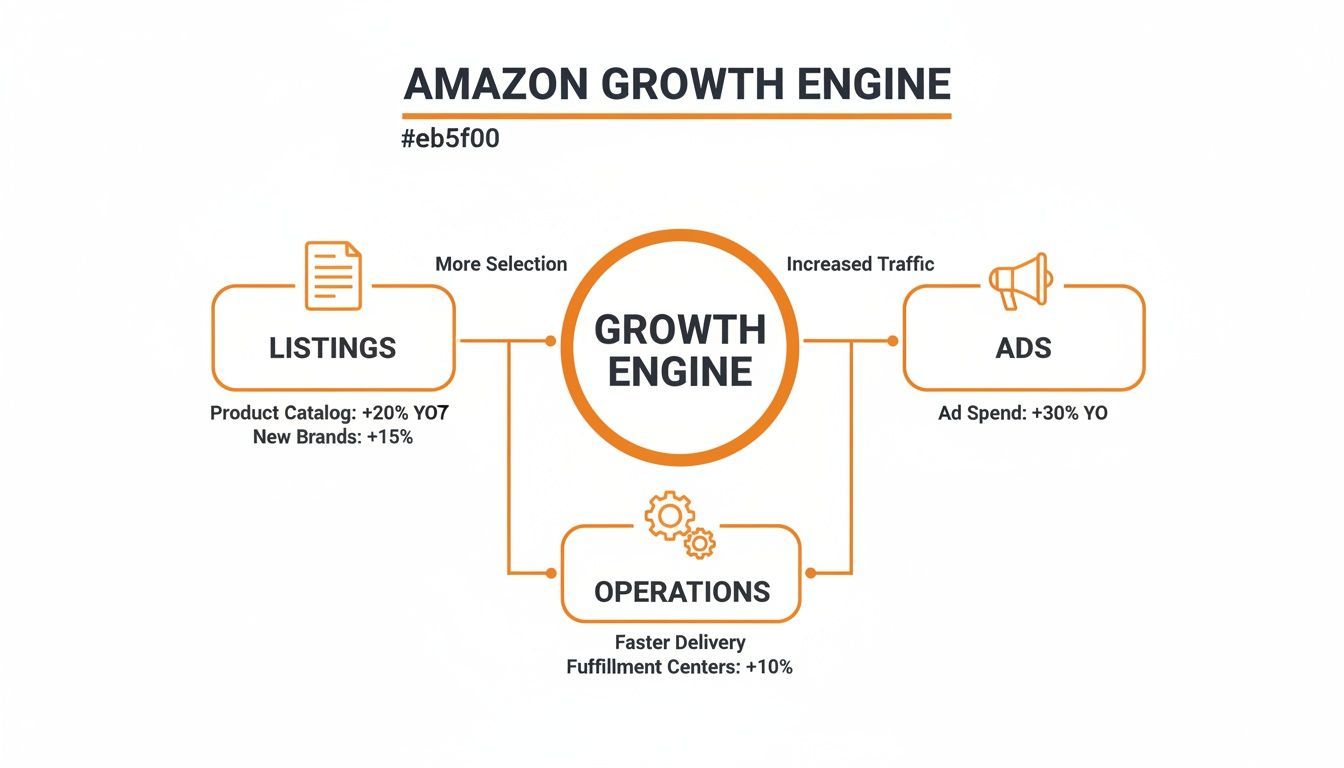
As you can see, sustainable growth isn’t about being great in just one area. It’s about creating real synergy between all of them.
If these pieces aren’t connected, you’re paying Amazon to show shoppers a listing that doesn’t convert — and then wondering why ads don’t work. For instance, spending thousands on ads to drive traffic to a weak listing with blurry photos and vague bullet points is like pouring water into a leaky bucket. All that traffic arrives, but the conversions just don’t happen.
And the competition is fierce. More than half of Amazon’s sales now come from independent sellers — which means you’re not just competing with big brands. You’re competing with sellers who are fast, aggressive, and dialled in.
To stand out, you can’t just participate; you have to orchestrate. A cohesive strategy makes sure your advertising budget generates more than just clicks—it drives profitable sales that boost your organic ranking and build a real brand presence.
This playbook is designed to help you become that orchestrator. We’re going to move beyond isolated tactics and show you how to blend compelling product presentation, data-driven advertising, and efficient operations into a powerhouse growth engine.
If you want predictable growth — not spikes followed by panic — this system is what makes it possible. This is your guide to building a resilient, profitable Amazon business that can thrive in any market.
Your product listing is your digital storefront on the world’s largest marketplace. It’s the single most important asset you have for driving organic traffic and is the foundation for improving Amazon sales. A poorly optimized listing will fail to attract shoppers and sabotage your ad spend, while a masterfully crafted one acts as a 24/7 sales engine.
Ranking isn’t about tricking the algorithm — it’s about matching what shoppers are searching for with a page that actually convinces them to buy. It’s a strategic blend of art and science—using persuasive copy to connect with shoppers while feeding Amazon’s A9 algorithm the exact data it needs to rank your product. Getting this balance right is what separates top sellers from those who remain buried on page ten.
It all starts with deep keyword research. You need to uncover the precise phrases customers are typing into the search bar, not just the ones you think they’re using. These keywords become the building blocks for your entire listing, from the title down to the backend search terms.
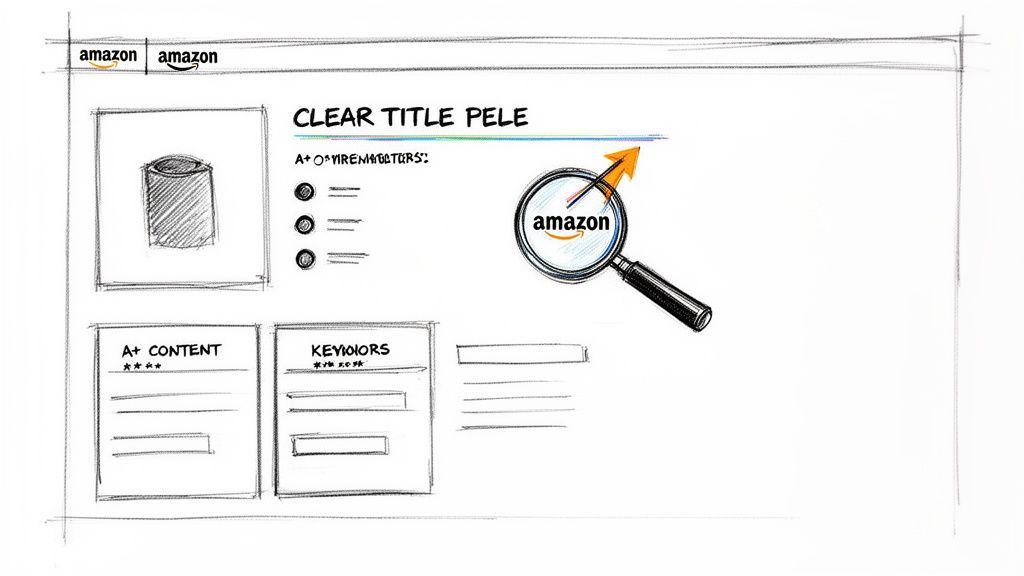
Your product title carries the most weight for SEO. It needs to be a powerful combination of your main keywords, brand name, and key product identifiers like size, color, or quantity. Think of it as your headline—it has to be compelling enough to earn the click amidst a sea of competitors.
A title like ‘Yoga Mat’ might technically be accurate — but it gives Amazon and the shopper almost nothing to work with. A much stronger, optimized title would be: “ProGrip Eco-Friendly Yoga Mat – 6mm Thick, Non-Slip TPE Material for Hot Yoga, Pilates & Fitness – Includes Carrying Strap.” This version immediately answers key customer questions and is packed with relevant search terms.
Your bullet points are where you sell the dream. This is your chance to expand on the features mentioned in the title and translate them into tangible benefits for the customer.
Remember, you’re writing for both humans and a machine. The copy must be persuasive and easy to read for the shopper, but also structured with the keywords the algorithm is looking for. This dual focus is non-negotiable for success.
Once the core components of your listing are optimized, A+ Content is your next major lever for growth. This feature lets you replace the standard text description with visually rich modules, including high-quality images, comparison charts, and brand storytelling. It’s your opportunity to build trust and dramatically increase your conversion rate.
Brands use templates or custom modules to showcase product features, brand story, and cross-selling opportunities, effectively turning a simple listing into a premium landing page. Investing time here is crucial. For a deeper dive into the technical side of on-page optimization, you can explore core SEO principles that apply across platforms.
There are two tiers of A+ Content, and both offer significant advantages. According to Amazon, sellers using Basic A+ Content see an impressive up to 8% increase in sales on average. Those who qualify for the more advanced Premium A+ Content can see their conversion rates jump by a massive up to 20%. At scale, even a single-digit lift in conversion rate can mean thousands in extra monthly revenue — without spending more on ads.
Understanding the differences between Basic and Premium A+ Content helps you decide where to invest your resources. Premium offers more immersive and interactive features that directly translate into higher conversion rates.
Feature
Basic A+ Content
Premium A+ Content
Average Sales Uplift
Module Access
Up to 5 standard modules
Up to 7 premium modules (video, carousels)
High
Content Width
Standard width
Full-width, immersive layouts
Very High
Interactive Elements
Limited (comparison charts)
Advanced (hotspots, Q&A carousels)
Very High
Eligibility
All brand-registered sellers
Stricter brand story and sales criteria
N/A
Ultimately, A+ Content helps you answer customer questions visually, differentiate your product, and build the brand credibility needed to turn a browser into a buyer. It’s an essential investment for any seller serious about improving their Amazon sales.
An optimized product listing is your foundation, but to really scale your Amazon sales, you need to pour fuel on the fire. Strategic advertising is that fuel. This isn't about randomly boosting products; it's about building a full-funnel campaign structure that grabs customers at every stage of their buying journey, from that first moment of awareness to the final click to buy.
A well-architected advertising strategy makes every dollar you spend work harder, delivering a strong Return on Ad Spend (ROAS). It means moving beyond a single-campaign mindset and thinking in layers. You'll be using different ad types to hit different goals, creating a system where each campaign props up the others.
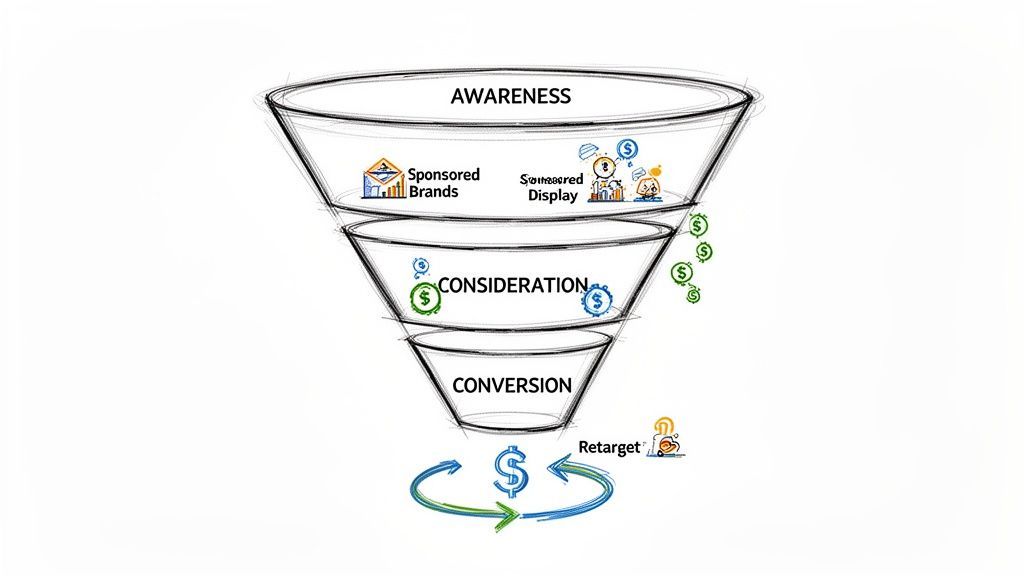
A full-funnel approach lets you engage shoppers whether they're just browsing or have their credit card in hand. Each ad type has a distinct job in guiding them from discovery to conversion.
Structuring campaigns this way creates a seamless customer journey. A shopper might first see your Sponsored Brand ad, later get hit with a Sponsored Display retargeting ad, and finally convert through a Sponsored Products ad. This multi-touch approach seriously stacks the odds in your favor.
One of the fastest ways to improve profitability is to stop paying for clicks that will never convert. Your most valuable tool for this is an aggressive negative keyword strategy. A negative keyword simply tells Amazon not to show your ad for a specific search query.
For example, if you sell premium leather wallets, you don't want to show up for "cheap vegan wallet" or "kids fabric wallet." Every click from those searches is just money down the drain. By regularly digging into your search term reports and adding irrelevant terms as negative exact or negative phrase keywords, you can systematically cut the fat from your ad spend.
A disciplined approach here can easily reduce wasted spend by 20-30%, which directly boosts your overall campaign ROAS without you having to spend a single dollar more. Think of it like pruning a plant—you're trimming the dead branches so the healthy ones can really thrive.
Static bids are a recipe for missed opportunities and leaving money on the table. To truly dominate your niche, you need to embrace dynamic bidding and advanced targeting that adapt to what's happening in the market right now.
This level of control makes sure your ads are most visible when traffic is peaking and in the exact spots that deliver the best results for your brand.
While Sponsored Ads are incredible for capturing demand on Amazon, Amazon's Demand-Side Platform (DSP) allows you to create demand both on and off the platform. DSP lets you programmatically buy display and video ads to reach specific audiences across Amazon-owned sites (like IMDb) and a huge network of third-party websites and apps.
The real power of DSP lies in its sophisticated retargeting. You can build audiences of users who:
By reaching these audiences off-Amazon and guiding them back to your product listing, you create a powerful retargeting loop that keeps your brand top-of-mind. This strategy is a game-changer for launching new products or driving massive sales velocity during key shopping events like Prime Day.
Data from Amazon itself shows that sellers who optimize Sponsored Products and Brands see dramatic lifts. This is especially true during major shopping events where PPC is the key to getting seen. You can explore more about how Amazon sales trends are influenced by these strategies. By combining Sponsored Ads for immediate conversion with DSP for broad reach and retargeting, you're not just running ads—you're building a comprehensive advertising engine that fuels sustainable growth.
Even the most brilliant ad campaign and perfectly optimized listing will fall flat if you can’t get your products into customers' hands. Smart inventory management isn't just a back-end task—it's a critical lever you have to pull to improve Amazon sales, protect your profits, and maintain your hard-earned organic rank.
Get it wrong, and you're caught in a vicious cycle. Stockouts don't just mean lost sales today; they signal to Amazon's algorithm that your product is unreliable. This can tank your Best Seller Rank (BSR) overnight, erasing all your momentum and essentially handing sales over to your competitors.
But on the flip side, overstocking is just as dangerous. It ties up your capital in stagnant products and racks up costly long-term storage fees from Amazon, eating directly into your margins. The sweet spot is a delicate balance, one that requires a strategic approach to both forecasting and fulfillment.
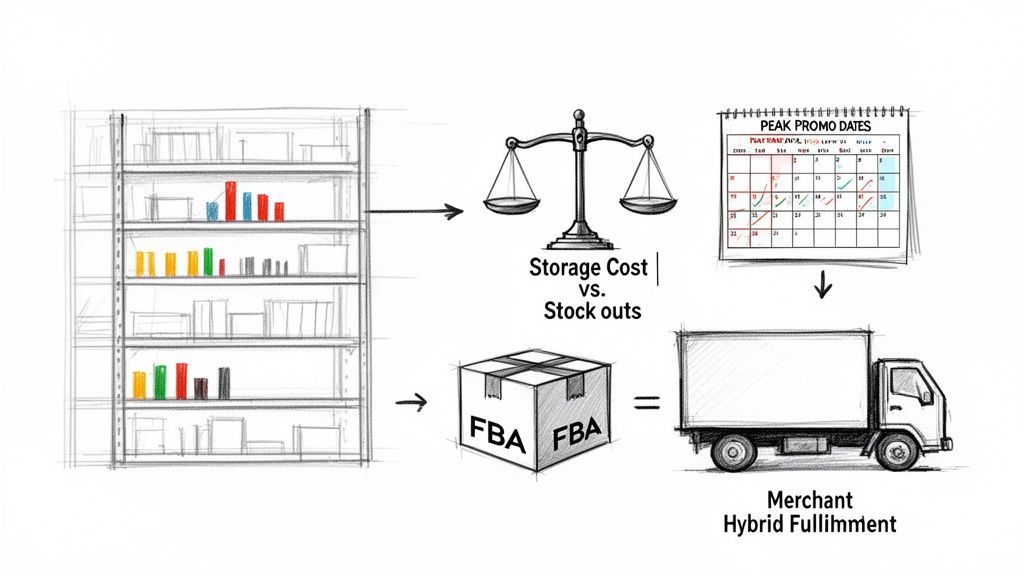
Effective demand forecasting is your first line of defense against both stockouts and overstocking. This means looking beyond just your historical sales data.
A robust forecast should incorporate several key inputs:
By aligning these data points, you can move from reactive ordering to a proactive inventory strategy that actually supports your growth plans instead of holding them back.
Your fulfillment method directly impacts your costs, delivery speed, and eligibility for programs like Prime. The two primary options on the table are Fulfillment by Amazon (FBA) and Fulfillment by Merchant (FBM).
Fulfillment by Amazon (FBA)
With FBA, you ship your products to Amazon's warehouses, and they handle the storage, picking, packing, shipping, and customer service. This is the simplest path to offering Prime shipping—a massive conversion driver. The trade-off? It comes with storage and fulfillment fees that can be significant, especially for slow-moving or oversized items.
Fulfillment by Merchant (FBM)
With FBM, you are responsible for storing your own inventory and fulfilling orders yourself or through a third-party logistics (3PL) partner. This gives you far more control over your inventory and can be more cost-effective for certain products. The major challenge is meeting Amazon's strict shipping standards to qualify for Seller Fulfilled Prime.
Pro Tip: Don't view FBA and FBM as an all-or-nothing choice. A hybrid model is often the smartest play. Use FBA for your best-sellers to maximize Prime exposure and sales velocity, while using FBM for larger, heavier, or slower-moving items to avoid high storage fees.
This hybrid approach also provides a crucial safety net. If your FBA inventory unexpectedly runs out, you can switch the listing over to your FBM offer, preventing a complete stockout and preserving your sales rank while you restock.
The efficiency of your fulfillment process has a massive impact on the customer experience. In fact, sellers using integrated shipping solutions can cut late deliveries by 20% on average, which directly boosts satisfaction and encourages repeat business.
As independent sellers now drive the majority of Amazon's store revenue, having synchronized, reliable stock management is non-negotiable for capturing your share of the market. To really grasp the scale of this opportunity, you can discover more insights about Amazon's explosive sales growth on oberlo.com.
Ultimately, your fulfillment strategy should be a dynamic part of your business plan. By mastering forecasting and strategically choosing between FBA, FBM, or a hybrid model, you protect your bottom line, keep customers happy, and build a resilient operational foundation that can support sustainable sales growth.
Getting a shopper to land on your product page is a great start, but it’s only half the battle. The real challenge is convincing them to click that "Add to Cart" button. This is where two of the most powerful conversion drivers on Amazon come into play: social proof (your reviews) and perceived value (your promotions).
If you want to turn casual browsers into actual customers, you have to master both.
A strong review portfolio isn’t just a nice-to-have; it's a non-negotiable part of selling on Amazon. Think about it from a shopper’s perspective. In the anonymous world of ecommerce, reviews are the ultimate trust signal. A product with hundreds of positive ratings feels like a safe, vetted choice. One with few or poor reviews? That just feels like a risky gamble.
Your baseline goal should be to maintain at least a 4.5-star rating. Anything lower can introduce enough doubt to kill a sale before it even happens. But how do you get a steady stream of real reviews without breaking Amazon’s rules? Simple: you use the tools they give you.
For brand-new products, the Amazon Vine program is one of the most effective ways to get the ball rolling. Amazon invites trusted reviewers, called Vine Voices, to receive your product for free in exchange for an honest, unbiased review. It does come with a fee, but it's often worth it to secure those crucial first 5-15 reviews that give future shoppers the confidence to buy.
Once you have sales coming in, automation is your best friend for long-term review generation. You could manually click Amazon’s "Request a Review" button for every order in Seller Central, but that gets old fast. A much better approach is to use a third-party service that automates compliant review requests. It’s a low-effort strategy that keeps your review count climbing over time.
A strong review portfolio does more than just build trust; it’s a goldmine of customer feedback. Pay close attention to the recurring themes—good and bad. This is unfiltered insight into what people love about your product and what you need to fix.
Once you’ve built a solid base of social proof with reviews, promotions add a layer of urgency and value that can push hesitant shoppers over the finish line. Amazon gives you a few different promotional tools, and knowing which one to use for the right situation is key to getting a good return.
These are your everyday workhorses, but they serve different purposes.
Coupons: Think of these as the digital version of clipping a coupon from the Sunday paper. They show up as a bright orange badge on your listing and are perfect for offering a small, consistent discount (like 5% off or $2 off) to sweeten the deal. They're flexible, easy to set up, and great for giving your click-through and conversion rates a little boost.
Deals (e.g., Lightning Deals, 7-Day Deals): These are high-visibility, time-sensitive events. A Lightning Deal, for example, creates intense urgency by offering a deep discount for just a few hours. They’re incredibly powerful for clearing out excess inventory or generating a massive sales spike, which can give your Best Seller Rank (BSR) a nice, albeit temporary, boost.
Just running promotions whenever you feel like it is a good way to burn money. The smart approach is to build a promotional calendar that lines up with key shopping holidays and your own business goals.
Your calendar should map out the entire year and plan your promotions around a few key areas:
Major Holidays: Plan your biggest and best deals for events like Prime Day, Black Friday, and Cyber Monday. Shopper intent is already sky-high, and a compelling offer can lead to a massive surge in sales.
Seasonal Peaks: If you sell swimwear, running a promotion in early spring just makes sense. If you sell winter coats, a deal in late fall will catch all the early shoppers. Time your offers to match when customers are already looking for what you sell.
Inventory Management: Got some slow-moving stock or want to clear out an old model? Use Lightning Deals or deep discounts to move it before Amazon’s long-term storage fees kick in.
By combining a steady flow of authentic reviews with a well-timed promotional strategy, you create a powerful conversion engine. The reviews build the trust, and the promotions provide the final nudge—a combination that’s essential for improving your Amazon sales and building a sustainable brand.
Even the most seasoned sellers run into questions when trying to grow on Amazon. It's a complex platform, and what worked last year might not work today. Here, we'll tackle some of the most common challenges and queries we hear from brands who are ready to scale.
If you need to make an impact now, the quickest way is a three-part blitz: aggressive PPC, a compelling coupon, and an unbeatable main image. This isn't just about doing three things at once; it's about how they amplify each other.
PPC is your accelerator, pushing immediate, high-intent traffic straight to your product. But that traffic is useless if they don't click. A sharp, eye-catching main image is what wins that click from the search results page, making your ad spend far more efficient. Once they're on your page, a limited-time coupon (even just 10% off) gives shoppers that final push they need to hit "Add to Cart." It’s a simple but powerful way to create and capture demand almost instantly.
We use this combination a lot for new product launches or to create a surge during big sales events like Prime Day. The sudden spike in sales velocity is exactly what Amazon's A9 algorithm loves to see, often leading to a lasting boost in organic rank long after the coupon has expired.
Backend keywords are one of the most underutilized tools in a seller's arsenal. Think of them as free, invisible real estate for your listing's SEO. Customers never see them, but Amazon’s algorithm indexes them completely.
This is where you can stuff all the relevant search terms that don't sound natural in your title or bullet points. Got a "stainless steel water bottle"? Your backend is the perfect spot for terms like "metal canteen," "gym flask," "reusable drink container," or even common misspellings.
Make sure you use every bit of the 249-byte character limit. Leaving that space empty is like handing free organic traffic over to your competitors. It's a simple fix that can dramatically expand how many different search queries your product shows up for.
Start with mastering Amazon PPC. No question. You’re targeting shoppers who are already logged in, searching, and ready to buy. It's the most direct path to generating your first wave of sales and, just as importantly, gathering crucial data on what converts.
Once your on-Amazon machine is running smoothly—your listing is converting well and your PPC campaigns have a healthy ROAS—then it's time to pour fuel on the fire with off-Amazon marketing. This means running ads on platforms like Google or Meta to build brand awareness and drive external traffic to your Amazon pages.
This creates a flywheel effect that can really take off.
This two-step approach lets you capture the demand that already exists on Amazon, then go out and create new demand to feed back into the system. That's how you build a sustainable, long-term brand.
A sudden drop in sales is always jarring, but don't panic. It's almost always caused by one of a few common culprits. The key is to act like a detective and investigate these areas right away:
Work through this checklist systematically. By isolating the problem quickly, you can take action before a one-day blip turns into a downward trend.
Ready to stop guessing and start growing? The team at Clickstera Solutions LLC builds and executes the kind of cohesive, data-driven strategies discussed in this guide. We help great brands scale faster and win bigger results on Amazon and beyond. Find out how we can help you at https://clickstera.com.
Talk to Clickstera and get a clear next-step plan to scale your performance marketing.