Loading article
Loading page...

At its most basic, a performance based marketing agency is a partner whose pay is tied directly to delivering real, measurable results—not just the hours they put in.
Think of it like hiring a salesperson who works purely on commission. They only earn when they close a deal, which completely aligns their goals with the company's. This model shifts the entire focus from effort to outcomes.
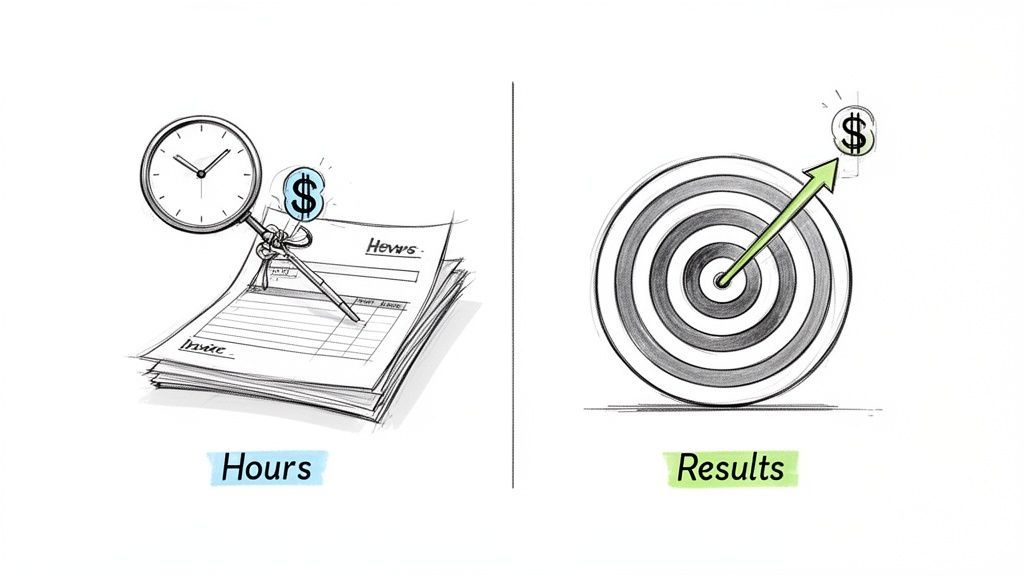
For decades, traditional marketing agencies have run on a retainer model. They bill for their time, their resources, and the services they provide. You pay for the work being done—the ad campaigns they build, the social media posts they schedule, the reports they compile. It’s a straightforward system, but it doesn't always guarantee that the agency is laser-focused on your bottom line.
A performance based marketing agency flips that dynamic completely. Their compensation is tied directly to hitting pre-agreed Key Performance Indicators (KPIs). This creates a powerful, built-in incentive for the agency to drive actual business growth, because their success is literally dependent on yours.
If you don't make money, they don't either. It's that simple.
This isn't just a different payment structure; it’s a whole different mindset. It changes the client-agency relationship from a standard vendor transaction into a true strategic partnership. Both parties share the risk and, more importantly, share the reward.
This results-first mentality is especially crucial in hyper-competitive ecosystems like the Amazon and Walmart marketplaces. In these arenas, every ad dollar and every decision has to directly fuel tangible outcomes, such as:
This model forges a true partnership where marketing stops being a line-item expense and becomes a predictable, scalable driver of revenue. The entire focus shifts from "Are we running ads?" to "Are our ads profitable?"
This approach is gaining serious momentum as businesses demand more accountability from their marketing spend. In fact, the global advertising industry is expected to reach $444.7 billion in revenue by 2025, driven by a growing need for specialized, data-centric expertise. You can dig deeper into these trends in this IBISWorld industry report. This growth underscores why performance models are becoming essential for brands that want to squeeze every last drop of value from their investment.
To really see the difference, let’s put the two models side-by-side. The table below breaks down how each one approaches the fundamental aspects of a client relationship.
Attribute
Traditional Agency Model
Performance Based Agency Model
Payment Structure
Monthly retainers, project fees, hourly rates
Revenue share, cost-per-acquisition, bonuses
Primary Focus
Activities, deliverables, and campaign execution
Measurable outcomes (sales, leads, ROAS)
Incentive
Completing contracted work and retaining clients
Hitting performance targets to earn compensation
Risk
Primarily on the client's side
Shared between the client and the agency
Typical Metrics
Impressions, reach, brand awareness
CAC, LTV, conversion rate, profitability
Ultimately, choosing a performance based marketing agency isn't just about outsourcing work. It’s about investing in a partner who has real skin in the game and is just as committed to your financial success as you are.
First, you need to understand the philosophy of a performance-based marketing agency. Once that clicks, the next step is seeing how that mindset translates into actual dollars and cents.
Unlike a traditional flat monthly retainer, performance models are built to be flexible. The whole point is to tie the agency’s paycheck directly to your business goals. These aren’t cookie-cutter agreements; they're carefully structured to reward the specific outcomes you care about most.
The beauty of this approach is its pure alignment. You're not paying for hours logged on a timesheet or tasks checked off a list—you're paying for tangible results that grow your bottom line. This completely changes the dynamic of the partnership, making sure you and your agency are rowing in the exact same direction.
Performance partnerships are built on a foundation of clear, measurable actions. While the specifics can always be customized, the payment structures almost always fall into a few primary buckets. Each one is designed for different business objectives, from drumming up initial interest to closing the final sale.
Here are the models you'll run into most often:
Cost Per Acquisition (CPA) or Cost Per Sale (CPS): This is performance marketing in its purest form. You pay the agency a set fee or a percentage for every single sale or new customer they bring in. For a DTC brand, this might mean paying the agency $30 for every new subscriber they acquire through an ad campaign. It’s simple, direct, and completely tied to revenue.
Revenue Share: With this model, the agency earns a percentage of the total revenue they generate for you. If an agency drives $100,000 in monthly sales and your agreement is a 5% revenue share, their compensation is $5,000. This works incredibly well for e-commerce brands because it directly rewards the agency for making your total sales number bigger.
Cost Per Lead (CPL): For businesses with a longer sales cycle, getting a qualified lead is the most critical first step. In a CPL model, you pay the agency a fixed fee for each validated lead they deliver—think someone who fills out a detailed "Request a Quote" form. This ensures your sales team gets a steady stream of genuinely interested prospects.
While pure performance models are powerful, sometimes a blended approach makes more sense. Hybrid models combine the stability of a traditional retainer with the motivation of a performance-based bonus, creating a structure that balances risk and reward for everyone involved.
A common hybrid structure involves a reduced monthly management fee to cover baseline operational costs, paired with performance bonuses that kick in when specific KPIs are met or exceeded.
This approach offers a few key advantages. The base fee gives the agency the stability to invest in long-term strategy and assign top-tier talent to your account. At the same time, the performance incentives keep everyone laser-focused on hitting ambitious growth targets, like a specific Return on Ad Spend (ROAS) or a certain number of monthly conversions.
For example, a brand might agree to a $3,000 monthly management fee plus a 10% bonus on all revenue generated above a $50,000 monthly threshold. This setup ensures the agency is compensated for their foundational work while being heavily motivated to scale results profitably. It’s a balanced partnership that protects the agency’s resources while ensuring the brand only pays big bonuses when real growth happens.
Ultimately, picking the right model comes down to your specific business goals, sales cycle, and profit margins.
When you switch to a performance-based marketing agency, the entire conversation changes. You're no longer paying for effort or activity; you're investing in outcomes. But which outcomes actually matter? A great partnership isn't about chasing vanity metrics like clicks or impressions—it's about moving the needles that dictate real profitability.
This is where Key Performance Indicators (KPIs) become the shared language between you and your agency.
These aren't just report-card numbers. They transform your marketing from a series of disjointed activities into a predictable growth engine. They give you the hard data needed to have strategic, bottom-line conversations. Instead of asking, "What did you do this week?" you'll be asking, "How did our CAC change, and what does that mean for our Q3 budget?"
This data-first approach is the bedrock of a healthy, results-driven relationship. It ensures everyone is looking at the same scoreboard and working toward the same goal: sustainable, profitable growth.
While metrics like Click-Through Rate (CTR) and Cost Per Click (CPC) offer some directional insight, they don't tell you anything about profitability. A top-tier performance agency will steer you away from these surface-level metrics and focus you on the "big three" that connect ad spend directly to your bottom line.
These are the KPIs that your CFO, investors, and leadership team actually care about because they measure the financial health and long-term viability of your marketing spend.
Return on Ad Spend (ROAS): This is the clearest, most direct measure of your advertising profitability. It answers the simple question: for every dollar we put in, how many dollars came back out? A ROAS of 4:1 means you're generating $4 in revenue for every $1 of ad spend. It's the ultimate top-line indicator of whether your campaigns are working.
Customer Acquisition Cost (CAC): This metric tells you exactly what it costs, in total, to acquire one new customer. It goes beyond ad spend to include agency fees and other related costs. Lowering your CAC is fundamental to scaling profitably. After all, if you're paying more to get a customer than they're worth to your business, you're just buying revenue at a loss.
Lifetime Value (LTV): This is the total profit you can expect from a single customer over their entire relationship with your brand. A strong LTV is a sign of deep customer loyalty and a healthy business model. The goal isn't just to acquire customers; it's to acquire customers whose LTV is multiples higher than your CAC.
Understanding the relationship between CAC and LTV is everything. A winning performance marketing strategy isn't just about acquiring customers cheaply (low CAC), it's about acquiring the right customers who stick around and spend more over time (high LTV).
A smart agency will obsess over this ratio because it's the true north of sustainable growth. Before diving into a partnership, it's critical to align on which KPIs will serve as the ultimate source of truth.
The table below outlines the essential metrics for evaluating an agency's impact, moving from tactical campaign data to strategic business outcomes.
| Essential KPIs for Evaluating Agency Performance |
| :— | :— | :— |
| KPI (Key Performance Indicator) | What It Measures | Why It's Critical for Performance Marketing |
| Return on Ad Spend (ROAS) | The gross revenue generated for every dollar spent on advertising. | It's the most direct measure of ad campaign profitability. A high ROAS means your ads are efficiently converting spend into sales. |
| Customer Acquisition Cost (CAC) | The total cost (ad spend + fees) to acquire one new customer. | This metric tells you if your growth is sustainable. Profitable scaling depends on keeping CAC well below LTV. |
| Lifetime Value (LTV) | The total net profit a customer is expected to generate over their lifetime. | LTV reveals the long-term value of the customers you're acquiring. A high LTV justifies a higher CAC and signals a healthy business. |
| Conversion Rate (CVR) | The percentage of users who take a desired action (e.g., make a purchase). | This KPI measures the effectiveness of your ads and landing pages. Improving CVR is a direct lever to lower CAC. |
| Average Order Value (AOV) | The average dollar amount a customer spends per transaction. | Increasing AOV is a key way to boost ROAS without necessarily acquiring more customers. It makes each conversion more valuable. |
Focusing on these KPIs ensures that both you and your agency are aligned on what truly matters: driving profitable growth, not just generating clicks. This shared focus is the foundation of a successful and long-lasting partnership.
Of course, none of these KPIs mean a thing if the data behind them is shaky. Rock-solid analytics and tracking aren't just a "nice-to-have"—they're completely non-negotiable for any legitimate performance marketing agency. Without accurate tracking, you're flying blind, unable to attribute sales correctly or make smart budget decisions.
This is why a proper setup of tools like Google Analytics 4 (GA4) and Google Tag Manager is mission-critical. These tools allow your agency to see the complete customer journey, from the first ad a person sees on Instagram all the way to the final purchase on your website.
A clean data setup empowers you to:
This technical foundation ensures that when your agency reports a specific ROAS, that number is real, verifiable, and trustworthy. It’s the technical backbone that makes true performance marketing possible. Building out this foundation is just as important as the ads themselves. For more on the technical components that support marketing, you can find great information from resources like RankMath.
A modern brand can’t survive on a single marketing channel, and a true performance partnership doesn't operate that way either. The real power of a performance-based marketing agency is its ability to build a cohesive, multi-channel system where each platform has a specific, strategic job. It’s less about running separate campaigns and more about creating a single, intelligent growth engine.
Think of it like an orchestra. Your social media ads are the violins, creating the initial emotional pull. Your search ads are the brass section, coming in with a powerful, direct statement when someone's ready to act. And your retargeting efforts? That's the percussion, keeping the rhythm and driving everything to a satisfying conclusion. Each part is vital, but the magic happens when they play in harmony, guided by a single conductor—your agency.
This integrated approach makes sure your message meets customers at every stage of their journey, from the first "what is this?" to the final "buy now."
Let's say you're a growing DTC brand launching a new line of premium coffee beans. A skilled agency won't just throw ad budget at one channel and cross its fingers. Instead, they’ll map out a full-funnel strategy where each channel builds on the last, telling a complete story.
This is where the numbers come in. An agency will be watching a handful of interconnected metrics to gauge the health and profitability of the whole system.
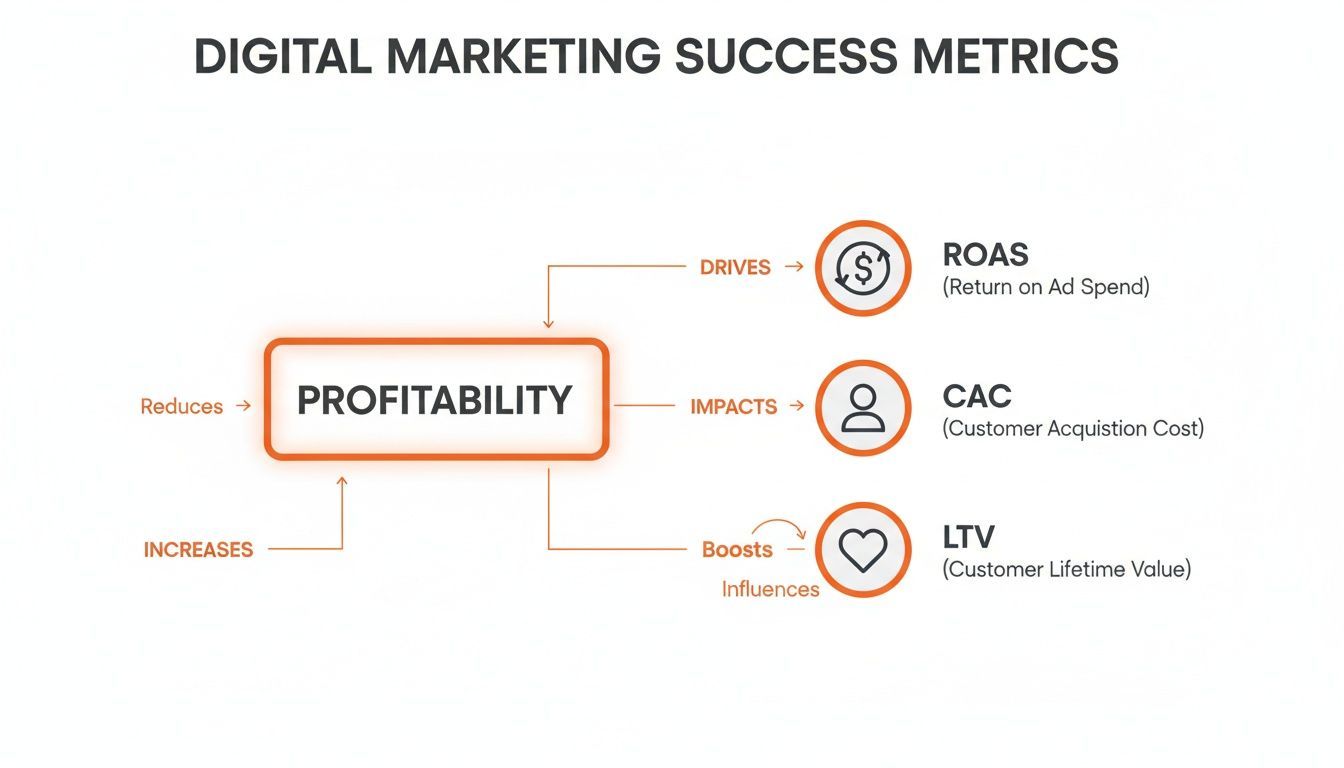
This visual really gets to the heart of it, showing how metrics like ROAS, CAC, and LTV are all linked. They form the financial backbone of a successful performance strategy.
Here’s how that multi-channel story might unfold for our coffee brand:
Awareness on Social (Meta & TikTok): The campaign kicks off with engaging, video-first ads showing the coffee's origin story and unique brewing methods. The goal here isn't immediate sales. It's about capturing attention and building an audience of interested coffee lovers. The main KPI is video view-through rate, not ROAS.
Consideration with Search (Google Shopping): As interest builds, people start Googling things like "best single-origin coffee beans." Now, your highly targeted Google Shopping ads appear, showing the product with clear pricing and strong reviews right when the customer is actively comparing options. This is a crucial mid-funnel touchpoint.
Conversion on Marketplaces (Amazon): The customer, now familiar with the brand, sees a sponsored product ad while browsing on Amazon. Because they've been warmed up by the social and search ads, they are far more likely to click and convert on a platform they already trust.
This coordinated effort creates a seamless journey, guiding the customer from casual interest to a confident purchase. The best agencies excel at this kind of strategic orchestration, which is why brands are increasingly relying on them for paid media. In fact, recent marketing agency benchmarks show 89% of agency leaders now see paid advertising as their top priority.
The real genius of an integrated strategy is how data from one channel informs and improves performance on another. This creates a powerful feedback loop that constantly refines your campaigns for better results. Your agency becomes a hub for cross-channel intelligence.
A performance agency doesn't just manage channels in isolation; they use them to talk to each other. An insight from TikTok can sharpen the targeting on Amazon, and a high-converting keyword from Google can inspire new ad copy for Meta.
Here are a few practical examples:
This data synergy transforms your marketing from a series of disconnected bets into a highly optimized, intelligent system. By using insights across the board, a skilled performance-based marketing agency cuts down on wasted ad spend and speeds up profitable growth. You can dive deeper into how data from tools like Google Analytics powers these strategies. Ultimately, this holistic approach is what separates a good agency from a great one.
Shifting to a performance-based marketing agency can seem like the perfect fix. It’s a partnership where everyone’s incentives are aligned, and every dollar you spend is tied directly to a result. But while this model offers some serious advantages, it isn't a magic bullet. You need to understand both its strengths and its potential pitfalls to make a decision that’s right for your brand’s long-term health.
This model completely changes the old client-agency dynamic. It becomes a shared-risk, shared-reward venture where both sides have skin in the game. When it clicks, it creates a powerful engine for growth. But its success depends entirely on clear communication, solid data infrastructure, and a mutual understanding of business goals that go beyond just the next sale.
The biggest draw for brands is the direct line between marketing spend and actual results. This creates a level of accountability that you just don't get with traditional retainer models.
Direct ROI Alignment: You’re paying for outcomes, not hours logged or tasks completed. This ensures your agency is laser-focused on the same thing you are: generating profitable revenue. Every strategic choice they make has your bottom line in mind.
Reduced Upfront Financial Risk: Models like revenue share or cost-per-acquisition keep your initial cash outlay low. This is a huge plus for emerging brands or companies launching new products, as it lowers the barrier to getting top-tier marketing talent in your corner.
A Highly Motivated Agency Team: When an agency’s paycheck is tied to hitting specific targets, their team is naturally driven to innovate, optimize, and push harder for results. They’re invested in your success, which often leads to more creative and proactive problem-solving.
While the upside is huge, the performance model comes with its own set of complexities. Acknowledging these potential hurdles from the get-go allows you to build an agreement that minimizes risks and sets the partnership up for success.
A major concern is the temptation to focus too heavily on short-term wins. If your agreement over-incentivizes immediate sales, an agency might ignore crucial brand-building activities that create long-term customer loyalty and higher lifetime value (LTV).
The core challenge of a performance model is balancing the drive for immediate, measurable results with the strategic patience required to build a lasting, valuable brand.
On top of that, this model demands an exceptional level of data integrity.
Intensive Tracking and Analytics: The entire system lives or dies by flawless tracking. If your analytics setup (like GA4) can't accurately attribute sales to the right channels, disputes are inevitable, and the model breaks down. You often need to invest significantly in your tech stack and setup upfront.
Risk of Short-Sighted Tactics: An agency focused solely on a CPA or CPL goal might lean on aggressive, discount-heavy tactics that can cheapen your brand over time. It’s critical to set clear brand guidelines and guardrails from day one.
Complexity in Service Scope: The best agencies adapt and grow with you. Recent data shows that agencies expanding their service offerings achieved a 9.7% growth rate, while those with static services grew by only 1.1%. This tells us that a partner offering integrated solutions—from PPC and DSP to creative and analytics—is better positioned to drive sustainable growth. You can dig into more insights on this trend in the 2025 Digital Agency Industry Report.
Ultimately, a successful partnership with a performance based marketing agency needs a transparent, balanced agreement. It has to reward measurable results while also protecting and investing in the long-term health and equity of your brand.
Picking a performance-based marketing agency is a big deal. It’s less like hiring a vendor and more like bringing on a business partner who gets paid when you get paid. To find the right fit, you need to go way beyond the slick sales deck and dig into how they actually work.
A great agency won’t just show you their highlight reel; they’ll break down the how and why behind their wins. They should be able to walk you through a campaign from start to finish—the initial strategy, the roadblocks they hit, and the specific tweaks that turned things around. That kind of transparency is non-negotiable.
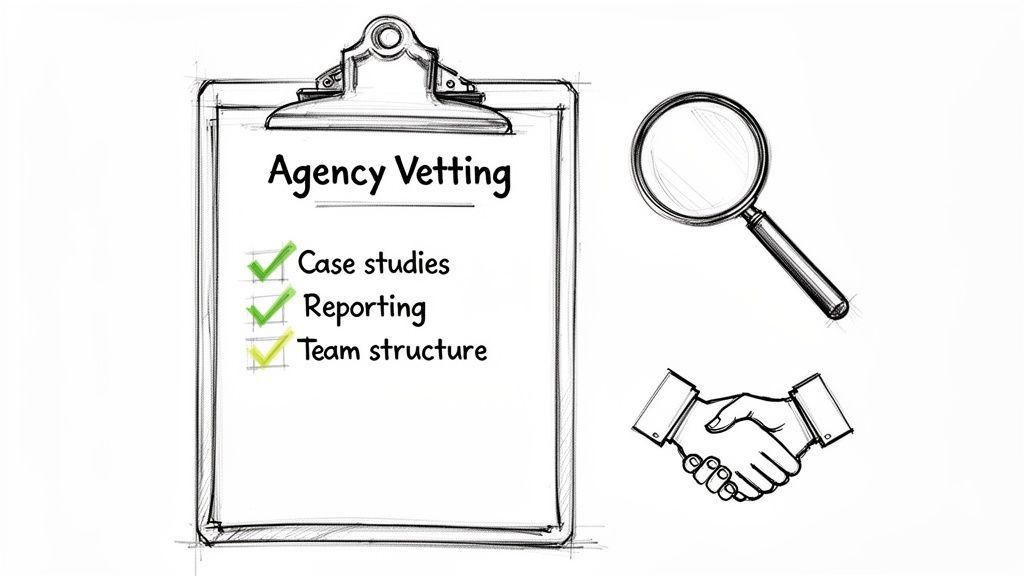
Treat this process like a high-stakes interview, because it is. Use this checklist to guide your conversations and compare potential partners on what really matters.
A partnership thrives on transparency and proactive communication. The agency you choose should feel like an extension of your own team, invested in your goals and candid about both successes and challenges.
Finally, look for signs of industry credibility. Certifications aren't just logos; they show a commitment to staying on top of best practices. For example, understanding what it means to be a Verified Partner with Amazon is crucial if marketplace growth is a priority.
Ultimately, choosing the right agency comes down to finding a partner with proven expertise, transparent processes, and a genuine commitment to driving your brand's profitable growth.
Diving into performance marketing always brings up a few key questions. We've pulled together the answers to the ones we hear most often from brands, cutting through the noise to give you practical, straightforward insights.
There's no one-size-fits-all answer here, because the cost is tied directly to the results you get. With a pure revenue share model, you might have zero upfront fees, but the agency will take a slice of the sales they generate—usually somewhere between 5% to 15%.
Another common setup is a Cost Per Acquisition (CPA) model, where you pay a fixed amount for every new customer the agency brings in. Many also offer a hybrid approach, combining a smaller monthly retainer—say, $2,000 to $5,000—with performance bonuses. The key is to run the numbers against your product margins and customer lifetime value (LTV) to see which model makes the most sense for your business.
While you might see some quick wins in the first 30 days, you should expect it to take about 90 days to see significant, repeatable results. This isn't a delay tactic; it’s a crucial period for the agency to gather data and start a rigorous testing process.
Think of the first three months as building the foundation. It’s all about testing ad creative, dialing in the audience targeting, and optimizing campaigns on platforms like Amazon and Google.
This methodical approach lets real-world data—not just guesswork—shape the strategy. A little patience in this phase is what sets the stage for sustainable, long-term growth.
Absolutely. The best ones know that ads are just one part of the equation. Their real goal is to optimize every variable that leads to a conversion, which means their services often go far beyond just buying media.
Many top-tier agencies provide essential support that directly impacts campaign performance, including:
This holistic approach makes sure every piece of the customer journey is firing on all cylinders.
Ready to partner with an agency that has real skin in the game? Clickstera Solutions LLC is an Amazon Verified Partner dedicated to driving profitable growth for brands on major marketplaces. We combine expert strategy with flawless execution to deliver measurable results. Schedule a free consultation today and discover how our performance-driven approach can scale your brand.
Talk to Clickstera and get a clear next-step plan to scale your performance marketing.