
Loading article
Loading page...
Seller Fulfilled Prime is a program that lets Amazon sellers ship Prime-eligible orders straight from their own warehouses, completely bypassing Amazon's FBA network. It’s your ticket to displaying that coveted Prime badge on your products, which instantly opens the door to millions of loyal Prime members—all while you keep total control over your inventory and fulfillment.
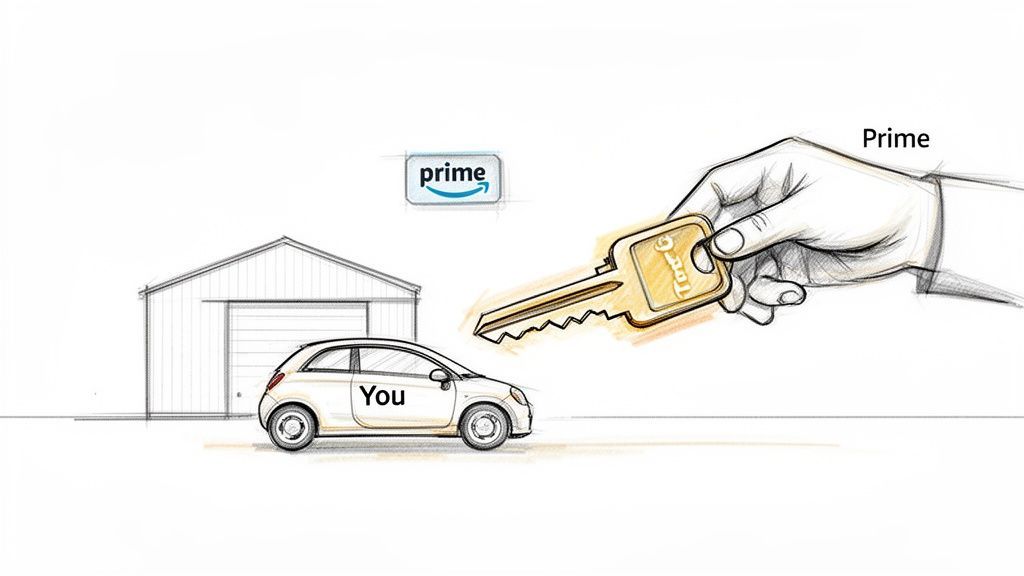
Think of Seller Fulfilled Prime (SFP) like this: Amazon hands you the keys to their Prime kingdom, but you’re still driving your own car. You get the incredible conversion power of the Prime badge—a symbol of trust and speed for millions of shoppers—without ever sending your products to an Amazon fulfillment center. This setup creates a unique middle ground between Fulfillment by Amazon (FBA) and standard Fulfillment by Merchant (FBM).
At its core, seller fulfilled prime fulfillment is a trade-off: you get more control, but you also take on a lot more responsibility. Instead of paying FBA fees, you’re in charge of your own warehousing, packing, and shipping. This is a huge win for brands that:
But let’s be clear, this model isn’t for everyone. Amazon guards the Prime customer experience with an iron fist, which means SFP sellers must meet incredibly strict performance metrics. It's a strategic program built for established brands with sophisticated, high-performing logistics, not a starting point for new sellers still trying to figure out fulfillment.
While FBA is still the dominant fulfillment method, SFP has carved out its place as a key alternative. As of Q3 2025, while roughly 82% of active Amazon sellers use FBA, the remaining 18% are increasingly exploring hybrid models like SFP. This points to a major opportunity for brands who want more operational control and better margins without giving up the benefits of the Prime badge. You can discover more insights about the evolving Amazon fulfillment landscape and how sellers are adapting.
The power of SFP lies in its ability to merge brand control with Amazon's market reach. You get to build your brand with custom packaging and direct inventory management while simultaneously leveraging the trust and visibility that the Prime logo provides.
Ultimately, choosing SFP comes down to your operational chops. Can your warehouse consistently hit two-day shipping promises nationwide? Are your systems ready to handle Amazon's demanding standards for on-time shipping and low cancellation rates? Answering these questions honestly is the first step in figuring out if this powerful program is the right move for your brand.
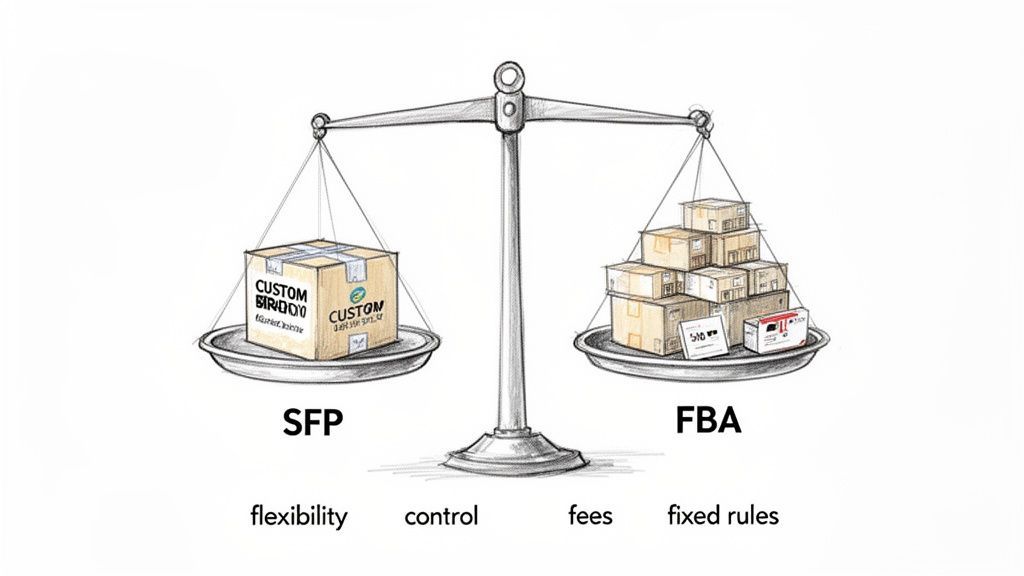
Choosing between Seller Fulfilled Prime (SFP) and Fulfillment by Amazon (FBA) isn't just a logistics decision. It's a strategic move that will shape your brand's cost structure, customer experience, and operational control for years to come. This isn't about picking a shipping method—it's about matching your fulfillment model to your long-term vision.
FBA is the classic turn-key solution: you ship your inventory to Amazon, and they take over everything from storage and packing to shipping and customer service. On the flip side, seller fulfilled prime fulfillment puts you firmly in the driver's seat. You get to wear the coveted Prime badge while managing the entire fulfillment operation from your own warehouse.
The first thing most brands notice is the fee structure. FBA comes with a complex web of costs—fulfillment fees, monthly inventory storage fees, and painful long-term storage fees for any items that don't move fast enough. These can eat away at your margins, especially if you sell oversized, heavy, or highly seasonal products.
SFP gets rid of those specific Amazon fees. Sure, you're now covering your own warehousing, labor, and shipping expenses, but you gain direct control over every dollar spent. This lets you protect your margins on products that are simply unprofitable to store in Amazon's network. Think of a furniture brand selling large tables—the FBA fees would be crippling, making SFP the only logical path to Prime.
Inventory management is another massive point of difference. With FBA, your stock is essentially locked inside Amazon's ecosystem. This creates separate inventory pools, meaning the products in an Amazon warehouse can't be used to fulfill orders from your own website or other marketplaces. It's a recipe for stockouts on one channel while you have perfectly good inventory sitting idle on another.
SFP brings all your inventory under one roof. By fulfilling orders from your own warehouse, you can use a single stock pool for Amazon, your Shopify store, and any other retail partners. This flexibility is a game-changer for preventing stockouts and improving capital efficiency since you're not tying up cash in fragmented inventory.
For a multi-channel brand, SFP transforms inventory from a series of isolated silos into a single, agile asset. This control is fundamental for scaling efficiently across different sales platforms without creating logistical headaches.
How your product shows up on a customer's doorstep is a huge part of your brand's story. FBA standardizes this entire experience—every order arrives in a generic, Amazon-branded box. It’s efficient, sure, but it completely erases any chance for a unique unboxing experience.
SFP gives you back that final, crucial touchpoint. You can ship in custom-branded boxes, slip in marketing inserts, or add a personalized thank-you note. This direct connection builds real brand loyalty and creates a memorable moment that FBA just can't replicate. It also means you handle returns and customer service directly, giving you complete ownership over your brand's reputation.
The table below breaks down the core differences between Seller Fulfilled Prime and Fulfillment by Amazon across critical business functions, helping brands choose the right model.
Business Aspect
Seller Fulfilled Prime (SFP)
Fulfillment by Amazon (FBA)
Prime Badge
Yes, earned by meeting strict performance metrics.
Yes, automatically included with the service.
Inventory Control
Full control from your own warehouse; unified stock for all channels.
Limited control; inventory is sent to and managed by Amazon.
Fulfillment Fees
No FBA fees; you cover your own warehousing, labor, and shipping.
Pay per-unit fees for fulfillment, storage, and other services.
Branding
High control; use custom packaging and marketing inserts.
No control; all orders are shipped in standard Amazon packaging.
Ideal Products
Bulky, heavy, high-margin, or slow-moving items.
High-volume, standard-sized, and lightweight products.
Operational Burden
High; you are responsible for meeting all of Amazon's demands.
Low; Amazon handles all logistics and customer service.
At the end of the day, FBA offers convenience but asks for control and margin in return. Seller fulfilled prime fulfillment, on the other hand, is a demanding but highly rewarding path for established brands with the operational muscle to maximize profitability and own their customer experience from click to unboxing.
Earning that Prime badge through seller fulfilled prime fulfillment isn't a "set it and forget it" kind of deal. It's an everyday commitment to keeping Amazon's promise to its customers. Think of it like joining an exclusive club where the dues are paid daily with flawless performance. Amazon holds the bar incredibly high for a simple reason: the Prime logo is their symbol of trust, and any slip-up on your end reflects directly on them.
This goes way beyond just shipping fast. It’s about building a fulfillment machine that operates with near-perfect precision, day in and day out. These standards aren't suggestions—they're non-negotiable rules designed to give every Prime customer the exact same top-tier experience, no matter who packs the box. If you want to keep your Prime badge, falling short is simply not an option.
To hold onto your SFP status, your operation has to consistently hit a series of tough benchmarks. These metrics are the lifeblood of the program, and you can bet Amazon is watching them like a hawk.
Here's what they're tracking:
These numbers leave almost zero room for error. One bad day—a carrier delay, a key employee calling in sick, or an inventory miscount—can put your SFP eligibility on the line. This is precisely why having bulletproof systems and backup plans is a must for any brand even thinking about this fulfillment model.
Before you even get to show off the Prime badge, you have to survive Amazon's trial period. This is your audition. You have to prove your warehouse can meet Prime-level standards without the benefit of the badge driving sales. During this trial, you’ll fulfill a certain number of Prime-eligible orders while hitting all the performance targets perfectly.
Think of the SFP trial period as a stress test for your entire logistics operation. It’s designed to expose any weaknesses in your processes before you’re given the responsibility of representing the Prime brand.
To make things even tougher, Amazon has tightened the graduation requirements. As of June 29, 2025, sellers must maintain new performance standards, including a steady volume of at least 100 Prime packages per month after they enroll. The trial itself has also become more challenging, with a blackout period between October 19 and December 25 where no new sellers can graduate. You can learn more about the 2025 SFP program updates and see how they affect both new and current sellers.
On top of the performance metrics, Amazon has a few operational mandates that are just as important. These rules are all about standardizing the Prime experience and guaranteeing reliability, no matter who the seller is.
Two of the biggest operational hurdles are:
Meeting these demands requires a serious investment in staffing, technology, and carrier management. It’s a clear message from Amazon: seller fulfilled prime fulfillment is for established businesses with mature, high-performance logistics that are ready to play at Amazon's speed.
Getting into seller fulfilled prime fulfillment isn't something you can just switch on. It’s a serious commitment that demands a clear roadmap, rock-solid preparation, and constant attention to detail. The path from application to daily operations is lined with strict rules and potential hang-ups, but if you approach it systematically, you can absolutely nail it.
The whole thing kicks off with enrollment, which usually means getting on a waitlist. Amazon opens and closes the SFP program to new sellers from time to time, so your first move is to get your name in the hat. While you're waiting, your time is best spent getting your operations in shape to meet the tough performance metrics from the moment you go live.
Once you’re greenlit for the SFP trial period, the real work starts. This is where you lay the groundwork for an operation that's both profitable and compliant. It’s not just about shipping fast; it's about shipping smart.
Here are your main tasks during setup:
This flow chart breaks down the critical performance metrics you have to live by for successful seller fulfilled prime fulfillment.
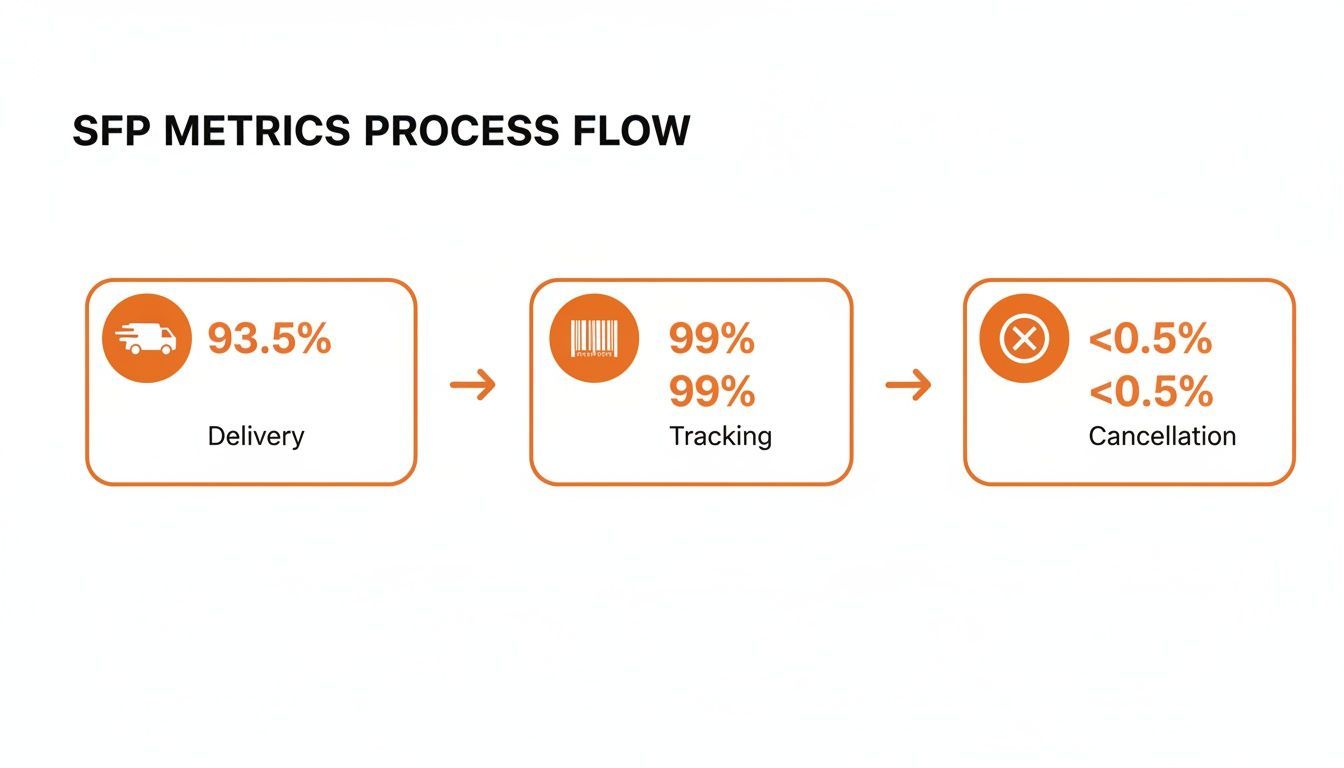
As you can see, the program demands near-perfect execution. There’s almost no room for error when it comes to cancellations or tracking issues.
So what does the daily grind actually look like? A smooth SFP operation is all about rhythm and process. You have to turn potential chaos into a predictable, well-oiled machine.
A proven operational flow usually looks something like this:
The daily SFP workflow is a high-stakes race against the clock. Success hinges on a disciplined, process-driven approach where every step, from order import to carrier handoff, is optimized for speed and accuracy.
As an Amazon Verified Partner, we've seen it firsthand: mastering this workflow is what separates the brands that thrive with SFP from those that quickly lose their Prime badge. It’s a tough game, but with the right system, it’s winnable.
Getting into the Seller Fulfilled Prime program is a huge win, but it’s really just the starting line. The real challenge—and where top brands pull away from the pack—is actually running your seller fulfilled prime fulfillment operation profitably. Without a laser focus on your costs and efficiency, that Prime badge can quickly turn into a vanity metric that just bleeds your margins dry.
To make SFP work for you, you have to treat it like its own business with its own P&L. This means getting granular with every single cost, from the packing tape on the box to the exact shipping rate for a specific zip code. This is how you shift from simply meeting Amazon's standards to making those standards work for your bottom line.
The bedrock of a profitable SFP strategy is a deep, SKU-by-SKU cost analysis. For every single product, you need to compare your all-in fulfillment cost against what you’d be paying in FBA fees. And I mean everything.
Your "all-in" SFP cost per unit should include:
Once you have this number, put it side-by-side with the FBA fee card for that exact same SKU. The results will be eye-opening. You'll immediately see which products are clear winners for SFP and which ones might be better off staying in an FBA warehouse. And this isn't a one-and-done task; you should be revisiting this analysis quarterly as carrier rates and labor costs inevitably change.
Trying to offer nationwide two-day shipping from a single warehouse is a recipe for financial disaster. The secret to controlling costs is to surgically manage which customers see the Prime badge by enabling and disabling specific shipping regions. Think of it as a set of smart switches you can flip to protect your profits.
Your goal is to perfectly align your Prime coverage with your carrier's most affordable and reliable shipping zones. For instance, if your warehouse is in Ohio, you can probably offer two-day ground shipping to the entire Midwest and even parts of the East Coast for a fraction of what an express shipment to California would cost.
By deactivating the Prime badge for those far-flung, unprofitable zones, you stop margin-killing orders before they even happen. Customers in those areas can still buy your product with standard shipping, but you won't lose money trying to meet an impossible two-day promise.
Your Prime shipping template is your most powerful profitability tool. It allows you to define your battlefield, ensuring you only compete for Prime orders where you have a clear cost advantage.
Trying to manage seller fulfilled prime fulfillment with spreadsheets and manual processes is completely unsustainable. Every successful SFP seller I know relies on a solid tech stack to hit the speed and accuracy targets required to stay in the program. Automation isn't a luxury here; it's a necessity.
The decision between fulfillment methods is now almost entirely a financial one, with sellers weighing the convenience of FBA against the margin preservation of SFP. For brands moving high volumes of products where per-unit FBA fees really add up, SFP can unlock some serious margin improvements—but only if their operational execution consistently hits that 93.5% on-time delivery mark. The data already shows that 34% of Amazon sellers have partnered with FBM service providers, which points to a growing ecosystem of third-party logistics solutions built to support the SFP model. You can explore more Amazon seller statistics to see just how this trend is shaping up.
By zeroing in on key metrics like Cost Per Order and On-Time Ship Rate and using the right tools, you can transform SFP from a logistical headache into a true competitive advantage and a powerful profit center for your brand.
Jumping into seller fulfilled prime fulfillment always stirs up a ton of questions. It's a high-stakes program, and it's smart to get some clarity before you even think about taking the leap. This section is designed to give you straight answers to the most common questions we hear from brands, cutting through the noise to get to the practical stuff: costs, operations, and risks.
Think of it as your SFP cheat sheet—just quick, clear insights to help you decide if it's the right move for you.
Nope. Seller Fulfilled Prime is an exclusive, invitation-only club. Amazon has hit pause on enrollment multiple times and usually keeps a waitlist. Just wanting in isn't enough; you have to get an invite and then pass a pretty tough trial period to prove your fulfillment game is truly at a Prime level.
That trial period is basically your audition. You have to hit all the SFP performance metrics, but you have to do it without the Prime badge showing on your listings. It’s a real-world stress test of your entire operation.
While you get to skip FBA fees, SFP rolls out a whole new set of costs that can sneak up on you. The biggest one? Two-day nationwide shipping. Without Amazon's deeply discounted carrier rates, shipping a small package from one coast to the other can absolutely destroy your profit margin.
But it doesn't stop at shipping. Other major costs include:
The true cost of SFP isn't just the price of a shipping label. It's the total investment in labor, technology, and operational excellence required to meet Amazon's demanding standards seven days a week.
This is a huge misconception. You absolutely do not have to offer two-day shipping to every customer in the U.S. In fact, a smart seller fulfilled prime fulfillment strategy is built on strategically defining your Prime regions inside Amazon's shipping templates.
You can—and should—only switch on the Prime badge for regions you can reliably reach in two days using cheap ground shipping. For any customer outside those zones, the Prime badge just won't show up, and they'll see your standard shipping options instead. This regional approach is the secret to staying profitable.
Amazon guards the Prime experience fiercely, so messing up the performance metrics has real consequences. The process is pretty structured, especially with the new rules.
The new rules kicking in on June 29, 2025, also limit you to three appeals per quarter, so there's very little room for error.
Yes, and this is a massive win for SFP sellers. FBA orders show up in generic Amazon-branded boxes, but SFP puts you in complete control of the unboxing experience. You can use custom-branded boxes, slip in marketing inserts, or add a personal thank-you note.
This control over the final touchpoint is priceless for building a real brand and creating a memorable experience that makes you stand out. It turns a simple delivery into a powerful marketing opportunity.
The trial period is your mandatory "audition" to prove you can handle the pressure. It usually runs for 30 days, and during that time, you have to meet all the strict SFP performance requirements on a specific number of Prime-eligible orders.
A few things you need to know about the trial:
Getting through the trial is a huge milestone. It’s the official sign-off that your operation is ready for the big leagues of seller fulfilled prime fulfillment.
We've covered some of the most pressing questions about SFP, and hopefully, this gives you a clearer picture of what the program entails. To make it even easier, here's a quick summary of the key points in a simple table.
Question
Answer
Is SFP open to everyone?
No, it's an invitation-only program that requires passing a strict trial period.
What's the biggest hidden cost?
Two-day nationwide shipping rates, weekend labor, and returns management.
Must I ship Prime nationwide?
No. You can strategically set regional Prime zones to control costs and maintain profitability.
What happens if I miss metrics?
You'll receive warnings, and repeated failures can lead to suspension from the program.
Can I use my own branded boxes?
Yes, SFP gives you full control over your packaging and the unboxing experience.
How does the trial period work?
It's a 30-day "audition" where you must meet all SFP metrics without the Prime badge on your listings.
Making SFP work requires a solid strategy and flawless execution. It's not for everyone, but for the right brands, it can be a powerful way to control your brand experience while tapping into the Prime customer base.
Ready to scale your brand on Amazon but need a partner with the expertise to navigate complex programs like SFP? The team at Clickstera Solutions LLC combines deep marketplace knowledge with performance-driven strategies to help great brands win. Learn how Clickstera can build a cohesive growth plan for you.
Talk to Clickstera and get a clear next-step plan to scale your performance marketing.