
Loading article
Loading page...

Selling on Amazon always comes with a few non-negotiable costs. Right out of the gate, you'll run into three main charges: a monthly subscription fee for your seller account, a referral fee (think of it as Amazon's commission on each sale), and fulfillment fees if you decide to let them handle warehousing and shipping for you.
These costs are the foundation of what you pay to play on Amazon's massive field.
Thinking about Amazon's selling charges is a lot like planning a road trip. You know you'll have to pay for gas—that's a given. But your total trip budget really depends on all the other costs like tolls, food, and places to stay. In the same way, your Amazon business has its foundational costs and a whole bunch of variable expenses that sink or swim your profit on every single sale.
Getting a handle on these fees isn't just an accounting chore; it's a core part of your business strategy. When you know the cost structure inside and out, you can price your products intelligently, forecast your profits with confidence, and choose the right fulfillment method. Fly blind, and you could be selling at a loss without even realizing it.
Every charge that pops up on your seller statement can be sorted into one of a few key categories. We'll dive deep into each one later, but it helps to get a bird's-eye view from the start.
This flowchart breaks down the entire fee structure into three main pillars: Account, Referral, and Fulfillment fees.
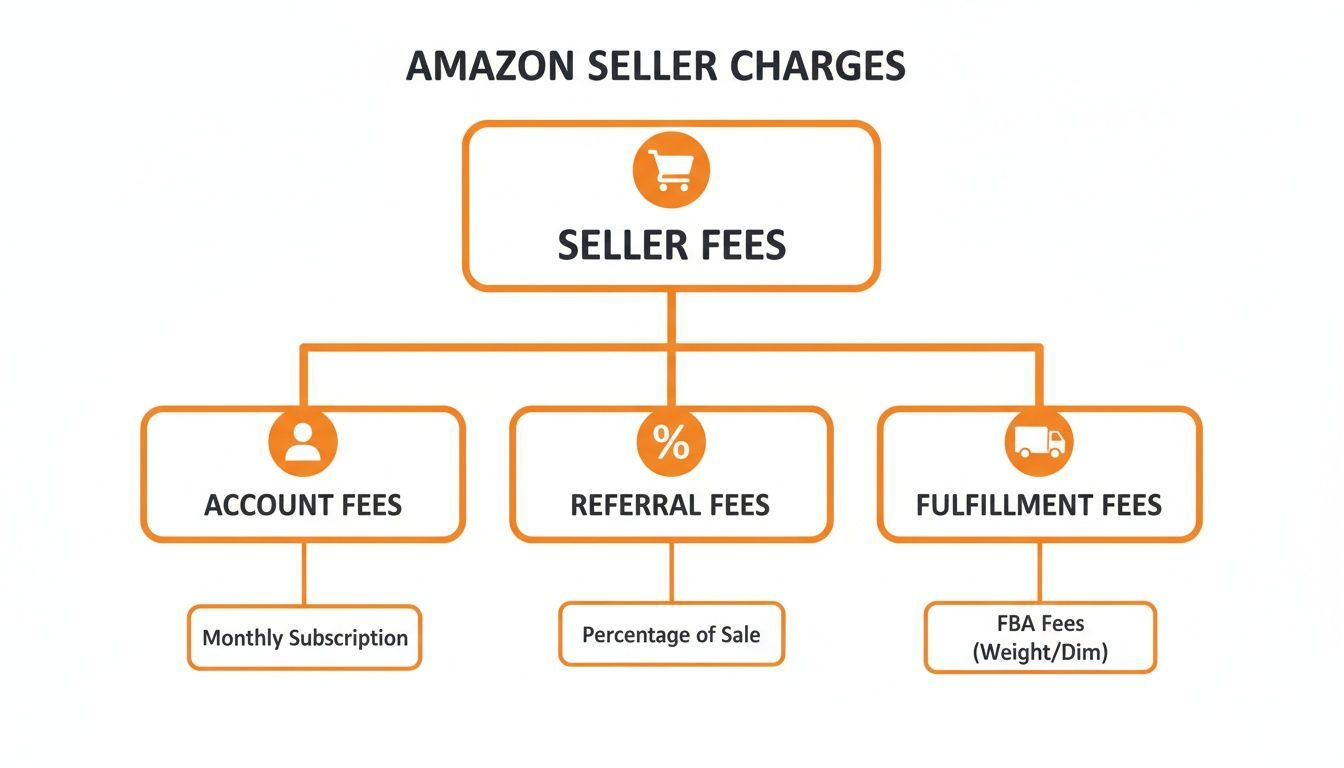
This visual makes a complex system much easier to digest, showing how every single cost traces back to one of these core areas. If you can master these three, you're well on your way to managing your profitability like a pro.
To give you a quick reference, the table below summarizes these primary fees, what they cover, and who they apply to. Think of it as your cheat sheet before we get into the nitty-gritty of each cost.
Here's a quick look at the main charges every Amazon seller needs to know, from account subscriptions to per-item costs.
Fee Type
Description
Who It Affects
Selling Plan Fee
A monthly subscription for having a seller account.
All sellers (Professional Plan) or per-item (Individual Plan).
Referral Fee
A percentage-based commission paid to Amazon on every sale.
All sellers, on every item sold.
Fulfillment Fee
Costs for picking, packing, and shipping items via FBA.
Sellers using Fulfillment by Amazon (FBA).
Storage Fee
Charges for storing inventory in Amazon's warehouses.
Sellers using Fulfillment by Amazon (FBA).
With this foundation in place, you’ll be better prepared to understand how each specific fee impacts your bottom line as we explore them in more detail.
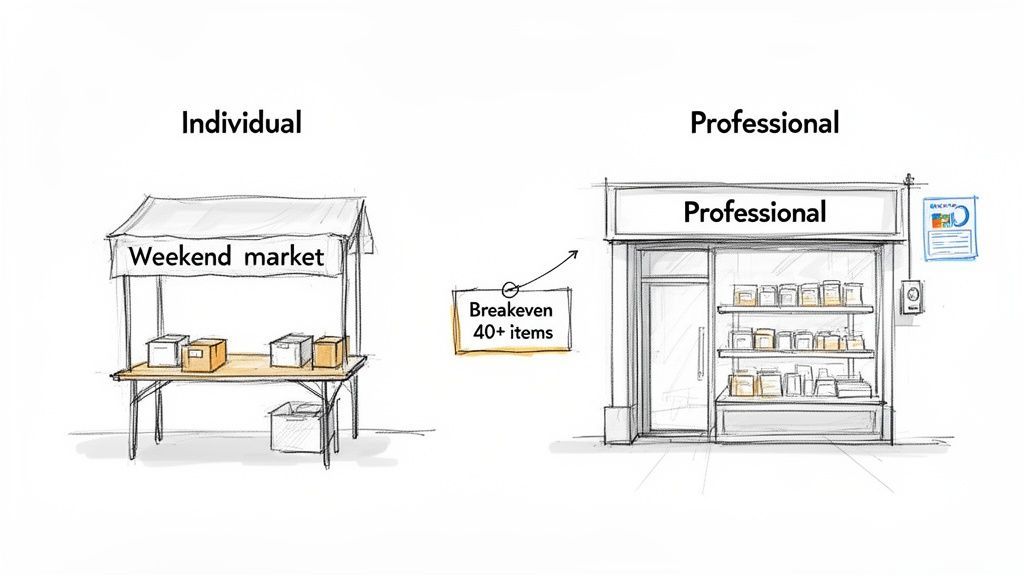
Your first big decision on Amazon has nothing to do with what you sell—it's about how you sell. The platform offers two main selling plans, Individual and Professional, and your choice here sets the stage for every fee you'll pay. Think of it like deciding between a casual weekend market stall or leasing a fully-equipped retail shop.
The Individual plan is that market stall. It’s built for people testing the waters—maybe selling a few old textbooks or some handmade crafts from the garage. There's no monthly subscription, which sounds appealing. Instead, you pay a flat $0.99 fee for every single item that sells.
This pay-as-you-go approach is great if you’re moving just a handful of products. But it's intentionally limited. You're locked out of advanced selling tools, can't run ads, and are barred from selling in many of the more lucrative, restricted categories. It’s a simple, low-risk way to get started, but that's about it.
On the other hand, the Professional plan is your dedicated retail storefront. For a flat $39.99 per month, that pesky $0.99 per-item fee vanishes completely. This plan is designed for actual businesses that want to grow on Amazon. It's less of a fee and more of an investment in a powerful toolkit.
Upgrading unlocks the machinery of a real Amazon business. These aren't just minor perks; they are fundamental for anyone serious about selling.
The decision often starts with simple math. If you consistently sell more than 40 items a month, the Professional plan pays for itself.
Breakeven Calculation: At 40 items, the Individual plan costs you $39.60 (40 x $0.99). The moment you sell your 41st item, you'd pay $40.59, making the $39.99 Professional plan the cheaper and infinitely more powerful option.
But honestly, the real decision isn't about hitting that 40-item mark. If your goal is to build a brand, run ads, and seriously compete in your niche, the Professional plan is non-negotiable from day one. The strategic advantages it offers are the difference between a hobby and a business. It’s the key to turning that market stall into a thriving enterprise.
Once you've picked a selling plan, the next fee you'll run into on every single sale is the referral fee. The simplest way to think about it is as Amazon's commission. You're getting access to their massive, high-trust marketplace, and this fee is what you pay for the privilege of making a sale on their platform.
It’s one of the most important costs to get right because it's not a flat rate—it's a percentage. And here’s a detail that trips up a lot of new sellers: that percentage isn't just based on your item's price tag. It's calculated on the total sales price.
So, what does that include?
This means your pricing strategy and shipping model directly impact your fees. It's a dynamic cost that changes with every single transaction.
Here’s where it gets a bit more complex. The referral fee percentage isn't a one-size-fits-all number. Amazon has a different rate for every product category, which generally reflects the typical margins and market dynamics for those goods. A book won't have the same fee as a laptop.
For instance, categories like Beauty or Health & Personal Care have a tiered fee structure. The referral fee is 8% for products priced at $10 or less, but it jumps to 15% for items over $10. Other categories like Electronics can range from 6% to 15%, while the catch-all "Everything Else" category sits at a standard 15%. Most categories also have a $0.30 minimum fee per sale. You can check out the full fee schedule to see exactly where your products land.
This tiered system is a huge deal. Your pricing decisions can literally push an item into a higher fee bracket, changing your profit margin in a big way.
Let's say you're selling a beauty product. At $9.99, your referral fee is $0.80 (8%). But if you price it just two cents higher at $10.01, that fee nearly doubles to $1.50 (15%). That's a massive difference from such a tiny pricing change.
Let's put this into practice with a few real-world examples. Seeing the numbers is the best way to understand how these charges for selling on Amazon really work.
Example 1: The Beauty Product
In this scenario, Amazon takes $4.50 right off the top, before you've even factored in your cost of goods, FBA fees, or advertising spend.
Example 2: The Electronics Accessory
Even with free shipping, the fee applies to the full item price. If this same charger was a higher-end model priced at $150, the fee structure would change. It would be 15% on the first $100 ($15) plus 8% on the remaining $50 ($4), for a total fee of $19.
Example 3: The Dietary Supplement
Getting these calculations right is non-negotiable for accurate profit forecasting. Before you even think about listing a product, you have to know its category's fee structure inside and out. If you don't, you risk pricing for revenue instead of profit, and this single fee can quietly eat away your entire margin.
For any brand serious about growing on Amazon, FBA is the engine that makes it all happen. It's how you get that coveted Prime badge, and it's how you delight customers with shipping so fast it feels like magic. But FBA isn't just one fee; it’s a whole suite of services, each with its own price tag. Think of it as handing over your entire warehouse and shipping operation to Amazon's massive global network.
When you sign up for FBA, you’re paying for someone else to handle everything after the customer clicks "buy." This includes:
This system frees you from the daily grind of taping boxes and making post office runs, so you can focus on building your business. But to keep your profit margins healthy, you have to know exactly what these FBA charges are and how they work.
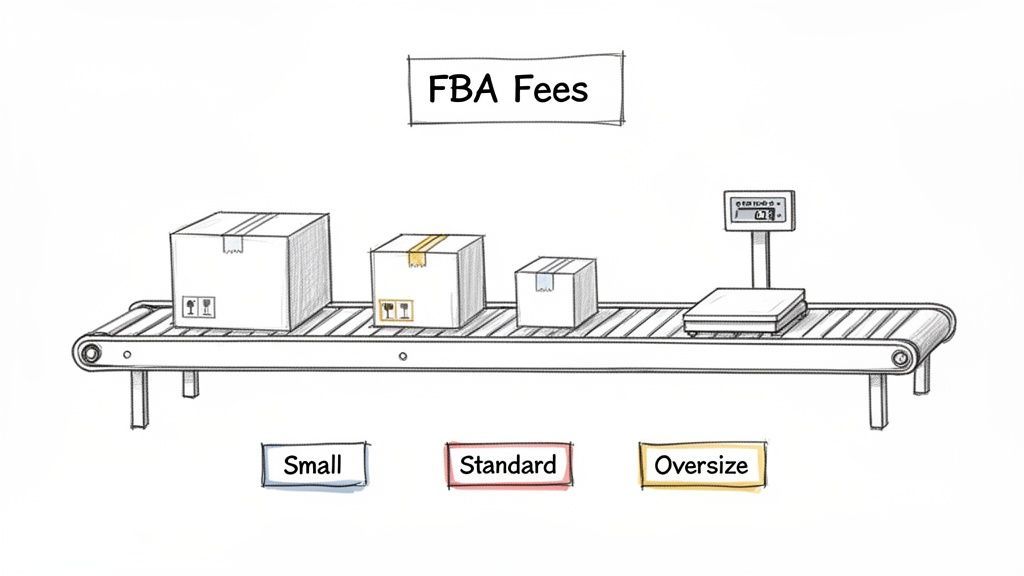
At its core, FBA pricing comes down to two simple things: your product's size and weight. Amazon slots every item into a specific size tier, from "Small Standard" all the way up to "Special Oversize." A small, light phone case will naturally cost a lot less to fulfill than a heavy, bulky kitchen mixer.
This is where your product's dimensions become your secret weapon for saving money. Even a tiny fraction of an inch can bump your product into a more expensive tier, instantly eating into your profit on every single sale.
For example, a "Large Standard-Size" item under 1 pound might cost you around $4.00 to fulfill. But if your packaging is just a little too big and it gets reclassified as "Small Oversize," that same fee could shoot up to over $9.00. That $5.00 difference is pure profit, lost to nothing more than a few millimeters of cardboard.
This makes it absolutely critical to design your packaging to be as lean and lightweight as possible without sacrificing protection. Small tweaks here can add up to thousands of dollars in savings over the year.
The FBA fulfillment fee is the main charge you'll see. It’s a flat fee you pay per unit sold, and it covers that whole pick, pack, and ship process. These fees aren't set in stone; Amazon adjusts them from time to time based on their own operational costs.
For example, while 2025 is clear of major fee hikes, Amazon has already announced a small adjustment for 2026. Starting January 15, 2026, FBA fees will go up by an average of just $0.08 per unit. This is a tiny increase—less than 0.5% on the average item's price—and stays well below what we see with inflation and other shipping carrier rate hikes. You can get all the details from their official post on the upcoming FBA fee adjustments.
Let's walk through a real-world example to see how it all adds up.
To make this crystal clear, here’s a simple breakdown of how FBA fees might look for a common type of product. Just remember, these are illustrative numbers and can change based on Amazon's current fee structure.
Fee Component
Example Calculation
Resulting Cost
Product Details
A small toy measuring 10" x 6" x 4" and weighing 1.5 lbs.
N/A
Size Tier
Falls into the "Large Standard-Size, 1 to 2 lb" tier.
N/A
Fulfillment Fee
The set fee for this specific size and weight tier.
$5.06
Referral Fee (15%)
On a sale price of $29.99, this fee is calculated separately.
$4.50
Total Fees
The sum of the primary charges for this sale.
$9.56
As you can see, the question "what are the charges for selling on amazon" never has just one answer. It's a combination of different costs. By understanding that your FBA fee is tied directly to your product's physical footprint, you can be smarter about packaging and logistics—and protect your bottom line on every single Prime sale.
Beyond the active work of picking and packing orders, there’s a quieter, more relentless charge always ticking in the background for FBA sellers: storage fees.
Think of your inventory sitting in an Amazon warehouse like a car in a paid parking garage. You’re paying for the space it occupies, and the longer it sits there, the more it costs you. If you don't pay close attention, these fees can become a silent margin killer.
These charges are calculated based on the daily average volume your inventory takes up, measured in cubic feet. Amazon simply looks at how much shelf space you're using and sends you the bill. But this simple concept has layers of complexity every seller needs to understand to protect their profits.
The first layer is the standard monthly inventory storage fee. This is your baseline cost for keeping products in Amazon’s fulfillment centers. The critical thing to know is that this fee isn't static; it changes dramatically with the seasons.
From January to September, the rates are relatively stable. But as the holiday shopping rush kicks into high gear, warehouse space becomes prime real estate, and Amazon’s fees shoot up to reflect that demand.
This Q4 spike means sellers who overstock inventory in the fall can watch their storage costs explode, wiping out the extra profit they were hoping to make from holiday sales.
The second, and far more punishing, layer of storage costs is the aged inventory surcharge (what we used to call long-term storage fees). This is Amazon’s way of making sure its warehouses are filled with products that actually sell, not items that just collect dust.
If your inventory sits unsold for too long, Amazon starts tacking on hefty surcharges on top of your regular monthly fees. It’s a powerful incentive to manage your stock levels with absolute precision.
These surcharges kick in once your inventory has been sitting for over 181 days. The penalty isn't small; it’s a clear signal from Amazon that you need to either sell through that stock or get it out of their warehouse.
Storage fees in Amazon's warehouses are charged monthly, with big surcharges for old or low-demand stock. Standard-size items cost around $0.87 per cubic foot during the off-peak months (Jan-Sep), but that jumps to $2.40 during the peak holiday season (Oct-Dec). Age-based surcharges start after 181 days and escalate quickly, acting as a real penalty for slow-moving products. You can learn more about the complete breakdown of Amazon's seller fees and see how these costs are structured.
Managing your inventory costs has become an even more delicate balancing act with newer fees. Amazon now hits sellers with a low-inventory-level fee for popular products that consistently run out of stock. This fee is designed to penalize sellers who can't keep enough inventory on hand to meet demand, which hurts the customer experience and, ultimately, Amazon's bottom line.
This creates a tricky situation for every seller:
Successfully navigating this tightrope requires a sharp understanding of your sales velocity—how quickly each of your products actually sells. It turns inventory management from a simple logistics task into a core strategic part of your business. Proactive forecasting and having a clear plan for liquidating slow-moving stock are no longer optional. They are essential for survival and profitability on the platform.
Getting a true handle on your Amazon profitability means looking past the fees we’ve already covered. To understand what the charges are for selling on Amazon, you have to account for the investments you make to actually drive sales. This is where your bottom line is truly decided.
Think of referral and FBA fees as the non-negotiable rent and utilities for your digital storefront. Advertising, however, is the marketing budget you control to get customers in the door. For nearly every successful brand, Amazon Advertising (PPC) is their single largest variable cost—and the most critical lever for growth. This isn't just a fee; it's a strategic investment in visibility.
Without a dedicated ad budget, even a fantastic product can get lost on Amazon's crowded shelves. Smart sellers don’t just "pay for ads." They manage their ad spend to acquire customers profitably, keeping a close eye on metrics like Advertising Cost of Sale (ACoS) to make sure every dollar spent brings a healthy return.
Beyond the big-ticket costs, a few smaller, situational fees can pop up on your statements. They might not hit every seller, but ignoring them can slowly chip away at your profits. Knowing they exist is key to accurate financial planning.
Here are a few other potential costs to be aware of:
These miscellaneous charges really highlight why you need to look at your total cost of selling, not just the obvious expenses. Every small fee adds up, and understanding them is crucial for protecting your margins on every sale.
When you combine your selling plan, referral fees, all FBA-related costs, advertising spend, and these smaller charges, you finally arrive at your Total Cost of Selling on Amazon (TCOSA). This is the real number that defines your profitability.
Mastering this complete financial picture lets you price your products with confidence, set realistic ad budgets, and build a business that’s truly sustainable. It’s the difference between just moving products and actually building a profitable brand on the platform.
Once you get a handle on the main fee categories, a few specific questions almost always pop up. It’s easy to get tangled in the details of Amazon’s fee structure, but clearing up these common points of confusion will help you build a much more confident and profitable strategy.
The best place to start is Amazon's own FBA Revenue Calculator. This free tool is incredibly useful for getting a quick, detailed estimate. You can plug in a product's ASIN—or just its dimensions and category—and it will spit out a clear breakdown of referral fees, FBA costs, and your potential net profit. It's perfect for vetting a new product idea or just double-checking your margins on an existing one.
But when you're trying to forecast across your entire catalog, that's when most growing brands bring in specialized third-party software. These tools hook directly into your Seller Central account, giving you a dynamic, real-time view of profitability at scale, often factoring in things like ad spend per product.
This is a tough one, because referral fees are pretty much set in stone by category. That said, you can still play it smart. First, always make sure your product is listed in the most accurate—and cost-effective—category possible. A simple miscategorization can sometimes mean you're paying a higher percentage than you need to.
Second, for categories with price-based fee tiers (like Beauty), clever pricing or product bundling can occasionally nudge your item into a lower fee bracket. The most powerful strategy, though, is to focus on increasing your product's selling price and perceived value. This makes the fixed percentage fee a smaller piece of your overall margin.
The real leverage isn't in changing the fee itself, but in growing the profit margin around it. A higher price point on a premium product makes a 15% referral fee much more manageable.
If you decide to handle fulfillment yourself—a method known as Fulfillment by Merchant (FBM)—you get to sidestep all FBA-related costs entirely. That means no FBA fulfillment fees and no FBA storage fees.
You’re still on the hook for your Selling Plan fee (either monthly or per-item) and the category-based Referral Fee on every single sale. The big difference is that you'll now have your own operational costs to cover, including:
You also have to manage all customer service and returns in-house. While FBM can be cheaper for certain large or slow-moving items, it demands a serious operational setup and doesn't automatically qualify your products for Prime, which can be a game-changer for sales volume.
Ready to stop guessing and start growing your profits on Amazon? At Clickstera Solutions LLC, we combine expert strategy with data-driven insights to manage your account, optimize your ads, and scale your brand. Learn how our full-service approach can help you win on Amazon by visiting https://clickstera.com.
Talk to Clickstera and get a clear next-step plan to scale your performance marketing.