Loading article
Loading page...
Let's cut through the jargon. ACoS stands for Advertising Cost of Sales. Think of it as a simple efficiency score for your ads on platforms like Amazon or Walmart, showing how much you spend on advertising to generate one dollar in sales.
Imagine ACoS as your campaign's report card. It doesn’t just tell you if you're making sales from ads; it tells you how efficiently you're doing it. The metric became a cornerstone of e-commerce advertising after Amazon launched its ad platform back in 2017, and it's just as crucial today.
It answers one critical question: for every dollar in revenue your ads bring in, how many cents did you have to spend to get it? Getting a handle on this is the first step toward making smarter decisions with your budget.
The calculation itself is refreshingly simple, revealing the direct relationship between what you spend and what you earn from your ads.
(Ad Spend ÷ Ad Revenue) x 100% = ACoS
Let's use a real-world example. Say you spend $20 on ads and generate $100 in sales from those ads. Your ACoS is 20%. This means you spent 20 cents for every dollar of revenue you brought in.
For many mid-market brands, hitting that 20% benchmark is a common goal, especially since it helps protect their profit margins, which often sit around 30-40%. For a deeper look, you can explore more insights on ACoS benchmarks for CPG brands.
Nailing this foundational concept is key before you dive into more advanced strategies. It transforms a confusing acronym into a practical tool for measuring the health and profitability of your advertising.
While ACoS is a great starting point, it's just one piece of the puzzle. Here’s a quick rundown of the essential metrics you'll encounter and what they really tell you about your campaigns.
Metric
What It Stands For
What It Measures
ACoS
Advertising Cost of Sales
The percentage of your ad revenue that you spent on ads.
ROAS
Return on Ad Spend
How much revenue you earn for every dollar spent on ads.
TACoS
Total Advertising Cost of Sale
The percentage of your total revenue (organic + ad) spent on ads.
CPC
Cost-Per-Click
The average amount you pay each time someone clicks your ad.
CTR
Click-Through Rate
The percentage of people who see your ad and actually click on it.
Impressions
Not an acronym
The total number of times your ad was displayed to shoppers.
Understanding how these metrics relate to each other gives you a much clearer picture of your overall advertising performance, helping you see beyond a single number and make truly informed decisions.
Knowing what ACoS stands for is one thing, but actually putting it to work is where the magic happens. The real power of this metric comes alive when you calculate it for your own products, because it pulls back the curtain on the true cost of winning a sale with your ads.
The formula itself is refreshingly simple. Just divide your total ad spend by the ad revenue it brought in, then multiply by 100 to turn it into a percentage. This little bit of math is your bridge from theory to action.
ACoS = (Ad Spend ÷ Ad Revenue) x 100
Let's walk through two classic e-commerce scenarios to see this in action. The point isn't just to crunch numbers—it's to understand the story those numbers tell about your strategy.
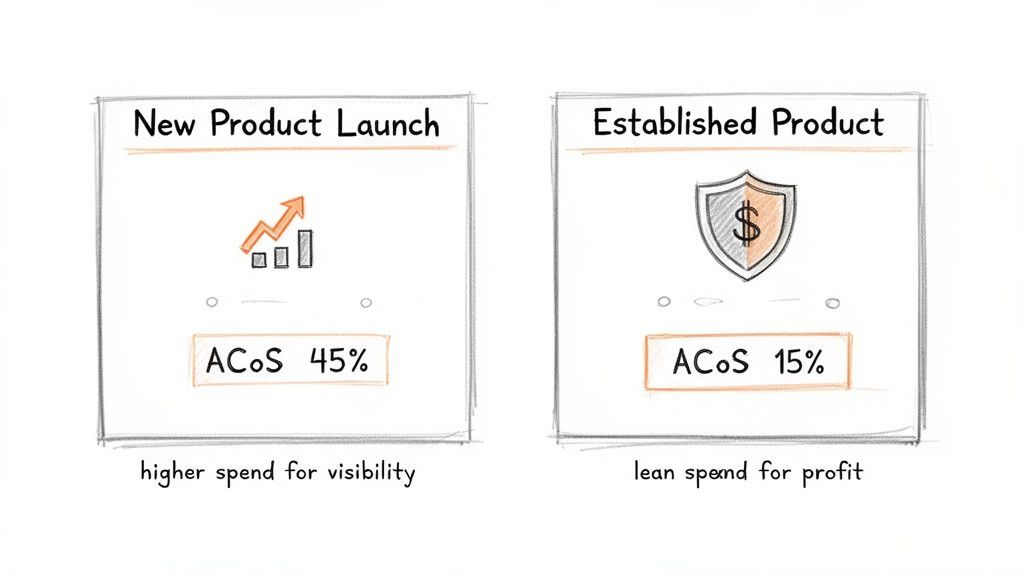
Picture a fashion brand dropping a new line of summer dresses. They want to make a big splash right out of the gate, so they decide to get aggressive with their advertising for the first month.
Plugging these into the formula:
($4,500 ÷ $10,000) x 100 = 45% ACoS
A 45% ACoS here isn't a red flag; it's a strategic investment. The brand is intentionally paying more per sale to build brand awareness, collect priceless sales data, and—most importantly—get those crucial first reviews. This high ACoS is simply the price of admission for building momentum in a crowded market.
Now, let’s switch gears to an office supply company with a hot-selling ergonomic chair. This product is already a star with hundreds of glowing reviews and a solid organic rank. The goal for their ads isn't about getting noticed; it's all about pure profit.
Using the same formula:
($1,500 ÷ $10,000) x 100 = 15% ACoS
A lean 15% ACoS is a sign of incredible efficiency. The ads are zeroing in on high-intent buyers and converting them at a minimal cost, which maximizes the profit on every single sale. This is the ideal approach for a mature product where you're focused on protecting your bottom line.
Learning how advanced PPC campaign management can help you fine-tune these goals is the next step. What these examples really show is that ACoS isn't a static number. It's a dynamic lever you pull to hit different business targets at different times.
Getting a handle on ACoS is a great first step, but knowing your Break-Even ACoS is what turns your ad spend from a simple expense into a profit-generating machine. This is the single most important number for making sure your campaigns are actually putting money in your pocket, not just driving sales.
Think of it as the tipping point. Your Break-Even ACoS is the exact percentage where your ad spend perfectly cancels out your product's profit margin. It's the line in the sand separating a profitable ad sale from an unprofitable one.
The calculation is surprisingly simple but incredibly powerful: your profit margin before you pay for ads is your break-even ACoS.
Pre-Ad Profit Margin % = Break-Even ACoS %
Let's walk through a real-world example. Imagine you sell a skincare product for $50. After you've paid for everything else—manufacturing, shipping, Amazon fees—you have $20 left over. That means your pre-ad profit margin is 40% ($20 profit ÷ $50 revenue).
In this case, your Break-Even ACoS is exactly 40%.
This one number gives you complete clarity. Any ACoS below 40% means you’re banking pure profit on every ad-driven sale. An ACoS of 30%, for example, means you spent $15 to make that $50 sale, leaving you with a $5 net profit. On the flip side, an ACoS of 50% means you spent $25, resulting in a $5 loss.
Mastering this concept lets you set smart, data-backed targets for your campaigns instead of just guessing or chasing vague industry benchmarks. Unfortunately, it's a step too many sellers skip. Data shows a staggering 68% of Amazon sellers were running ads above their break-even point in 2023, often forcing them to pause campaigns and kill their own growth. In contrast, well-optimized campaigns often achieve ACoS figures like 18%, creating a huge lift in net margin. You can dive deeper into Amazon ACoS and profitability on SellerAssistant.app.
Knowing your break-even point is the foundation of any successful advertising strategy. It gives you the confidence to push for growth without accidentally sacrificing your bottom line.
Advertisers new to Amazon often get tangled up comparing ACoS (Advertising Cost of Sales) and ROAS (Return on Ad Spend). While they sound completely different, they’re really just two sides of the same coin—offering opposite perspectives on the exact same campaign data.
Think of it like describing a glass of water. ACoS is the "half-empty" view, focusing on how much you spent. ROAS is the "half-full" view, focusing on how much you got back.
ACoS measures your ad costs as a percentage of the revenue they generate, making it a pure efficiency metric. ROAS, on the other hand, measures how many dollars in revenue you earn for every single dollar you spend on ads. It literally flips the ACoS formula upside down.
The connection between them is a simple inversion. Once you see it, you can't unsee it.
An ACoS of 25% means you’re spending $0.25 to earn $1.00. This is the exact same performance as a 4x ROAS, because $1.00 in ad spend is generating $4.00 in revenue.
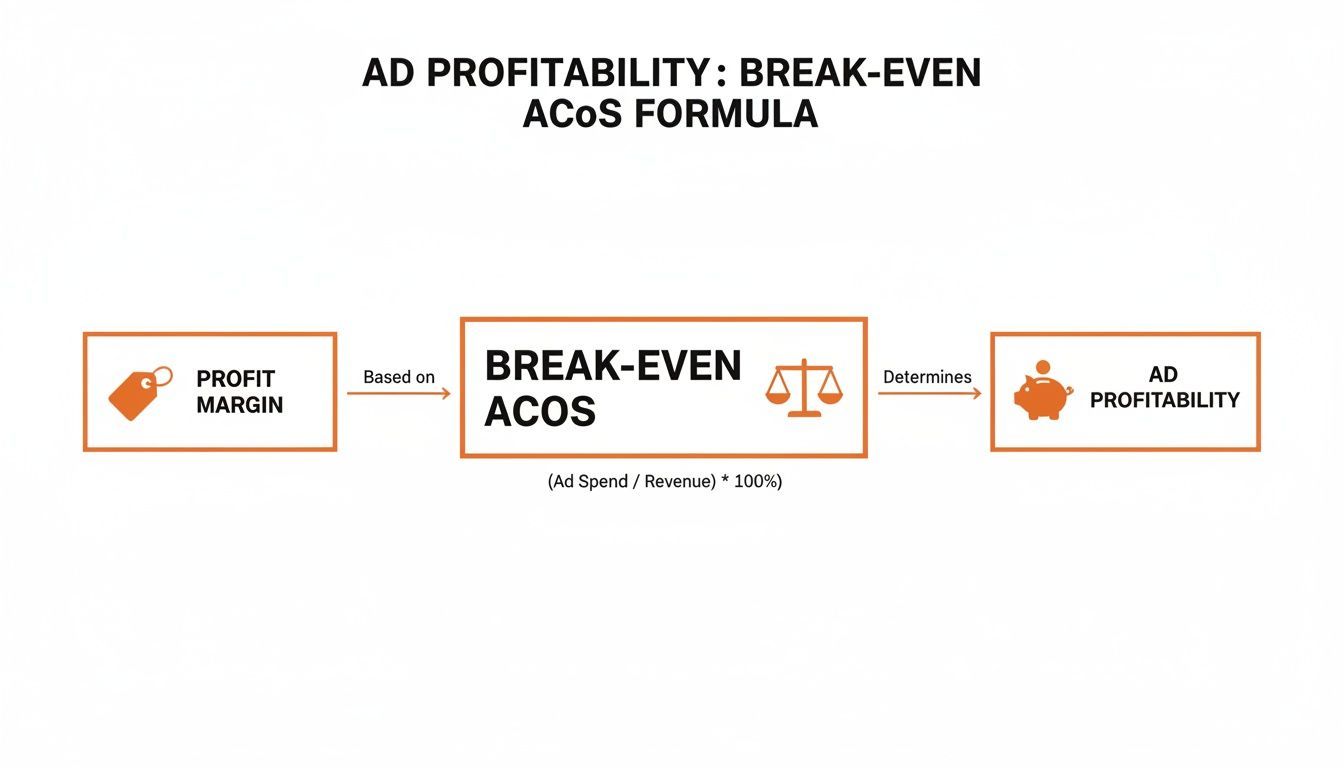
Understanding your profit margins is the first step to setting ad targets that actually make you money, not just sales. This simple flowchart breaks it down.
As you can see, everything flows from your product's profit margin. Nail that down, and you can calculate your break-even ACoS, which tells you precisely how profitable your campaigns are.
To make it even clearer, here’s a table that lays out the key differences between ACoS and ROAS. This should help you decide which metric makes the most sense for your reports and internal discussions.
Aspect
ACoS (Advertising Cost of Sales)
ROAS (Return on Ad Spend)
Focus
Cost-centric (what % of revenue did I spend?)
Return-centric (how many dollars did I get back?)
Calculation
(Ad Spend / Ad Revenue) x 100
Ad Revenue / Ad Spend
Format
Percentage (%)
Multiplier (e.g., 4x) or Ratio (4:1)
Primary Platform
Native to Amazon Advertising
Universal standard (Google, Meta, etc.)
Best For
Day-to-day campaign optimization on Amazon
High-level, cross-channel performance reporting
Ultimately, choosing between them isn’t about which one is "better." It's about which one answers the right question for the right audience.
So, which metric should you live by? It really depends on who you're talking to and where you're advertising.
ACoS is cost-focused and native to Amazon. It's the language of Seller Central. Use it for the nitty-gritty, day-to-day management of your campaign efficiency. It’s perfect for making quick decisions on bids and budgets right inside the platform.
ROAS is return-focused and universal. It’s the standard metric for platforms like Google and Meta. This makes it far better for high-level performance reports where you need to compare how different marketing channels stack up against each other. For example, Google Ads strategies are almost always built around target ROAS goals.
The smartest advertisers are fluent in both. Knowing how to translate ACoS to ROAS (and back again) allows you to communicate performance effectively, whether you're adjusting keyword bids on Amazon or presenting a quarterly marketing overview to your leadership team.
Knowing what ACoS is and how to calculate it is one thing. Actually managing it to improve your profitability is where the real work begins. The good news? Lowering your Advertising Cost of Sales rarely requires a complete campaign teardown. More often than not, a few precise adjustments can make a huge difference to your bottom line.
Think of it like tuning a high-performance engine. You're not rebuilding it from scratch; you're just making small, strategic tweaks to boost efficiency and power. These proven tactics are your playbook for turning wasteful ad spend into profitable growth.
The fastest way to lower your ACoS is to stop paying for clicks that don't convert. It all starts with your keyword strategy. Too many campaigns hemorrhage money on broad, irrelevant search terms that attract window shoppers, not actual buyers.
The solution is a two-part fix:
This process systematically trims the fat from your campaigns, forcing your budget to focus only on shoppers who are looking for exactly what you sell.
Your ad's job is to get the click. Your product page's job is to close the sale. A high click-through rate paired with a low conversion rate is a classic sign of a product page problem, and it's a direct cause of inflated ACoS. Even the world's best ad campaign will fail if it sends shoppers to a page that doesn't convince them to buy.
A high-converting product page is your most powerful tool for lowering ACoS. For every 1% you increase your conversion rate, you can effectively lower your ACoS by a corresponding amount without ever touching your bids.
To boost your page's performance, zero in on these core elements:
Finally, your bidding strategy is what determines how much you pay for each click. Overbidding on keywords can quickly destroy your profitability, but underbidding means you'll miss out on valuable traffic. The key is to bid dynamically based on actual performance.
Instead of setting one bid for all keywords, adjust your bids based on their individual ACoS. Lower your bids on keywords that have a high ACoS and are floating above your break-even point. On the flip side, you can afford to increase bids on your highly profitable keywords (the ones with a very low ACoS) to capture more traffic and maximize your sales volume.
By combining precise keyword targeting, a conversion-focused product page, and intelligent bidding, you create a powerful system for consistently driving down your ACoS. For brands looking to scale these efforts, learning more about how a verified Amazon partner can help is often the next logical step.
Even after you nail the basics, a few practical questions always pop up. Here are the straight answers to the most common ones we hear, designed to help you manage your Advertising Cost of Sales with a bit more confidence.
There’s no magic number here. The “right” ACoS is completely tied to your product’s profit margin and what you’re trying to achieve with your ads. The first step is always to figure out your break-even ACoS.
Anything below that number means you’re making a profit. From there, your goal sets the target:
A high ACoS is usually a red flag pointing to a problem in one of three places: your targeting, your conversions, or your bids. It’s a clear signal that your ad dollars aren't converting into sales as efficiently as they should be.
Start digging into your search term report. Look for irrelevant clicks you can block by adding them as negative keywords. After that, take a hard, honest look at your product listing. Are the images compelling? Are bad reviews dragging you down? Is your price competitive? Any of these can tank your conversion rate and send your ACoS through the roof.
Definitely not. While a super-low ACoS might look impressive on a spreadsheet, it can actually be a sign that your campaign is starved for oxygen. Chasing the absolute lowest number often means you're bidding too conservatively and leaving money on the table.
An ultra-low ACoS might mean you're only winning bids on a few obvious, branded keywords. This severely limits your overall sales volume and misses massive opportunities for customer discovery and market share growth.
The real goal is finding that sweet spot—the perfect balance between profitability and the sales velocity you need to grow. This ensures you’re not just being efficient, but you’re also scaling your brand.
Ready to stop guessing and start growing? The team at Clickstera Solutions LLC combines expert strategy with advanced analytics to build profitable, scalable advertising campaigns on Amazon and beyond. Find out how our full-service management can drive your brand forward.
Talk to Clickstera and get a clear next-step plan to scale your performance marketing.