
Loading article
Loading page...
In the competitive world of Amazon selling, understanding your advertising metrics isn’t just helpfulit’s essential for profitability and growth. Whether you’re managing your own campaigns or working with an Amazon PPC agency, two critical metrics stand at the centre of every successful Amazon advertising strategy: ACoS (Advertising Cost of Sale) and TACoS (Total Advertising Cost of Sale). These metrics tell you whether your Amazon PPC advertising is driving profitable results or draining your budget without sustainable returns.
Many sellers invest heavily in Amazon sponsored products and Amazon PPC ads without fully understanding how to measure their true impact. Some focus exclusively on sales numbers, missing the bigger picture of advertising efficiency. Others get overwhelmed by the complexity of Amazon PPC management and abandon potentially profitable campaigns too early. The reality is that mastering ACoS and TACoS gives you a clear roadmap for scaling your Amazon business profitably, whether you’re just starting with Amazon PPC marketing or refining an established strategy with an e-commerce PPC agency.
Key takeaways from this guide:
ACoS is the percentage of attributed sales you spend on advertising. In simpler terms, it tells you how much you’re spending to generate revenue specifically from your Amazon PPC ads. The formula is straightforward: divide your total ad spend by the sales generated from those ads, then multiply by 100 to get a percentage.
ACoS Formula: ACoS = (Ad Spend ÷ Ad Sales) × 100
For example, if you spend $30 on Amazon PPC advertising and generate $120 in direct sales from those ads, your ACoS is 25%. This means for every dollar you earn through paid advertising, you’re spending 25 cents on ads. Most Amazon PPC management software automatically calculates this metric, but understanding the underlying math helps you make smarter decisions about your campaigns.
Essential ACoS facts:
ACoS is the primary metric most Amazon PPC managers use to gauge campaign profitability because it directly connects advertising investment to revenue outcomes. An Amazon PPC expert can quickly assess whether your campaigns are profitable by comparing your ACoS to your product margins. If your product has a 40% profit margin and your ACoS is 50%, you’re losing money on every advertised salea clear signal that your Amazon PPC strategy needs adjustment.
However, ACoS shouldn’t be viewed in isolation. During product launches, many sellers working with an Amazon advertising agency intentionally run higher ACoS campaigns to build visibility, reviews, and organic ranking momentum. This strategic loss on advertising can pay dividends through improved Amazon SEO and reduced future advertising dependency. The key is knowing when high ACoS is a strategic investment versus wasteful spending.
Why Amazon PPC management services focus on ACoS:
TACoS takes a broader view of your advertising efficiency by measuring ad spend against your total salesincluding both sales from ads and organic sales. This metric reveals how dependent your business is on paid advertising and whether your Amazon PPC marketing is helping drive long-term organic growth.
TACoS Formula: TACoS = (Ad Spend ÷ Total Sales) × 100
Using the same $30 ad spend example, if your total account sales (combining both paid and organic) are $250, your TACoS would be 12%. This lower percentage compared to ACoS indicates that your advertising is successfully driving organic sales alongside paid conversions, a sign of healthy business growth that any e-commerce PPC agency would celebrate.
Critical TACoS insights:
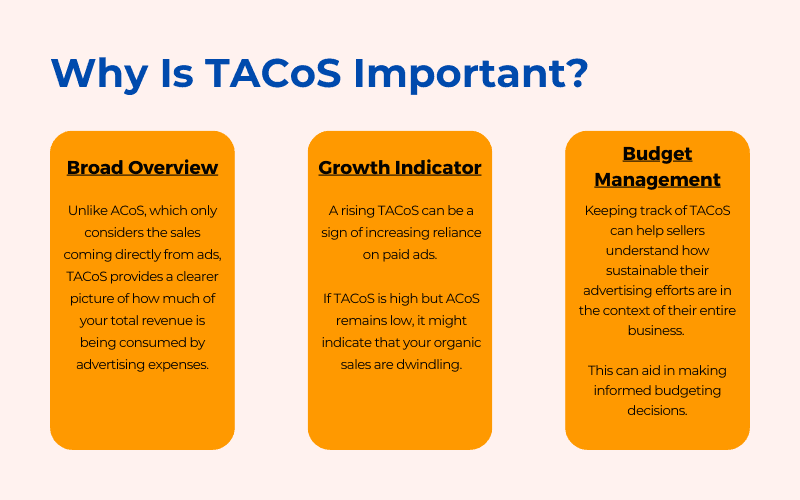
While ACoS measures advertising efficiency, TACoS measures business health and sustainability. A business with 60% ACoS might seem unprofitable until you see that their TACoS is only 15%indicating strong organic sales that make the overall business highly profitable. This is why experienced Amazon PPC management services track both metrics together rather than focusing solely on ACoS.
TACoS is particularly valuable for sellers investing in Amazon listing optimization and Amazon SEO optimization. As your organic rankings improve through strategic Amazon product listing optimization, you’ll see TACoS decline even if your ad spend remains constant. This creates a virtuous cycle: advertising boosts visibility and sales velocity, which improves organic rankings, which reduces advertising dependency, which improves profitability.
Why TACoS matters for your business:
The fundamental difference between these metrics lies in what sales they measure against your ad spend. ACoS uses only sales directly from ads, while TACoS uses all sales. Think of ACoS as your “advertising efficiency score” and TACoS as your “business sustainability score.”
An effective Amazon PPC strategy optimizes both metrics simultaneously. You might accept higher ACoS on new products to drive initial visibility, but you should see TACoS improving over time as organic sales grow. Conversely, extremely low ACoS with high TACoS could indicate you’re under-investing in advertising and missing growth opportunities.
Key differences at a glance:
There’s no universal “good” number for either metric because target ranges depend on profit margins, product lifecycle stage, competitive landscape, and business objectives. However, understanding industry benchmarks helps you set realistic goals with your Amazon PPC manager or when using Amazon PPC management software.
Your break-even ACoS equals your profit margin. If your product has a 35% profit margin, any ACoS above 35% means you’re losing money on advertising. However, strategic reasons might justify temporarily exceeding break-even ACoS, such as launching new products, defending market share, or liquidating inventory.
ACoS targets by product lifecycle:
Factors affecting your ideal ACoS:
TACoS typically runs significantly lower than ACoS because it includes organic sales in the denominator. A healthy TACoS indicates your business isn’t overly dependent on paid advertising. As your Amazon SEO and product reputation improve, TACoS should gradually decline even if your advertising budget remains stable or grows.
TACoS targets by business maturity:
What impacts your TACoS:
Improving your ACoS requires a systematic approach to campaign optimization, keyword refinement, and conversion rate improvement. Whether you’re managing campaigns yourself or working with an e-commerce PPC management team, these strategies form the foundation of profitable Amazon PPC advertising.
Your listing quality directly impacts conversion rates, which dramatically affect ACoS. A poorly optimized listing means you’re paying for clicks that don’t convert into sales, driving ACoS higher. Professional Amazon product listing optimization ensures every visitor has the best chance of becoming a customer, making your ad spend more efficient.
Amazon listing optimization essentials:
Keyword performance varies dramatically; some convert at 20% while others waste budget at 2% conversion. Regular keyword analysis using Amazon PPC management software or through your Amazon PPC expert helps identify winners and losers. Shift budget from underperforming keywords to those driving profitable sales.
Keyword optimization tactics:
Higher conversion rates mean more sales from the same ad spend, directly lowering ACoS. Focus on elements that influence purchase decisions: social proof through reviews, compelling content, and trust signals. Even small conversion rate improvements compound into significant ACoS reductions.
Conversion rate improvement strategies:
Bid optimization is where experienced Amazon PPC managers demonstrate their value. Rather than set-and-forget bidding, successful campaigns require regular adjustment based on performance data, competitive changes, and seasonal trends. Most Amazon PPC advertising services use sophisticated bidding strategies that balance cost and conversion.
Strategic bidding approaches:
Negative keywords prevent your ads from showing for irrelevant searches, eliminating wasted spend on clicks that will never convert. This is one of the fastest ways to improve ACoS, yet many sellers neglect this aspect of PPC for e-commerce. Regular negative keyword maintenance is a hallmark of effective Amazon PPC management.
Negative keyword best practices:
Reducing TACoS requires strengthening your organic sales foundation, which means focusing on factors that improve your natural search rankings and discoverability. While Amazon PPC marketing provides immediate visibility, Amazon SEO optimization creates sustainable, cost-effective traffic that improves your overall business economics.
Amazon’s A9 algorithm prioritizes products most likely to convert and generate revenue. Improving your organic rankings reduces reliance on paid advertising, directly lowering TACoS. Professional Amazon SEO services understand the nuances of backend keyword optimization, content strategy, and performance signals that drive rankings.
Amazon SEO optimization tactics:
Strategic use of Amazon sponsored products should accelerate organic growth rather than replace it. When you run sponsored campaigns on keywords where you already rank organically, you’re cannibalizing your own free traffic. A smart Amazon PPC strategy focuses paid advertising on gaps in your organic coverage while allowing strong organic rankings to carry traffic where possible.
Balanced advertising approach:
Amazon DSP (Demand-Side Platform) advertising reaches customers both on and off Amazon, creating additional sales touchpoints that may not be captured in your standard sponsored products data. While Amazon DSP requires higher minimum spend and more sophisticated management, it can drive incremental sales that improve TACoS by expanding your total revenue base without proportionally increasing your ACoS-tracked spending.
Amazon DSP benefits for TACoS:
TACoS improves when your total sales grow faster than your ad spend. This happens naturally as you improve fundamental business operations: better inventory management reduces out-of-stock incidents that kill organic momentum, superior customer service generates reviews that boost conversion, and faster fulfilment improves Amazon’s algorithmic favouritism toward your products.
Business fundamentals that lower TACoS:
Managing Amazon PPC effectively requires significant time, expertise, and access to sophisticated tools. Many sellers reach a point where partnering with an Amazon PPC agency or an ecommerce PPC agency makes more sense than self-management. The question isn’t whether professional Amazon PPC services provide value, but whether that value exceeds the cost for your specific situation.
A qualified Amazon PPC expert brings campaign optimization experience across hundreds of accounts, access to premium Amazon PPC management software, and dedicated time to monitor and adjust your campaigns daily. They understand seasonal patterns, competitive dynamics, and algorithm changes that impact performance. The best ecommerce marketing agency partners function as strategic advisors, not just campaign operators.
When to consider professional Amazon PPC management services:
What to look for in an Amazon advertising agency:
Services offered by comprehensive e-commerce PPC services:
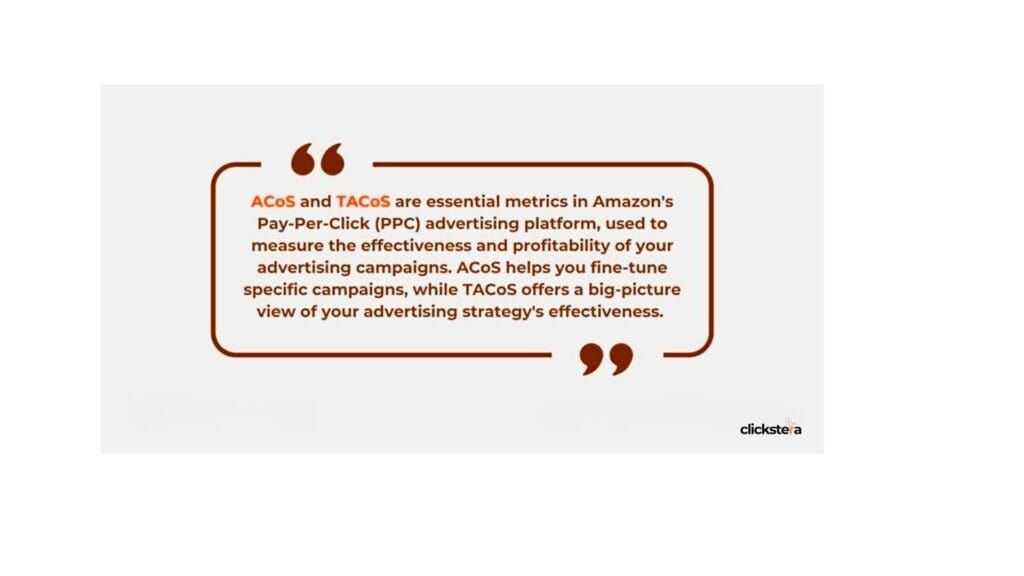
Understanding ACoS and TACoS transforms your Amazon advertising from a confusing expense into a strategic growth engine. ACoS tells you whether individual campaigns are efficient, while TACoS reveals whether your overall business model is sustainable. Together, these metrics provide a complete picture of your advertising performance and guide smart optimization decisions.
Remember that both metrics exist on a continuum; there’s no universal “good” or “bad” number. Your ideal ACoS and TACoS depend on your profit margins, business stage, and strategic objectives. A new product might justify 45% ACoS and 20% TACoS while building market position, while a mature product should target 18% ACoS and 8% TACoS to maximize profitability.
At this stage, having the right metrics is only half the equation execution is what determines results. This is where Clickstera comes in. We help Amazon brands interpret ACoS and TACoS in context, align them with real business goals, and build PPC systems that balance efficiency with long-term growth. Instead of chasing arbitrary benchmarks, our focus is on creating sustainable, profit-driven strategies where every click serves a purpose.
Whether you’re launching a new product or scaling a mature catalog, mastering Amazon PPC metrics with the right strategy can turn advertising into a true growth lever. And when done right, ACoS and TACoS stop being numbers you react to and become tools you control.
Talk to Clickstera and get a clear next-step plan to scale your performance marketing.