Loading article
Loading page...
At its core, DSP advertising is just a smarter, faster way to buy digital ad space. Think of a Demand-Side Platform (DSP) as your personal stockbroker for the internet. Instead of buying stocks, it automatically finds and buys the most valuable ad placements in real time to get your message in front of the right people.
Imagine trying to call up thousands of different websites, apps, and streaming TV channels to place your ads one by one. It would be a nightmare—slow, inefficient, and practically impossible to manage. DSP advertising fixes that. It connects advertisers to one massive, central marketplace for ad inventory, automating the entire buying process with data-driven precision.
Instead of haggling with individual publishers, you simply tell the DSP your campaign goals, who you want to reach, and what your budget is. The platform takes it from there, jumping into millions of tiny, lightning-fast auctions to snap up the ad space that fits your strategy perfectly. This is the magic of programmatic advertising: moving from slow manual deals to automated, intelligent buying.
To really get what DSP advertising is all about, it helps to break it down into four key parts. Each piece has a specific job, and they all work together seamlessly to turn your advertising goals into actual ads seen by real customers.
These pillars form a continuous loop:
A DSP doesn't just buy ads; it buys access to specific audiences. The goal isn't just to fill an ad slot but to fill it with your ad when the right person is viewing it, maximizing every dollar spent.
This automated, audience-first approach is what makes DSPs so powerful. The technology handles all the complex bidding and placement, freeing you up to focus on what really matters: your strategy.
To make this even clearer, here’s a quick breakdown of how these pieces fit together.
This table simplifies the core components of DSP advertising, using an easy-to-understand analogy to show how everything connects.
Component
Description
Analogy
Advertiser
The brand or agency that wants to run a digital ad campaign.
The Investor
DSP
The software that automates the ad buying process on behalf of the advertiser.
The Stockbroker
Ad Inventory
The ad spaces available on publisher websites, apps, and streaming services.
The Stock Market
Audience
The specific user segments the advertiser wants to reach with their ads.
The Target Asset
Ultimately, the advertiser (the investor) uses the DSP (the stockbroker) to buy ad inventory (stocks on the market) in order to reach their target audience (the valuable asset). It's a system designed for precision and efficiency from the ground up.
To really get what DSP advertising is, you have to understand the engine that makes it all possible: programmatic bidding. This isn't just simple automation; it's a super-fast, data-heavy auction that happens in the time it takes you to blink. The whole thing plays out in the milliseconds it takes a webpage to load.
Picture this: someone clicks a link to their favorite news site. The second that page starts to load, a signal goes out offering up its empty ad space to the highest bidder. This kicks off a real-time auction where your DSP, working for you, goes head-to-head with other advertisers who also want to reach that exact person. The highest bid wins, and their ad pops up instantly.
This whole transaction is called Real-Time Bidding (RTB), and it’s the heart of programmatic advertising. It flips ad buying from a slow, manual process of phone calls and emails into an immediate, auction-based decision, making sure you only pay for the impressions that perfectly match your campaign goals.
For this split-second auction to go off without a hitch, a few different platforms need to talk to each other flawlessly. While your DSP is on your side (the demand), other platforms are working for the publisher (the supply).
So, when a user lands on a website, the publisher's SSP offers the ad impression to the ad exchange. The exchange then shoots out a bid request to tons of DSPs, including yours. Your DSP looks at the request, checks the user against your targeting rules, and if it's a good match, it places a bid. Again, this all happens faster than you can blink.
This flowchart shows how quickly that information flows between the advertiser, the DSP, and the publisher's ad space.
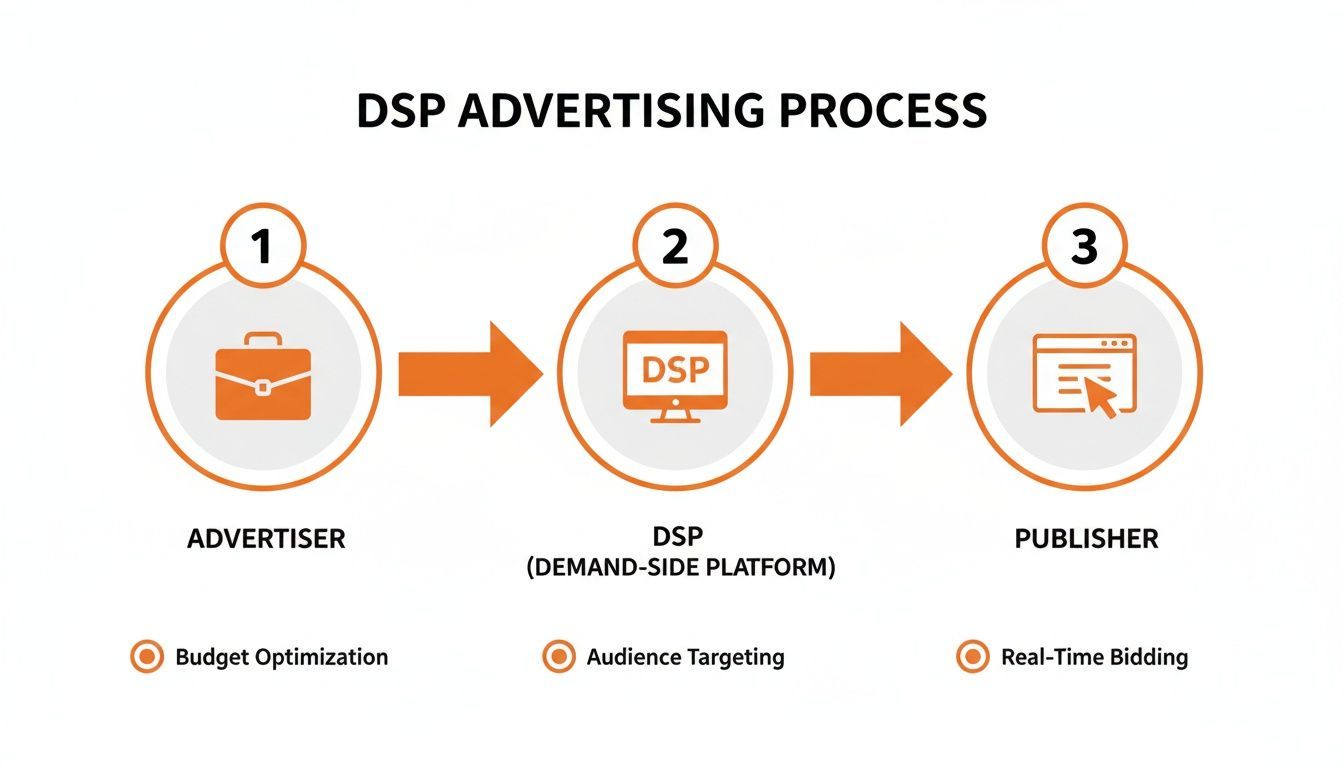
This process shows how technology acts as the critical bridge, letting an advertiser’s budget get spread efficiently across countless publisher sites through smart, automated bidding.
Let's trace the journey of a single ad, from the auction block to the user's screen. This sequence really shows how programmatic bidding gets the right ad in front of the right person at the perfect time.
This entire cycle—from the user's click to the ad appearing—is completed before the webpage even finishes loading. It's an incredible display of the speed and efficiency of the programmatic world.
This highly automated process is what gives DSP advertising its power. It makes sure your ad budget is spent with surgical precision, targeting individual users who are most likely to convert instead of just buying a spot on a website and hoping for the best. Every single ad impression is bought and sold based on its own merit, pushing your return on investment as high as it can go.
Choosing the right Demand-Side Platform is a lot like picking the right tool for a job. You wouldn't use a hammer to turn a screw. Similarly, the best DSP for your brand depends entirely on your specific goals, your audience, and where you sell your products.
While dozens of platforms are out there, three major players really dominate the market for marketplace brands: Amazon DSP, Google Display & Video 360 (DV360), and The Trade Desk. Each one brings something different to the table, and understanding their core strengths is the first step in figuring out which one actually fits your strategy.
For any brand selling on Amazon, the Amazon DSP is a game-changer. Its biggest advantage is its direct access to Amazon's massive trove of first-party shopper data. This isn't just demographic information; it’s real, verified purchase behavior.
You can target audiences based on what they’ve browsed, what they’ve bought, and even what products they’re currently considering. This makes it incredibly powerful for both on-Amazon and off-Amazon advertising. You can retarget shoppers who viewed your product but didn't buy or find new customers who have purchased from your competitors. No platform has a closer link to the point of purchase.

Google's Display & Video 360, or DV360, thrives on its deep integration with the entire Google ecosystem. If your marketing strategy already leans heavily on YouTube, Google Analytics, and Google Search, DV360 ties it all together beautifully. It allows you to build powerful audience segments using data from your website analytics and search campaigns.
DV360 excels at connecting the dots between how users search, what videos they watch, and what websites they visit. This holistic view enables sophisticated cross-channel campaigns that can guide a customer from initial awareness on YouTube all the way to a final purchase.
For brands looking to get more out of their existing Google data, DV360 offers a unified and potent solution.
The Trade Desk has carved out a reputation as a powerful, independent DSP that excels in versatility and reach, particularly in emerging channels like Connected TV (CTV). Unlike Amazon or Google, it isn't tied to a single massive "walled garden," which gives it a more objective and flexible position in the market.
Its platform is known for a robust data marketplace and advanced tools for planning, buying, and measuring campaigns across display, video, audio, and CTV. This makes it a go-to choice for advertisers focused on large-scale brand awareness campaigns that need to span multiple devices and platforms seamlessly.
To help you decide, here’s a clear breakdown of how these top DSPs compare for brands selling in online marketplaces.
Feature
Amazon DSP
Google DV360
The Trade Desk
Primary Strength
Unmatched first-party shopper data from Amazon.
Deep integration with the Google ecosystem (YouTube, Search, Analytics).
Independent, cross-channel reach, especially strong in CTV.
Best For
E-commerce brands focused on driving sales on and off Amazon.
Advertisers heavily invested in Google's ad and analytics tools.
Brands focused on broad awareness and multi-channel campaigns.
Key Differentiator
Ability to target users based on actual purchase history.
Seamless audience sharing between Google properties.
Platform-agnostic approach with extensive third-party data options.
Ultimately, the right platform is the one that best matches your unique business objectives and customer journey. Each offers a distinct advantage, so the "best" choice is the one that aligns with where you want to grow.
Demand-Side Platforms aren't just about automated bidding; their real power comes from the toolkit they give you to find and engage your perfect audience with incredible precision. This is where you move beyond the mechanics and into the art of audience building. Instead of casting a wide, inefficient net, you can use data to pinpoint the exact users most likely to become customers.
The strength of a good DSP strategy is its ability to layer different targeting methods. This creates a complete approach that guides customers from that first moment of awareness all the way to the final purchase. Let's break down the most effective methods you can use to build these powerful, full-funnel campaigns.
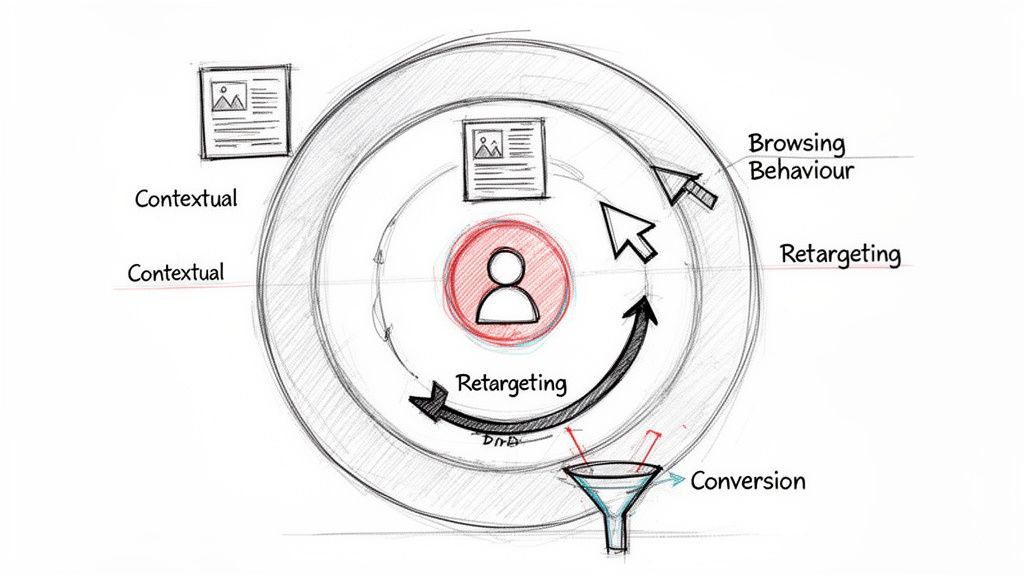
Contextual targeting is the most straightforward approach. It’s all about placing your ads on web pages, apps, or videos based on the content of that specific page. The logic is simple: people browsing content related to your product are probably in the right mindset to consider what you're selling.
Imagine you sell premium hiking gear. With contextual targeting, your DSP can put your display ads on places like:
This method aligns your brand with relevant content, catching users right when they're in a discovery mode. It’s a fantastic way to introduce your brand to new, highly-qualified audiences.
While contextual targeting focuses on the "where," behavioral targeting focuses on the "who." It uses anonymous data about a user's past online actions—like websites they've visited, articles they've read, or products they've viewed—to show them relevant ads, no matter where they are on the internet.
A user who has been researching hiking destinations and reading reviews for camping equipment has signaled a clear interest in the outdoors. Behavioral targeting lets your DSP identify this person and show them your hiking gear ad, even if they're currently checking the weather or reading the news. This strategy is incredibly powerful for reaching people based on their proven interests and buying intent.
Retargeting is easily one of the most powerful tools in any DSP campaign. It’s all about re-engaging users who have already interacted with your brand in some way but haven't converted yet.
The strategy is built on a simple premise: a user who has visited your website or viewed your product is a much warmer lead than someone who has never heard of your brand. Retargeting keeps your brand top-of-mind and nudges them to come back and finish what they started.
For example, you can create specific retargeting audiences based on their actions:
This technique has been a digital marketing staple for years. But it was DSP advertising that truly unlocked its potential by automating ad buys through real-time bidding. Around 2007-2008, platforms like Invite Media emerged, allowing brands like those we work with at Clickstera Solutions LLC to target audiences across Amazon, Google, and Meta with incredible precision. This innovation made sophisticated strategies like large-scale retargeting accessible and efficient for everyone. You can learn more about the market's history and its impact from Grand View Research.
By layering these three strategies—contextual, behavioral, and retargeting—you create a full-funnel machine. You use contextual and behavioral targeting to fill the top of your funnel with new, interested prospects. Then, you use retargeting to nurture them through the consideration phase, guiding them toward a final purchase and maximizing your return on ad spend.
Launching a DSP campaign is just the start—proving it actually worked is what really matters. If you're just looking at clicks and impressions, you're missing half the story. To see the real return on your investment, you need to dig deeper into metrics that connect your top-of-funnel ads to actual business growth.
A smart measurement strategy looks beyond the last click. Last-click attribution is notorious for undervaluing display and video ads, which often plant the seed of an idea long before a customer makes a purchase. The real goal is to understand the entire customer journey, from the first ad they saw to the moment they hit "buy."
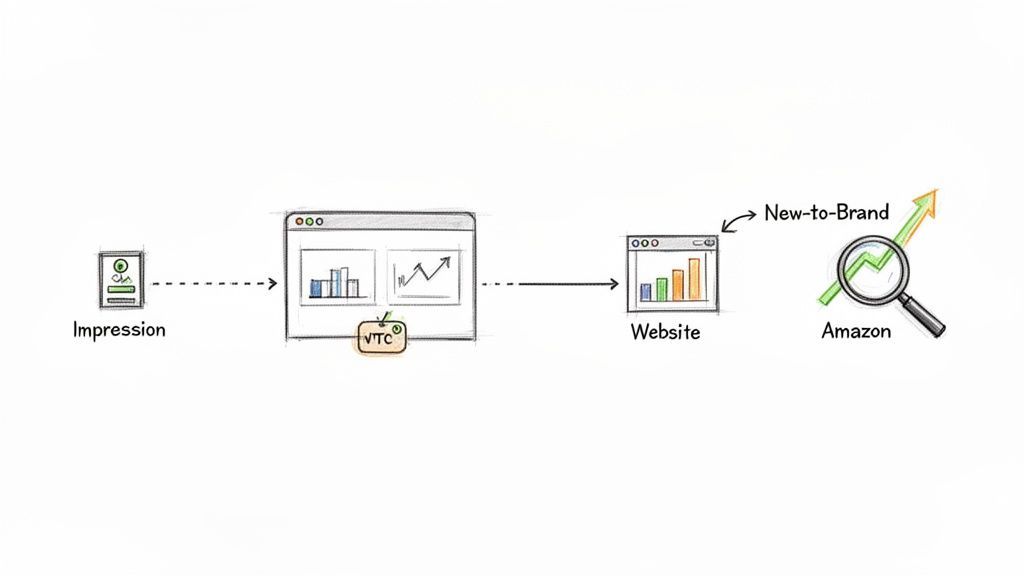
To prove the real impact of your DSP spend, you need to track metrics that tell a more complete story. These metrics help you understand how your ads influence behavior, even when users don’t immediately click.
This focus on advanced metrics is becoming standard. While the DSP market is projected to skyrocket from $32.75 billion in 2025 to $205.7 billion by 2034, measurement complexity remains the top headache for 61% of marketers. Getting ahead means looking beyond the simple data points. You can find more insights on the booming demand-side platform systems market on Market Report Analytics.
A solid attribution framework is all about connecting the dots. It links your DSP campaigns directly to your sales channels, whether that's your own website or an Amazon storefront. But this requires a technical setup to make sure all the data flows correctly.
Setting up pixels and conversion trackers is the foundation. For instance, the Amazon Attribution tag lets you see exactly how your off-Amazon ads—like those run through a DSP on a news site—directly lead to sales on your product pages.
The goal is to create a unified view of performance, attributing sales to the display or video ad that influenced the purchase. This demonstrates how your DSP spend, which builds initial awareness, directly fuels your sales engine.
For brands driving traffic to their own e-commerce sites, tools like Google Analytics 4 and Google Tag Manager are essential. They let you track complex user journeys, attribute conversions across multiple touchpoints, and understand how DSP campaigns work alongside your other marketing channels. You might be interested in exploring our resources on advanced analytics setups for marketplace brands.
By implementing a measurement strategy that includes VTCs, new-to-brand metrics, and a proper attribution setup, you can confidently demonstrate the full value of your DSP advertising, connecting your awareness campaigns directly to bottom-line results.
A powerful DSP campaign should never exist in a silo. Instead of treating it like another channel, think of it as the connective tissue that makes your entire marketing ecosystem stronger. Real growth happens when you weave DSP advertising into your broader strategy, letting its unique strengths amplify everything else you're doing.
This integrated approach creates a powerful flywheel. For example, you can use a DSP to drive highly targeted traffic from news sites and blogs straight to your Amazon product listings. This doesn't just ring the register today; it can also boost your product's organic ranking in Amazon's A9 algorithm, giving you a sustainable edge long-term.
The real magic happens when you coordinate your channels. Imagine a shopper first sees your brand in a paid social ad. Days later, they're retargeted with a compelling video ad on a streaming service, all powered by your DSP. This creates a cohesive, multi-touch journey that guides people from awareness all the way to checkout.
But to make that happen, you need a clear roadmap. It starts by aligning your goals across every channel.
A winning strategy doesn't see DSP as just another ad channel. It's a strategic lever for scaling brand reach and driving profitable, long-term growth. It connects what happens off-platform to the results you see on-platform.
To properly integrate what DSP can do, you need a structured approach. This checklist ensures you cover the essentials for building a unified strategy that delivers real, measurable results.
As you get your head around DSP advertising, a few practical questions always pop up. Let's tackle the most common ones to give you a clearer picture of how DSPs fit into the real world.
The easiest way to think about it is scope and access. Google Ads (specifically the Google Display Network) lets you run ads across Google’s properties like YouTube and its massive network of partner sites. It’s powerful, but it keeps you inside Google’s own "walled garden."
A Demand-Side Platform (DSP), on the other hand, is like having a master key that opens doors to countless other gardens. It plugs you into multiple ad exchanges at once, giving you access to Google's inventory plus a huge range of other publishers, streaming services, and app networks. In short, a DSP gives you a much broader, centralized reach across the entire open internet, all from one dashboard.
DSP costs can vary wildly, but it's generally a channel for brands ready to make a serious investment. Most DSPs work on either a managed-service model, where their team runs your campaigns, or a self-serve model, where you handle everything yourself.
For managed services, you’re often looking at minimum monthly ad spends starting around $10,000 to $25,000, and that’s before platform fees. While some self-serve platforms might have lower entry points, running a DSP campaign effectively takes serious expertise. The final cost depends on how complex your audience targeting is, the quality of inventory you’re buying (premium TV streaming vs. standard website banners), and what you’re trying to achieve.
That investment reflects the platform's power. DSPs unlock premium inventory and targeting capabilities that are miles ahead of standard ad platforms, which is why they command a higher price tag.
Yes, but you need to be smart about it. While DSP advertising was once reserved for huge corporations, it's becoming more accessible. Platforms like Amazon DSP have lowered the barrier to entry, making it a real option for ambitious small and mid-sized businesses hungry to scale.
The secret is to team up with an agency or partner who can provide both access and expertise. Instead of trying to meet the high platform minimums on your own, you can work with a partner who pools resources across multiple accounts. This approach delivers two huge benefits:
For a growing brand, this partnership model makes DSP advertising a realistic and powerful way to compete with the big players and win over new audiences.
Ready to unlock the full potential of DSP advertising for your brand? Clickstera Solutions LLC specializes in creating and managing high-performance DSP campaigns that drive measurable growth on and off Amazon. Our team of experts builds strategies that connect with your ideal customers and deliver real results.
Schedule your free consultation with a Clickstera marketplace expert today!
Talk to Clickstera and get a clear next-step plan to scale your performance marketing.