Loading article
Loading page...
A Demand-Side Platform (DSP) is the software that lets advertisers buy ad space across the internet automatically, all from one place. Think of it as a stock trading platform for ads. But instead of buying shares in a company, you’re buying moments to show your ads to specific people, in real time.
It’s the machine behind modern programmatic advertising.
Imagine you want to advertise a new line of running shoes. The old way meant calling dozens of websites one by one, haggling over prices, and emailing creative files back and forth. It was slow, inefficient, and a massive headache—like trying to buy groceries by visiting a separate farm for each item on your list.
A DSP flips that entire model on its head. It connects advertisers to a huge ecosystem of ad exchanges where millions of ad impressions are auctioned off every single second. Instead of dealing with individual publishers, you just set your campaign goals and define your audience in the DSP, and its algorithm does all the heavy lifting for you.
This automated buying process is called programmatic advertising, and it's what a DSP is built to do. It replaces slow human negotiations with machine-learning algorithms that make buying decisions in milliseconds.
The shift has been massive. The global DSP market, already over USD 13 billion, is expected to jump to more than USD 65 billion by 2032. That's because programmatic advertising now makes up over 85% of digital ad spend in major markets like the U.S. You can find a deeper dive in this demand-side platform market analysis-market).
This automation gives brands a serious edge:
The magic behind all this is Real-Time Bidding (RTB). It’s an incredibly fast auction that happens in the time it takes for a webpage to load.
Here’s how it works: when a user who matches your target audience visits a site with ad space, your DSP gets an instant notification. It then places a bid against other advertisers who also want to reach that same person. The winner’s ad is shown—all in the blink of an eye.
Key Takeaway: A DSP isn't just a tool; it's your automated agent in a massive, real-time digital ad auction. It helps you find your ideal customers anywhere on the internet and show them the right ad at the perfect moment.
To help you keep these terms straight, here's a quick cheat sheet breaking down the core concepts we've just covered.
Concept
Simple Explanation
What It Does for You
Demand-Side Platform (DSP)
A single piece of software for buying ad space automatically from many sources.
Saves you time and gives you access to a huge range of ad inventory.
Programmatic Advertising
Using software and algorithms to buy and sell digital ads in real time.
Replaces manual negotiations with efficient, data-driven ad buying.
Real-Time Bidding (RTB)
An auction that happens in milliseconds to sell an ad impression to the highest bidder.
Lets you compete for individual ad placements to reach your specific audience.
For e-commerce and marketplace brands, this is a game-changer. While tools like Amazon Sponsored Ads are great for capturing shoppers who are already searching on the platform, a DSP lets you find and influence them before they even start looking.
You can retarget shoppers who viewed your product but didn't buy, find new audiences who look just like your best customers, and build a brand presence that extends far beyond a single marketplace. This ability to engage customers across their entire digital journey is why understanding what a DSP is in advertising is so fundamental for growth today.
Ever wonder what happens between someone landing on a website and a perfectly relevant ad flashing on their screen? It’s not magic. It’s a high-speed, automated auction powered by a DSP, and it all happens faster than you can blink. The whole process is a masterclass in speed and data-driven decision-making.
Let’s walk through what this looks like in the real world. Imagine a shopper just spent a few minutes browsing for high-end coffee makers on Amazon. A little later, they click over to their favorite news blog to catch up on the day's headlines. The moment that blog page starts to load, a signal goes out across the programmatic ad world, putting that empty ad space up for auction.
This is where your DSP jumps into the game, replacing the old, document-heavy way of buying ads with an automated, intelligent approach.
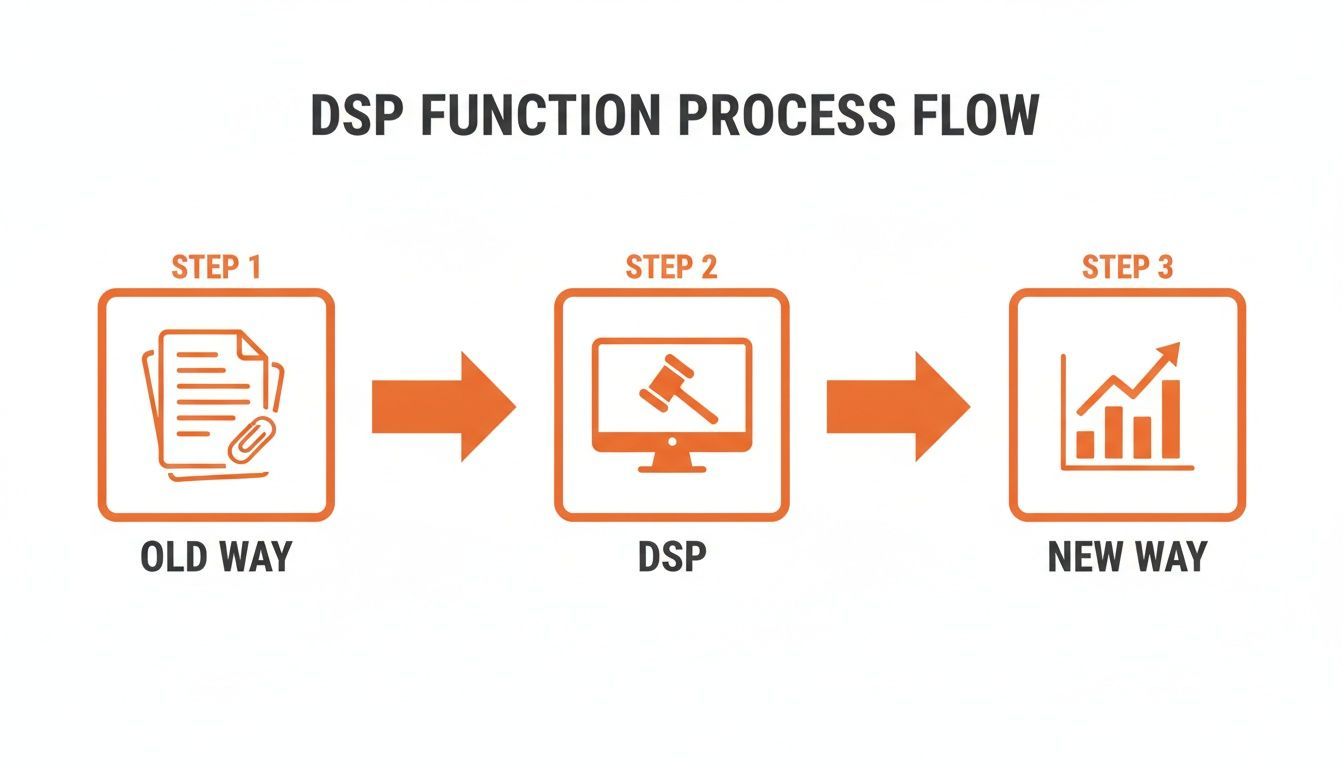
This lightning-fast transaction is what makes it possible to reach the right audiences at massive scale, moving from slow negotiations to measurable, immediate growth.
This high-speed auction is called Real-Time Bidding (RTB). As soon as that ad space becomes available, your DSP receives the request, which is packed with details about the website and anonymous data about the user visiting it. In a split second, the platform’s algorithm runs through a checklist based on the campaign goals you’ve set.
It instantly asks a few critical questions:
If the DSP’s algorithm likes the answers, it submits a bid. This entire analysis happens in about 100 milliseconds. For perspective, a single blink of an eye takes 300 to 400 milliseconds. While this is happening, dozens of other advertisers’ DSPs are doing the exact same thing, creating a competitive little marketplace for that single ad view.
Key Insight: A DSP isn't just buying ad space; it's buying a specific opportunity to show an ad to a valuable user at a precise moment. It evaluates thousands of potential impressions per second but only bids on the ones that perfectly align with your campaign strategy.
Once all the bids are in, the ad exchange declares a winner—highest bidder takes the prize. If your DSP wins the auction, it immediately fires your ad creative (the image, video, or banner) over to the publisher’s website.
The user’s browser then renders your ad right on the page. All of this happens so seamlessly that the webpage hasn't even finished loading. The user sees a relevant ad for a coffee maker, completely unaware of the intense, super-fast auction that just took place on their behalf.
This automated process is what unlocks incredible efficiency and scale. Instead of negotiating with one publisher at a time, your DSP can jump into billions of auctions every single day across thousands of different websites, apps, and streaming platforms. It’s designed to cut through all the noise and find the exact moments that matter most for your brand.
What makes a DSP so smart is the data it uses to make these instant bidding decisions. It taps into various data sources to build a rich picture of the user, which is what allows for the kind of precise targeting that drives real results.
This data usually falls into a few key buckets:
By layering these data sources, a DSP like the Amazon DSP can spot high-value users with incredible accuracy. It knows who viewed your products, who bought from a competitor, and who is actively shopping for items in your category. This allows it to bid much more intelligently and deliver a far better return on your ad spend.
A Demand-Side Platform doesn't operate in a vacuum. To really get what a DSP is, you have to understand the bigger system it’s a part of. Think of the programmatic world as a massive, bustling stock exchange for digital ads, with clear roles for buyers, sellers, and the market itself.
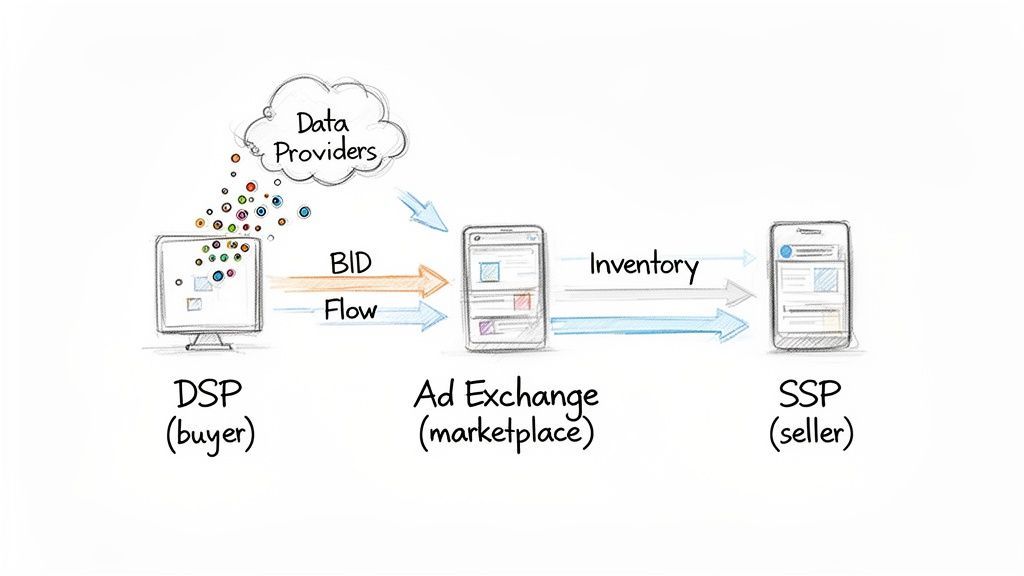
It’s a three-sided marketplace designed to make the chaotic process of buying and selling ads online feel smooth and automated. Let’s break down who’s who.
On one side, you have the advertiser—the brand trying to get its product in front of the right people. Their goal is simple: find ideal customers online and show them ads that matter. Doing this manually across thousands of websites is impossible, which is where the Demand-Side Platform (DSP) comes in.
The DSP is the advertiser's automated buying agent. It plugs into countless ad exchanges, giving the advertiser a single dashboard to access a gigantic pool of ad space from all over the internet. Its only job is to buy the best possible ad placements at the lowest possible price to hit the advertiser's targets.
On the other side are the publishers. These are the websites, apps, and content creators who have an audience and want to make money by selling ad space to that audience. Their goal is the exact opposite of the advertiser's: they want to sell their ad space for the highest price possible.
To do this, they use a Supply-Side Platform (SSP). An SSP is the publisher's version of a DSP. It connects their available ad slots to multiple ad exchanges, automatically putting their inventory up for sale to the highest bidder. It ensures they maximize revenue from their "supply" of ad space.
So, where do the DSP (representing the buyer) and the SSP (representing the seller) actually meet to do business? That happens in an Ad Exchange.
The ad exchange is the neutral, digital marketplace where the real-time auctions take place. It’s like the New York Stock Exchange, but for ad impressions. SSPs feed available ad inventory into the exchange, and DSPs analyze that inventory in milliseconds to place bids for advertisers. Major players like Google operate massive exchanges that facilitate billions of these transactions daily.
Key Analogy: Think of it this way. The DSP is the stockbroker buying shares (ad impressions) for an investor (the advertiser). The SSP is the system selling those shares on behalf of a company (the publisher). The Ad Exchange is the stock market itself, where all the trading actually happens.
This three-part system keeps the entire process organized, fair, and incredibly fast.
It's easy to get these terms mixed up, but their roles are distinct. This table clears up any confusion.
Platform
Who It Serves
Main Goal
Simple Analogy
DSP
Advertisers & Brands
Buy the most effective ad impressions at the best price.
The Buyer’s Agent
SSP
Publishers & Websites
Sell ad inventory for the highest possible price.
The Seller’s Agent
Ad Exchange
Both DSPs & SSPs
Facilitate the auction between buyers and sellers in real time.
The Marketplace
Understanding these roles is crucial. When you run a campaign through a DSP, you're not just buying an ad; you're tapping into this entire interconnected network. The DSP is your smart agent, navigating the exchanges, negotiating with SSPs, and bidding intelligently to get your message to the right person, on the right screen, at the perfect moment.
If you're a brand selling on a marketplace like Amazon or Walmart, you know that sponsored product ads are table stakes. They're great for capturing shoppers who are already searching for what you sell, but they operate within the marketplace's four walls. The real secret to explosive growth is reaching customers before they even think to search, and that’s where the Amazon DSP becomes a total game-changer.
What sets the Amazon DSP apart from every other platform is its fuel source: Amazon’s exclusive first-party shopper data. This isn't just demographic information; it's a direct line into who buys what, who browses specific categories, and who adds your competitor's product to their cart but never checks out. For a marketplace brand, this insight is an almost unfair advantage in finding and winning over your next customer.
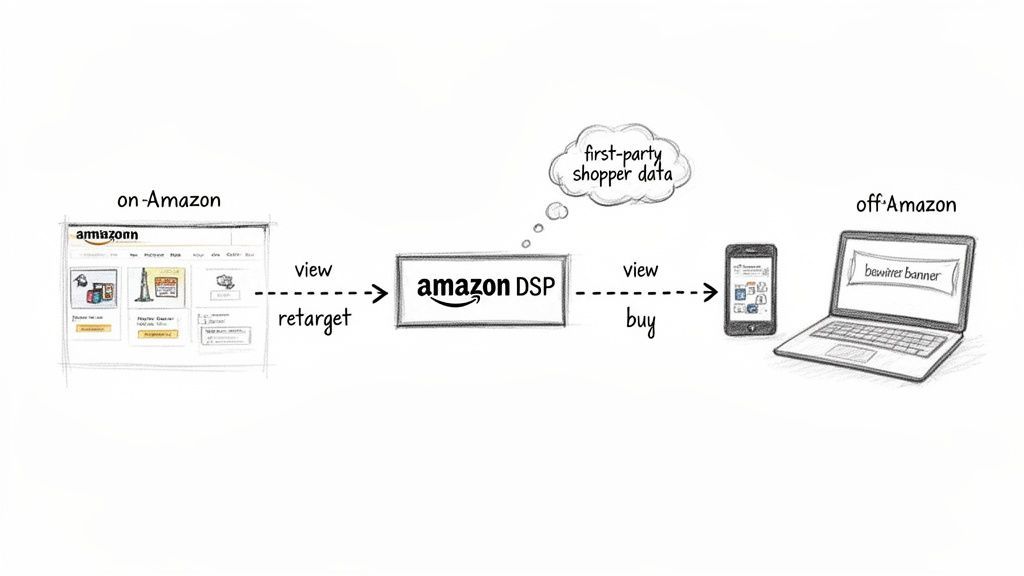
This tool lets you build a true full-funnel marketing strategy that lives both on and off Amazon, driving awareness and sales in a way that basic sponsored ads simply can't match.
The magic of the Amazon DSP lies in its ability to build incredibly specific audiences based on actual shopping behavior. You stop guessing who might be interested and start targeting people you know are. This intelligence is what powers hyper-effective campaigns that build your brand and drive sales at the same time.
Here are a few practical examples of the kinds of audiences you can build:
This level of precision means your ad budget goes toward shoppers who are genuinely likely to buy, maximizing every dollar. It's a proactive way to grow your business by creating new demand instead of just fighting for the demand that already exists.
Key Takeaway: Amazon DSP flips advertising from a guessing game into a data-driven science. By using Amazon's shopping insights, you can find your ideal customers with incredible accuracy, whether they're on Amazon or browsing their favorite news site.
Once you have these powerful audiences, you can run strategies that cover every single stage of the customer journey. It’s a huge leap beyond simple keyword targeting. You're building a complete plan that guides shoppers from their first flicker of interest all the way to checkout.
Here’s how you can put the Amazon DSP to work for your brand:
These strategies don't work in isolation; they create a powerful, interconnected growth engine. The platform is so effective that even Microsoft named the Amazon DSP as its preferred transition partner for its Microsoft Invest customers. For marketplace brands, this combination of data, reach, and strategic power is what separates the sellers who just survive from the ones who truly lead their market.
Any powerful advertising tool is only as good as the results it delivers. After you get a handle on how a DSP works, the next obvious question is, "How do I know if it's actually working?"
Measuring a DSP campaign isn't like looking at your usual search or social ads. You have to look beyond the obvious metrics to build a complete picture of performance, from the first time someone sees your brand to the moment they click "buy."
While the final sale is always the goal, a DSP's real power is its ability to influence the entire customer journey. This means you need to track both hard performance numbers and softer brand awareness metrics. Put simply, you need to know which numbers tell you what part of the story.
For any e-commerce brand, it all comes down to profitable growth. These are the metrics that draw a straight line from your ad spend to your revenue, proving that your DSP campaigns are actually moving the needle. They're the bedrock of any serious performance strategy.
This is where you see why DSPs are such game-changers. It starts with Click-Through Rate (CTR), which is just the percentage of people who see your ad and actually click on it. A high CTR is a great sign that your creative is resonating with the right audience.
Next up is Conversion Rate, which tells you how many of those clicks turn into sales. For anyone chasing profit on platforms like Amazon or Walmart, this number is vital. And then there's the king of all metrics: Return on Ad Spend (ROAS). It answers the one question that matters most: for every dollar you put into ads, how many dollars do you get back?
You can learn more about how brands use these core metrics to achieve success.
Not every ad is designed to make a sale right then and there. A massive advantage of DSP advertising is its power to build your brand and fill the top of your funnel with new potential customers. These upper-funnel metrics are what tell you if you're succeeding at getting on people's radar.
Key Takeaway: A winning DSP strategy is a balancing act. You use upper-funnel metrics to make sure you're reaching new, relevant people, and you use performance metrics to confirm you're turning that new awareness into profitable sales.
These are the KPIs that tell you if your brand is actually capturing attention:
By keeping a close eye on these numbers, you can ensure your brand-building campaigns are actually doing their job efficiently. They help you figure out if your message is cutting through the noise and making a real impression. When you connect these insights with your hard performance data, you get a 360-degree view of how your DSP is fueling your brand's long-term, sustainable growth.
Picking the right Demand-Side Platform isn't about finding the "best" one on the market—it’s about finding the best fit for your brand’s goals, budget, and the team you have in place. With so many platforms out there, each with its own quirks and strengths, the choice can feel paralyzing. But if you focus on a few key criteria, you can cut through the noise and find a partner that will actually help you scale.
The DSP world is dominated by a few heavy hitters, and they all serve slightly different needs. For marketplace sellers, the Amazon DSP is often the go-to. Why? It gives you direct access to Amazon's treasure trove of first-party shopper data, which is invaluable. On the other hand, platforms like The Trade Desk and Google’s Display & Video 360 (DV360) are powerhouses for reaching audiences across the open internet, making them ideal for brands focused on massive awareness campaigns and complex, multi-channel strategies.
Recent data shows just how concentrated this space is. Among U.S. advertising executives, 64% use The Trade Desk, 56% use Google’s DV360, and 33% use MediaMath. This tells you that the industry leans heavily on top-tier platforms that can handle privacy shifts and deliver real performance. For brands looking to make a smart choice, you can explore more insights on programmatic advertising trends.
When you start comparing platforms, it's easy to get lost in the marketing jargon. Ignore the buzzwords and focus on these fundamentals that will directly impact your campaign success and day-to-day workflow.
One of the biggest forks in the road is deciding whether to manage the DSP in-house (self-service) or work with an agency that offers a managed service.
Key Consideration: The choice between self-service and managed service is a classic trade-off: control versus expertise. A self-service platform puts you in the driver's seat, but it comes with a steep learning curve and requires a dedicated, skilled team to run it well.
A managed service, on the other hand, gives you immediate access to a team of experts who live and breathe programmatic advertising every day. This is often the smartest path for brands that don't have the internal bandwidth or specialized knowledge to run complex DSP campaigns effectively. Partners like Clickstera are a perfect example of this, offering the expertise needed to navigate these powerful platforms as a verified partner.
Ultimately, the right DSP is the one that gives you the data, inventory, and support model that best lines up with your strategic goals and what your team can realistically handle.
Even after getting the basics down, a few practical questions always pop up when brands first look into using a Demand-Side Platform. Let's tackle the most common ones to connect the concepts to your real-world business decisions.
The easiest way to think about it is that Google Ads gives you exclusive access to Google's world—Search, YouTube, Gmail, and its display network. A DSP, on the other hand, gives you access to the entire open internet.
While Google Ads is a powerhouse within its own ecosystem, a DSP opens the door to thousands of different publishers, ad exchanges, connected TV apps, and streaming audio platforms. This gives you a much bigger playground for finding and engaging your customers wherever they spend their time online, far beyond what a single network can offer.
DSP costs are usually broken into two parts: the media cost (what you pay for the ad impressions, typically priced per thousand, or CPM) and a platform fee (a percentage of your ad spend). The biggest hurdle for many brands, however, is the minimum monthly spend requirement, which can be pretty steep on the top-tier platforms.
This financial barrier is exactly why so many businesses choose to work with a managed service partner instead. It's a way to get access to the best DSP technology and expert campaign management without the high fixed costs or the intense learning curve of going it alone.
Key Insight: A DSP is an investment in both technology and reach. The right approach—whether self-service or managed—really comes down to your budget, team capacity, and what you’re trying to achieve.
Absolutely. In fact, that’s one of its biggest strengths. A good DSP strategy allows you to run campaigns that hit every single stage of the marketing funnel, often at the same time.
For example, you can run a massive campaign focused on building brand awareness, where you’re measuring things like reach and viewability. Simultaneously, you can run hyper-targeted retargeting campaigns optimized to drive immediate sales and hit a specific Return on Ad Spend (ROAS). The best strategies use a DSP to build a complete customer journey, introducing the brand at the top of the funnel and converting shoppers at the bottom.
Ready to see how a managed DSP strategy can build your brand and drive profitable sales on marketplaces like Amazon and Walmart? The team at Clickstera Solutions LLC combines expert knowledge with powerful technology to scale brands like yours. Schedule a free consultation today and start building your growth engine.
Talk to Clickstera and get a clear next-step plan to scale your performance marketing.