Loading article
Loading page...
Retargeting is a surprisingly simple concept: it's your brand’s digital way of tapping a customer on the shoulder and saying, "Hey, remember this?" It’s a marketing strategy focused on showing personalized ads to people who have already visited your website, app, or social media profile. Think of it as a digital "second chance" to bring warm leads back and gently guide them toward making a purchase.
It's one of the most effective ways to stay top-of-mind, but only with an audience that has already signaled they’re interested in what you have to offer.
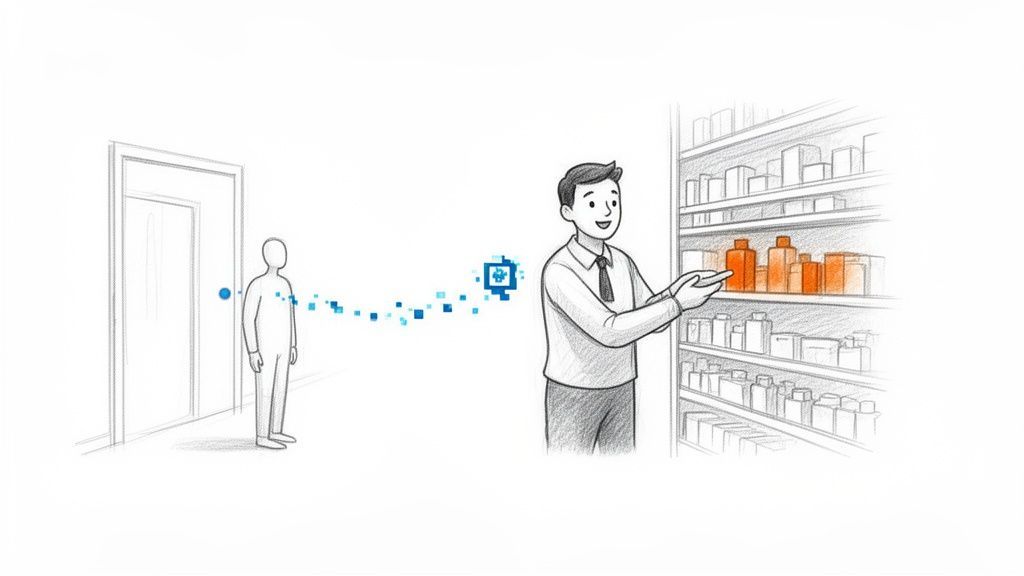
Imagine a shopper walks into your brick-and-mortar store, picks up a pair of shoes, looks them over, but then leaves without buying. The next day, your store manager spots them walking by and holds up those exact shoes in the window. That’s retargeting in the real world. Online, we just use technology to create that same personalized, timely reminder.
The magic behind it all is a tiny snippet of code, usually called a tracking pixel or tag, that you add to your website. When someone visits your site, this pixel drops an anonymous browser cookie—a small file that remembers their visit without storing any personal information.
Later, when that same person is scrolling through social media, reading the news, or using an app, that cookie signals to the ad network that this is a user who has visited your site before. This triggers your ads to appear, reminding them of your brand and maybe even the specific products they viewed.
This strategy works so well because you're no longer talking to cold leads. You're re-engaging people who are already familiar with you. The modern buyer's journey is messy and rarely linear; most people need to see a brand multiple times before they feel ready to buy. Retargeting automates those crucial follow-up touchpoints.
By focusing on users who have already shown intent, retargeting doesn't just increase visibility; it strategically re-engages shoppers at the most opportune moments, turning initial interest into a completed sale.
The data backs this up big time. Retargeting campaigns are known to dramatically boost conversion rates. In fact, they can deliver conversion rates up to 150% higher than standard display ads and help e-commerce brands on Amazon and Walmart recover up to 26% of abandoned carts. You can dive deeper into how ad spending trends are evolving by checking out the latest research on global ad spend from MarketingProfs.
For any brand, especially those in crowded marketplaces, this approach offers some serious advantages.
This table breaks down the core advantages you can expect when you implement a smart retargeting strategy.
Benefit
Impact For Your Brand
Example Metric
Increased Conversions
Turns browsing visitors into paying customers by reminding them of products they've already considered.
Conversion Rate
Higher Brand Recall
Keeps your brand visible and top-of-mind as potential customers continue their online journey.
Ad Recall Lift
Improved ROAS
Focuses ad spend on a high-intent audience, maximizing the return on every dollar you invest.
Return on Ad Spend (ROAS)
Audience Segmentation
Allows you to deliver highly personalized messages to different user groups (e.g., cart abandoners vs. page viewers).
Click-Through Rate (CTR)
Ultimately, these benefits work together to create a more efficient and profitable marketing funnel, ensuring your ad budget is spent on the people most likely to become loyal customers.
Not all retargeting is the same. Once you’ve grasped the basic idea—re-engaging people who’ve already shown interest—the next move is picking the right play for your specific goals. Different types of retargeting let you connect with potential customers in different moments, whether they’re searching for a product or just scrolling through their social feeds.
Think of it like fishing. You wouldn't use the same lure in every part of the lake. In the same way, you need to choose the right retargeting approach based on where your audience is hanging out and what you want them to do next. This is what turns a simple reminder into a serious conversion driver.
Let's break down the most common and effective types of retargeting that marketplace managers and brand founders can use to build awareness, nurture leads, and win back lost sales.
This is the classic, the original. Site retargeting is all about showing ads to people who have already visited your website or even specific pages on it. You place a pixel on your site, which then lets you build audience lists based on what visitors did—like viewing a product, browsing a category, or ditching their cart at checkout.
For example, if someone looks at your collection of running shoes but clicks away without buying, you can serve them display ads featuring those exact shoes as they browse other websites. It keeps your products top-of-mind and gives them an easy path right back to your store.
What if you could get in front of people looking for products like yours, even if they've never heard of you? That’s where search retargeting comes in. This powerful technique lets you target users based on the keywords they’ve recently typed into search engines like Google or Bing.
It works by zeroing in on users who have shown clear intent with their searches. A brand selling organic dog food, for instance, could retarget users who recently searched for "grain-free puppy food" or "best food for sensitive dogs." You can find guides on leveraging Google for your advertising to learn how to set up powerful campaigns on platforms like these. This strategy lets you introduce your brand to a super-relevant, in-market audience that is actively looking for a solution you offer.
Search retargeting bridges the gap between intent and awareness, allowing you to engage with high-value prospects before they even land on a competitor's website.
With billions of people scrolling every day, social media platforms are prime real estate for re-engaging your audience. Social media retargeting means showing ads to your past website visitors while they’re on platforms like Meta (Facebook and Instagram), TikTok, or LinkedIn.
Because these platforms know so much about their users, you can create incredibly personal and engaging ad experiences.
This approach feels natural to the user’s experience, making it a less intrusive and often more effective way to reconnect.
Your list of existing customers is a goldmine. CRM retargeting, sometimes called list-based retargeting, lets you take your own customer lists—like email subscribers or past buyers—and serve ads directly to them on other platforms.
You just upload a securely hashed list of emails or phone numbers to an ad platform like Google Ads or Meta. The platform matches that data with its user profiles to show your ads right to your customers or leads. This is a fantastic tool for upselling, cross-selling, or luring back dormant customers with special offers, turning one-time buyers into loyal fans.
Too many marketers box retargeting into a tiny corner, seeing it only as a last-ditch effort to recover an abandoned cart. And sure, it's brilliant at that. But its real power comes from its role across the entire customer journey.
When done right, strategic retargeting guides potential customers from that first flicker of awareness all the way to becoming loyal fans. It’s less of a sales recovery tool and more of a sophisticated growth engine. It’s all about meeting customers where they are in their journey, not just where you wish they were.
The following infographic breaks down the main types of retargeting you can use at each stage.
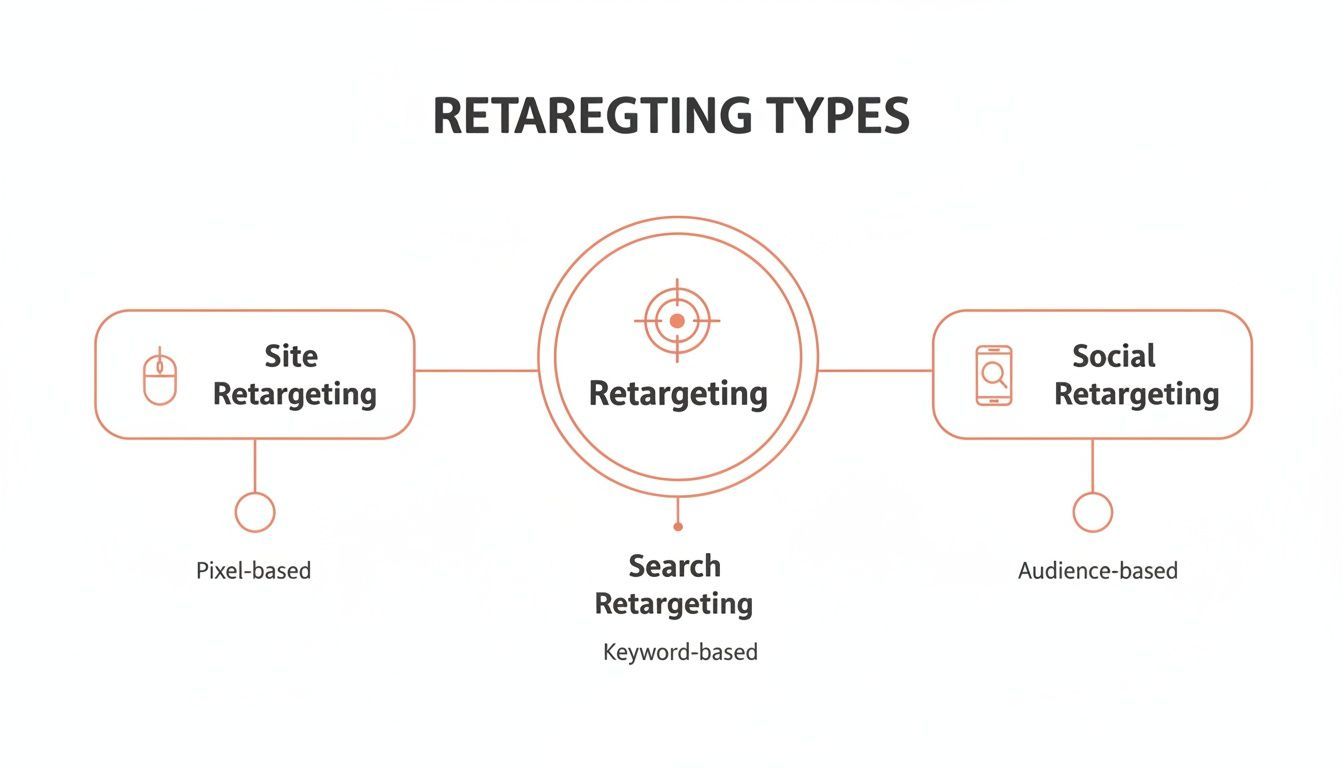
As you can see, each method taps into a different user signal—from a simple site visit to specific search behavior—giving you the flexibility to customize your approach for maximum impact.
At the top of the funnel (TOFU), your goal isn't a hard sell. It's about making an introduction and staying memorable. Retargeting at this stage is all about people who’ve had a light interaction but aren't deep in the buying cycle. Think video viewers on platforms like Meta or TikTok.
Someone who watched 75% of your promotional video is clearly intrigued. Instead of immediately pushing a "Buy Now" ad, you nurture that interest by retargeting them with:
This keeps your brand top-of-mind without being pushy, gently warming up a cool audience for the next step.
Once someone hits the middle of the funnel (MOFU), they're actively weighing their options. They’ve probably clicked on specific product pages, compared a few items, or read some reviews. Now, your retargeting needs to shift from building awareness to actively nurturing their interest.
Your ads should get more specific and product-focused. For instance, if a visitor was looking at your line of skincare serums, you could retarget them with ads that:
This is where you demonstrate real value and help the user visualize how your product fits into their life, nudging them closer to making a decision.
This is what retargeting is famous for. At the bottom of the funnel (BOFU), you're talking to people who have shown serious buying intent—they've added an item to their cart, started the checkout process, or spent a lot of time on one product page. Your goal is direct and simple: close the sale.
Dynamic product ads are absolute killers here. Showing someone the exact item they left behind is a powerful, personalized reminder. For brands selling on Amazon, using Amazon DSP to retarget cart abandoners off-platform is a complete game-changer. It follows those high-intent shoppers across the web, reminding them to head back to the marketplace and finish their purchase.
Retargeting is no longer just a safety net for lost sales. It is a strategic framework for building relationships, educating prospects, and creating a seamless path from discovery to purchase across every channel.
The explosive growth of programmatic and social channels proves its importance. Social media giants like Meta and TikTok, which are key for retargeting, are projected to command 23.6% of worldwide ad spend by 2026. And the data backs it up: for DTC brands expanding to marketplaces, retargeting through Amazon DSP can recover off-platform demand and boost sales by 20-30%. You can dig into more data on how platforms are shaping ad spend by checking out the latest global advertising forecasts from Dentsu.
To bring this all together, here’s a look at how these strategies map across the funnel for marketplace brands.
Funnel Stage
Goal
Platform Example
Audience Segment
Top-of-Funnel (TOFU)
Build brand recall & introduce value
Meta, TikTok
Video viewers (e.g., 75% view-through), Page followers
Mid-of-Funnel (MOFU)
Nurture interest & showcase benefits
Google Display Network, Amazon DSP
Category page visitors, blog readers, specific product viewers
Bottom-of-Funnel (BOFU)
Drive conversions & recover sales
Amazon DSP, Google Search (RLSA), Meta
Cart abandoners, initiated checkout, high-value past purchasers
This table shows there’s a specific retargeting play for every stage of the customer journey. By matching your audience and message to their intent, you create a far more effective and cohesive experience that drives real growth.
Getting a retargeting campaign live is just the starting line. To really know if it's working—and justify what you’re spending—you have to look past feel-good numbers like clicks and impressions. Success isn’t about reaching people; it's about connecting your ads to real business outcomes, proving that your strategy is driving actual sales and growth.
Think of it this way: a high click-through rate is nice, but if none of those clicks turn into purchases, your campaign is just a leaky bucket. To get the full picture, you need to zero in on the metrics that track the entire customer journey, from the ad they saw all the way to the final sale. This is how you start making smart, data-driven decisions that sharpen your approach and maximize every dollar.
To figure out what is retargeting advertising really doing for your brand, you need a handful of key performance indicators (KPIs) that tell the whole story. These are the numbers that reveal both how efficient your campaigns are and how profitable they are.
Here are the essentials to keep on your dashboard:
By focusing on Conversion Rate, CPA, and ROAS, you shift the conversation from "how many people saw our ad?" to "how much revenue did our ad generate?" This is the key to demonstrating real business value.
You can't track what you can't see. Luckily, there are powerful tools available to help you set up tracking, pull in data, and analyze the customer journey with total clarity. Two of the most foundational tools for the job are Google Analytics 4 and Google Tag Manager.
Here’s a look at a typical Google Analytics dashboard, where you can monitor user engagement and conversion events.
This view allows you to visualize key metrics like user sessions and event counts over time, helping you spot trends related to your retargeting campaigns.
The data is clear: retargeting's ROI is a massive driver for marketplace growth. In fact, website and SEO channels—often supercharged by retargeting—are projected to deliver top returns at 27%. For many consumer packaged goods (CPG) founders, dynamic retargeting ads are non-negotiable for recovering 15-25% of lost conversions. It’s no surprise that 50% of marketers focus heavily on conversion rate optimization tactics where retargeting is the star player. You can discover more insights on how marketers are leveraging these strategies from HubSpot.
By mastering these tools and metrics, you can transform your retargeting from a simple advertising tactic into a predictable and scalable revenue channel.
Effective retargeting isn't about shouting louder; it's about whispering the right message to the right person at just the right moment. Once you get the mechanics down, success comes from two places: compelling ad creative and smart audience segmentation. Getting these right turns a simple reminder into a powerful conversation that guides shoppers back with precision.
Think of your audience like visitors in a physical store. Some are just window shopping, others are comparing prices, and a few have items in their hands but got distracted. You wouldn't say the same thing to each person, right? The same logic applies online, where your ad creative has to align perfectly with where your audience is in their buying journey.
Your retargeting ads need to be more than just pretty pictures. They are functional tools designed to reignite interest and push for a specific action. To pull this off, your creative must be personal, clear, and compelling.
One of the best tools for this is Dynamic Creative Optimization (DCO). Instead of showing a generic brand ad, DCO automatically fills the ad with the exact products a user viewed, added to their cart, or browsed in a specific category. This level of personalization feels less like an ad and more like a helpful nudge.
Beyond dynamic content, every single ad needs a crystal-clear Call-to-Action (CTA). Vague CTAs like "Learn More" just don't cut it compared to direct, action-oriented prompts.
These small tweaks in language make a massive difference. They tell the user exactly what to do next, removing friction from their journey back to your site.
Segmentation is the art of slicing your website visitors into smaller, more manageable groups based on their behavior. This is what lets you tailor your messaging with incredible accuracy. A one-size-fits-all approach is just a recipe for wasted ad spend and annoyed users.
Instead, start by building distinct audience lists based on intent. Here are a few fundamental segments every brand should create:
Smart segmentation turns your retargeting campaign from a megaphone into a series of personal conversations. By matching your message to a user's specific journey, you increase relevance, boost conversions, and build stronger brand affinity.
Even the best creative and segmentation can backfire if you overwhelm your audience. To maintain a positive user experience and protect your brand's reputation, you absolutely must implement two critical controls: frequency capping and exclusion lists.
Frequency Capping limits how many times one person sees your ad in a set period. Blasting the same ad ten times in one day is a surefire way to cause ad fatigue and annoyance. A good starting point is capping impressions at 3-5 per user per day.
Exclusion Lists are just as important. These are lists of users you actively want to stop showing ads to. Your most important exclusion list should be recent purchasers. There is no faster way to create a negative experience than by showing ads for a product someone just bought. By excluding them for at least 30 days, you save money and avoid buyer's remorse.
Alright, let's move from theory to action. Kicking off your first retargeting campaign can feel like a lot, but when you break it down into a clear, repeatable process, it becomes much more manageable. Think of this checklist as your roadmap, guiding you through every critical step from initial strategy to launch.
Following these steps ensures you build a campaign on a solid foundation, ready to re-engage valuable audiences and drive results you can actually measure. It’s designed to bring clarity to the setup process for busy marketing managers and brand founders.

This initial phase is all about laying the technical and strategic groundwork. Getting these first few steps right is absolutely essential for accurate tracking and effective targeting down the line. Nail this, and the rest gets easier.
Define Clear Campaign Goals: Start with the end in mind. What are you actually trying to achieve? Are you hoping to recover abandoned carts, upsell existing customers, or just boost brand recall? Your goal dictates everything—your audience, your messaging, and your budget. For example, a cart recovery goal demands a very specific, high-intent audience segment.
Choose Your Platforms: Where does your audience hang out online? Pick the platforms that align with your goals and your customers' behavior. For e-commerce brands, a combination of Amazon DSP for marketplace shoppers and Meta for social media engagement is a seriously powerful mix.
Install Tracking Pixels: This is non-negotiable. You have to install the tracking pixels from your chosen ad platforms (like the Meta Pixel or Google Tag) on your website. This is the bit of code that lets you collect visitor data and build the retargeting audiences you'll need.
With the technical setup handled, it’s time to focus on the "who" and "what" of your campaign. This stage is all about slicing up your audience into meaningful groups and designing ads that will actually get their attention.
Build Your Audience Segments: Don't just target every person who ever visited your site. Get specific. Create lists based on behavior, like "Cart Abandoners (Last 7 Days)" or "Product Viewers (Last 14 Days)." This level of detail is what allows for highly relevant messaging that converts.
Design Compelling Ad Creative: Now, tailor your ads to each segment. Use dynamic ads to show cart abandoners the exact products they left behind. It’s a game-changer. For more general visitors, showcase your best-sellers or a strong brand message that reminds them why they were interested in the first place.
A successful retargeting strategy hinges on relevance. The more you can align your ad creative with a user's previous interaction, the more your ad will feel like a helpful reminder instead of an annoying interruption.
Finally, it's go-time. This is where you set your campaign live and begin the real work: monitoring, tweaking, and refining its performance.
Set Budgets and Bids: Allocate your budget based on your goals. It makes sense to assign a bigger chunk of your spend to high-intent audiences like cart abandoners. Start with a conservative budget you can scale once you prove the ROI. For more details on aligning your brand with key platforms, you can find valuable information in our article about becoming a Verified Amazon Partner.
Launch and Monitor Performance: Time to go live! Keep a close eye on key metrics like ROAS, CPA, and conversion rate in the first few days. Be ready to make quick adjustments to your bids, creative, or audience targeting based on what the initial data tells you.
As you start to think about what retargeting could do for your brand, some questions are bound to pop up. Getting clear answers is the first step to building a strategy that feels right for your business—and more importantly, your customers. Let’s clear up a few of the most common ones.
This is easily the most common point of confusion, and frankly, you'll hear the terms used interchangeably all the time. But in the world of digital advertising, there's a subtle but important difference between them.
So, while both are trying to bring interested people back, retargeting uses paid ads for a broad, anonymous audience, while remarketing leans on direct communication with contacts you already have in your database.
This is a great question and a totally valid concern. Nobody wants to be that brand—the one that follows people around the internet until they're more annoyed than interested. Ad fatigue is real, but it’s also completely avoidable when you approach it thoughtfully.
Effective retargeting isn’t about chasing people down. It’s about giving them a timely, helpful nudge. You can make sure the experience feels positive by putting a few simple guardrails in place.
The goal of retargeting isn’t to follow users everywhere, but to meet them at the right moment with a relevant message. When done with care, it feels less like an ad and more like helpful customer service.
Smart tactics are your best friend here. Set frequency caps to limit how many times one person sees your ad in a day. Rotate your ad creative so it doesn't get stale. And most importantly, use exclusion lists to immediately stop showing ads to people who just made a purchase.
One of the best things about retargeting is that you don't need a massive budget to get started. It's incredibly scalable, making it a perfect fit for emerging brands that need to make every dollar count. In fact, starting small isn't just okay—it's the smart move.
The best place to put your initial budget is on your highest-intent audience: cart abandoners. These are people who were one click away from buying. They offer the fastest path to proving a positive return on ad spend (ROAS) and showing you that the strategy works.
Once you see that first campaign generating revenue, you can reinvest those profits. From there, you can confidently expand your budget to target other groups, like people who viewed specific products or just browsed your homepage. You grow as you go.
At Clickstera Solutions LLC, we build and manage these precise, full-funnel retargeting strategies to help brands scale profitably on marketplaces like Amazon and beyond. Find out how our expertise can drive your growth at https://clickstera.com.
Talk to Clickstera and get a clear next-step plan to scale your performance marketing.