
Loading article
Loading page...
Walmart Marketplace is Walmart’s third-party selling platform, but it operates very differently from Amazon or eBay. While Walmart owns the customer relationship and storefront, sellers compete primarily on fulfillment speed, price consistency, and operational reliability rather than review volume alone.
In practice, this means brands that already run disciplined e-commerce operations tend to scale faster on Walmart than early-stage or experimental sellers.
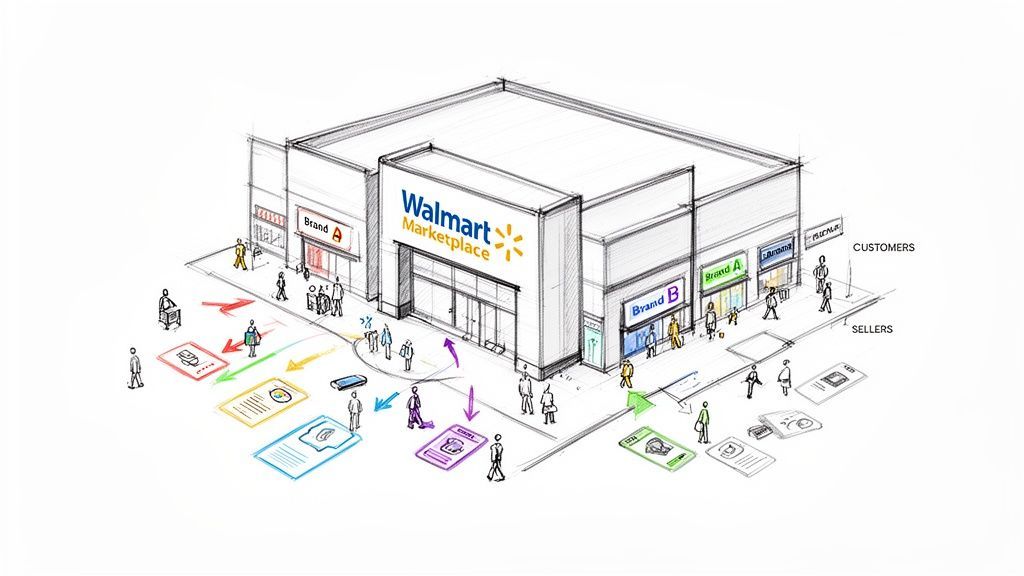
At its heart, the Marketplace is Walmart’s strategic move to transform Walmart.com from a single-seller website into a sprawling, dynamic ecosystem. It’s an open invitation for both established and emerging brands to tap into one of the largest retail audiences in the world—no physical store presence required. For sellers, this is a game-changer. Instead of spending a fortune to build an audience from scratch, you get to place your products on digital shelves that millions of loyal shoppers already visit every single day. To give you a clearer picture, here’s a quick rundown of what the platform offers. From a seller’s perspective, Walmart Marketplace rewards consistency more than aggressive experimentation. Accounts with stable pricing and predictable inventory levels tend to outperform sellers who rely on frequent changes or short-term promotions.
Feature
Description
Seller Model
Third-party sellers list and sell their own products on Walmart.com.
Customer Reach
Access to over 120 million unique monthly visitors on Walmart.com.
Primary Audience
A loyal, value-conscious customer base that trusts the Walmart brand.
Fulfillment Options
Sellers can self-fulfill or use Walmart Fulfillment Services (WFS).
Advertising Platform
Walmart Connect offers Sponsored Products, Display, and other ad formats.
Cost Structure
No monthly subscription fees; sellers pay a referral fee per sale.
What this means in practice is that Walmart Marketplace favours sellers who already understand their unit economics. Without monthly subscription fees, unprofitable SKUs can quietly erode margins if pricing and fulfillment costs are not tightly controlled.
This isn’t just a place to list your products and hope for the best. It’s a fully integrated system built to help you manage and scale your e-commerce operations. Once you’re approved, you get access to a powerful suite of tools. Here are the key elements you’ll be working with:
At its core, the Marketplace is an opportunity for brands to leverage Walmart’s immense credibility and logistical power. It blends the reach of a retail giant with the agility of independent e-commerce selling.
The platform is growing incredibly fast, which means competition is heating up, too. Simply listing products without a fulfilment and advertising strategy commonly leads to stalled accounts after the initial launch period. Real success demands a smart strategy that covers pricing, fulfillment, and marketing. Understanding how all these pieces fit together is the first step toward building a profitable business on the platform. For brands ready to scale, teaming up with a specialist who gets the nuances of this ecosystem can make all the difference. That’s why many turn to a verified marketplace partner for guidance. Throughout this guide, we’ll break down each component in detail, giving you a clear roadmap to not just survive, but thrive in this exciting retail space.
To really get what Walmart Marketplace is, you have to see how all the pieces fit together. Picture a customer browsing Walmart.com for a new coffee maker. They aren’t just seeing products shipped from a Walmart warehouse; they’re also seeing listings from thousands of independent sellers like you, all woven into a single, seamless shopping experience. Walmart’s algorithm places significant weight on early operational performance. Poor on-time shipment rates or order defects in the first 30–60 days can suppress visibility long after those issues are corrected. When that customer finds and buys your product, it triggers a process that you manage from a single central hub: the Seller Centre. This is your command centre for everything product listings, pricing, inventory levels, even customer messages. The whole system is built to feel consistent and trustworthy for the shopper, no matter who actually ships the order.
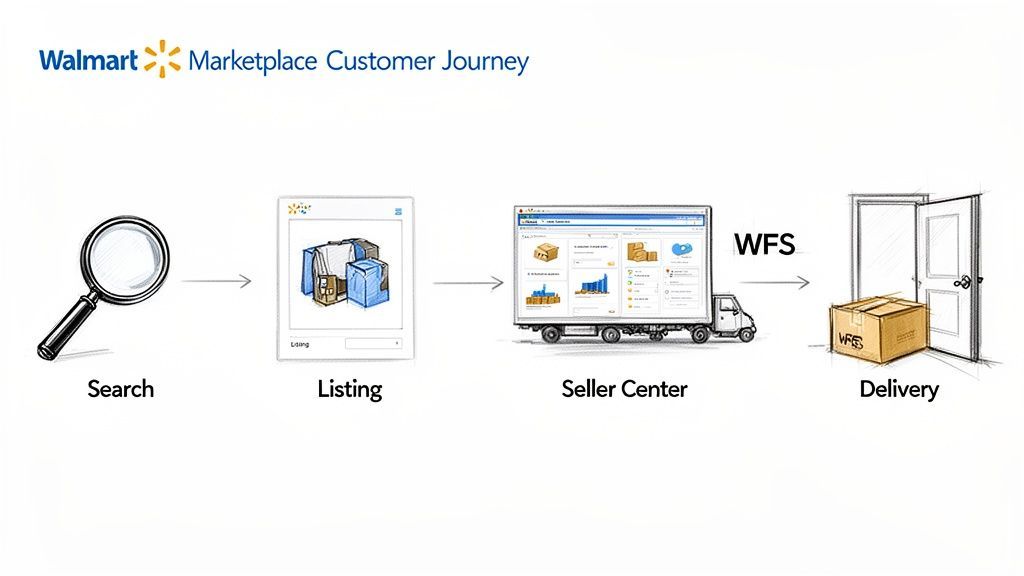
The Seller Center is the engine room of your entire Walmart Marketplace operation. It’s the dashboard where you’ll spend most of your time steering the day-to-day activities of your business, giving you a complete view of your performance and all the tools you need to succeed. From this one platform, you can:
Think of the Seller Center as the back office for your digital storefront. It’s what plugs your products, inventory, and fulfillment directly into Walmart’s massive retail machine, making sure everything runs like clockwork from the moment a customer clicks “buy” to the moment the package lands on their doorstep.
Getting your products to customers quickly and reliably is a massive piece of the puzzle. Walmart gives sellers some powerful options here, with the biggest one being Walmart Fulfillment Services (WFS). It’s pretty simple: you send your inventory to Walmart’s fulfillment centers, and they take it from there—storage, picking, packing, shipping, and even customer service. While WFS improves conversion rates and search visibility, it reduces flexibility. Sellers with oversized, seasonal, or slow-moving inventory should evaluate storage costs carefully before enrolling all SKUs. Products fulfilled through WFS get the trusted “Fulfilled by Walmart” tag and automatically qualify for two-day shipping. This is a huge deal, as it significantly boosts their visibility and conversion rates. The service is designed to level the playing field, giving you access to Walmart’s world-class logistics network so you can compete with anyone.
Just listing your products isn’t enough to stand out in such a competitive space. That’s where Walmart Connect, the platform’s advertising arm, comes in. It gives you the power to promote your products directly on Walmart.com through highly targeted campaigns.
The Walmart Marketplace isn’t just another sales channel; it’s a complete ecosystem. It pulls your products, fulfillment, and advertising into a single, integrated platform, letting you tap into Walmart’s infrastructure to grow your own brand.
The growth of this ecosystem has been nothing short of explosive. The platform blew past the 200,000 active sellers milestone in early 2025, adding a staggering 44,000 new sellers in just the first five months of the year. This rapid expansion, attracting sellers from all over the globe, shows just how big the opportunity is for brands looking to claim their piece of Walmart’s growing e-commerce pie. You can explore the full Marketplace Pulse report for more details on this incredible growth.
Before you can start selling on Walmart Marketplace, you have to get the green light. Unlike platforms that are a free-for-all, Walmart runs a more curated community of sellers. This isn’t to make things difficult; it’s a vetting process designed to protect customers and maintain a high standard of quality, which ultimately benefits every reputable brand on the platform. The application isn’t just a formality. Think of it less like an open invitation and more like applying to join an exclusive retail club. Walmart is verifying that you’re a legitimate, established business ready to meet their customers’ expectations. You need to show you have a solid foundation and a track record of great service.
While the exact criteria can shift over time, Walmart consistently looks for a few key qualifications from new sellers. Getting these documents ready ahead of time will make your application process much smoother and seriously boost your chances of getting a quick approval. Here’s the essential information you’ll need to have on hand:
Having this information organized and ready from the get-go shows you’re prepared and professional, which is exactly what Walmart wants to see.
Once your application is approved, the journey to becoming an active seller kicks off. The process is straightforward and well-guided, designed to get your account set up for success. It generally moves from registration to account setup in the Seller Center, and finally, to item setup and launch. During this onboarding phase, you’ll work through a series of steps to get your digital storefront ready. This means configuring your tax and shipping info, setting up payment details with a partner like Payoneer, and filling out your seller profile. Each step is a building block toward a successful launch.
One of the best things about selling on Walmart Marketplace is its simple and transparent fee structure. Unlike a lot of its competitors, Walmart does not charge any monthly subscription or setup fees. This makes it much easier to get started and means you only pay when you actually make a sale. The main cost you’ll run into is the referral fee. This is simply a percentage of an item’s sale price that Walmart takes as a commission for bringing the customer to you.
The fee structure is designed to be straightforward: no hidden costs, no recurring subscriptions. Your main cost is a simple referral fee paid on each successful sale, making it a performance-based model.
The percentage changes depending on the product category, but most fall into a predictable range. For instance, the referral fee for Apparel & Accessories is 15%, while for Consumer Electronics it’s 8%. This model aligns Walmart’s success directly with yours—they only make money when you do. To give you a clearer picture, here’s a quick look at some sample referral fees across different categories.
Product Category
Referral Fee Percentage
Apparel & Accessories
15% on the total sales price
Beauty
8% for items $10 or less; 15% for items over $10
Consumer Electronics
8% on the total sales price
Home & Garden
15% on the total sales price
Pet Supplies
15% on the total sales price
This direct, sale-based fee structure is a huge advantage for sellers, especially those just starting out or working with a tight budget. It takes the pressure of monthly overhead off the table and lets you focus on what really matters: selling great products.
How your products actually get to your customers is one of the most important decisions you’ll make on Walmart Marketplace. This isn’t just about shipping boxes; it directly hits your costs, customer happiness, and even where you show up in search results. You essentially have two paths: go all-in with Walmart’s own logistics powerhouse, or team up with an independent provider. The choice really comes down to a fundamental trade-off. Do you want the deep, seamless integration that comes with the Walmart ecosystem? Or do you need the flexibility to run a multi-channel business your own way? Let’s break down what each option looks like in the real world. For brands focused exclusively on Walmart growth, WFS generally delivers stronger results. Multi-channel brands may accept lower Walmart visibility in exchange for centralized inventory management through a 3PL.
Walmart Fulfillment Services (WFS) is Walmart’s answer to Amazon’s FBA, and it’s built to be just as powerful. The process is simple: you ship your inventory to Walmart’s fulfillment centers, and they take it from there—storage, picking, packing, shipping, returns, and even customer service. But this is about more than just offloading work. It’s about plugging your brand directly into Walmart’s trusted, high-speed logistics machine. When you sign up for WFS, you unlock a couple of game-changing advantages that can seriously boost your sales and visibility. Products enrolled in WFS automatically get two huge perks:
By using WFS, you’re not just handing off logistics; you’re buying into the Walmart brand promise. The ‘Fulfilled by Walmart’ tag and two-day shipping are more than just features—they are powerful trust signals that directly influence purchasing decisions and search visibility.
These benefits also feed directly into your search performance. Walmart’s algorithm is designed to reward sellers who provide a great customer experience, and nothing says that better than fast, reliable shipping. As a result, WFS items often get bumped up in search results, driving more organic traffic and sales your way. Walmart even sweetens the pot with special promotions, like waiving peak season storage fees during the critical Q4 holiday rush. That lets you stock up for the busiest time of year without getting hit with extra costs. The flowchart below gives you a quick look at the basic requirements for getting started on the platform, which is the first step before you can even consider a service like WFS.
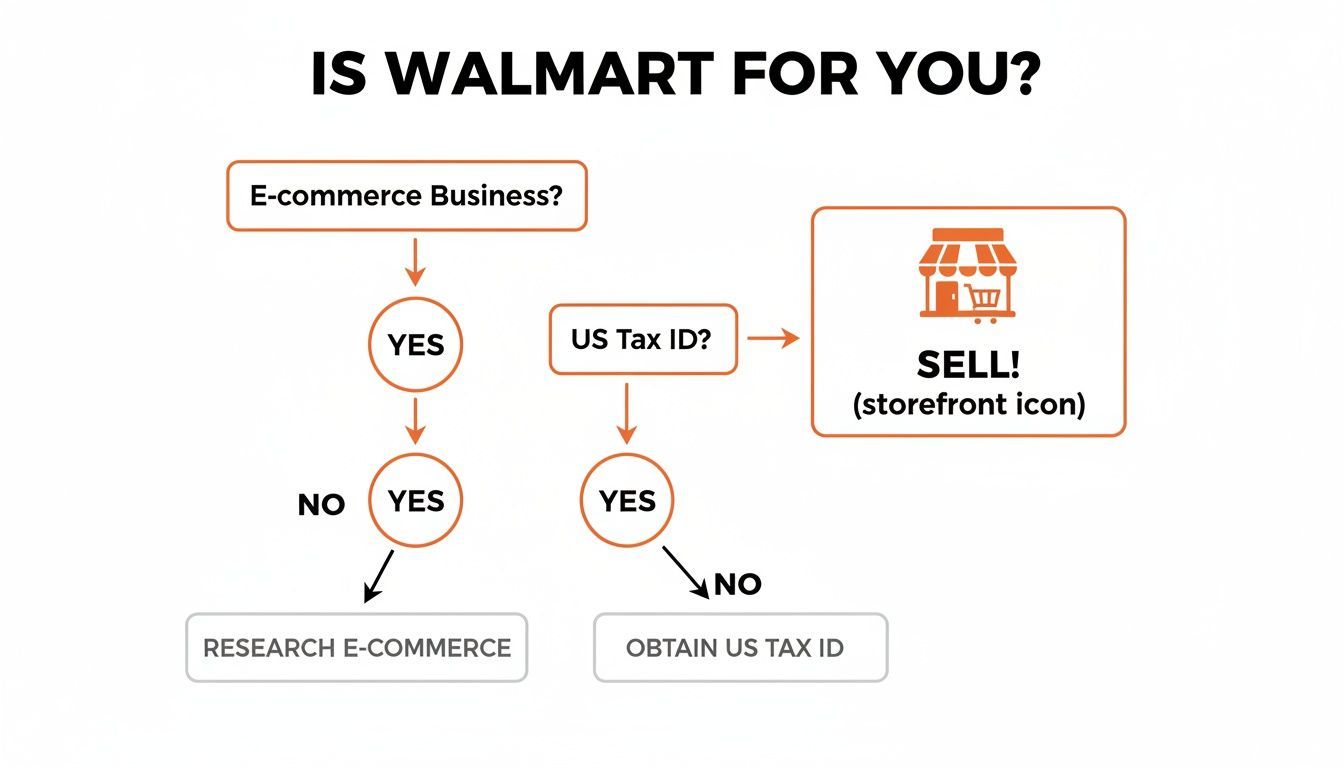
As you can see, the journey begins with having an established e-commerce business and the right U.S. tax documentation in place.
WFS offers incredible integration, but it’s not your only move. Partnering with a third-party logistics (3PL) provider offers a different kind of strength: flexibility and control. A 3PL is an independent company that handles your warehousing, order processing, and shipping for you. This route is often the perfect fit for brands with more complex businesses. If you’re selling across multiple channels—your own website, Amazon, and Walmart—a 3PL can centralize all your inventory in one spot. This avoids the massive headache of splitting your stock between different fulfillment networks and trying to keep track of it all. Here are the main upsides of going with a 3PL:
The trade-off, of course, is that you miss out on the official ‘Fulfilled by Walmart’ tag and the automatic search boost that comes with it. To stay in the game, you’ll need to make sure your 3PL can meet Walmart’s strict Seller-Fulfilled TwoDay and ThreeDay delivery promises.
So, how do you decide? The right fulfillment strategy is the one that fits your specific business model, your products, and your goals for the future. Here’s a simple way to think about it:
Consider WFS If…
Consider a 3PL If…
Walmart is your main (or only) sales channel.
You sell across multiple marketplaces and your own DTC site.
Your products are a standard size and weight.
You have bulky, oversized, or special-handling items.
You want to maximize your visibility and sales on Walmart.com.
You want to control custom branding and packaging for all your orders.
You prefer a streamlined, hands-off logistics solution.
You need one centralized inventory system to manage all your channels.
At the end of the day, the goal is to create a flawless customer experience. For sellers who are laser-focused on crushing it within the Walmart Marketplace, WFS is almost always the clear winner. But for multi-channel brands that need a unified, flexible solution, a well-chosen 3PL is the smarter, more strategic play.
Getting your products live on Walmart Marketplace is just the start. The real challenge—and opportunity—is winning the battle for shopper attention. This is where Walmart Connect, the platform’s advertising suite, becomes your most valuable tool. It’s what separates a product that just exists from one that gets seen and sold. Picture Walmart.com as a massive, sprawling retail store. Without a strategy, your product is just sitting on a shelf somewhere in the middle of a very long aisle. Walmart Connect lets you buy the best real estate in the store—think premium end-caps or a feature display right by the entrance. You stop hoping customers find you and start putting your brand directly in their path.
The foundation of any serious ad strategy on Walmart is Sponsored Products. These are the pay-per-click (PPC) ads that show up at the top of search results, on category pages, and even on other product pages. When a shopper searches for “air fryer,” your brand can be the first one they see, capturing their focus before the organic results even load. These campaigns operate on a keyword-bidding model. You bid on the exact terms shoppers use, like “non-stick pan” or “organic dog food.” The whole point is to align your product with a customer’s intent the moment they’re ready to buy. A well-run campaign funnels your ad spend directly to the most relevant, high-intent shoppers, making it an incredibly efficient way to spark immediate sales.
Walmart advertising isn’t just about paying for clicks. It’s a strategic investment in visibility that drives sales, builds momentum, and ultimately lifts your organic ranking over time.
This boost in traffic and sales creates a powerful flywheel effect. The more sales your ads generate, the more Walmart’s algorithm recognizes your product as relevant and popular. This can lead to a higher organic search ranking, meaning you start earning more “free” traffic. For any brand serious about scaling, a solid ad plan is non-negotiable. For a closer look, check out our guide on how PPC campaigns can fuel your growth. Sponsored Products campaigns tend to perform best when launched within the first 14–30 days of a listing going live. Delayed launches often require higher bids to regain visibility.
While Sponsored Products are perfect for catching shoppers who are already looking for you, Walmart also gives you tools to build brand awareness and connect with customers earlier in their journey. This is where Display advertising and the Demand-Side Platform (DSP) come into play.
This kind of omnichannel approach is essential, especially when you look at Walmart’s incredible e-commerce growth. In Q3 FY26, the company’s e-commerce sales shot up by 27% year-over-year, driven by a Marketplace where third-party sales grew by a massive 34%. This digital push is a huge reason why global e-commerce now accounts for 18% of Walmart’s total business. You can see the full story in Walmart’s latest earnings report. Scaling successfully on Walmart Marketplace isn’t just about flipping on some campaigns. It requires a smart approach to budgeting, constant performance monitoring, and relentless optimization. To maximize your return on ad spend (ROAS), you need to know which keywords convert, which audiences to target, and when to fine-tune your bids. By blending Sponsored Products with broader Display and DSP campaigns, you build a full-funnel strategy that doesn’t just make sales today—it builds a powerful, recognizable brand for tomorrow.
Turning all this theory into a real-world launch takes a clear, step-by-step plan. Don’t think of this as a rigid set of rules, but more like a roadmap to get you from day zero to your first sale and beyond. Nailing these steps helps you build a solid foundation on Walmart Marketplace, setting you up for the long haul. This checklist pulls everything we’ve talked about into a simple sequence. It covers what you need to do before you start, during the actual launch, and—most importantly—in those first few weeks after your store goes live. Let’s walk through it.
Before you even think about creating your first listing, you need to get your house in order. This is all about research, paperwork, and planning. Getting this right now saves you from massive headaches later and makes the whole application process way smoother.
With all your prep work done, it’s time to go live. This is where you actually build your store, create listings that sell, and get your inventory ready for customers. Attention to detail is your best friend here.
A successful launch isn’t a single event; it’s a carefully orchestrated sequence of steps. Each phase builds upon the last, from initial research to activating your first ad campaign, creating a powerful momentum for your brand.
Getting your store live is just the starting line. The first 90 days are absolutely critical for building momentum, collecting data, and tweaking your strategy. What you do right after launch sets the tone for your long-term growth on the platform.
Diving into a new marketplace always brings up a few questions. It’s a smart move to get these answered before you launch, as understanding the landscape can save you a ton of headaches down the road. We’ll tackle some of the most frequent queries we hear from brands gearing up to sell on Walmart. Think of this as your head start on building a strategy that works from day one.
On the surface, they might look like two sides of the same coin, but Walmart and Amazon are completely different arenas. The biggest difference? Competition and opportunity. Amazon is a sprawling, noisy stadium with over 2 million active sellers all vying for attention. It’s tough to get noticed without a massive ad budget. Walmart, by contrast, feels more like an exclusive, high-traffic retail park. It’s a curated space with a much smaller (but growing) seller base. This gives ambitious brands a real shot at standing out and building a following. Here’s a quick breakdown:
Selling on Amazon is like trying to be heard in a packed stadium. Selling on Walmart is like being the main attraction.
It’s easy to trip over the same hurdles that catch most newcomers. Getting these things right from the start is the key to building momentum and keeping your account in good health. The single biggest mistake we see is poor listing quality. We’re talking low-res images, bland product descriptions, and titles that are missing crucial keywords. Your listing is your online salesperson—if it doesn’t do a good job, shoppers will just keep scrolling. Another classic pitfall is sloppy inventory management. Stockouts and canceled orders are the fastest way to sink your seller metrics and lose Walmart’s trust.
So many brands underestimate how much Walmart values operational excellence. The algorithm heavily favors sellers who nail the basics—like on-time shipping and low order defect rates—right out of the gate.
Yes, they absolutely can, but it’s not a free-for-all. Walmart welcomes international sellers, provided they can meet some pretty specific business requirements. Walmart is fiercely protective of its customer experience and needs to know you can deliver. To get the green light, international businesses must have a U.S. Business Tax ID (an EIN) and a U.S. business address for handling returns. This setup ensures that even if you’re based halfway across the world, you can provide the same reliable service that American shoppers expect from Walmart.
Making the jump to Walmart Marketplace takes a smart approach. Clickstera Solutions LLC specializes in launching brands and scaling them with expert account management, sharp advertising campaigns, and the data insights you need to win. We work with brands that already have proven products and need structured execution on Walmart Marketplace, with a focus on operational stability, profitable ad scaling, and long-term account health.
Talk to Clickstera and get a clear next-step plan to scale your performance marketing.