
Loading article
Loading page...
Amazon conversion rate optimization is all about turning more of your page visitors into paying customers. It’s the art and science of fine-tuning everything on your product listing—from the title and images to your reviews and A+ Content—to build trust and make the “Add to Cart” button irresistible. The end goal is simple: get more sales from the traffic you already have, which in turn boosts your revenue and your organic ranking.
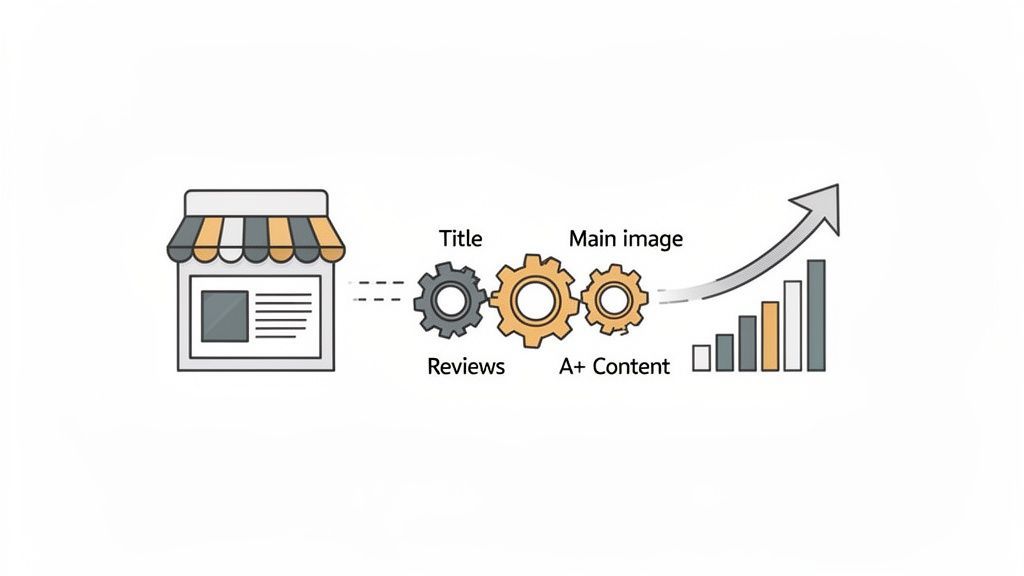
Before you start tweaking bullet points, you need to appreciate just how different Amazon is from a typical brand website. Shoppers don’t land on Amazon to browse aimlessly; they arrive with a wallet in hand, ready to buy. This high-intent mindset creates a massive opportunity for sellers who know how to close the deal.
The entire platform is engineered to be a conversion engine. Between 2018 and 2024, the average Amazon conversion rate consistently hovered between 10–15%. That figure absolutely dwarfs the 1–4% you see on most standalone e-commerce sites. Think about that for a second. A shopper on Amazon is anywhere from 3 to 10 times more likely to buy than someone on a brand’s own website. You can find more great benchmarks in this deep dive on Amazon conversion rates from Parah Group.
Because the buying intent is so high, every single element on your product detail page carries immense weight. Optimization isn’t just a “nice-to-have”—it’s about methodically knocking down barriers to purchase and building a compelling case for your product at every turn.
One of the most important concepts to grasp is what I call ‘conversion momentum.’ It’s a flywheel effect. When your listing is well-optimized and starts converting visitors at a high rate, it doesn’t just make you more money. It also sends a powerful signal to Amazon’s A9 algorithm that your product is a winner.
What happens next? Amazon rewards you with better organic search rankings.
This higher visibility brings in more traffic which, when it lands on your high-converting page, leads to even more sales. This positive feedback loop is what drives sustainable, long-term growth on the platform. It also makes your advertising far more efficient because you’re sending paid traffic to a page that’s already proven to work.
For marketplace managers, this is a critical mindset shift. Amazon CRO isn’t a one-off task. It’s the engine that powers a growth flywheel, making every marketing dollar you spend work harder and smarter.
Your product detail page is made up of dozens of conversion triggers. When they all work together, they create a seamless path from discovery to purchase. Here’s a quick look at the core levers that directly influence your conversion rate.
This table breaks down the primary factors that directly influence your Amazon conversion rate.
Optimization Area
Key Components
Primary Impact
Listing Content
Title, Bullet Points, Product Description
Informs and persuades by highlighting benefits and addressing potential customer questions.
Creative Assets
Main Image, Secondary Images, Video, A+ Content
Builds trust and helps shoppers visualize the product, demonstrating value beyond text.
Social Proof
Star Rating, Review Count, Customer Q&A
Creates confidence by showing that other shoppers have purchased and are satisfied with the product.
Value Proposition
Price, Coupons, Promotions, Shipping Speed (FBA)
Incentivizes immediate action by creating a sense of urgency and demonstrating clear value for the money.
Each of these areas is a link in your conversion chain. A keyword-stuffed title might get the click, but it’s the compelling main image, the glowing reviews, and the benefit-packed bullet points that work together to secure the sale. If any one of these is weak, you risk losing shoppers to a competitor who’s done the work.
Ultimately, mastering Amazon conversion rate optimization means treating your product page like your best salesperson—one that works 24/7 to turn clicks into customers. It demands a deep understanding of your audience and a relentless commitment to data-driven improvement.
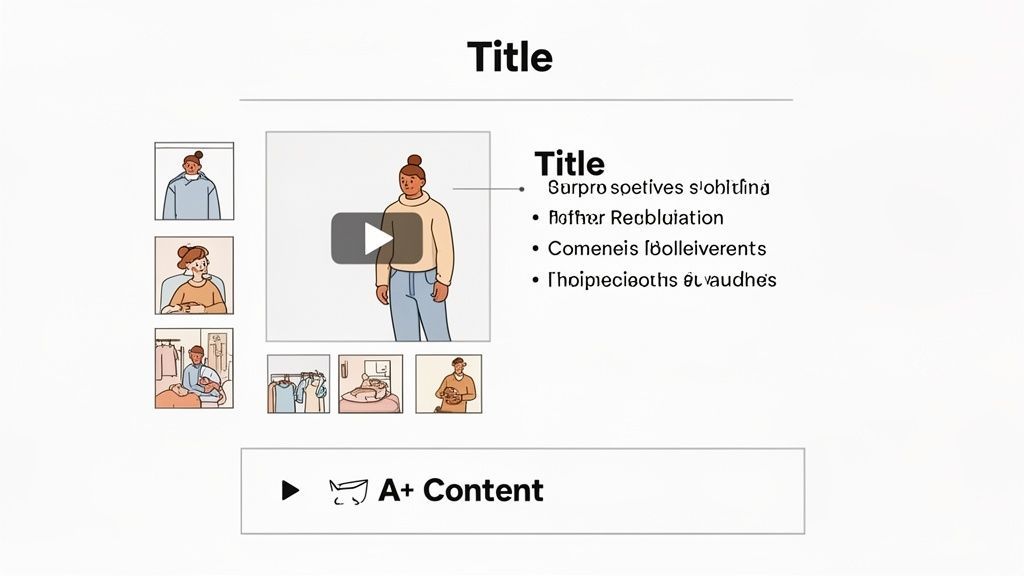
Think of your product detail page as your single best salesperson. It works 24/7, never takes a break, and every single element—from your title down to the last pixel of A+ Content—needs to work together to turn a casual browser into a committed buyer. All the high-quality traffic in the world is useless if the landing page doesn’t seal the deal.
This is where the real craft of Amazon conversion rate optimization comes into play. It’s a methodical process of engineering every piece of your listing to answer questions, build trust, and create an undeniable urge to click “Add to Cart.”
Your product title pulls double duty. It has to satisfy Amazon’s A9 algorithm with relevant keywords while also speaking clearly to a human shopper. So many sellers get this wrong, stuffing their titles with a jumbled mess of keywords that reads like gibberish and scares buyers away.
A great title has a logical flow. Start with your brand name and core product, then weave in the most critical features and benefits.
See the difference? The second one is still packed with keywords, but it tells a story. “Superior Non-Slip Grip” and “Joint Support” aren’t just features; they’re solutions to a customer’s problems.
Your bullet points are your chance to dismantle a shopper’s objections before they even fully form. Stop just listing features. Instead, explain precisely how those features solve a real-world problem or make the customer’s life better.
A classic mistake is treating bullets like a spec sheet. They’re not. They’re your opportunity to answer the customer’s unasked questions. The best way to find these is to dive deep into your top competitor’s reviews and Q&A section—that’s where shoppers tell you exactly what they care about.
For every bullet, try this simple framework:
Here’s how that looks for a portable power bank:
“NEVER RUN OUT OF BATTERY AGAIN: Our high-capacity 20,000mAh battery delivers over four full charges for an iPhone 15, keeping you connected on long trips without hunting for an outlet.”
People buy with their eyes. It’s that simple. Shoppers often make their final decision based on images alone, which makes your creative assets some of the heaviest hitters in your conversion toolkit. While your main image must be a crisp, high-res shot on a pure white background, your secondary images are where you build a narrative.
Your image gallery should be a well-rounded visual pitch:
A+ Content and the Brand Story module are your secret weapons for standing out. This is your space to turn a standard product page into a genuine brand experience. It’s where you reinforce your unique value, show off your brand’s personality, and give shoppers a deeper dive into what makes your product better.
You can build and manage everything right from your Seller Central dashboard. This is your command center for creating visually rich content that can seriously lift conversion rates by answering lingering questions and building brand loyalty.
Avoid the temptation to create a wall of text. Instead, lean on high-quality images, comparison tables, and icons to make the information scannable and engaging. The goal is to build confidence with every scroll. All these listing elements are crucial pieces of the puzzle; for a more detailed look, you can learn more about how to optimize Amazon listings in our deep-dive guide.
Pouring ad spend onto an unoptimized product detail page is like trying to fill a bucket with a massive hole in it. The goal isn’t just to drive more traffic; it’s about attracting the right traffic—shoppers who are already primed to buy. A truly effective Amazon advertising strategy is one that works in perfect harmony with your conversion rate optimization efforts.
Anyone can drive clicks. But driving profitable sales? That requires a much deeper level of alignment.
Think of it this way: your ad is the promise, and your product page is the fulfillment of that promise. If a shopper clicks your Sponsored Products ad because it highlighted a “superior non-slip grip,” your listing’s images, bullet points, and A+ Content had better validate that claim immediately. Any disconnect, and you’ve just paid for a bounce.
This screenshot shows exactly where Sponsored Products ads appear in search results, giving you a prime opportunity to grab high-intent shoppers right at the top of the page.
This premium placement is why your ad creative—the main image, title, price, and review rating—has to be perfectly tuned. You’re competing for that first click, and every element matters.
Not all keywords are created equal. A shopper searching “yoga mat” is probably just browsing. But a shopper searching for an “eco-friendly TPE yoga mat with carry strap” is signaling a much clearer intent to purchase. Your entire campaign structure should be built to capture this bottom-of-the-funnel traffic.
Your advertising dashboard is a goldmine of conversion data if you know how to read it. One of the most common—and revealing—scenarios is seeing a high click-through rate (CTR) but a low conversion rate for a specific keyword. What does that tell you?
It’s a classic sign of a promise vs. reality gap. Your ad was compelling enough to earn the click (congrats on the great main image and title!), but something on your product detail page made the shopper lose confidence and walk away.
Key Takeaway: A high CTR paired with a low conversion rate isn’t an advertising problem—it’s a listing problem. The keyword is relevant, but your page isn’t closing the deal. This is your cue to dive back into your bullet points, secondary images, and customer Q&As to figure out what objections you’re failing to address.
Recent industry data confirms this powerful link. One Q2 2023 analysis reported that conversion rates for Sponsored Brands ads shot up 17% quarter-over-quarter, while Sponsored Brands video rose 9%. This drove sales growth of +10% and +16% respectively, even while click-through rates stayed flat. You can find more insights on these Amazon ads conversion rate trends.
Let’s be real: not every visitor will convert on their first visit. That’s where remarketing with Sponsored Display and Sponsored Brands comes into play. These ad types let you follow shoppers who viewed your product but didn’t buy, reminding them of your product as they browse other pages on and off Amazon.
This tactic is especially powerful for higher-priced items with a longer consideration cycle. By staying top-of-mind, you dramatically increase your odds of winning the sale when that shopper is finally ready to pull the trigger.
You can even connect your off-Amazon efforts to your on-Amazon sales. For a complete overview, check out our guide on Amazon Attribution, the missing link between Google Ads, Meta Ads, and Amazon sales. By syncing your ad strategy with your listing optimization, you create a powerful flywheel that boosts both your conversion rate and your return on ad spend (ROAS).
On Amazon, once a shopper clicks on your listing, two things matter more than anything else: social proof and perceived value. It all boils down to two simple questions running through a buyer’s mind: “Can I trust this product?” and “Is it worth the money?”
Get these right, and you’re well on your way to a solid conversion rate.
Social proof, which on Amazon really just means customer reviews, is everything. Shoppers are hardwired to look for validation from others before they pull out their wallets. A product with only a handful of reviews or a shaky star rating just feels like a risk, and that hesitation is often all it takes to send a potential customer clicking over to a competitor.
You can’t just sit back and hope for reviews to roll in. Building a steady stream of authentic feedback is something you have to actively manage, and thankfully, Amazon gives you a few compliant ways to do it.
How you handle the bad reviews is just as important as getting good ones. When a negative review pops up, respond to it publicly and professionally. It shows everyone else browsing your page that you stand behind your product and actually care about your customers. It’s a simple act that can completely neutralize a bad review and build a ton of trust.
Pro Tip: Never ignore a one-star review. A thoughtful response that offers a solution or a sincere apology can do more for your brand reputation than ten five-star reviews. I’ve seen it turn hesitant shoppers into buyers because it shows there’s a real human behind the brand who cares.
Your price is a direct lever for winning the Buy Box, which is where the vast majority of sales happen. But this isn’t about a race to the bottom. Smart pricing is about finding that perfect balance between being competitive and actually making a profit.
The goal is to be Buy Box eligible and competitive, not just the cheapest option. Amazon’s algorithm looks at more than just price—it heavily favors FBA for its fulfillment speed and reliability, and it also considers your overall seller metrics. A product priced slightly higher than a competitor’s but offered with Prime shipping will almost always win the Buy Box.
If you use automated repricing tools, do it carefully. Set hard floors and ceilings based on your COGS to make sure you don’t accidentally give away all your margin.
Promotions are fantastic psychological triggers. They create a sense of urgency and make your offer feel like a better deal, which can be just the push a hesitant shopper needs to click “Add to Cart.”
Amazon gives you a few different tools, and knowing when to use each one is key.
The choice between a coupon or a deal really depends on your goal. Looking for a steady, sustained lift in daily sales? Go with a coupon. Need a powerful, concentrated sales burst to shoot up the Best Seller Rank? A Lightning Deal is your weapon of choice.
To really nail your strategy, you need to pick the right tool for the job. Not all promotions are created equal, and their impact on conversions can vary wildly depending on your goals and product. This table breaks down the most common options to help you decide.
Promotion Type
Best For
Typical Conversion Lift
Considerations
Coupons
Sustained, moderate sales lift; improving click-through rate from search; new product launches.
5-15%
Highly visible green badge attracts clicks. Easy to set up and control budget.
Lightning Deals
Massive, short-term sales velocity; liquidating inventory; boosting Best Seller Rank (BSR).
50-200%+ (during event)
Requires sufficient inventory. Higher fees involved. Must be approved by Amazon.
7-Day Deals
A sustained sales boost over a full week; great for high-traffic periods or seasonal pushes.
20-80%
Longer exposure than a Lightning Deal but less intense urgency. Good for testing demand.
Prime Exclusive Discounts
Driving sales from loyal Prime members, especially around Prime Day and holiday events.
10-40%
Only visible to Prime members. Must meet specific criteria (e.g., star rating).
Ultimately, the best promotional strategies often involve a mix of these tools. You might run a continuous coupon to maintain daily sales and then schedule a Lightning Deal to get a big ranking boost before a major holiday.
By combining authentic reviews, competitive pricing, and the right promotions, you create an offer that’s hard to refuse. You’re not just selling a product; you’re building trust and creating value, which is exactly how you turn browsers into buyers and maximize your conversion rate on Amazon.
The most successful Amazon sellers I’ve worked with all share one fundamental belief: optimization is never a one-and-done task. It’s a relentless, data-driven cycle of testing, learning, and refining your approach. Just launching a beautifully designed listing isn’t enough to win. To stay ahead, you have to embrace a mindset of constant improvement.
This is where you graduate from making educated guesses to making decisions backed by cold, hard data. The goal is to build a repeatable system that consistently uncovers new opportunities to improve your listing’s performance.
The whole process revolves around isolating one variable at a time and measuring its real-world impact. Key conversion levers like your reviews, pricing, and promotions each play a unique role in swaying a shopper’s decision.
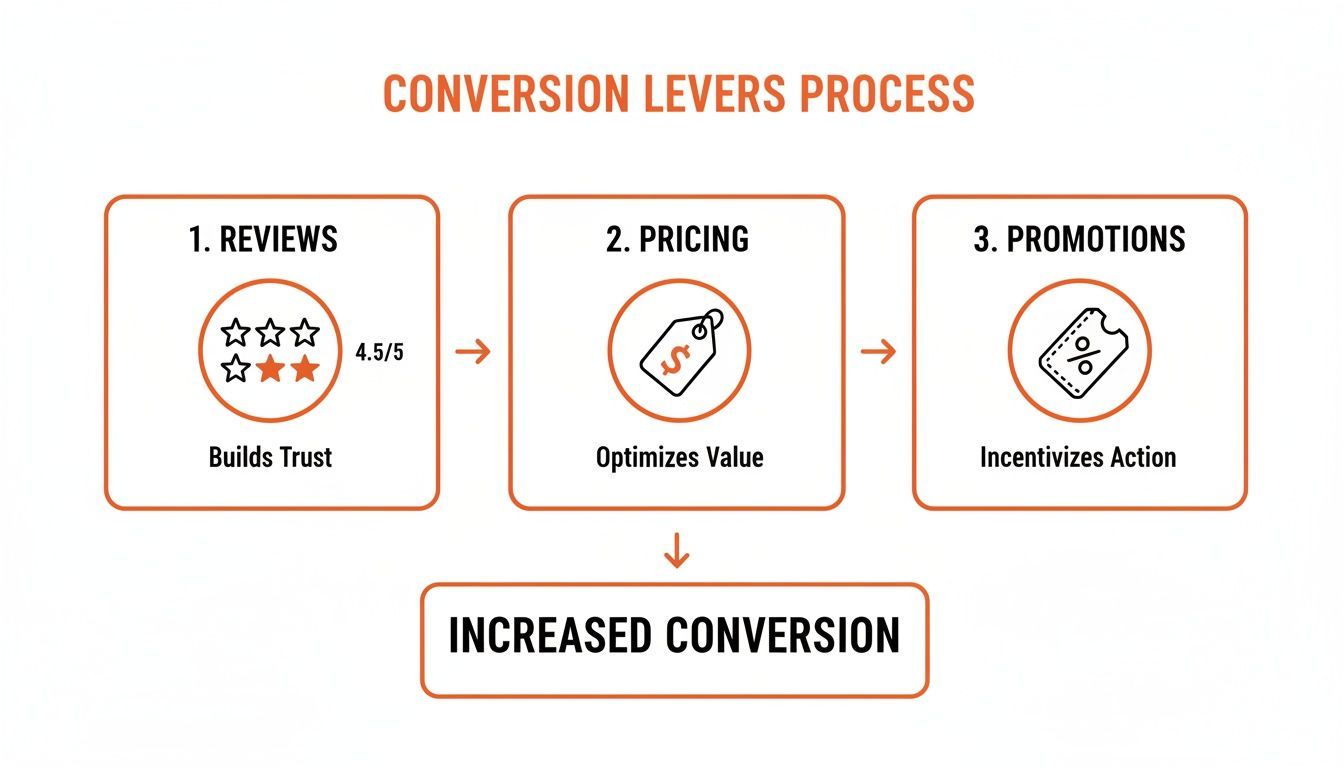
This flow really breaks it down. Reviews build that initial layer of trust, pricing frames the product’s value, and a well-timed promotion creates the urgency needed to close the sale. By methodically testing elements within each of these stages, you can systematically lift your overall conversion rate.
Thankfully, Amazon gives us a powerful, built-in tool for exactly this: Manage Your Experiments. This feature is your ticket to running direct, head-to-head A/B tests on the most critical parts of your product detail page. It’s the best way to cut through the noise of opinions and let actual customer behavior tell you what works.
With this tool, you can finally get definitive answers on things like:
The process is surprisingly straightforward. Amazon automatically splits the traffic heading to your listing, showing half the shoppers Version A and the other half Version B. After the test runs its course—usually 4 to 10 weeks—it declares a winner based on statistically significant results, even telling you the probability that the winning version will keep outperforming the original.
When you start digging into analytics, it’s easy to get lost in a sea of data. But for Amazon conversion, one metric stands head and shoulders above the rest: the Unit Session Percentage Rate. You’ll find this right in your Business Reports inside Seller Central.
This is Amazon’s direct measure of conversion. It’s simply the number of units purchased divided by the number of sessions (visits) your page received. If 100 shoppers land on your listing and 15 of them buy, your Unit Session Percentage Rate is 15%.
For a deeper look at the broader principles of conversion rate optimization that apply here, our guide on improving ecommerce conversion rates is a great resource.
Key Takeaway: Clicks and impressions are great for gauging traffic, but your Unit Session Percentage Rate is the true health indicator for your listing. If that number is trending up, your efforts are paying off. If it starts to dip, it’s an immediate red flag that something needs your attention.
Your goal is to turn this into a perpetual optimization loop that never stops.
By consistently running these experiments, you’re not just making tiny, random tweaks. You are methodically building a smarter, more effective listing with every single cycle. This relentless focus on data and iteration is what truly separates the top-tier sellers from everyone else.
Even with a clear roadmap, the world of Amazon conversion rate optimization can be a bit of a minefield. Many sellers find themselves wrestling with the same questions: Where do I even begin? How can I be sure my changes are actually moving the needle?
Let’s cut through the noise and tackle some of the most common questions head-on.
It’s easy to get bogged down by all the things you could change. If you’re looking for the biggest initial bang for your buck, start with what shoppers see first in the search results.
That means your main image, title, price, and review count. These four elements are the gatekeepers to your listing—they have a massive influence on your click-through rate (CTR), which is the very first conversion you need to win.
If you’re getting tons of impressions but hardly any clicks, you have a “first impression” problem. Your listing simply isn’t compelling enough to earn that click. The first thing I’d do is A/B test the main image. It’s often the single most powerful lever you can pull to get more qualified traffic onto your product page.
This is the classic “it depends” question, and it really comes down to your traffic volume. For a high-traffic ASIN, you might see an A/B test on a main image reach statistical significance in just a couple of weeks. But for a product that gets less traffic, you might need to let it run for a month or more.
It’s so important to be patient and let your tests run their full course. I’ve seen countless sellers kill a test early because they got excited by initial data, only to make the wrong call. Trust the process—Amazon’s ‘Manage Your Experiments’ tool will tell you when a result is statistically significant.
Beyond A/B tests, broader optimizations like overhauling your bullet points or A+ Content can start to show up in your Unit Session Percentage Rate within a few weeks as traffic filters through the updated listing.
While the marketplace average tends to hover around 10-15%, a “good” conversion rate is all about context. It’s highly category-dependent. A simple, low-cost item in Home & Kitchen might easily convert at 25% or more. On the other hand, a complex, high-ticket electronic gadget might be a huge success with a 5% conversion rate.
Instead of getting fixated on a universal number, your focus should be on your own data. Benchmark against your historical performance and your closest direct competitors. The real goal is continuous improvement. If you can lift your Unit Session Percentage Rate from 12% to 14%, that’s a massive win, no matter what the category average is.
Yes, but not in the way you might think. The biggest mistake isn’t making too many improvements, it’s making too many changes at once. If you rewrite your title, swap all your images, and update your bullet points at the same time, you’ll have zero clue which specific change was responsible for the lift—or drop—in sales.
True Amazon conversion rate optimization is a methodical, scientific process. It’s about discipline.
This approach ensures every decision is informed and builds on the last, creating sustained, long-term growth instead of just chaotic, unpredictable results.
Ready to stop guessing and start making data-driven decisions to scale your brand on Amazon?
The team at Clickstera Solutions LLC combines years of marketplace expertise with advanced analytics to build winning strategies that boost visibility and drive profitable growth.
Let’s build your success story together. Learn more at https://clickstera.com.
Talk to Clickstera and get a clear next-step plan to scale your performance marketing.