
Loading article
Loading page...
Think of Amazon Launchpad as a high-visibility accelerator program for innovative products trying to stand out. It’s not just a badge on your listing; it’s a dedicated storefront and marketing suite designed to give unique brands a spotlight in a massive marketplace. This program offers enhanced tools and special placements to help new products cut through the noise.
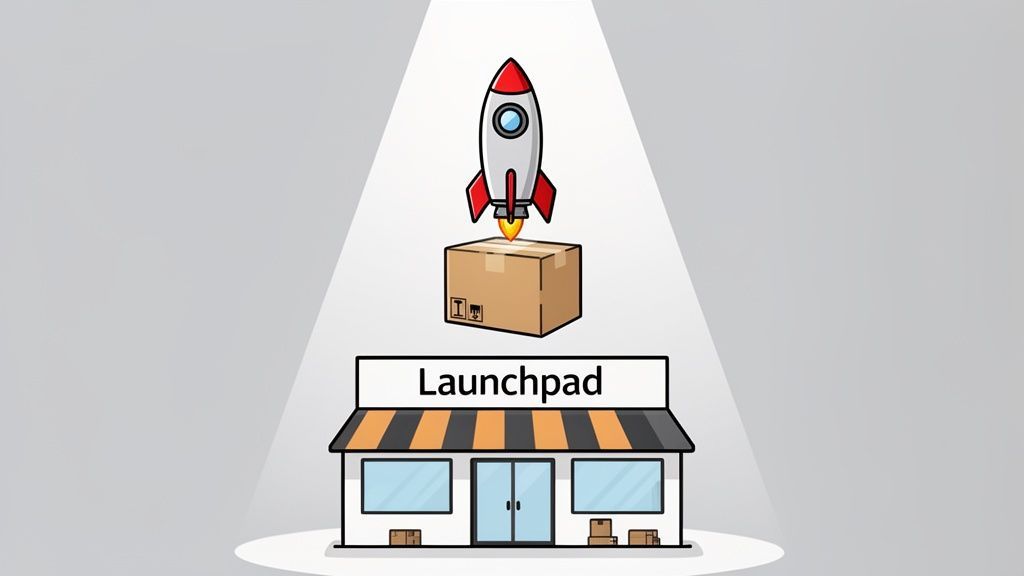
Imagine a bustling farmers’ market with thousands of vendors. Most sellers have a simple stall, but a select few are given a prime spot right at the entrance, complete with better signage, sample stations, and mentions in the market’s weekly newsletter. That premium placement is precisely what Amazon Launchpad offers to emerging brands.
It’s an ecosystem built to solve one of the biggest challenges for new products: discovery. In a marketplace with millions of sellers, gaining initial traction is a monumental task. Launchpad acts as a strategic lever, providing the visibility needed to find an audience.
The program isn’t just a label; it’s a suite of marketing and merchandising tools. Brands accepted into the program gain access to features that are typically reserved for much larger, established sellers. These tools are designed to help you tell a more compelling story and capture customer attention effectively.
To give you a clearer picture of what’s on offer, here’s a quick breakdown of the core components.
This table provides a quick summary of the core components of the Amazon Launchpad program, outlining what brands get and what they need to qualify.
Feature or Requirement
What It Means for Your Brand
A Dedicated Storefront
Your products get featured in a curated section of Amazon that shoppers visit specifically to discover new and interesting items.
Enhanced Content Features
You can use premium A+ Content, which allows for more immersive brand storytelling with video, interactive modules, and richer imagery.
Merchandising & Placements
Amazon often features Launchpad products in special marketing campaigns, themed gift guides, and other high-traffic promotional spots.
Innovation-Focused Eligibility
The program is designed for unique, often venture-backed products with a compelling story or novel technology.
Commission Fee
Launchpad charges an additional 5% commission on top of standard referral fees, reflecting the premium services provided.
Essentially, the program bundles high-impact visibility tools with a curated shopping experience to help innovative products break through.
In essence, Amazon Launchpad provides a curated platform where innovation is the main attraction. It helps bridge the gap between having a great product and getting that product in front of millions of potential customers who are eager to find the next big thing.
Amazon Launchpad was introduced globally in July 2015 as a dedicated platform to help startups and emerging brands “launch, market, and distribute” products. Positioned within an ecosystem serving over 300 million active users, the program gives young brands exposure that would be extremely costly to replicate on their own.
That kind of scale means that even a small uplift in impressions or conversion can translate into meaningful revenue for brands ready to capitalize on the extra visibility. You can dig deeper into the Amazon Launchpad overview to see its history and specific case studies.
This program is most beneficial for brands with unique, story-driven products. If your product has a compelling backstory, a patented feature, or solves a problem in a novel way, Launchpad gives you the stage to share that narrative. It’s a powerful tool for differentiation in a crowded digital aisle.
The high-level perks of Amazon Launchpad definitely sound appealing, but success really comes down to the practical details. You have to understand the true costs and what it takes to get accepted. It’s not just about having a cool, innovative product; you need to meet some specific operational and financial bars that prove you can handle the spotlight.
Think of the application as a readiness check. Before Amazon puts its marketing muscle behind you, it wants to be sure your business is built on a solid foundation. That means having the right account type, fulfillment strategy, and healthy performance metrics already locked in.
Let’s get straight to the point: Launchpad isn’t free. It’s a direct investment in premium marketing and merchandising, and that investment comes in the form of an additional fee on top of what you already pay.
The program’s fee structure has changed quite a bit over the years. It used to work more like a wholesale model, but it’s since moved to a third-party (3P) marketplace structure, which gives brands full control. This means you’ll pay the standard category referral fees (usually 15–17%) plus FBA costs, but Launchpad tacks on a premium fee—in some regions, this is an extra 5% referral fee. You can dig into how this Launchpad model gives brands greater control and what that means for your overall strategy.
It’s helpful to see that extra 5% not just as a fee, but as your marketing budget for getting into an exclusive club with powerful tools.
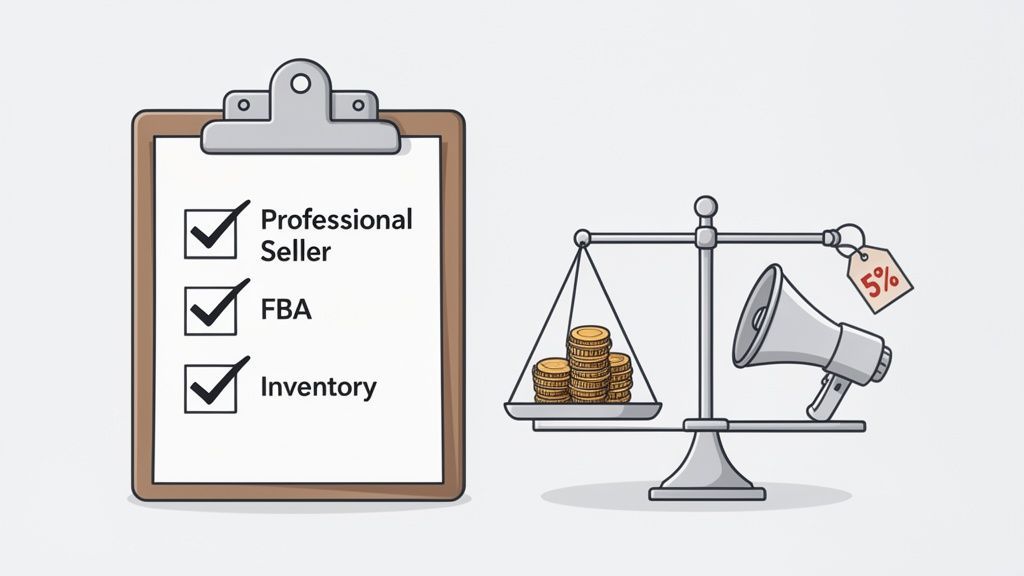
Cost-Benefit Analysis: If your product sells for $100, a standard 15% referral fee is $15. The Launchpad fee adds another $5, bringing your total referral fee to $20. So, the big question is: will the extra visibility, conversion lift from premium content, and credibility from the Launchpad badge generate enough new sales to make that extra $5 a profitable investment?
Before you even start crunching the numbers, your brand has to clear a few non-negotiable hurdles. Amazon uses these requirements to filter for sellers who are ready to scale and can deliver a top-notch customer experience.
**Professional Seller Account:** You have to be on the Professional selling plan. The Individual plan won’t cut it, as this is a basic prerequisite for nearly all advanced tools on Amazon.
**Fulfillment by Amazon (FBA):** Your products must be enrolled in FBA. Launchpad is tightly woven into Amazon’s logistics network to guarantee the Prime-eligible, fast shipping that customers expect from featured products.
**Healthy Account Metrics:** Your Seller Central account needs to be in good shape. That means low order defect rates, late shipment rates, and pre-fulfillment cancellation rates. No exceptions.
**Sufficient Inventory:** You must be able to keep your products in stock. Nothing kills momentum faster than getting a huge promotional boost and then immediately running out of inventory. It’s a wasted opportunity and a bad look.
If you meet the requirements and the fee structure works for your budget, the application itself is pretty straightforward. It’s less about filling out tedious forms and more about telling your brand’s story.
Getting into Amazon Launchpad can feel like being handed an all-access pass at a massive festival. It definitely gets you into exclusive areas designed to put your brand in the spotlight, but it’s critical to understand what that pass gives you—and what it costs.
The biggest perk, without a doubt, is the enhanced visibility. Launchpad products get special placement in the Launchpad storefront, a curated corner of Amazon that shoppers visit specifically to find cool, innovative new stuff. This isn’t just another category page; it’s a destination.
This exposure often gets a boost from Amazon’s own marketing machine, like features in themed email campaigns and seasonal gift guides. For a new product, getting into a “Cool Gadgets for the Holidays” email blasted to millions of Prime members can drive more traffic in one day than you’d get in months of grinding away with ads.
Beyond just getting more eyeballs, Launchpad gives you better tools to tell your story. Participants get access to premium A+ Content, which lets you build product detail pages that are far more dynamic and engaging.
Instead of just plain text and images, you can use things like:
This stuff isn’t just for show; it builds buyer confidence and can seriously improve your conversion rates. When a customer gets your product’s value and the story behind it, they’re much more likely to click “Add to Cart.” If you want to dive deeper into turning traffic into sales, check out our detailed guide on Amazon conversion rate optimization.
But Launchpad isn’t a silver bullet. It’s an amplifier. And it comes with some very real trade-offs you need to consider. The most glaring one is the additional cost—a 5% premium tacked onto your standard referral fees. That 5% comes directly out of your profit, so your product needs healthy margins to absorb that hit and still be profitable.
On top of that, the very thing that makes Launchpad great can also be a weakness. You’re in a curated collection of “innovative” products, which is awesome, but if your product doesn’t truly stand out, it can get lost in a sea of other clever gadgets. You’re no longer competing with average products; you’re on a stage full of other headliners.
Launchpad works best when it accelerates existing momentum. It will not fix a flawed product, a poor pricing strategy, or an underfunded advertising plan. It provides the fuel, but your brand must already have a well-built engine.
To help you weigh the pros and cons, here’s a straightforward comparison of what you get with Launchpad versus a standard seller account.
This table breaks down the key differences between a standard Professional Seller account and one enrolled in Amazon Launchpad, focusing on features, costs, and strategic opportunities. It’s a quick way to see where Launchpad adds value and where it introduces new challenges.
Feature
Standard Seller Account
Amazon Launchpad Account
Referral Fees
Standard category fees (e.g., 15%)
Standard category fees + an additional 5% premium
Content & Branding
Basic A+ Content, Brand Story
Premium A+ Content, video modules, interactive hotspots, enhanced brand storytelling tools
Visibility
Standard search results, reliant on SEO & PPC
Dedicated Launchpad storefront placement, potential features in Amazon marketing campaigns & emails
Onboarding Support
Self-service via Seller Central resources
Dedicated onboarding manager and strategic support during the initial launch phase
Marketing Access
Standard advertising tools (Sponsored Products, Brands, etc.)
Access to exclusive marketing opportunities like gift guides, event placements, and deal features
Best For
Established products, brands with tight margins
Genuinely innovative products with strong margins and a compelling brand story
Ultimately, the decision to use Launchpad comes down to whether your product is ready for the accelerator. You need a product that isn’t just different but demonstrably better, a financial model that can handle the higher fees, and a marketing plan ready to capitalize on the visibility from day one.
The program exists because two massive trends have collided: Amazon’s total dominance in product search (over 56% of shoppers now start there) and the rise of digitally-native brands. Launchpad provides the tools—premium placements, richer analytics—that can compress a multi-year brand-building effort into just 12–24 months for the right product. You can find more powerful insights like this from these Amazon statistics on Mobiloud.com.
For brands that tick all the boxes, Launchpad can be an incredible growth engine. For those that don’t, it risks becoming a costly distraction from the fundamentals.
Getting into Amazon Launchpad isn’t like flipping a switch for automatic sales. Think of it more like installing a supercharger in your car’s engine—it gives you a massive boost in potential power with increased visibility, enhanced credibility, and premium content tools. But to actually win the race, you still need a skilled driver behind the wheel, executing a smart advertising strategy to turn all that new attention into profitable, sustainable growth.
Launchpad provides the traffic and credibility, but your advertising has to convert that potential into performance. Without a solid plan to capture the influx of new shoppers, you risk wasting the program’s biggest perks. The core idea is simple: use Launchpad’s organic lift to make every single dollar of your ad spend work harder and more efficiently.
The program gives your product detail pages an inherent advantage. Armed with premium A+ Content and video, your conversion rates are almost guaranteed to improve, creating a powerful flywheel effect for your paid campaigns.
This diagram breaks down how Launchpad’s core pillars—Visibility and Storytelling—interact with its Limitations to form a complete strategy.
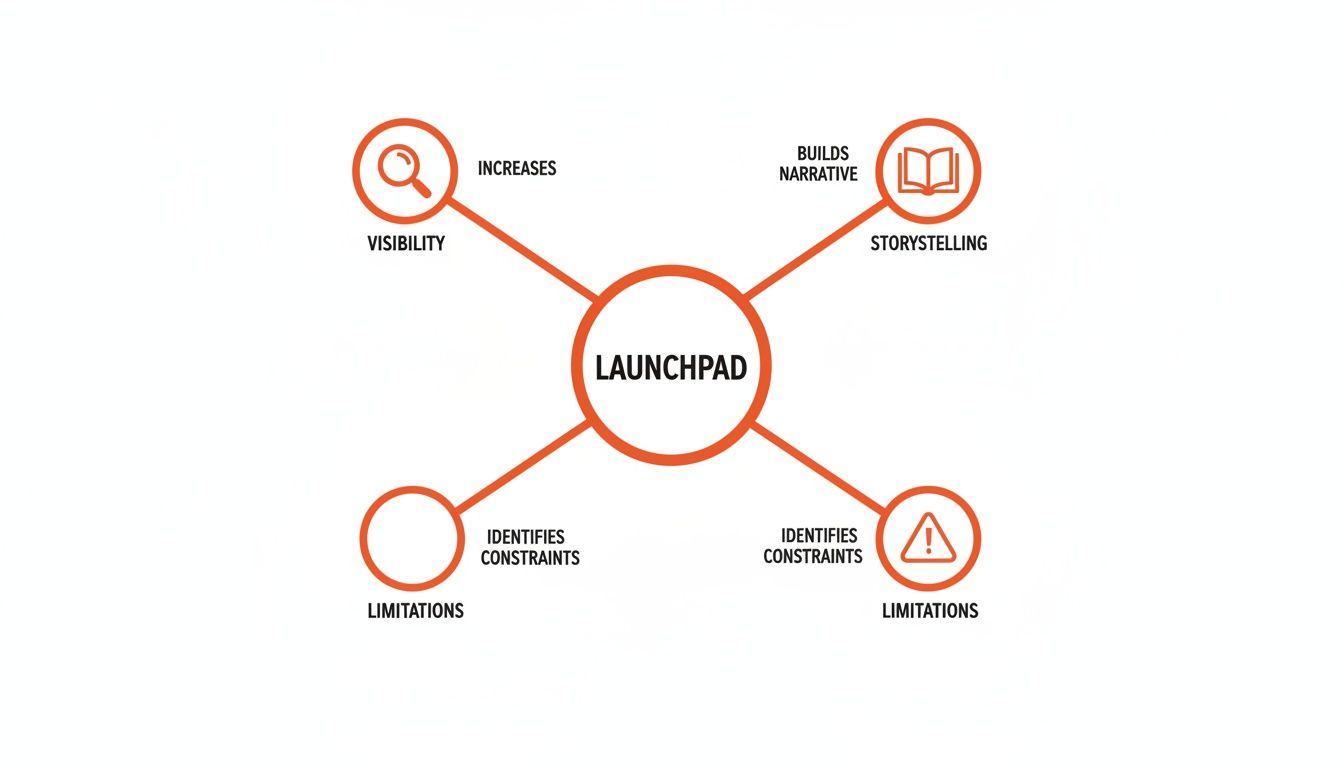
As you can see, while visibility and storytelling are powerful benefits, they have to be managed alongside the program’s built-in limitations to really be effective.
The most immediate impact you’ll see from Launchpad is on your Pay-Per-Click (PPC) campaigns. The extra organic visibility and higher trust that comes with the Launchpad badge can directly lead to a better click-through rate (CTR) on your ads. When a shopper sees your sponsored ad next to a competitor’s, that Launchpad affiliation acts as a powerful form of social proof, making your listing the more compelling choice.
A higher CTR signals to Amazon’s algorithm that your ad is highly relevant, which often leads to a better Ad Rank and, potentially, a lower cost-per-click (CPC). This means your budget stretches further. On top of that, the enhanced content on your landing page drives up conversion rates, which in turn lowers your Advertising Cost of Sale (ACoS).
Think of it this way: Launchpad gets more shoppers to click your ad, and your premium content ensures more of those clicks turn into sales. This one-two punch makes your entire PPC funnel more profitable.
For brands just starting out, building an effective advertising plan is absolutely crucial. To get a head start, you can explore a complete guide to crafting an Amazon PPC strategy for new product launches, which provides actionable steps for building momentum from day one.
While PPC is essential for capturing bottom-of-funnel demand, Amazon’s Demand-Side Platform (DSP) is your tool for building your brand and capitalizing on the new audiences discovering you through Launchpad. DSP lets you reach shoppers both on and off Amazon, turning that initial interest into long-term loyalty.
Here’s how to weave DSP into your Launchpad presence:
**Retargeting Engaged Shoppers:** Create campaigns that specifically target users who viewed your Launchpad product page but didn’t buy. Remind them of your product’s unique story with display and video ads as they browse other websites or apps in the Amazon network.
**Building Lookalike Audiences:** Once you have a steady stream of new customers from Launchpad, you can use that data to build powerful lookalike audiences. DSP can identify other shoppers with similar browsing and buying habits, letting you proactively introduce your innovative product to a massive, highly relevant audience.
Ultimately, success with the Launchpad on Amazon program demands a unified advertising strategy. Your PPC campaigns capture the immediate intent generated by your newfound visibility, while your DSP campaigns build a pipeline of future customers and retarget those who showed interest.
Here’s a simple breakdown of how the pieces fit together:
By aligning these elements, you transform Launchpad from a simple merchandising program into a central component of a robust, full-funnel growth engine. The visibility it provides is the starting point, not the finish line.
Amazon Launchpad can give a brand a serious leg up, but it’s a specialized tool, not a one-size-fits-all solution. Deciding to join isn’t something to take lightly. The program is built for a specific kind of brand and product, and you have to be honest about whether you fit the profile before committing.
Think of it like choosing the right gear for a climb. If you’re scaling a sheer cliff face, specialized ropes and harnesses are non-negotiable. But for a gentle hiking trail, that same equipment is just heavy, expensive, and completely unnecessary. Launchpad is that specialized gear—perfect for the right challenge, but overkill for others.
The brands that really take off with Launchpad share a few key traits. They aren’t just selling another product; they’re bringing something genuinely new to the table and are ready to handle the kind of growth that comes with a sudden blast of visibility.
Here are the core ingredients of a brand that’s a great fit for the program:
**A Truly Innovative Product:** Your product needs a clear, undeniable differentiator. This could be patented tech, a unique design, or a fresh solution to an old problem. If you’re selling a “me-too” item in a crowded space, the Launchpad spotlight won’t do much for you.
**A Compelling Brand Story:** Launchpad’s premium content tools are made for storytelling. If you have a powerful origin story, a mission that resonates, or a fascinating journey behind your product, you can use these features to forge a real connection with customers.
**Healthy Profit Margins:** That extra **5%** fee comes directly off your bottom line. Your pricing has to be able to absorb that hit while still leaving room for ad spend and actual profit. Low-margin products just don’t work here.
**Operational Readiness:** Getting featured in an Amazon gift guide can trigger a massive, overnight sales spike. You absolutely must have a solid supply chain and enough inventory to handle those surges without stocking out.
If your brand ticks all these boxes, Launchpad can be a massive accelerator, squeezing years of brand-building into a much shorter timeline. But if you’re missing one or more of these pieces, don’t worry—there are other fantastic tools in the Amazon ecosystem that might be a better fit.
So, you’ve decided Launchpad isn’t the right move for your brand right now. That’s perfectly fine. Amazon offers several other powerful programs that can help you hit your growth targets without the premium fee. These alternatives give you the brand-building muscle you need, either as a primary strategy or as a foundation for future growth.
Let’s walk through a few of the most effective options.
**[Amazon Brand Registry](https://brandservices.amazon.com/):** This should be non-negotiable for any serious brand on Amazon. Think of Brand Registry as the foundation for everything else. It gives you control over your listings, protects you from counterfeiters, and unlocks a whole suite of marketing tools, like A+ Content and Brand Stores.
**Amazon Storefronts:** Once you’re in Brand Registry, you can build your own dedicated [Amazon Storefront](https://advertising.amazon.com/solutions/products/stores). This is your brand’s home on Amazon—a multi-page, curated shop that you control completely. You can tell your story, spotlight new products, and create a boutique feel, all without the Launchpad fee.
**Vendor Central:** For brands that have already scaled up and prefer a wholesale model, [Vendor Central](https://vendorcentral.amazon.com/) is another path. Here, you sell your products directly *to* Amazon, and they become the seller. This simplifies your logistics, but it also means you give up control over your retail pricing.
By taking a hard look at where your brand stands—its product innovation, margins, and operational maturity—you can make the right call. It’s all about aligning the tool with your goals to make sure every dollar and every hour you invest is pushing your brand forward.
Knowing what Launchpad is and actually making it work for you are two different things. If you’ve decided the program fits your brand’s ambitions, this is your roadmap to hitting the ground running and squeezing every last drop of value out of it.
Think of this as a 12-month game plan. The goal isn’t just to sell more products with Launchpad, but to use it as a springboard to build a brand that can eventually stand on its own.
The real work starts way before you even hit “apply.” Your product listings need to be primed and ready for the surge of traffic Launchpad can deliver. This is about more than just filling in the blanks—it’s about crafting rich, conversion-focused pages that act as your best salesperson, 24/7.
Your readiness is everything. Don’t waste the initial visibility boost on operational headaches or a poor customer experience. Before you even think about applying, get these fundamentals locked in.
Success with Launchpad is about more than a quick sales bump. To justify that extra 5% fee, you have to look beyond the obvious and track the KPIs that show the program’s real impact on your brand’s long-term health.
Launchpad’s real value lies in its ability to accelerate your brand’s organic flywheel. The goal isn’t just to sell more products through Launchpad, but to use Launchpad to build a brand that no longer needs it.
Track these metrics like a hawk:
Stepping into a specialized Amazon program always brings up a few questions. To clear things up, here are the answers to the most common uncertainties we see brands wrestling with when they consider Amazon Launchpad.
This is the million-dollar question, isn’t it? The honest answer: it completely depends on your product’s margins and whether it’s ready for the spotlight. That extra 5% fee isn’t just a cost; it’s a direct investment into getting seen, unlocking premium content tools, and snagging exclusive marketing placements.
The best way to decide is with some simple back-of-the-napkin math. Figure out if the potential conversion lift and extra traffic could generate enough profit to more than cover the fee. For innovative, high-margin products with a great story to tell, the answer is very often yes.
Think of the Launchpad fee as a marketing expense. If the platform’s benefits deliver a better return than what you’d get spending the same amount on PPC or DSP, it’s a smart move.
When you join, you should plan on being in the program for at least 12 months. This gives Amazon a fair runway to feature your products in different campaigns and gives you enough time to collect the data you need to see its true impact.
After that initial year, you can typically opt out if it’s not delivering. But the real goal is to use Launchpad as an accelerator. You want to build enough organic momentum that your brand can stand on its own two feet after graduating from the program.
No, and this is a key point. The program is pretty selective. Amazon Launchpad is built for products that are genuinely unique, innovative, and different. Just having a solid product in a crowded space isn’t going to cut it.
The brands that get in usually have something special going on. They might have:
Amazon wants products that will get people excited and make the Launchpad store a destination for discovering “the next big thing.” A standard private label product with a few tweaks is almost guaranteed to be turned away. The program’s entire appeal rests on its curated collection of new and interesting finds.
At Clickstera Solutions LLC, we help brands figure out the right way to grow—whether that’s through a specialized program like Launchpad or by building a powerful foundation with advanced advertising and optimization. To see how our full-service management can scale your brand profitably, visit us at clickstera.com.
Talk to Clickstera and get a clear next-step plan to scale your performance marketing.