
Loading article
Loading page...

For ambitious brands, the question isn’t if you should sell on Amazon worldwide, but how and how fast. Going global has quickly shifted from a nice-to-have strategic goal to a core part of building a resilient, high-growth business. It’s a direct line to hundreds of millions of new customers, and this guide is the playbook for getting you there.
Expanding beyond your home marketplace is one of the most powerful levers you can pull for growth. While the U.S. market is incredibly competitive, international Amazon marketplaces represent a massive—and often less saturated—opportunity. We see it time and time again: brands that diversify their revenue streams globally build far more resilient and valuable businesses.
This isn’t about starting from scratch in a new country. It’s about plugging into a world-class infrastructure that Amazon has already built. The fulfillment centers, the payment processing, the built-in customer trust—it’s all there, waiting for you to enter markets like Germany, the UK, and Japan without having to build a new operational footprint yourself.
Your main challenge is adapting your strategy, not rebuilding your business from the ground up.
Thinking of international sales as a “bonus” is an outdated mindset. The data paints a clear picture: non-U.S. markets are a massive force in Amazon’s ecosystem. By 2024, Amazon’s international marketplaces were pulling in approximately $143 billion in net sales, with international sales growing around 9% year over year.
This isn’t just a slow trickle; it’s a sign that customer demand outside North America is accelerating, creating fertile ground for brands ready to make a move. You can explore more powerful Amazon statistics to see the full scale of this opportunity.
For mid-market and emerging brands, this scale is a total game-changer. Amazon’s platform gives you access to a global customer base of over 300 million active users, which includes more than 200 million Prime members who are already conditioned to look for fast, convenient purchases.
Tapping into Amazon’s global infrastructure means you can reach new continents with the same core business model. Your product is already proven; the next step is finding where else in the world customers are waiting for it.
Diversifying your presence on Amazon is about so much more than just juicing your top-line revenue. It offers a few key strategic benefits that make your entire brand stronger.
The first moves you make when taking your brand international on Amazon are everything. Get them right, and you build a scalable foundation for growth. Get them wrong, and you’ll find yourself fixing costly mistakes instead of focusing on sales.
This isn’t just about ticking off boxes and opening an account. It’s about being deliberate. You need to figure out which international marketplaces actually make sense for your products, get a feel for the competition, and square up with the operational realities of selling across borders.
It’s tempting to dive headfirst into the biggest, most obvious markets like the UK or Germany. But that’s not always the smartest play. A much better approach is to use data to find that sweet spot—a market with solid demand but without cutthroat competition.
Let’s imagine a brand selling high-end kitchen gadgets. The UK seems like a no-brainer because of the language. But a quick look might show the market is completely saturated. Meanwhile, a smaller market like Australia could have slightly less overall demand but way fewer competitors. This gives the brand a real shot at grabbing a big slice of the market and becoming a category leader fast.
The goal isn’t just to enter a new market; it’s to enter a market you can actually win. Look for regions where your product’s unique selling points will shine, even if it means starting a bit smaller.
To take the emotion out of it, build a simple prioritization matrix. This tool forces you to score potential markets against what really matters for your business, making the decision crystal clear.
Here’s a framework to help you score and select your first international Amazon marketplaces. It’s a simple but powerful way to compare your options side-by-side and make a decision based on data, not just gut feeling.
International Marketplace Prioritization Matrix
Marketplace (e.g., UK, Germany, Japan, Canada)
Market Size & Prime Penetration
Competition Level (Low/Med/High)
Cultural/Language Proximity
Logistical Complexity
Overall Priority Score
UK
High
High
High
Low
7/10
Germany
High
High
Medium
Medium
6/10
Japan
High
Medium
Low
High
5/10
Australia
Medium
Low
High
Medium
8/10
Using a matrix like this helps you weigh the pros and cons logically. Sure, Japan has a massive customer base, but the language barrier and completely different consumer habits add a ton of complexity for a brand just starting its global journey.
Once you’ve zeroed in on a market, it’s time to get your account structure sorted. Amazon actually makes this pretty straightforward with its Unified Account system. This lets you manage sales across multiple countries from one Seller Central dashboard.
For instance, a single North America Unified Account covers the U.S., Canada, and Mexico. The European Unified Account does the same for the UK, Germany, France, Italy, and Spain. Using this is a game-changer for efficiency, as it keeps your listings, inventory, and orders all in one place.
Be warned: the account verification process can be a real headache. Get your documents ready ahead of time. You’ll need:
Every single detail on your documents must match what you enter in Seller Central perfectly. Something as small as using “St.” instead of “Street” can get your application flagged and cause major delays.
This is the part that trips up so many sellers. When you enter a new country, you have to play by their tax rules, especially when it comes to Value Added Tax (VAT) or Goods and Services Tax (GST).
If you plan on using FBA and storing your inventory in a European country, you absolutely must register for VAT in that country before a single product lands at the fulfillment center. Selling with FBA in Germany, for example, means you need a German VAT number. Skip this step, and you’re risking account suspension and some pretty hefty fines.
Keep these key things on your radar:
Nailing these initial steps puts your global expansion on solid footing. With the boring-but-critical admin work done, you can move on to the more exciting part: adapting your product listings for local shoppers. To get a head start, check out our guide on how to optimize Amazon listings for better visibility and sales.
Once your international accounts are up and running, the real work begins. The initial setup is just the starting line; now, the focus shifts to execution. This is the part that separates the brands that barely break even from the ones that build a seriously profitable global business.
When you’re selling on Amazon worldwide, it all boils down to three core pillars: logistics, localization, and pricing.
Nailing these three means creating a seamless customer experience that feels completely local, even if you’re managing everything from thousands of miles away. It’s time to ditch the one-size-fits-all approach and start tailoring your strategy to the unique quirks and demands of each new marketplace.
Before we dive into the operational weeds, it’s helpful to remember the foundational steps that get you to this point.
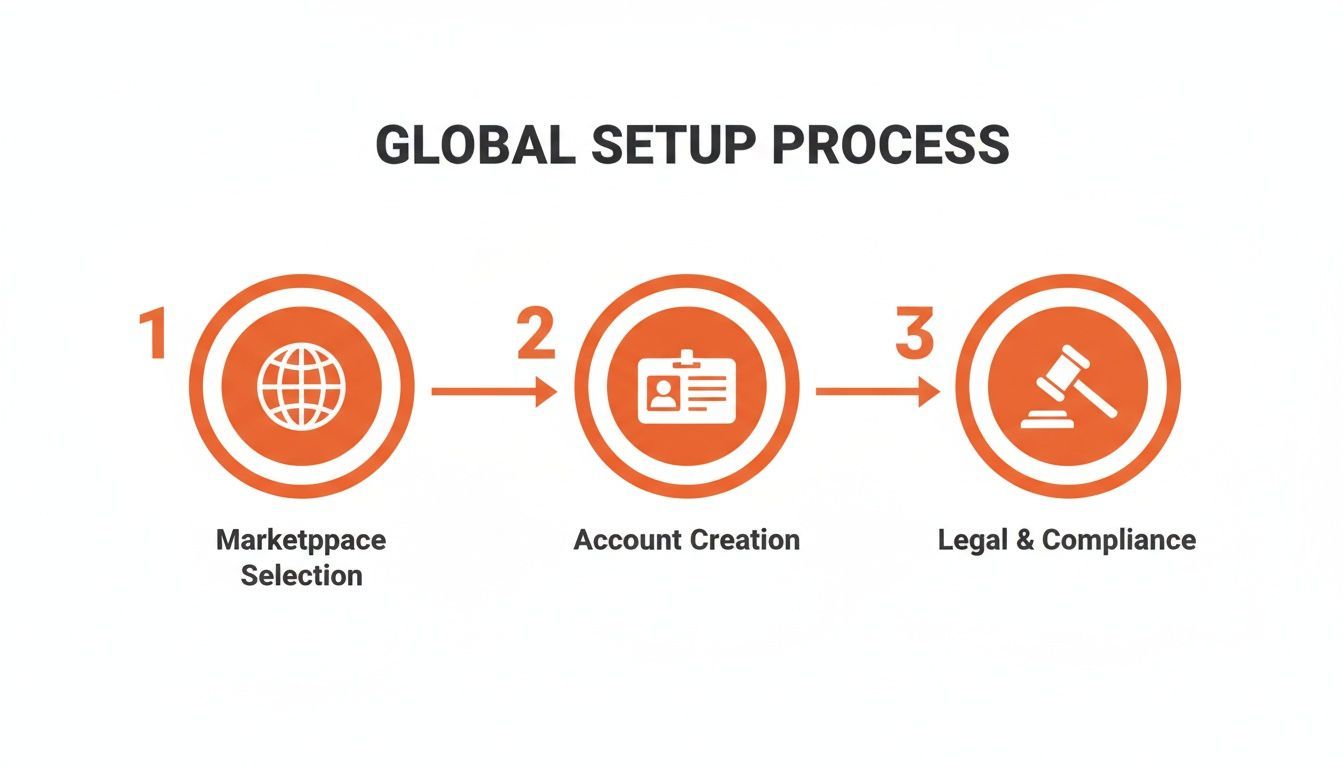
As this shows, a smart launch always starts with picking the right markets, followed by a meticulous account setup and ensuring you’re squared away on all the legal stuff.
Your fulfillment strategy is the engine of your international operations. It directly impacts your delivery speed, customer satisfaction, and, ultimately, your bottom line. Amazon gives you a few different models to work with, each suited for different stages of your global expansion. Picking the right one is all about balancing cost, complexity, and control.
H3: Where to Start: FBA Export
Initially, FBA Export is the perfect low-risk way to dip your toes in the water. It lets you fulfill orders in other countries using the FBA inventory you already have in your home country. You don’t need to worry about foreign tax registration or shipping pallets of inventory overseas, which makes it an ideal way to test demand in a new market with minimal commitment.
H3: Leveling Up: Pan-European FBA and MCI
Once you’ve proven a market and see consistent sales, it’s time to level up. For Europe, the Pan-European FBA program is a total game-changer. You just send your inventory to a single Amazon fulfillment center in an EU country, and Amazon handles distributing it across their European network to get it closer to customers.
This move dramatically cuts down on cross-border fulfillment fees, makes you Prime-eligible in multiple countries, and seriously speeds up delivery times. We saw one of our clients, a seller of premium coffee accessories, slash their European fulfillment costs by over 30% after they switched from FBA Export to Pan-EU FBA.
Another great option is Multi-Country Inventory (MCI). With MCI, you get more granular control by choosing which specific countries to store your inventory in. This is super useful if your sales are heavily concentrated in just one or two key markets, like Germany and France, and you want to avoid the broader VAT obligations that come with the full Pan-EU program.
If you think running your product descriptions through Google Translate is enough, you’re setting yourself up for failure. Effective localization is about cultural adaptation. Your entire product detail page—from the title and bullet points down to the A+ Content—needs to connect with local shoppers on their terms.
Start with keyword research that’s specific to that marketplace. A direct translation of your top US keywords will almost certainly miss the mark on how local customers actually search. For example, a “portable charger” in the US is often called a “power bank” in the UK and, more specifically, a “Handyakkuladegerät” (mobile phone charger) in Germany. Using their language is critical for even being discovered.
Your images and A+ Content also need a local touch. A photo showing your product in a distinctly American-style kitchen might not land well with a Japanese audience.
Consider these localization tactics:
Pricing your products for international markets is way more complex than a simple currency conversion. You have to account for a whole new set of costs to protect your profit margins.
Your international price needs to factor in:
A smart move is to use a dynamic pricing tool that can automatically adjust your prices based on exchange rates and what your competitors are doing. But always, always set a floor price to make sure you never sell at a loss.
As you start to scale, keeping an eye on all these moving parts is essential. For a deeper look at tracking performance, our guide on how to set up Google Analytics 4 offers a great framework for monitoring user behavior and conversion data across different regions.
Breaking into a new international market is a lot like launching your brand for the very first time. The playbook that brought you success at home is a solid foundation, but you can’t just copy and paste it. Every marketplace has its own unique rhythm—different customer habits, competitive pressures, and advertising quirks.
Your mission is to build a self-sustaining flywheel. It starts with paid advertising to drive that initial sales velocity and get your products seen. This early traction boosts your organic search ranking, which, in turn, makes your ads more efficient and profitable. It’s a powerful loop, but getting it started in a new country demands a deliberate, market-specific approach.
For brands that nail this, the opportunity is huge. Third-party sellers, not Amazon Retail, are now the main engine of sales on the platform. Globally, the number of independent sellers pulling in over $1 million a year has jumped from around 60,000 in 2021 to more than 100,000 today. If you want to dig deeper into this trend, these in-depth Amazon marketplace seller statistics are worth a look.
What works for your Amazon PPC campaigns in the U.S. will almost certainly need a major overhaul for a market like Germany or Japan. Bids, keyword relevance, and the actual search terms customers use can be wildly different. You have to treat each new marketplace as a blank slate for keyword research.
First things first: structure your international PPC campaigns completely separately from your domestic ones. This is non-negotiable for controlling budgets and analyzing performance accurately market by market.
For any brand launching a new product, a well-thought-out ad plan is make-or-break. If you need a refresher, our guide offers a detailed Amazon PPC strategy for new product launches that you can easily adapt for international expansion.
While PPC is your go-to for capturing customers ready to buy, Amazon DSP (Demand-Side Platform) is the tool you use to create that demand in the first place. When you enter a new country, your brand is likely a complete unknown. DSP lets you run display and video ads to build that crucial brand awareness, both on and off Amazon.
Think of it as formally introducing your brand to a new audience. You can target shoppers based on their past buying habits, lifestyle interests, and demographic data. For instance, if you’re selling high-end running shoes in France, you could use DSP to reach audiences who have recently bought fitness gear or searched for marathon training guides.
The first 90 days in a new market are a critical data-gathering period. Don’t be afraid to start with a modest budget and adjust aggressively based on what the performance data tells you. Agility is your greatest asset.
Ads get you in the game, but you still need to generate those first crucial sales and, just as importantly, social proof. A product with zero reviews is a tough sell for a new customer.
Here are a few tactics to build that early momentum:
Getting your first international sale is a huge win, but let’s be honest, it’s just the starting line. The real growth—and profit—kicks in when you stop thinking market-by-market and start managing your brand with a cohesive global strategy. This is the leap from just selling worldwide to truly managing a global brand.
Without a centralized view of your entire international operation, you’re essentially flying blind. You can’t see which markets are actually making you money, which are draining your resources, and where your next big opportunity is hiding. A fragmented approach is a recipe for disaster: stockouts in one country, overstock in another, and ad budgets getting burned with little to show for it.
You can’t fix what you can’t see. The first step to scaling intelligently is to build a dashboard that pulls data from all your international marketplaces into one clean, consolidated view. This doesn’t have to be some custom-coded software marvel; it can start as a well-organized spreadsheet or a business intelligence tool that plugs into Amazon’s API.
At a minimum, your dashboard needs to track these global vitals:
With this unified view, you can finally make strategic calls. For instance, you might notice your TACoS in Germany is a bit high but trending down, which justifies doubling down on your investment. At the same time, you might see your profit margin in France is shrinking, signaling it’s time to rethink your pricing or logistics for that market.
Once you’ve got a solid grip on your global performance data, you can start pulling more advanced levers to speed up growth. One of the most powerful tools in your arsenal here is Amazon Attribution. This program finally lets you measure how your off-Amazon marketing—think Google Ads, Facebook campaigns, or influencer collaborations—is driving actual sales in different countries.
Imagine you’re running an influencer campaign in the UK. With Amazon Attribution, you can generate unique tracking URLs and see exactly how many sales that specific campaign drove on Amazon.co.uk. This data is pure gold. It lets you optimize your external marketing channels and pour money into what’s actually working in each region, not just what you think is working.
Selling on Amazon worldwide increasingly means orchestrating performance across a huge and competitive seller ecosystem, where data-driven strategy is decisive. The landscape is vast; by early 2025, estimates suggest there were roughly 9 to 9.7 million total Amazon sellers globally.
Success is anything but guaranteed. While over 100,000 sellers now pull in over $1 million in annual revenue, the most lucrative markets demand a far more sophisticated game plan. For example, a whopping 43% of U.S. marketplace sellers generate $100,000+ per year, while the global average is just 19%. This stat alone shows why building an analytics-driven operation is essential if you want to compete in the top tiers. You can get a better sense of the scale of Amazon’s seller ecosystem to understand just how crowded the field is.
As you grow, keeping your brand identity consistent across borders becomes both more important and more challenging. Your brand’s voice, visuals, and values need to feel the same everywhere, even after localization.
This is where Amazon Brand Registry becomes your best friend. Enrolling your trademark in Brand Registry in each region gives you powerful tools to fight counterfeiters and shut down unauthorized sellers who can drag your brand’s reputation through the mud.
Finally, don’t drop the ball on customer service. Amazon handles the logistics for FBA, but you’re still on the hook for answering product-specific questions. Make sure you have a system in place—whether it’s an in-house team or an outsourced service—to provide fast, accurate support in the local language. A single bad customer experience in one country can quickly tarnish your brand’s credibility everywhere.
Taking your brand worldwide is exciting, but it definitely brings up a lot of questions. We get it. Below, I’ve broken down the most common practical hurdles we see brands face when they decide to sell on Amazon internationally. The goal here is to give you direct, no-fluff answers to help you move forward.
Everyone knows about referral and FBA fees, but the international game has a few extra costs that can sneak up on you if you’re not ready. Budgeting for these from day one is the key to protecting your margins.
Here’s what you really need to plan for:
As a solid rule of thumb, we tell our clients to budget an extra 15-20% on top of their standard cost of goods sold (COGS). This buffer is crucial for covering these international operational expenses without killing your profit.
Thankfully, the answer is usually no. You don’t need to spin up a new company in every country where you want to sell. Your existing business entity, whether it’s an LLC or a corporation, is almost always enough to operate on Amazon’s global marketplaces.
But—and this is a big but—that doesn’t get you off the hook for local taxes. Here’s the critical distinction: while your business entity can stay the same, you must register that entity with local tax authorities for things like VAT in the UK and EU. This is non-negotiable if you plan to use FBA and store inventory in another country.
Before you do anything, talk to an international tax advisor. They can confirm the exact requirements for your business and target markets, saving you from some very expensive compliance headaches down the road.
Amazon is crystal clear on this: you have to provide customer support in the local language of whatever marketplace you’re selling on. This sounds like a huge operational hurdle, but you actually have a few great ways to handle it.
A lot of successful global sellers we work with use a hybrid model. They let CSBA handle the common, everyday questions and bring their in-house team in for more complex or escalated problems.
For any brand just dipping its toes into selling on Amazon worldwide, the answer is simple: start with FBA Export.
Seriously, it’s the lowest-risk way to get started. FBA Export lets international customers buy your products directly from your home marketplace. Amazon handles the export and fulfillment using your existing domestic inventory. You get to test international demand without the immediate headache of foreign tax registration or shipping pallets of inventory overseas.
Think of it as your validation phase. Once you see consistent sales coming from a specific market, then you can graduate to a more advanced—and more cost-effective—method like Pan-European FBA to really scale things up.
Expanding your brand globally is a major step, but with the right strategy and a detail-oriented partner, it’s one of the most powerful growth drivers out there. Clickstera Solutions LLC specializes in helping brands navigate the complexities of international marketplaces to achieve profitable scale.
Ready to take your brand worldwide? Contact Clickstera for a growth consultation.
Talk to Clickstera and get a clear next-step plan to scale your performance marketing.