
Loading article
Loading page...
Full-funnel marketing isn’t just another buzzword; it’s a complete shift in how you think about growth. It’s a strategy that guides a potential customer through their entire experience with your brand, from the very first time they hear your name to the moment they become a loyal advocate.
Think of it as building a relationship. You don’t ask someone to marry you on the first date, right? You build trust and provide value at every single stage, not just when you’re chasing the final sale. This approach creates a much more cohesive and powerful marketing engine built for the long haul.
So many brands fall into the same trap: they fixate entirely on the bottom of the funnel—the conversion. They pour their entire budget into ads that scream “Buy Now!” while completely ignoring the huge pool of potential customers who just aren’t ready to pull the trigger yet.
That’s like a farmer only watering their crops on harvest day, forgetting all the essential work of planting seeds and nurturing the soil. It just doesn’t work.
Full-funnel marketing is the perfect antidote to this short-sighted thinking. It recognizes that the customer journey is a process, not a one-off event. It’s all about creating specific, targeted strategies for people depending on where they are in their decision-making process.
A true full-funnel strategy doesn’t treat marketing stages as isolated silos. Instead, it views them as interconnected parts of a single, fluid customer experience, where efforts in one area directly strengthen the results in another.
This integrated model means you’re not just capturing existing demand—you’re actively creating it. You build brand awareness, educate prospects, and establish trust long before you ever ask for the sale. This methodical approach builds a steady stream of qualified leads who already know and trust your brand when they’re finally ready to buy.
When you stop chasing single-stage campaign goals and adopt a full-funnel view, the advantages are massive. By engaging with people at every touchpoint, from that first moment of discovery to post-purchase loyalty, you build deeper, more resilient customer relationships. The benefits aren’t just theoretical; they’re measurable and impactful.
Businesses that lean into this comprehensive strategy see some pretty compelling results. A full-funnel approach can lead to up to a 45% higher return on investment (ROI) and even a 7% bump in offline sales compared to campaigns that only target one part of the journey. To see how this plays out in the real world, check out our guide on smarter audience targeting in full funnel retail media.
Ultimately, this strategy shifts your mindset from being transactional to relational. It allows you to:
To give you a clearer picture, let’s break down how this holistic strategy stacks up against the old-school, siloed way of doing things.
This table offers a quick summary of the full-funnel concept, contrasting it with traditional, single-stage approaches that many brands still rely on.
Aspect
Full Funnel Marketing
Traditional Marketing
Primary Goal
Build a long-term relationship and guide the entire customer journey.
Secure an immediate sale or conversion.
Focus
Holistic; addresses awareness, consideration, conversion, and loyalty.
Siloed; typically focuses only on the bottom of the funnel (conversion).
Customer View
A person on a journey who needs value at every stage.
A potential transaction or lead to be closed.
KPIs
Engagement, lead quality, CLV, brand recall, and ROI across all stages.
Cost-per-acquisition (CPA), conversion rate, and immediate ROI.
Budgeting
Allocated across all funnel stages to create and capture demand.
Concentrated on bottom-funnel channels with the highest conversion rates.
As you can see, the difference is stark. Full-funnel marketing is a strategic investment in sustainable growth, while traditional methods often amount to a short-term scramble for sales.
By understanding the complete customer lifecycle, you can allocate your resources far more effectively and build a powerful engine for predictable, lasting business growth.
To build a full-funnel strategy that actually works, you have to get inside your customer’s head. Their journey from stranger to loyal fan isn’t a straight line—it’s a winding path with distinct phases, each driven by a different mindset and a different set of questions.
If you can map this path, you can show up with the right message at exactly the right time. You stop just pushing for a sale and start building a real relationship.
Think of it like being a tour guide. You wouldn’t hand a detailed city map to someone who hasn’t even decided they want to take a trip. First, you have to inspire them, then help them pick a destination, then guide them through the booking process. Each step requires a totally different conversation.
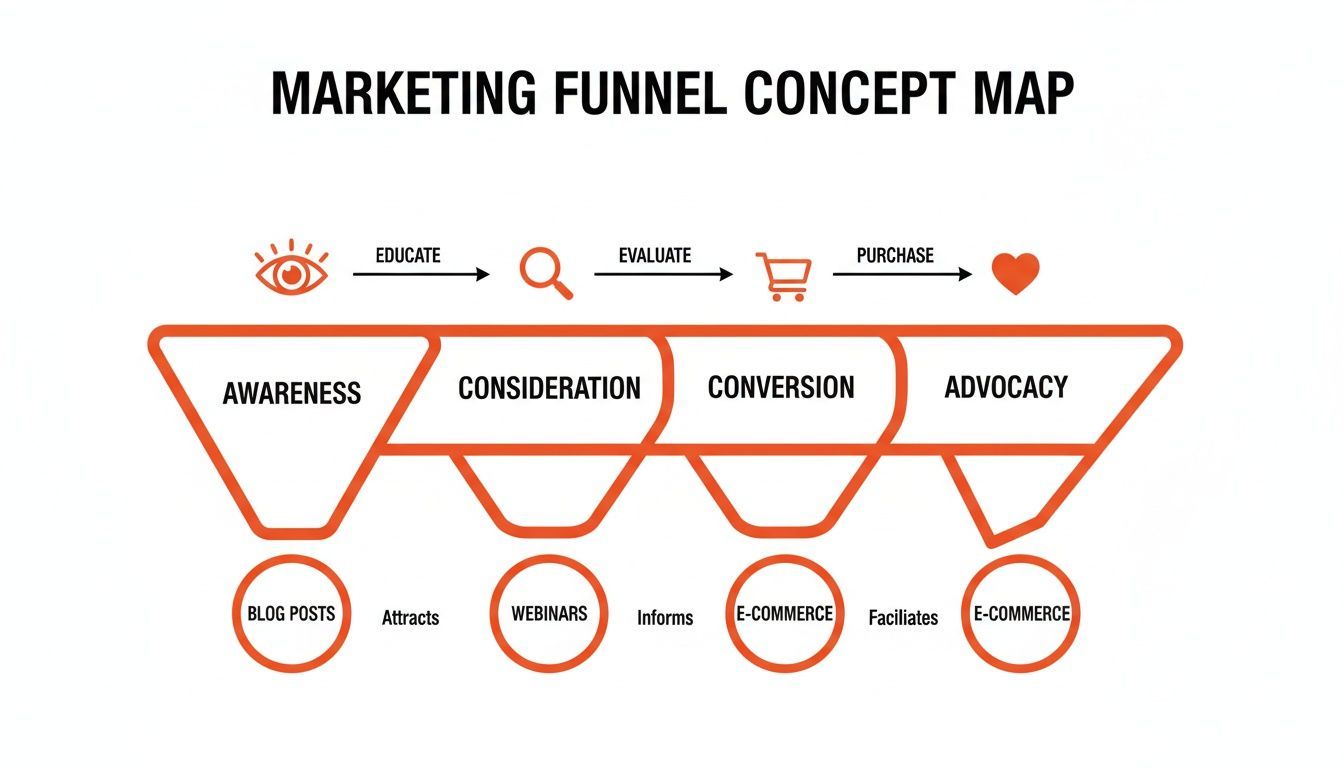
This journey is typically broken down into four key phases: Awareness, Consideration, Conversion, and Advocacy. Let’s walk through each one.
This is the very top of the funnel (TOFU). At this point, potential customers might not even know your brand exists. Heck, they might not even realize they have a problem you can solve. They aren’t looking for you; your job is to get on their radar.
Their mindset here is one of passive curiosity. They’re scrolling through social media, watching a video, or reading an article when they happen to stumble across your brand.
Their internal monologue is pretty simple:
Your goal here is all about brand introduction and education. You’re just planting a seed. Forget about selling; you’re just trying to make a good first impression so that when they do have a need, your name pops into their head.
Welcome to the middle of the funnel (MOFU). Now things are getting interesting. A potential customer has identified a need and is actively hunting for solutions. They know who you are, but they also know who your competitors are, and they’re sizing you all up.
Here, their mindset shifts from passive curiosity to active evaluation. They’re hungry for information, weighing the pros and cons, and digging for proof that you can actually deliver on your promises.
This is arguably the longest and most critical stage. Most buyers narrow their options down to just two or three brands. Your entire goal is to be one of them by providing genuinely helpful content that builds trust, not just a sales pitch.
Their questions get much more specific:
Your objective is to educate and differentiate. This is where you roll out the heavy hitters: in-depth comparison guides, compelling case studies, and detailed product demos that prove your value and build unshakable credibility.
We’ve reached the bottom of the funnel (BOFU)—the moment of truth. Your prospect has done their homework, weighed their options, and is ready to pull the trigger. They have high intent and just need that final nudge to commit.
The customer’s mindset is decisive. They’re looking for a smooth, easy path to purchase and a little reassurance that they’re making the right call. Any friction now, like a clunky checkout or surprise shipping costs, can kill the deal instantly.
Their final questions are practical and seek confirmation:
Your objective is crystal clear: facilitate the purchase and remove all friction. This is where strong offers, clear calls-to-action (CTAs), and a seamless user experience become non-negotiable. You have to make it incredibly easy for them to say “yes.”
The sale isn’t the finish line. The post-funnel stage is where you turn a one-time buyer into a loyal, repeat customer—and maybe even a vocal brand advocate. This is where real, sustainable growth comes from.
Now, the customer’s mindset is all about their own experience. They’re evaluating their purchase, forming a long-term opinion of your brand, and deciding if they made the right choice.
Their questions have shifted again:
Your final objective is to delight and retain. This means top-notch customer service, loyalty programs, and community-building efforts. A happy customer is your single most powerful marketing asset. They’ll not only buy from you again but will also spread the word, feeding brand new customers right back into the top of your funnel.
Knowing the funnel stages is one thing, but actually putting them to work is a whole different ballgame. This is where we connect the dots between theory and action. A winning full-funnel marketing strategy is all about matching the right channels and tactics to a customer’s mindset at each specific phase.
Think of it like a toolkit. You wouldn’t use a hammer to saw a piece of wood, right? In the same way, the flashy social video that grabs attention in the Awareness stage is the wrong tool for closing a sale in the Conversion stage. Smart execution means picking the perfect instrument for the job at every step of the journey.
This visual guide breaks down the core stages of the marketing funnel, from sparking that initial interest all the way to creating long-term brand fans.
As you can see, a customer’s journey isn’t a straight line. It’s a progression through distinct phases, and each one demands a different approach to keep them moving forward.
To bring this to life, let’s map out which channels and tactics fit best for each objective. This table breaks down the entire process, giving you a clear playbook for what to use, when to use it, and how to measure success.
Funnel Stage
Objective
Recommended Channels & Tactics
Primary KPIs
Awareness (Top Funnel)
Get noticed. Introduce your brand to a wide, new audience.
Paid Social (Meta, TikTok): Visually engaging, scroll-stopping videos.
Streaming TV (CTV/OTT): High-impact video ads on Hulu, YouTube TV.
Display & Programmatic: Brand-building visual ads on relevant sites.
Impressions, Reach, Video Views, Ad Recall Lift, Website Visitors
Consideration (Mid Funnel)
Build trust. Educate prospects who are actively researching solutions.
SEO & Content Marketing: In-depth blog posts, guides, webinars.
Educational PPC (Google Ads): Target problem-aware, non-branded keywords.
Case Studies & Comparisons: Showcase expertise and social proof.
Clicks, CTR, Time on Page, Bounce Rate, Email Signups, Asset Downloads
Conversion (Bottom Funnel)
Drive action. Make it easy for high-intent buyers to purchase.
High-Intent Search Ads: Bid on branded and specific product keywords.
Retargeting (Display, Social): Re-engage site visitors and cart abandoners.
Email Marketing: Send targeted offers and reminders to warm leads.
Conversions, Cost Per Acquisition (CPA), Conversion Rate, ROAS
Loyalty & Advocacy
Retain customers. Turn one-time buyers into repeat fans.
Loyalty Programs: Reward repeat purchases with exclusive perks.
Email & SMS Nurturing: Provide tips, community content, and check-ins.
Exceptional Customer Support: Proactive service to build relationships.
Customer Lifetime Value (CLV), Repeat Purchase Rate, Churn Rate, NPS
This map isn’t just a list of tactics; it’s a strategic framework. By aligning your efforts this way, you ensure that every dollar you spend and every piece of content you create serves a specific purpose, guiding customers smoothly from one stage to the next.
At the very top of the funnel, your goal is simple: get noticed. You’re introducing your brand to a huge audience, many of whom don’t even know they have a problem you can solve. This is about casting a wide net and making a strong first impression.
Your tactics here should be all about reach and engagement, not direct sales. The idea is to build brand recall, so when a need does pop up, your name is the first one they think of.
Once someone knows you exist, the game completely changes. Now they’re actively researching and comparing their options. Your job is to pivot from broad awareness to targeted education, proving you’re the best choice out there.
Content is absolutely king at this stage. You have to provide real value and answer your audience’s questions with authority. This is how you build the trust needed to earn their business.
This middle-funnel stage is where most brands either win or lose a customer. Providing in-depth, helpful content isn’t just a nice-to-have; it’s the core activity that separates you from the competition and positions your brand as a trusted expert.
Key tactics for this phase include:
Pulling this off means coordinating your efforts across different platforms. To see how it all fits together, check out our detailed guide to building a successful multi-channel marketing strategy.
Down at the bottom of the funnel, your audience is finally ready to make a decision. They have high intent and are just looking for a clear signal to buy. Every effort you make now has to be laser-focused on removing friction and making the purchase process dead simple.
Your messaging needs to become more direct. It’s time to highlight offers, share testimonials, and give them compelling reasons to buy now. Any hesitation or confusion at checkout can kill the sale, so a seamless user experience is non-negotiable.
Top conversion tactics include:
The relationship doesn’t end once the sale is made. In fact, that’s just the beginning. The post-funnel stage is your golden opportunity to turn a first-time buyer into a lifelong fan—someone who not only buys again but tells everyone they know about you. This is hands-down the most cost-effective way to grow.
Here, your focus shifts from acquisition to relationship-building. It’s all about delighting your customers and making them feel valued.
A full-funnel strategy is a powerful engine for growth, but without proper measurement, you’re just driving blind. How do you actually know if your top-of-funnel awareness campaigns are influencing bottom-funnel sales? This is where a unified analytics approach stops being a “nice-to-have” and becomes non-negotiable.
It’s what transforms your marketing from a collection of isolated tactics into a cohesive, measurable system. To really understand what’s working, you have to connect the dots across the entire customer journey, moving beyond siloed metrics like clicks and impressions to see the full picture.
Modern marketing is fragmented. With brands juggling an average of 15 different channels, it’s no wonder that only 54% of global marketers feel confident in their measurement capabilities. Platforms like Google Analytics 4 (GA4) and Google Tag Manager are the essential toolkit for cutting through this complexity.
These tools work hand-in-hand to create a single source of truth:
With robust conversion tracking in place, you can finally connect a top-of-funnel video view on social media to a middle-funnel email signup, and ultimately, to a bottom-funnel purchase.
Measuring success isn’t a one-size-fits-all game. The KPIs that matter for an awareness campaign are worlds apart from what you’d use to evaluate a conversion-focused retargeting ad. You have to align your metrics with the specific goals of each stage.
The secret to effective measurement is to track the micro-conversions that happen between stages. An asset download or a video completion might not be a sale, but it’s a critical signal that a prospect is moving deeper into the funnel and that your strategy is working.
Here’s a practical breakdown of the KPIs to watch at each phase:
Attribution is easily one of the trickiest parts of full-funnel marketing. In short, it’s the process of assigning credit to the various touchpoints that lead to a sale. A customer might see a TikTok ad, click a Google search result a week later, and finally buy after seeing a retargeting ad. So, which channel gets the credit?
Simplistic last-click attribution, which gives 100% of the credit to the final touchpoint, just doesn’t cut it anymore. A true full-funnel approach demands more advanced models. Data-driven attribution models, like those in GA4, analyze all converting and non-converting paths to assign credit based on each touchpoint’s actual contribution.
Understanding this is crucial, especially for brands selling on marketplaces. You can learn more about how to connect your off-platform advertising to on-platform sales in our guide to Amazon Attribution. By accurately attributing value, you can confidently put your budget into the channels that are truly driving growth across the entire funnel—not just the ones that happen to close the deal.
Moving from theory to a working full-funnel strategy requires a clear, step-by-step plan. You don’t just stumble into a cohesive customer journey; you build it with intention. This checklist is your framework for building that strategy from the ground up.
Think of it like assembling a high-performance engine. You can’t just throw parts together and hope for the best. Every component—from defining your audience to tracking performance—needs to be connected perfectly to make the whole system run smoothly. Let’s walk through how to put it all together.
Before a single campaign goes live, you have to lay the groundwork. This first phase is all about defining your goals, truly understanding your customer, and getting the technical setup right so you can actually measure what matters. Skipping these steps is like trying to build a house without a blueprint—it’s not going to end well.
With your foundation solid, it’s time to build out the actual customer journey. This is where you create the content and campaigns that will guide people from their very first interaction with your brand all the way to purchase and beyond.
A successful full-funnel strategy isn’t about being on every channel. It’s about being on the right channels with a message that’s perfectly timed to the customer’s mindset at that specific moment.
Your strategy is live, but the work is far from over. This final phase is a continuous loop of measuring, learning, and tweaking to improve performance and drive sustainable growth.
This long-term, integrated approach pays off in a big way. One company that shifted to a full-funnel paid media model saw that just 3.5 years later, 82% of its sign-ups came from organic channels and referrals. Their direct marketing costs plummeted while the business scaled. You can read more about these transformative full-funnel results to see the full impact.
By following this checklist, you can stop running disconnected campaigns and start building a resilient, predictable engine for growth.
Even with a clear game plan, rolling out a full-funnel strategy can bring up some real-world questions. How long until I see results? Can I even do this on a small budget? What’s the biggest mistake I need to avoid? Let’s get straight to the answers.
Our goal here is to give you the confidence to build a strategy that doesn’t just look good on paper but actually works in the real world to drive sustainable, long-term growth for your brand.
Patience is probably the most important ingredient here. A full-funnel approach is a long-term investment in building your brand, not a shortcut for a quick sales spike. While every brand’s timeline will look a little different, you can generally expect results to show up in stages.
You’ll see the first signs of life at the top of the funnel.
The end goal is sustainable growth. Those initial investments in awareness steadily bring down your customer acquisition costs over time because you’re building a brand that people actually seek out and trust.
Absolutely. Full-funnel marketing is a way of thinking, not a budget requirement. You don’t need a massive ad spend to use its principles; you just have to be smarter and more focused with the resources you have.
The key is to prioritize your efforts instead of trying to be everywhere at once.
A small brand can’t afford to waste a single dollar. Instead of spreading a small budget thin across a dozen different channels, it should zero in on the highest-impact activities for its specific audience. For example, a startup might concentrate on a few core tactics.
The principle is the same no matter the budget: engage customers with the right message at each stage of their journey. This focused approach makes sure every dollar is spent efficiently to guide people from discovery to purchase.
The single most common and damaging mistake is a lack of integration and measurement. A lot of brands think they’re doing full-funnel marketing when they’re actually just running separate “awareness,” “consideration,” and “conversion” campaigns in total isolation from one another.
This creates a choppy and confusing experience for the customer. It also makes it impossible to see how your top-funnel activities are really influencing bottom-funnel sales.
A successful strategy requires a unified plan where all channels and tactics work together in concert, supported by end-to-end analytics that attribute value correctly across the entire journey. Without this, you’re just running siloed campaigns, not a true full-funnel strategy.
When your TikTok video campaign, your SEO blog content, and your retargeting ads don’t “talk” to each other, you lose all the momentum you’ve built. A customer who saw your brand video should be treated differently from someone who has never heard of you. True full-funnel execution connects these dots, ensuring a smooth, logical progression for the customer and clear, actionable data for you.
At Clickstera, we specialize in building these cohesive, data-driven strategies that turn browsers into buyers and buyers into brand advocates.
We help brands master marketplaces like Amazon and Walmart by connecting every stage of the customer journey.
If you’re ready to move beyond siloed campaigns and build a true engine for growth, explore how we can help at
https://clickstera.com.
Talk to Clickstera and get a clear next-step plan to scale your performance marketing.